Video Marketing Trends 2026: What Actually Works
Key Takeaways
- Video marketing trends 2026 center on short-form vertical video, AI-enabled production, and authentic creator content.
- Mobile-first viewing habits demand vertical formats and sound-off accessibility as standard practice.
- AI is automating scripting, editing, and personalization, but human oversight remains critical for brand storytelling.
- Personalized and localized video experiences are transforming how brands connect with diverse audiences at scale.
- Paid video strategies now extend beyond social platforms to CTV and retail media, requiring creative variation and rigorous testing.
- Measuring success means linking video engagement to revenue, retention, and brand lift, not just views.
Video marketing trends 2026 are the strategic shifts in format, production, and distribution that define how brands win attention and drive results this year. AI tools, short-form content, and creator-driven campaigns now set the standard.
The State of Video Marketing in 2026
Video’s Unstoppable Growth
Video marketing is the strategic use of moving imagery to communicate with audiences, build brands, and drive business outcomes. According to Wyzowl’s 2026 report, 91% of businesses now use video as a marketing tool. That figure doesn’t leave much room for debate. Video has moved from a nice-to-have to a baseline expectation, and the brands still treating it as optional are already behind.
The Strategy Gap
High adoption doesn’t equal smart execution. While 79% of organizations say video improves marketing outcomes, only 43% have a clearly defined video strategy, according to Dropbox’s 2026 video trends report. That gap is where most brands lose. Recognizing video’s value is easy. Building a repeatable system around it is the actual work.
Why 2026 Is a Pivot Point
Several forces are converging at once. Mobile consumption dominates: 78% of video views now happen on mobile devices in portrait mode, per Dropbox. Production barriers have collapsed, with 71% of companies now creating videos in-house. And audience expectations have shifted hard toward authenticity and personalization. Together, these shifts mean video marketing trends 2026 are as much about operational efficiency as they are about creative excellence.
“As feeds get more crowded, video success isn’t about making more. It’s about making what matters.”
– Dropbox 2026 Video Trends Report
Short-Form Video: Still the Dominant Format
Why Short-Form Wins
Short-form video is content typically under 60 seconds, optimized for rapid consumption on social feeds. It remains the dominant format in 2026 because it matches how people actually browse: in quick bursts between tasks, during commutes, and during late-night scroll sessions. According to Visla’s 2026 data, 71% of marketers believe short-form videos in the 30-second to two-minute range perform best. Meanwhile, 63% of consumers say they prefer short video when learning about a product or service. Brevity isn’t just a creative choice. It’s a performance requirement.
Building a Short-Form Content Engine
Winning in short-form isn’t about posting random clips and hoping something sticks. The best teams in 2026 treat short-form like a product line, not a one-off post. They build series-based content that viewers recognize and algorithms reward. Reliable series formats include “one problem, one fix” (30 to 45 seconds), “mini demo” (45 to 90 seconds), “myth vs. reality” (30 seconds), and “before/after” (15 to 45 seconds). They also treat hooks as a key performance indicator, tracking 2-second and 3-second views to optimize the crucial opening moment. By repurposing longer footage into multiple short cuts, teams maximize output without burning out.
Platform Tactics
Each platform rewards slightly different approaches. YouTube Shorts averages 200 billion daily views globally, according to designforce.co’s 2026 guide, and it favors content that feels native to the feed: funny, educational, or trend-linked. TikTok’s algorithm amplifies custom audio and fast-paced edits. Instagram Reels continue to dominate the app’s discovery engine. Across all of them, vertical orientation is non-negotiable. Tools like Visla let you export a single project in 16:9, 1:1, and 9:16 to cover every base without rebuilding from scratch.
A comparison of common video formats clarifies their distinct roles:
| Format | Typical Length | Best For | Key Platforms | Engagement Style |
|---|---|---|---|---|
| Short-Form | 15–60 sec | Quick tips, product teasers, trends | TikTok, Reels, Shorts | Passive consumption, quick reactions |
| Long-Form | 1 min+ | In-depth tutorials, brand stories, documentaries | YouTube, Vimeo, websites | Lean-in, sustained attention |
| Live Video | Real-time | Q&As, events, behind-the-scenes | LinkedIn, YouTube, Twitch | Two-way interaction, high trust |
| Shoppable Video | Variable | Direct product purchases within content | Instagram, TikTok, live streams | Active shopping behavior |
Creator and UGC Content Build Trust at Scale
The Authenticity Imperative
User-generated content (UGC) is video created by customers or creators rather than the brand itself. In 2026, audiences consistently reward videos that feel like a real person made them for other people. Polished brand spots are losing ground to relatable, raw footage because it signals trustworthiness. According to designforce.co’s guide, 85% of people have been convinced to buy a product or service by watching a video, and UGC often drives that conversion because it functions as social proof at scale. This shift sits at the heart of video marketing trends 2026: authenticity isn’t a style choice, it’s a conversion strategy.
Launching a UGC Pipeline
You don’t need a complex program. A simple, repeatable process works. Start by defining three weekly content prompts: a customer pain point, a success outcome, and an objection handled. Collect raw footage from customers, employees, or micro-influencers. Standardize a quick-edit style that feels on-brand but unpolished. Then recycle top performers into paid ads, landing pages, and emails. This pipeline turns sporadic testimonials into a steady stream of persuasive content without requiring a full production crew.
From Organic to Paid: The Repurposing Flywheel
Organic UGC that performs well can be repurposed into paid ad creative, turning authentic moments into cost-effective conversion drivers. Brands are increasingly using creator-style content for CTV spots and retail media placements, proving that the “real” aesthetic scales across channels. By building a library of UGC assets tagged by theme (trust, demo, objection), teams can rapidly test variations in paid campaigns. Visla calls this the “variant factory” approach, and it’s one of the most efficient tactics within video marketing trends 2026.
Shoppable Video and AR: Commerce Meets Content
Shop While You Watch
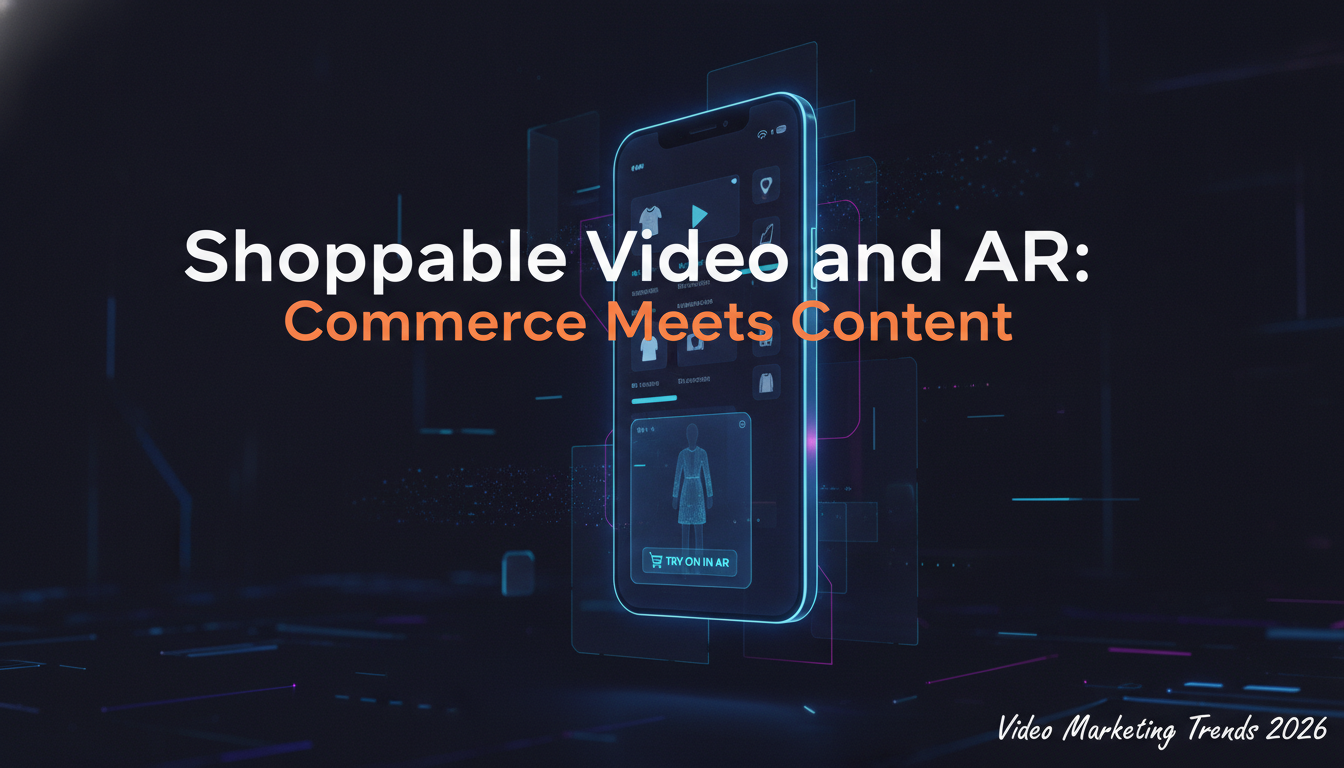
Shoppable video is one of the fastest-growing formats within video marketing trends 2026. It lets viewers purchase products directly inside the video experience, collapsing the gap between discovery and transaction. Instagram, TikTok, and live stream platforms have made shoppable formats increasingly accessible, and brands selling physical products are seeing strong results by integrating buy buttons and product tags directly into their content.
AR and 3D Content Enter the Mainstream
Augmented reality (AR) and 3D video are becoming more mainstream on social platforms, according to radiantdigital.com’s 2026 trends analysis. Fashion brands let viewers virtually try on clothes and accessories. Product demos now feature interactive 3D environments users can explore. Platforms like Instagram, TikTok, and Snapchat are expanding AR features, making these experiences more accessible to brands without massive production budgets. For brands in retail, beauty, or home goods, AR video is worth testing now before it becomes table stakes.
AI-Powered Production: Baseline, Not Bonus
Where AI Fits
AI in video production refers to the use of artificial intelligence to automate or augment tasks such as scripting, editing, captioning, and generating complete videos. By 2026, AI has moved from experimental to baseline. According to designforce.co, around 75% of marketing videos are expected to be AI-generated or AI-assisted, with tools handling time-consuming steps across the entire production chain. AI Video Generators create rough cuts. AI avatars present scripted content in multiple languages. Voice cloning personalizes messages without re-recording.
Human Taste, Machine Speed
The winning formula is AI for velocity, humans for taste. AI can suggest b-roll clips, optimize captions for silent viewing, and predict which hook variants will retain viewers. But oversight on brand voice, emotional resonance, and creative direction remains essential. As feeds fill with auto-generated content, the brands that stand out will be those where AI amplifies, not replaces, human creative judgment. That balance defines the smarter side of video marketing trends 2026.
Silent Video and Caption Optimization
Sound-off viewing is now a default behavior, not an edge case. Most social feeds autoplay video without audio, which means captions aren’t optional. They’re the primary communication layer for a large portion of your audience. AI tools now auto-generate captions, optimize their timing, and even suggest caption styles that match platform aesthetics. Brands that treat captions as an afterthought are leaving engagement on the table. Treat them like copy: every word matters.
Tools Shaping the Landscape
Platforms like Visla, Dropbox Dash, and integrated suites from Adobe and Canva are embedding AI across the production chain. Key capabilities include scene-based editing that trims by transcript, auto-resizing for multi-platform delivery, and AI-driven testing of thumbnails and hooks. For teams scaling output, this means one person can now manage what once required a full production crew, provided they have a clear creative brief and a quality-control checkpoint in place.
Personalization and Localization: The New Standard
Why Generic No Longer Works
Personalization is the practice of tailoring video elements, such as imagery, voiceover, or offers, to individual viewer segments or even named individuals. As of 2026, viewers expect video content that speaks directly to their context. Hyper-personalization, powered by AI and data analytics, is a standout trend within video marketing trends 2026. According to radiantdigital.com, companies are dynamically customizing videos based on browsing history, location, and preferences, making every viewer feel the content was created just for them.
Scaling Localization
Localization extends personalization by adapting videos for different languages, regional nuances, and cultural references. AI avatars and voice cloning, highlighted by Visla, allow a single video to be versioned into dozens of languages without expensive reshoots. Workflows now integrate automated translation and lip-sync, making it feasible for mid-sized brands to run truly global campaigns. One master video can spawn a library of localized assets, each feeling native to its market.
Workflows That Work
Set up a variant factory. Start with a core script and footage, then use AI to generate language variants. Add region-specific b-roll and text overlays. Test these variants on local platforms to see which cultural references land. By tracking performance at the variant level, you quickly learn what resonates, turning personalization from a cost center into a revenue driver.
Paid Video Advertising Expands Beyond Social Media
CTV and Retail Media Enter the Mix
Paid video in 2026 has burst well beyond social platforms. Connected TV (CTV) advertising, which serves video ads on streaming platforms like Hulu, Roku, and YouTube on TV, is now a major channel for brands that previously lived only on Instagram and TikTok. Simultaneously, retail media networks are opening up video ad placements on their sites and apps. This fragmentation means advertisers must build variant factories of creative assets tailored to each environment’s specs and viewer expectations.
Creative Optimization at Scale
Test different hooks, lengths, and aspect ratios across platforms. AI tools can auto-generate multiple versions from a single core video, but human oversight ensures brand consistency. The goal is to run dozens of ad variations simultaneously, learning which combinations drive the highest return. This approach turns video marketing trends 2026 into a continuous optimization machine rather than a quarterly campaign cycle.
Measuring Paid Video in a Fragmented Landscape
Data fragmentation is a real challenge. Brands need a unified view of performance across social, programmatic CTV, and retail media. Key metrics include video completion rate, cost per acquisition, and view-through conversions. Leading organizations are connecting these metrics to CRM and revenue data to prove that a CTV impression ultimately drove an in-store purchase, which is the holy grail in cross-channel attribution.
Distribution Channels: Social, CTV, and Beyond
Social Media Platforms in 2026
Social remains the front door for video discovery. Instagram Reels, TikTok, and YouTube Shorts prioritize vertical, sound-optional content that hooks within two seconds. LinkedIn continues to rise as a B2B video hub, with live streams and native content getting priority in the feed. The key shift: each platform’s algorithm now explicitly rewards content that drives conversation and shares, so stopping the scroll has never been more literal or more competitive.
Connected TV (CTV) and OTT Opportunities
CTV delivers the lean-back viewing experience of traditional TV with digital targeting precision. In 2026, it’s where branding meets performance. Advertisers can target by household, device, and even past viewing behavior. The best CTV creative blends the polish of TV with the direct response of digital, often featuring shoppable QR codes. As Visla notes, video that performs on CTV can be repurposed with subtitles and vertical crops for lighter social edits, providing a full-funnel solution from one asset.
Website and Email Video Integration
Embedding video on landing pages has long been known to increase conversion rates. In 2026, interactive video elements like clickable in-video CTAs and branching narratives are becoming easier to implement without a developer. Email video (using animated GIFs or click-to-play thumbnails) lifts click-through rates, especially for abandoned cart and re-engagement campaigns. These owned-channel placements give you a direct line to your audience without algorithmic intermediaries cutting into your reach.
Pros and Cons of Embracing Video Marketing Trends 2026
Pros
- Proven ROI: 79% of organizations report improved outcomes from video, making it one of the highest-return content investments available.
- Lower production barriers: With 71 percent of companies now producing video in-house and AI tools handling rough cuts, getting started costs less than ever.
- Cross-channel flexibility: A single video asset can be resized, re-captioned, and redistributed across social, CTV, email, and web with minimal extra effort.
- Trust at scale: UGC and creator-style content build credibility faster than traditional brand advertising, especially with younger audiences.
- Personalization at scale: AI-powered localization and segmentation let mid-sized brands compete with enterprise-level personalization without enterprise-level budgets.
Cons
- Strategy gap is real: Only 43 percent of organizations have a clear video strategy, meaning most brands are producing content without a coherent plan to measure or optimize it.
- Creative fatigue risk: As AI floods feeds with auto-generated content, standing out requires stronger creative direction, not just faster output.
- Attribution complexity: Connecting a CTV impression to an in-store purchase or a closed deal remains technically challenging without the right data infrastructure.
- Platform fragmentation: Managing content across TikTok, Reels, Shorts, LinkedIn, CTV, and email simultaneously demands systems and discipline most small teams don’t yet have.
Measuring Success in 2026: Metrics That Matter
From Vanity to Value
Views and likes are no longer enough. The video marketing trends 2026 demand a shift to metrics that tie directly to business outcomes: lead generation, pipeline influence, customer retention, and revenue. Dropbox’s report notes that 79 percent of organizations see improved outcomes from video, yet many struggle to prove it because they lack the right measurement framework to connect content performance to commercial results.
Key Performance Indicators (KPIs)
For top-of-funnel content, track 2-second and 3-second views, engagement rate, and share velocity. For mid-funnel, measure click-through rate, time on site after viewing, and assisted conversions. Bottom-funnel metrics include cost per lead, demo bookings, and return on ad spend. Unified dashboards that pull from YouTube Analytics, TikTok Pixel, LinkedIn Insights, and CRM data are becoming essential for any team serious about proving video’s impact.
Aligning Video with Revenue
The most advanced teams use attribution models that follow a viewer from a social short, to a website video, to a sales call. By tagging videos with campaign IDs and syncing with marketing automation, they can report how many pipeline dollars were influenced by each asset. This approach justifies investment and guides creative iteration, closing the loop on what video marketing trends 2026 actually demand from a measurement standpoint.
“The brands winning with video in 2026 aren’t the ones producing the most content. They’re the ones with the clearest system for knowing what works and why.”
– Emin Media Creative Team
How to Build a Future-Proof Video Strategy in 2026
Step 1: Define Your Goals and Audience
Start with the end in mind. Are you aiming for brand awareness, lead generation, or customer retention? Map each goal to a specific audience segment. Use existing customer data and social listening to understand the formats and platforms they engage with most. Without this foundation, even the best-produced video lands in the wrong place.
Step 2: Choose Formats and Channels Aligned to Goals
Not every trend fits every brand. If your audience is C-suite executives, long-form LinkedIn content and CTV might outperform TikTok. If you sell direct-to-consumer products, shoppable Reels and influencer UGC could be your sweet spot. Select channels based on where your audience actually spends time, not just where the industry hype is pointing this week.
Step 3: Build an Efficient Production Workflow
Adopt an in-house, always-on model. Use AI tools to handle scripting, captioning, and rough cuts, then bring in human editors for final polish. Create templates and brand kits to maintain consistency across every asset. Aim to produce a batch of short-form videos from one long-form recording session. As LiveWebinar.com describes it: “one big video, ten small clips.” This approach conserves resources and ensures a steady cadence without burning out your team.
Step 4: Measure, Learn, and Optimize
Launch with a hypothesis, track the right KPIs, and iterate. Run A/B tests on hooks, lengths, and CTAs. Replicate what works and cut what doesn’t. Continuously feed insights back into your creative process, building a virtuous cycle of improvement. Agility and data-driven decision-making are the true differentiators within video marketing trends 2026, not production budgets or posting frequency.
Frequently Asked Questions
What is the biggest video marketing trend in 2026?
Short-form vertical video remains the biggest trend in video marketing trends 2026, driven by mobile consumption habits and platform algorithms that reward bite-sized, authentic content. Building a repeatable short-form content system, rather than posting one-off clips, is what separates brands that grow from brands that plateau.
How much video content is AI-generated in 2026?
Around 75 percent of marketing videos are expected to be AI-generated or AI-assisted in 2026, according to designforce.co. AI handles scripting, editing, captioning, and personalization tasks, but human creative direction remains essential for brand consistency and emotional resonance.
Why is user-generated content so effective for video marketing?
UGC builds trust because it feels authentic and relatable. According to designforce.co’s 2026 guide, 85 percent of people have been convinced to buy a product or service by watching a video, and creator-style content often drives that conversion by functioning as real social proof. It can also be repurposed directly into paid ad creative, making it one of the most cost-efficient assets in your library.
What platforms are best for video marketing in 2026?
TikTok, YouTube Shorts, and Instagram Reels lead for short-form discovery. YouTube and CTV platforms are essential for long-form and brand storytelling. LinkedIn is the primary B2B video channel, with live streams and native video getting strong algorithmic priority in professional feeds.
How can small businesses compete with video marketing trends 2026?
Focus on producing authentic UGC and creator-style content, which costs less and often outperforms polished brand spots. Use AI tools for cost-effective production and distribution. Pick one or two platforms where your audience is most active and build a consistent cadence there before expanding to additional channels.
What metrics should I track for video marketing success?
Move beyond views to track engagement rate, click-through rate, conversion rate, and revenue influence. Connect video performance data to your CRM so you can report on pipeline impact, not just content reach. Bottom-funnel metrics like cost per lead and return on ad spend are what justify continued investment.
Video marketing trends 2026 make one thing clear: success doesn’t come from chasing every new format. It comes from mastering a few core shifts: short-form authenticity, AI-enabled efficiency, and personalized distribution across an expanding channel mix. Brands that build a system around these pillars turn video from a line item into a measurable competitive advantage. Ready to build something bold? Contact Emin Media for a free brand consultation and let’s map out your 2026 video strategy together.
Enjoyed this article?
Contact Emin Media for a free brand consultation and let's create something amazing together.
Get in TouchRelated Articles
Visual Content Marketing Trends for 2026
Visual content marketing trends for 2026 are reshaping how brands connect. Discover AI visuals, interactive…
Brand Voice Examples 2026: Build a Voice That Sticks
Explore the best brand voice examples 2026 has to offer. Learn frameworks, archetypes, and steps…
What Are the 3 Cs of SEO? Content, Code & Credibility
What are the 3 Cs of SEO? Learn how Content, Code, and Credibility work together…