18 Types of Marketing Every Brand Should Know
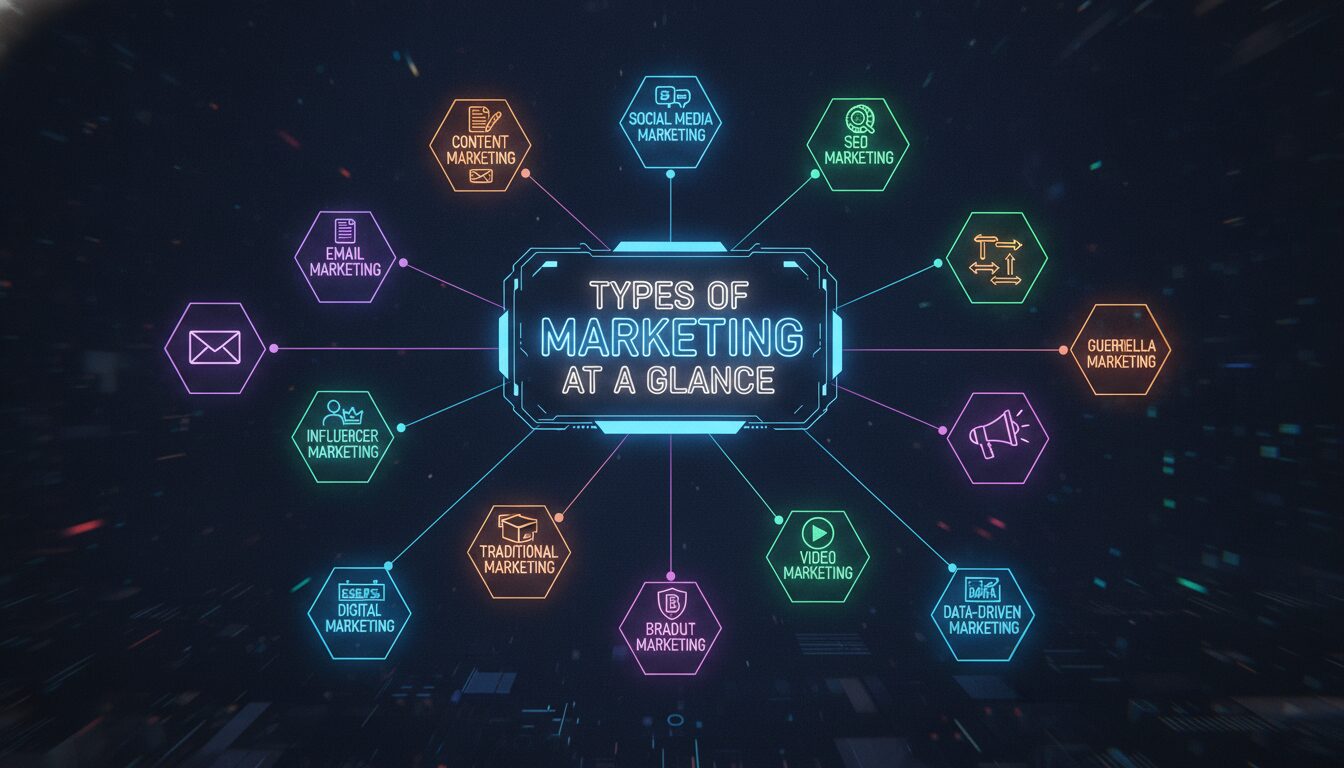
Types of marketing are the distinct channels, strategies, and approaches brands use to reach audiences and drive growth. From TV spots to TikTok campaigns, each type serves a different purpose, and the right mix depends on your audience, budget, and goals.
Key Takeaways
- of marketing fall into broad categories: traditional vs. digital, B2B vs. B2C, and inbound vs. outbound.
- Digital marketing now accounts for 58% of most marketing budgets, according to the American Marketing Association as cited by Western Governors University.
- Content marketing is used by 90% of organizations, making it one of the most widely adopted this type of marketing available.
- Social media influences 24% of Baby Boomers and 46% of Gen X consumers when discovering new products, per AMA data.
- Success requires aligning your chosen this kind of marketing with specific goals, audience insights, and continuous testing.
Types of Marketing at a Glance
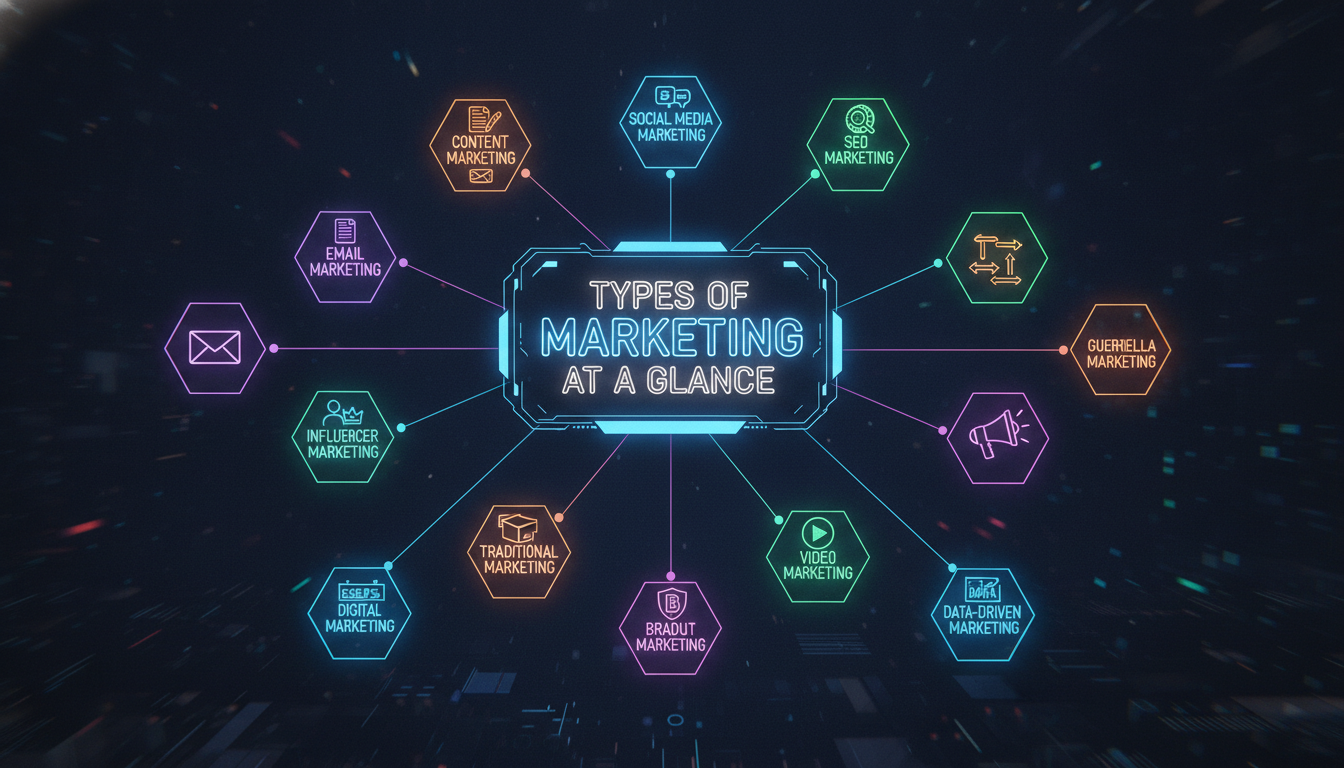
types of vary widely in cost, reach, and measurability. Below is a comparative overview of the most impactful approaches, highlighting key characteristics, advantages, drawbacks, and ideal use cases.
| Marketing Type | Description | Pros | Cons | Best For |
|---|---|---|---|---|
| Content Marketing | Creating valuable content to attract audiences | Builds authority, long-term ROI | Time-intensive | Thought leadership, SEO |
| Social Media Marketing | Engaging on platforms like Facebook, Instagram | Broad reach, direct engagement | Algorithm changes, time-consuming | Brand awareness, community |
| Email Marketing | Targeted messages to subscriber lists | High ROI, personalization | Spam filters, requires quality list | Lead nurturing, retention |
| Search Engine Marketing | SEO and paid search ads | High intent traffic, measurable | Competitive, technical | Immediate visibility, local |
| Influencer Marketing | Collaborating with influential personalities | Trust transfer, niche reach | Cost, brand alignment risk | Product launches, awareness |
| Traditional Marketing | Offline methods like TV, radio, print | Mass reach, tangible | Expensive, hard to track | Broad demographics |
| Affiliate Marketing | Revenue-sharing with third-party publishers | Low risk, pay for results | Quality control, commission costs | E-commerce, digital products |
| Guerrilla Marketing | Unconventional, surprise-based tactics | Memorable, low-cost | Reputation risk | Small budgets, brand stunts |
These of marketing are not mutually exclusive. The most effective strategies blend several approaches into a single, coherent customer experience.
Pros and Cons of Using Multiple Types of Marketing
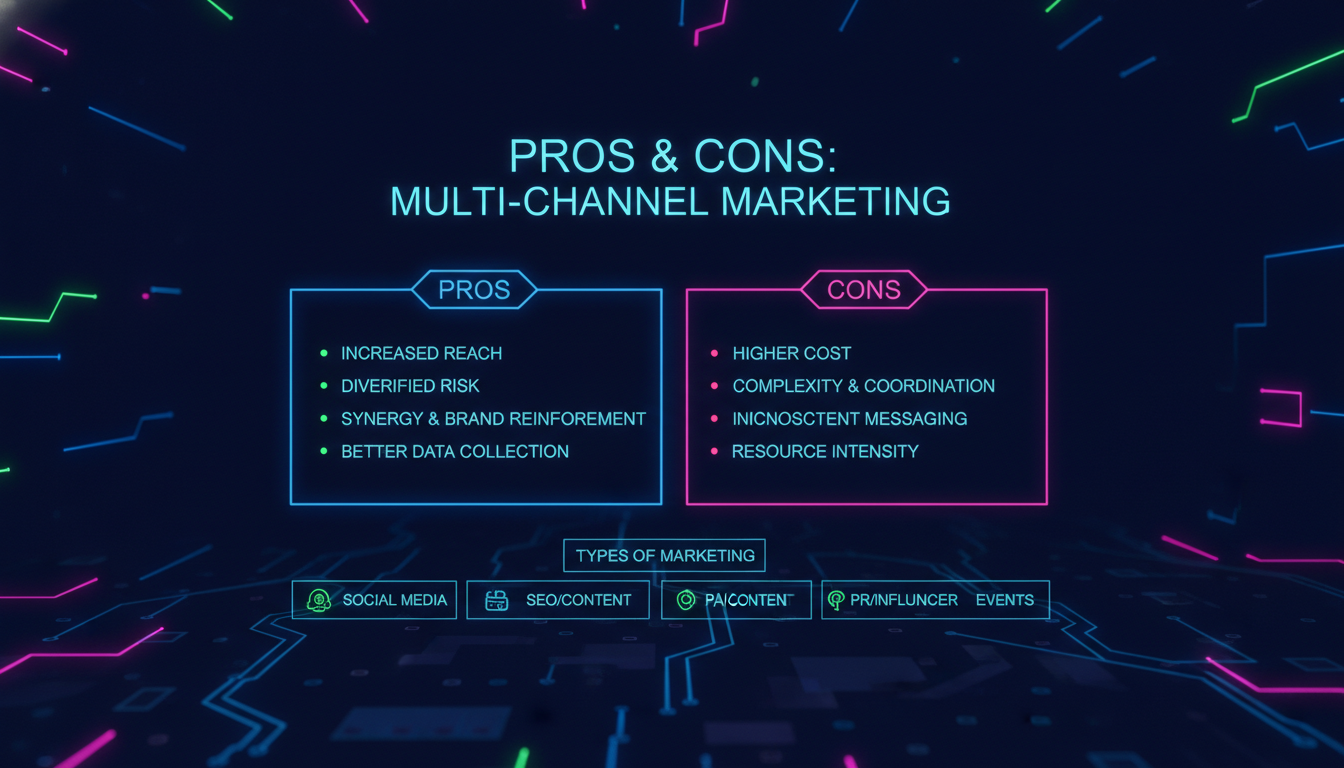
Pros
- Broader reach: Different this type of marketing connect with different audience segments, so a blended approach leaves fewer gaps.
- Risk distribution: If one channel underperforms, others can compensate, keeping your pipeline healthy.
- Compounding returns: Content marketing and SEO build long-term organic traffic while paid channels deliver immediate results.
- Richer data: Running multiple this kind of marketing simultaneously gives you cross-channel insights that single-channel strategies simply cannot provide.
- Audience flexibility: You can tailor messaging by channel, speaking to a B2B buyer on LinkedIn while reaching a consumer audience on Instagram.
Cons
- Complexity: Managing several types of at once demands strong coordination, clear ownership, and robust analytics.
- Budget dilution: Spreading spend too thin across many channels can mean none of them receive enough investment to perform well.
- Inconsistent brand voice: Without a unified creative brief, messaging can fragment across channels and confuse your audience.
- Measurement challenges: Attribution gets complicated when a customer touches five different channels before converting.
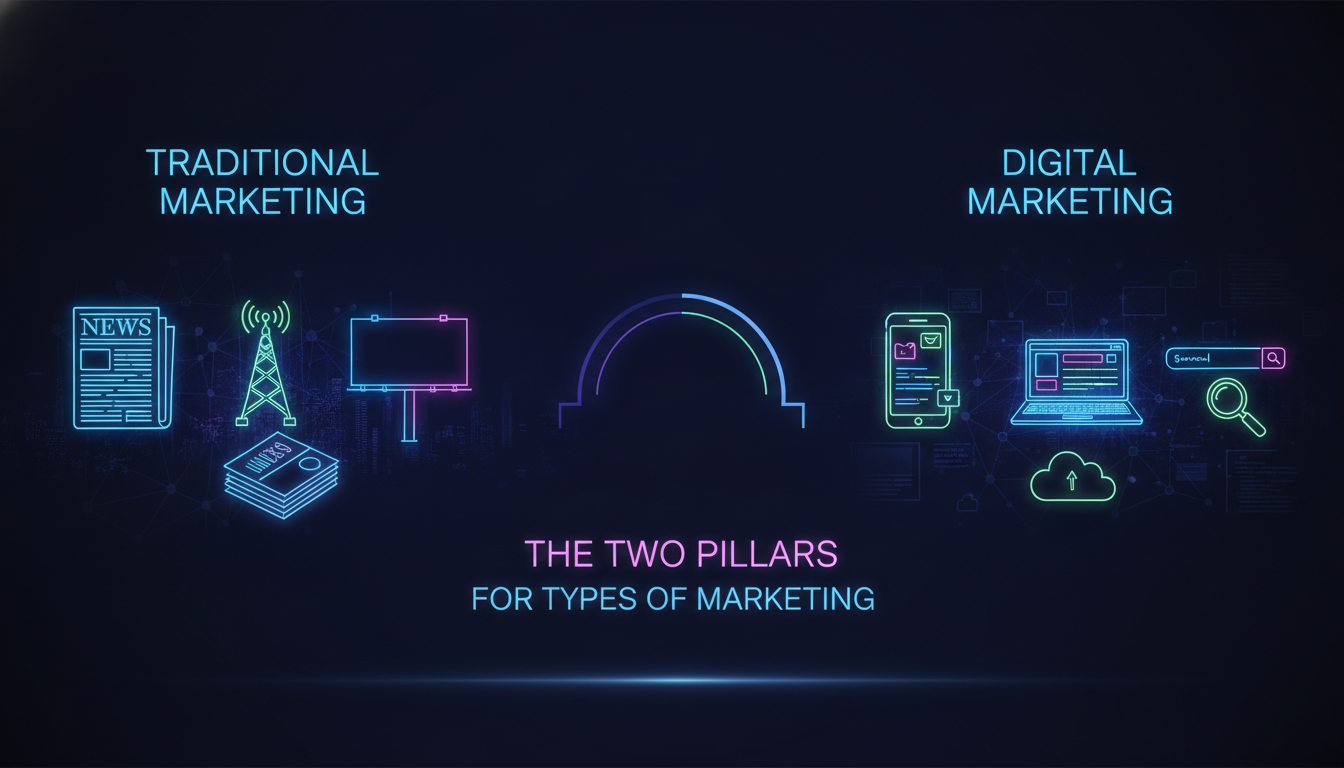
Traditional vs. Digital Marketing: The Two Pillars
What is Traditional Marketing?
Traditional marketing is any offline promotional activity that predates the internet, including print ads, broadcast media, outdoor advertising, direct mail, and telemarketing. These channels excel at building broad brand awareness and reaching demographics less active online. For decades, traditional marketing was the primary way businesses communicated with consumers, and many iconic campaigns, from Coca-Cola’s holiday commercials to McDonald’s golden arches, were built entirely on traditional platforms. Even today, local services, retail, and entertainment brands lean on radio and billboards for geographic targeting.
What is Digital Marketing?
Digital marketing encompasses all online strategies that use internet-connected channels to reach prospects, including content marketing, SEO, SEM, social media, email, influencer partnerships, affiliate programs, and display advertising. Its core advantage is precise targeting, real-time analytics, and the ability to personalize messages at scale. According to the American Marketing Association, as cited by Western Governors University, digital marketing now accounts for 58% of most marketing budgets. That figure reflects a fundamental shift toward data-driven, interactive campaigns that traditional channels simply cannot match on measurability.
Hybrid Approaches: Blending Old and New
The most resilient brands weave traditional and digital threads into a single customer experience. A retailer might run a TV ad that drives viewers to a social media contest, or a direct mail piece might include a QR code linking to a personalized landing page. This omnichannel approach ensures consistent messaging across touchpoints, increasing frequency and recall. Blending of marketing also mitigates risk: if one channel underperforms, another compensates. The result is a feedback loop that refines both over time.
Marketing by Audience: B2B vs. B2C
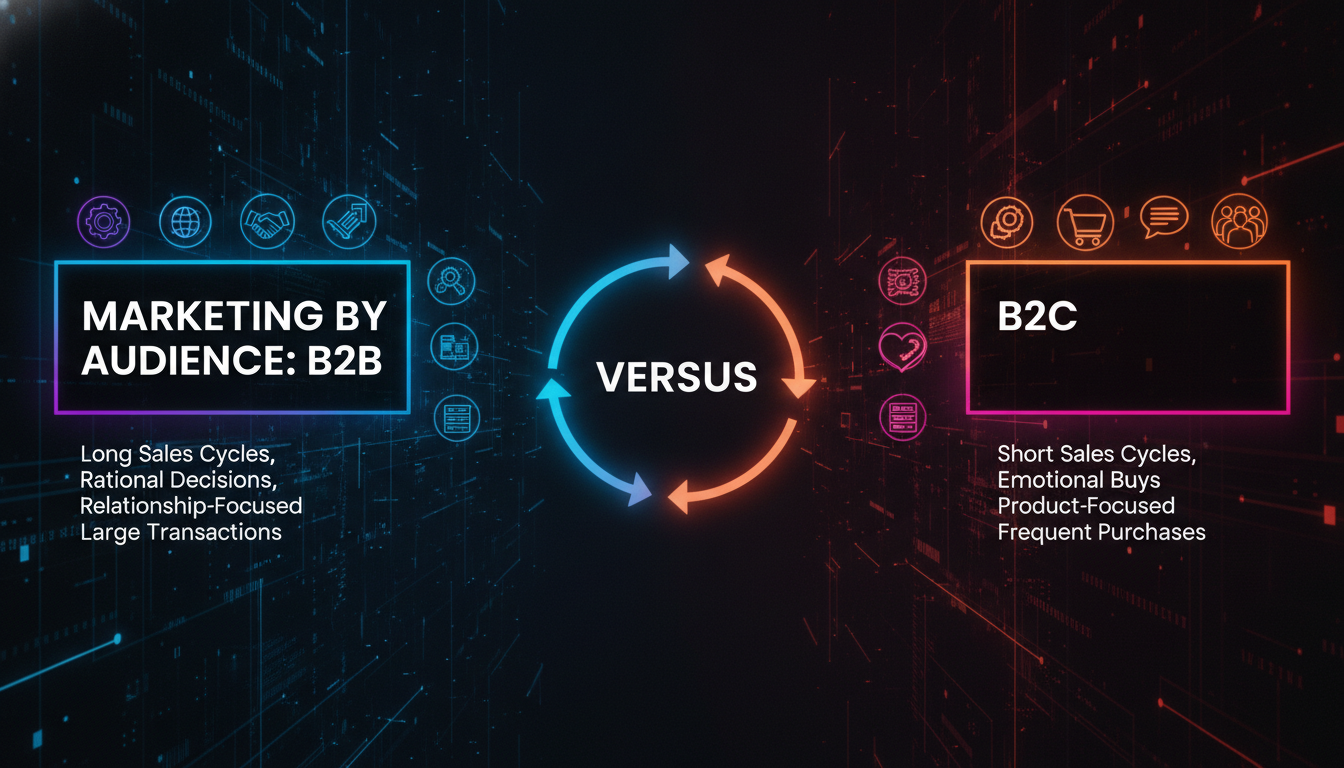
B2B Marketing: Building Trust and Value for Businesses
B2B marketing targets other companies rather than individual consumers, with messaging that emphasizes problem-solving, efficiency, and return on investment. B2B buyers are often rational, committee-based, and require evidence of competence before committing. Tactics include case studies, white papers, webinars, email campaigns, and LinkedIn advertising. As Salesforce notes, B2B marketing focuses on generating qualified leads from business teams and turning them into long-term customers, because purchase decisions involve multiple stakeholders and extended sales cycles. Small businesses succeed in B2B by creating specialized content that demonstrates expertise, such as compliance guides or risk assessments that build authority within a niche.
B2C Marketing: Speaking the Customer’s Language
B2C marketing sells directly to the end user. It’s typically more emotional, faster-paced, and designed for scale. The objective is to capture attention, spark desire, and drive immediate action. B2C campaigns use social media, influencer partnerships, video, and paid search to create brand affinity. Because purchase decisions are often impulsive or tied to personal identity, storytelling and visual content play a central role. A fashion brand might use Instagram Reels to showcase an aspirational lifestyle, while a food delivery app deploys seasonal promotions through email and push notifications.
Key Differences and Overlaps
While B2B and B2C types of marketing differ in tone and complexity, both rely on the same foundational tools: content, SEO, email, and social media. The biggest distinctions lie in sales cycle length, decision-making structure, and value proposition. B2B customers often require detailed onboarding and proof of ROI, whereas B2C consumers respond to convenience and emotional resonance. Many organizations serve both segments, maintaining distinct brand voices for each while coordinating data and learnings across teams.
Inbound vs. Outbound Marketing: Pull vs. Push
Inbound Marketing: Attracting Customers to You
Inbound marketing is a pull-based approach that draws prospects in through valuable content and experiences tailored to their needs. Instead of interrupting audiences with unsolicited messages, inbound strategies use blog posts, SEO, social media, ebooks, and webinars to earn attention organically. The philosophy is simple: by helping potential customers find answers and solve problems, you build trust and authority that leads to higher conversion rates over time. Inbound marketing aligns with modern buyer behavior, where consumers research extensively online before making a purchase, making it one of the most cost-efficient types of marketing for long-term growth.
Outbound Marketing: Pushing Your Message Out
Outbound marketing is a push-based approach that broadcasts a message to as many people as possible, regardless of their current interest level. Traditional examples include TV and radio commercials, telemarketing, billboards, and print ads. Digital outbound methods include display ads, pop-ups, and cold email outreach. While outbound can feel interruptive, it remains effective for building mass awareness quickly, especially when targeting broad demographics or launching a new product. Outbound often works best alongside inbound: an initial outbound campaign jumpstarts brand recognition, and inbound content nurtures the interest that follows.
Choosing the Right Balance
Most mature strategies blend inbound and outbound techniques. The ideal ratio depends on your product lifecycle, budget, and audience behavior. For complex B2B sales, inbound typically carries more weight because buyers need deep education before committing. For consumer goods, a mix of outbound TV ads and inbound social media campaigns can reinforce each other powerfully. Analytics platforms reveal which types of marketing drive the highest engagement and conversions at the lowest cost, allowing you to shift resources dynamically.
Content Marketing: Creating Valuable Connections
Blogging and SEO: The Backbone of Organic Discovery
Content marketing is a strategic approach centered on creating and distributing relevant, valuable content to attract and retain a clearly defined audience. According to the American Marketing Association, 90% of organizations use content marketing, and 80% of consumers prefer custom content that reflects their interests. Blogging is one of the most foundational techniques: regular articles improve SEO, demonstrate expertise, and answer the exact questions your prospects are typing into search engines. A well-maintained blog becomes a 24/7 lead-generation engine, compounding in value with every new post.
Video Marketing: Capturing Attention in Motion
Video marketing has emerged as a dominant force within content marketing, thanks to its ability to convey complex information quickly and evoke emotion. Platforms like YouTube, TikTok, and Instagram have made video accessible to brands of any size. Videos serve multiple purposes: product demos, tutorials, customer testimonials, behind-the-scenes footage, and live streams. Research consistently shows that video boosts engagement and shareability, making it a vital component of any modern marketing mix. As part of your content strategy, video can repurpose blog topics into an easily digestible format, reaching audiences who prefer watching over reading.
Ebooks, Whitepapers, and Webinars: Educating for Leads
For businesses targeting a professional audience, in-depth resources like ebooks, whitepapers, and webinars are powerful lead-generation tools. By offering high-value content in exchange for contact information, you build a permission-based list of prospects actively interested in your domain. Webinars add a layer of real-time interaction, allowing you to address questions directly and showcase expertise live. These assets are central to B2B content marketing, where trust and authority are paramount. A consistent schedule of such content, supported by a blog and social promotion, establishes your brand as a thought leader and steadily moves leads through the sales funnel.
Social Media and Influencer Marketing
Organic Social Media: Building Communities
Social media marketing uses platforms like Facebook, Instagram, LinkedIn, X (Twitter), and TikTok to connect with audiences, share content, and build community. Organic social efforts, including unpaid posts, stories, comments, and direct messages, humanize your brand and provide a channel for customer service and feedback. Consistency and authenticity are the price of admission. The data is clear: the American Marketing Association reports that 24% of Baby Boomers and 46% of Gen X consumers discover new products through social media. Social media is not just for younger demographics; it’s a cross-generational discovery tool that no brand can afford to ignore.
Paid Social Advertising: Precision Targeting at Scale
Paid social advertising allows brands to amplify their reach beyond organic limitations by targeting specific audience segments based on demographics, interests, behaviors, and custom lists. Platforms offer robust retargeting options, meaning you can re-engage users who visited your website or interacted with a previous post. Paid campaigns are measurable down to the click, enabling real-time optimization. When combined with organic content, paid social accelerates brand awareness and drives conversions. This hybrid approach is one of the most versatile types of marketing available, adaptable for B2B lead generation on LinkedIn or B2C impulse purchases on Instagram.
Influencer Marketing: Borrowing Trust
Influencer marketing involves partnering with individuals who have a dedicated social following and the ability to sway purchase decisions. Unlike traditional celebrity endorsements, influencers often cultivate niche communities built on authenticity and shared interests. Collaborations range from sponsored posts and product reviews to account takeovers and affiliate codes. For brands, the benefit is instant access to a trusted audience. Selecting the right influencer requires careful vetting to ensure alignment with brand values; a mismatch can damage credibility fast. When executed well, influencer marketing drives engagement and user-generated content that extends your campaign’s reach organically.
Search and Email Marketing Essentials
Search Engine Optimization (SEO): Earning Organic Visibility
SEO is the practice of improving a website’s visibility in unpaid search results, covering on-page factors like content quality and keyword usage, off-page factors like backlinks, and technical aspects like site speed and mobile-friendliness. By ranking higher for relevant queries, you attract visitors with high purchase intent, making SEO one of the most cost-effective types of marketing over the long term. SEO is a marathon, not a sprint. It requires continuous content creation, technical maintenance, and adaptation to algorithm updates. The organic traffic it generates compounds over time, yielding returns that paid channels rarely match on a per-click basis.
Search Engine Marketing (SEM): Instant Paid Visibility
SEM refers to paid advertising on search engines, most commonly through Google Ads. Unlike SEO, which takes time to build, SEM delivers immediate visibility for targeted keywords. Advertisers bid on keywords, and when users search for those terms, ads appear at the top of results. SEM is highly measurable: you pay per click and can track conversions directly. It’s particularly effective for short-term campaigns, product launches, and competitive markets where organic rankings are hard-fought. A balanced approach uses SEM for quick wins while nurturing an SEO strategy for sustained, compounding growth.
Email Marketing: Direct, Personalized Communication
Email marketing remains one of the most reliable direct-response channels in the entire spectrum of types of marketing. By sending targeted messages to a subscriber list, you can nurture leads, promote products, and retain customers with precision. Automation tools enable behavioral triggers such as welcome series, abandoned cart reminders, and re-engagement campaigns. Personalization goes beyond a first name: dynamic content can tailor entire email bodies to past purchase history or browsing behavior. Because email is permission-based, deliverability and relevance are critical. Clean lists, compelling subject lines, and mobile-optimized designs are table stakes. When integrated with a CRM, email marketing becomes a central hub for lifecycle marketing, driving repeat sales and loyalty.
Emerging and Niche Types of Marketing
Affiliate Marketing: Performance-Based Partnerships
Affiliate marketing is a revenue-sharing model where you reward third-party publishers for driving traffic or sales through their own promotional efforts. Affiliates can be bloggers, review sites, coupon platforms, or influencers. The structure is transparent: affiliates earn a commission for each sale, lead, or click generated. For businesses, it’s a low-risk strategy because you pay only for results. Affiliate networks like ShareASale or Commission Junction facilitate these relationships. This approach works best for e-commerce and digital products, where tracking is straightforward and margins can support commissions.
Guerrilla Marketing: Unconventional and Memorable
Guerrilla marketing relies on creativity, surprise, and low-cost tactics to generate maximum impact. Think flash mobs, street art, sticker campaigns, or viral stunts. The goal is to create a memorable experience that spreads through word-of-mouth and social sharing. This approach is ideal for small businesses with limited budgets that want to stand out in a saturated market. Guerrilla marketing can yield outsized returns, but it carries reputation risk if perceived as intrusive or off-brand. Successful campaigns tie the spectacle directly to the brand’s message, making the shock value purposeful rather than random.
Cause and Event Marketing: Aligning with Values and Experiences
Cause marketing partners a brand with a social or environmental cause, demonstrating corporate responsibility while resonating with values-driven consumers. Examples include donating a portion of sales to a charity or launching a campaign around a societal issue. Event marketing creates face-to-face or virtual experiences, including conferences, pop-up shops, workshops, and webinars, that immerse customers in the brand. Both types of marketing build deep emotional connections and generate authentic user-generated content. They’re particularly effective for brands looking to differentiate through purpose or relationship building.
Word-of-Mouth and Brand Marketing: Trust at Scale
Word-of-mouth marketing is one of the oldest and most powerful types of marketing in existence. When a satisfied customer recommends your brand to a friend, the trust transfer is immediate and credible in a way no ad can replicate. Brands accelerate word-of-mouth through referral programs, exceptional customer experiences, and community building. Brand marketing, closely related, focuses on shaping how your company is perceived at an emotional and cultural level rather than promoting a specific product. Think of it as the long game: consistent visual identity, tone of voice, and brand story that make your company instantly recognizable and genuinely preferred over time.
Personalized and Direct Marketing: One-to-One at Scale
Personalized marketing uses data, behavioral signals, and automation to deliver individually tailored messages to each prospect or customer. It goes well beyond inserting a first name into an email subject line. It means recommending products based on past purchases, serving ads based on browsing history, and adjusting landing page content based on the visitor’s location or referral source. Direct marketing, a related discipline, involves communicating directly with a targeted list through mail, email, or SMS without a media intermediary. Both approaches prioritize relevance over reach, making them especially effective for retention and upsell campaigns where you already know your audience well.
How to Choose the Right Types of Marketing for Your Business
Step 1: Align Marketing Types with Business Goals
Not all types of marketing are equally suited to every objective. If your goal is short-term sales, paid search and email promotions might take priority. For brand awareness, social media and content marketing, especially video, are strong candidates. Lead generation often leans on content marketing, webinars, and LinkedIn ads. Mapping your goals to the types of marketing that best achieve them prevents scattered spending and ensures every tactic has a measurable purpose. Use the SMART framework, Specific, Measurable, Achievable, Relevant, Time-bound, to define objectives, then select channels that directly contribute.
Step 2: Understand Your Audience and Budget
Your target audience dictates which channels will be most effective. Conduct market research to understand where your prospects spend time, how they consume information, and what influences their decisions. Budget matters equally: digital channels often have lower entry costs and more granular control, making them accessible for small businesses. Traditional media may require larger investments but can deliver mass reach. A pragmatic approach begins with a small, diversified budget across a few key types of marketing, then reallocates based on performance data. A B2B software company will naturally invest more in SEO and LinkedIn than TikTok, while a direct-to-consumer skincare brand might emphasize Instagram and influencer partnerships.
Step 3: Audit Your Resources
Assess your team’s skills, budget, and existing assets including your website, content library, and email list. There’s no point investing heavily in video marketing if you have no production capacity, or in webinars if your audience prefers short-form content. Match the types of marketing you pursue to the resources you can realistically sustain. Consistency beats ambition every time.
Step 4: Analyze Competitor Strategies
Use tools like Semrush or Similarweb to see which channels your competitors are using and where they’re strongest. If a competitor dominates organic search, you might find faster wins in paid social or email. Competitive analysis reveals gaps in the market that your types of marketing can fill, rather than simply mirroring what everyone else is doing.
Step 5: Test, Measure, and Iterate
Run 30- to 90-day experiments on two or three selected types of marketing, measuring key performance indicators like cost per lead or engagement rate. Double down on what works, cut what doesn’t, and always look for emerging channels that might give you an edge. As Dr. Jolivette Wallace of Southern New Hampshire University emphasizes:
“Marketing requires processes that focus on delivering value and benefits to customers by choosing the appropriate marketing strategy. Therefore, choosing the right strategy is of vital importance.” – Dr. Jolivette Wallace, Associate Dean of Business, Southern New Hampshire University
“Successful marketing strategies should highlight what sets a product or service apart from competitors and offer a compelling value proposition that communicates the unique benefits and value customers can expect.” – Dr. Jessica Rogers, Senior Associate Dean of Business Programs, Southern New Hampshire University
The most successful types of marketing are those that align with your brand identity, resonate with your audience, and are supported by consistent measurement. View marketing as an integrated system rather than isolated tactics, and you build a sustainable competitive advantage that compounds with every campaign.
Ready to build a marketing strategy that actually moves the needle? Explore how Emin Media approaches brand-building and digital campaigns, or contact us for a free brand consultation and let’s build something bold together.
Frequently Asked Questions
What are the four main types of marketing?
The four main categories are traditional marketing, digital marketing, inbound marketing, and outbound marketing. Some frameworks define them as B2B, B2C, product, and service marketing, but the most common approach divides by channel (traditional vs. digital) and strategy (inbound vs. outbound).
What are the 7 ways of marketing?
A widely used framework includes content marketing, social media marketing, email marketing, search engine marketing, influencer marketing, affiliate marketing, and traditional advertising. These seven cover both online and offline methods, providing a solid foundation for most businesses regardless of size or industry.
What are the 10 types of marketing?
Ten commonly cited types are content marketing, social media marketing, email marketing, SEO, SEM, influencer marketing, affiliate marketing, video marketing, traditional marketing, and event marketing. The list varies by source, but these represent the core channels active brands use as of 2026.
What are the two main types of marketing?
Traditional marketing (offline) and digital marketing (online) are the broadest classifications. Almost every other marketing type falls under one of these two umbrellas, making them the most useful starting point for any strategic conversation.
What is the most effective type of marketing?
Effectiveness varies by goal. Content marketing is frequently cited for long-term ROI, while email marketing consistently delivers strong returns for retention and lifecycle campaigns. The best type of marketing depends on your audience, industry, and specific KPIs, which is why testing multiple approaches is always the right move.
How do I start with marketing for a small business?
Begin by clearly defining your target customer and setting a realistic budget. Focus on a mix of low-cost digital types of marketing such as social media, content marketing, and email. Track results rigorously from day one, and gradually expand into additional channels as you learn what resonates with your specific audience.
Enjoyed this article?
Contact Emin Media for a free brand consultation and let's create something amazing together.
Get in TouchRelated Articles
Digital Marketing for Creatives: A Bold Guide
Digital marketing for creatives builds real visibility and sales. Learn strategies for social media, SEO,…
Branding & Design Agency Tips That Actually Work
Discover branding and design agency tips to choose the right partner, set clear goals, and…
Creative Agency Pitch Deck Tips That Win Clients
Master creative agency pitch deck tips that win clients in 2026. Learn storytelling, design, and…