SEO Is Dead or Evolving 2026: The Real Answer
SEO Is Dead or Evolving 2026: The Real Answer
SEO is dead or evolving 2026 is the question every brand owner, founder, and marketing manager is asking right now. The short answer: SEO is very much alive, but the old playbook is obsolete. AI overviews, zero-click results, and multi-platform search have rewritten the rules entirely.
Key Takeaways
- Google still commanded 89% of U.S. web traffic in 2025, making organic search far from irrelevant.
- 65% of Google searches end without a click, but high-intent visitors who do click are far more likely to convert.
- AI search engines rely on indexed web content, so strong SEO ensures you appear in ChatGPT, Perplexity, and AI overviews.
- Entity-based optimization, structured data, and E-E-A-T signals are now the foundation of ranking, not keywords alone.
- AI and LLM platforms account for roughly 6% of global search volume and are growing fast, demanding a search-everywhere strategy.
- Organic search still drives 53% of all website traffic, according to BrightEdge’s 2026 State of Search report.
The Reality of SEO in 2026: Is SEO Dead or Evolving 2026?
Whether evolving 2026 is the defining debate in digital marketing right now, and the answer is clear: SEO is evolving, not dying. According to Neil Patel, Google still controlled 89% of all U.S. web traffic in 2025, proving that traditional search isn’t going anywhere. Yet platforms like TikTok, Amazon, ChatGPT, and Claude are pulling away queries that once went directly to Google. This dual reality means SEO must evolve from a single-channel focus to a multi-surface optimization discipline.
Marketers who frame this type of 2026 as a binary choice miss the nuance entirely. The core goal, connecting users with relevant and authoritative content, remains unchanged. The mechanisms, however, have shifted dramatically. AI-generated answers, voice assistants, and social search behavior demand a new approach.
“SEO isn’t dead, but the old playbook needs an update. Chasing low-competition keywords, informational ‘what is’ articles, and generic content have given way to brand, authority, and genuine usefulness.” – SurferSEO, 2026
AI Search Isn’t Replacing SEO. It’s Reshaping It
AI search engines like ChatGPT, Perplexity, and Google’s Gemini do not magically generate answers. They synthesize existing web content, often citing sources directly. As WebFX notes, “ChatGPT relies on traditional search engines to retrieve information from relevant webpages.” This creates a feedback loop: sites that rank well in Google are the same ones AI models pull from. If your SEO is weak, you disappear from both traditional search and AI-generated responses. The debate over whether this kind of evolving 2026 becomes moot because SEO is the prerequisite for AI visibility.
Zero-Click Searches and Their Real Impact
Zero-click searches, where users get answers directly on the results page without clicking through, have stoked real fears. SparkToro’s 2025 Zero-Click Search Study found that 65% of Google searches end without a click. Alarming on the surface, but this actually filters out low-intent queries. When a user clicks after seeing your site in an AI overview or featured snippet, they arrive pre-qualified and far more likely to convert. Many businesses report that zero-click improves lead quality because tire-kickers are satisfied without ever landing on your site.
How Traditional SEO Tactics Have Died
To fully grasp why the is dead or evolving 2026 is a valid concern, you need to understand what has actually become obsolete. The old guard of keyword stuffing, purchased backlinks, and thin content farms has been systematically dismantled by Google’s algorithm updates. Panda, Penguin, and every major update since have penalized manipulative tactics, forcing a shift toward genuine user value. Any attempt to rank by repeating a phrase 50 times or buying directory links will trigger manual actions today.
The Fall of Keyword Stuffing and Link Schemes
Remember when adding a city name to every heading and stuffing footers with exact-match anchors worked? Those days are gone. Google’s Hummingbird and BERT updates introduced natural language processing, making it possible for the algorithm to understand context and intent. Synonyms, conversational queries, and entity relationships now matter more than keyword repetition. Link schemes, including private blog networks, comment spam, and low-quality directories, are actively deindexed. The surviving backlinks are those that demonstrate genuine editorial endorsement.
Google’s Algorithm Updates That Killed Old SEO
Google rolls out 12-plus algorithm changes per day, according to Neil Patel. The cumulative effect has been to reward sites that demonstrate E-E-A-T: Experience, Expertise, Authoritativeness, and Trustworthiness. This framework, especially critical for YMYL (Your Money Your Life) topics, evaluates content creators and the site as a whole. Old SEO ignored these signals entirely, focusing on on-page tweaks. Today, a site without clear authorship, citations, and a positive brand footprint will struggle no matter how well its meta tags are optimized.
The New SEO Playbook: From Keywords to Entities
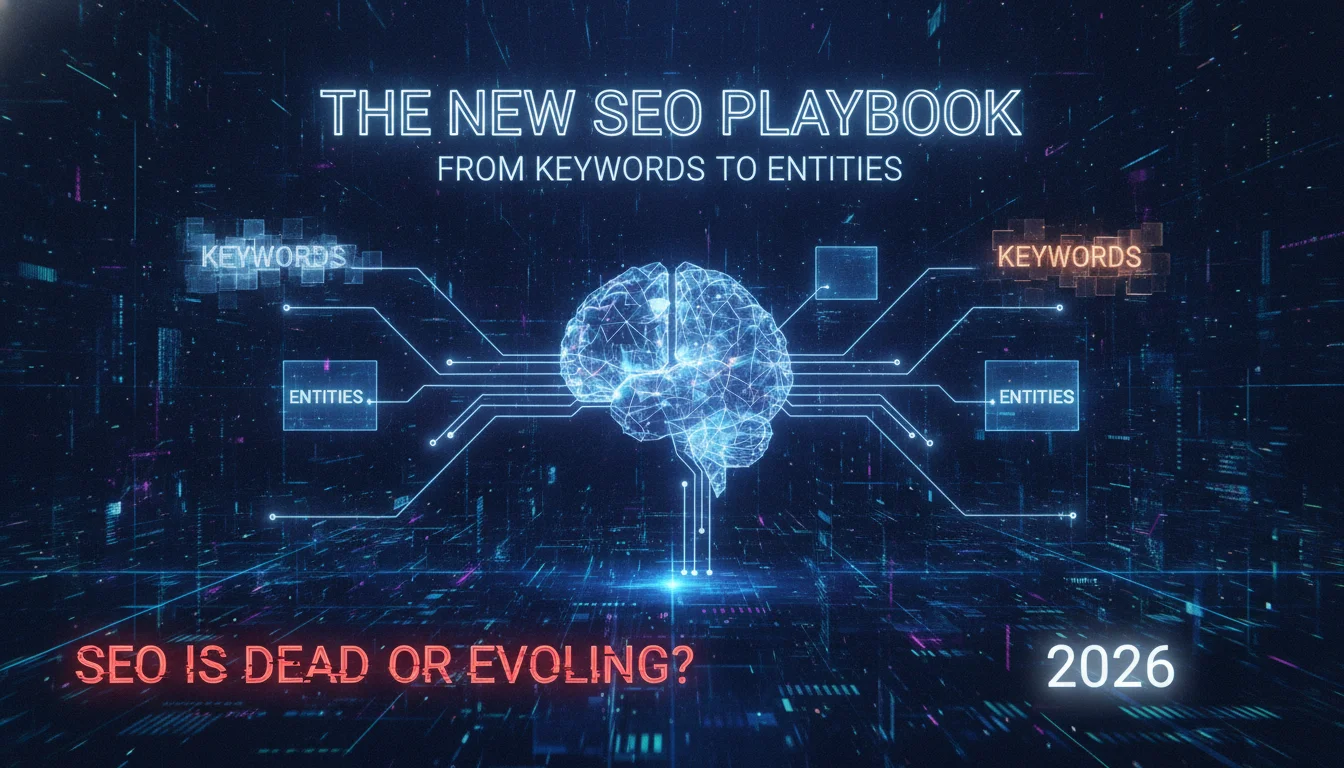
If the question of whether 2026 has an operational answer, it’s this: SEO has evolved from a keyword-centric to an entity-centric discipline. An entity is any distinct, defined piece of information, a person, place, thing, concept, or idea, that Google understands in relation to other entities. This shift allows Google to answer complex queries by connecting entities rather than matching literal strings. For businesses, this means optimizing not just for “plumber near me” but for attributes like service hours, certifications, and location, all stored in Google’s Knowledge Graph.
Understanding Entity-Based Optimization
Entity-based optimization involves structuring content and metadata so search engines can identify and connect your brand to relevant topics. Use schema markup to explicitly declare your business type, products, reviews, and FAQ. Claim and optimize your Google Business Profile, because it feeds directly into local knowledge panels and voice search results. Competing in 2026 means your website is no longer the sole SEO asset. Your entire digital footprint across directories, social profiles, and review sites must reinforce entity signals.
Building Topical Authority Across Your Niche
Instead of chasing individual keywords, build comprehensive topic clusters. A central pillar page covers the broad subject, and cluster pages address related subtopics, all interlinked. This internal linking structure signals to Google that you have depth and breadth on a subject. A digital agency might create a pillar on “SEO in 2026” with clusters on AI optimization, Core Web Vitals, and local search. This approach helps search engines see your site as a trusted resource, improving rankings across the board and reducing the impact of individual algorithm updates.
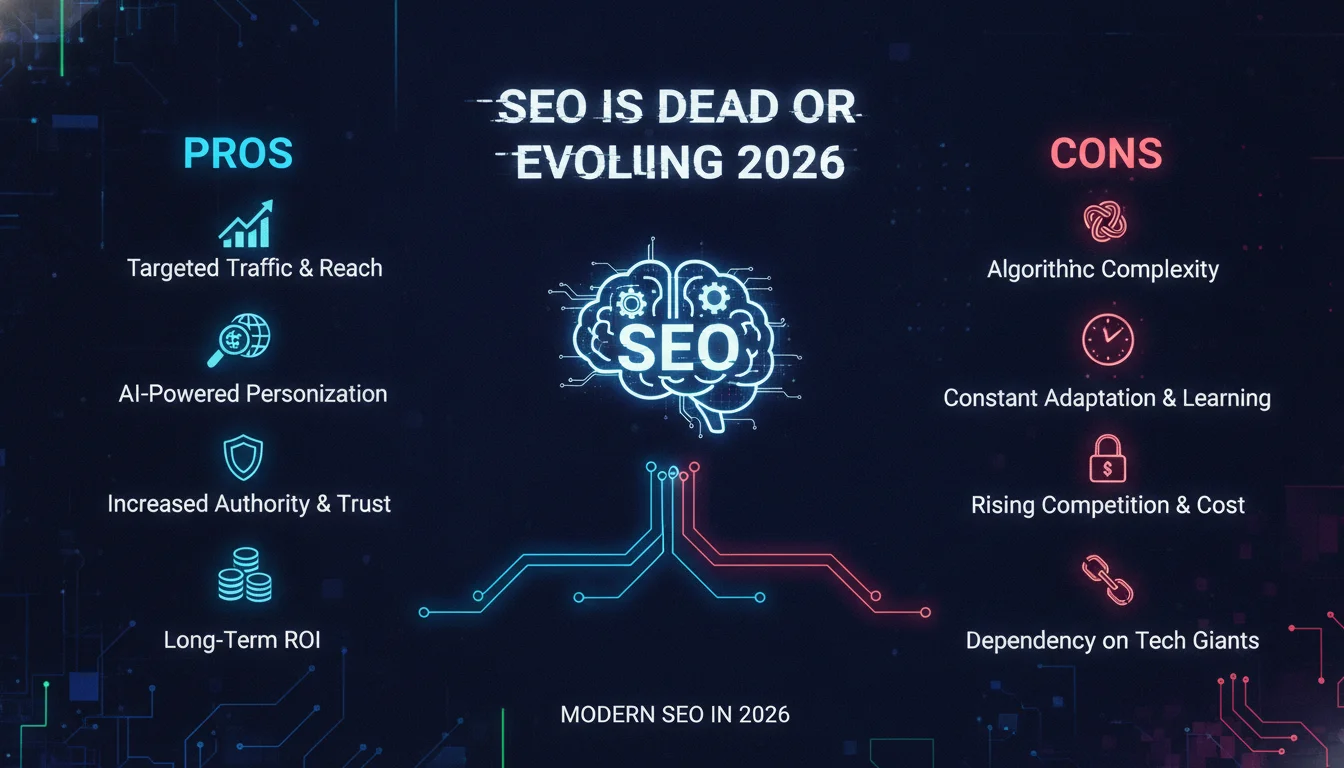
Pros and Cons of Modern SEO in 2026
Pros
- Higher-quality traffic: Zero-click filters out low-intent users, so visitors who do arrive are pre-qualified and more likely to convert.
- AI amplification: Strong SEO now feeds AI citation engines, meaning one piece of well-optimized content can appear across Google, ChatGPT, and Perplexity simultaneously.
- Long-term compounding returns: Unlike paid ads, organic authority built through entity optimization and E-E-A-T compounds over time.
- Broader discovery surface: A search-everywhere strategy puts your brand in front of audiences on TikTok, Reddit, YouTube, and AI chatbots, not just Google blue links.
- Organic search durability: BrightEdge’s 2026 data shows organic search still drives 53% of all website traffic, making it the single largest discovery channel.
Cons
- Longer time to results: Entity-based SEO and topical authority take months to build, making it a poor fit for brands needing immediate traffic.
- Higher content bar: Generic, thin content no longer ranks. Every piece needs original insight, expert authorship, and structured data, raising production costs.
- Measurement complexity: Tracking LLM citation rates and multi-surface visibility is harder than reading a rank tracker, requiring new tools and new thinking.
- Zero-click erosion: With 65% of searches ending without a click, informational content may drive brand awareness but limited direct traffic.
Why “SEO Is Dead or Evolving 2026” Is the Wrong Question
Framing the debate as seo is implies a binary choice, but the reality is far more layered. SEO is not a single tactic. It’s a collection of strategies that adapt to user behavior. The better question is: how are user search behaviors evolving, and how can your business adapt? Shifting focus to user intent moves you from reactive alarm to proactive strategy.
User Intent Has Replaced Keyword Strings
In 2026, search engines interpret four primary types of intent: informational, navigational, commercial investigation, and transactional. Instead of optimizing for “cheap running shoes,” successful sites create content that addresses the underlying need, whether comparing models (commercial investigation) or locating a store (navigational). Tools like Google’s People Also Ask and Related Searches reveal intent clusters. By mapping content to these clusters, you attract users at every stage of the buyer journey, often ranking for queries you never explicitly targeted.
Search Everywhere Optimization: Beyond Google
Search is no longer confined to a single search box. Users now discover content on TikTok, Reddit, Amazon, YouTube, and AI chatbots. A brand that ranks only on Google is invisible to the growing segment of users who bypass traditional results entirely. Search everywhere optimization means creating platform-specific content: short-form video for TikTok, detailed answers for Reddit, product feeds for Amazon, and structured, citable content for LLMs. As @ericosiu put it on Instagram: “Plan your business as if search traffic is zero, but don’t ignore it.” That balanced mindset is exactly right for 2026.
Local SEO in 2026: The Voice Search Factor
Local SEO has become one of the clearest proofs that seo is dead or evolving 2026 lands on the “evolving” side. When someone asks their phone “find a plumber near me who works weekends,” voice assistants pull directly from Google Business Profiles and local search results. No SEO presence means no voice search visibility. For local businesses, this is the most immediate and measurable consequence of ignoring modern SEO.
Optimize your Google Business Profile with accurate hours, service categories, and regular posts. Collect and respond to reviews, because review signals feed both local rankings and AI overview citations. Ensure your NAP (name, address, phone) is consistent across every directory, review site, and social profile. These steps are not optional extras. They are the baseline for local visibility in 2026.
Step-by-Step Guide to Adapting Your SEO Strategy in 2026
Ready to act on the reality that seo is dead or evolving 2026 lands firmly on “evolving”? Here is a practical three-step process to modernize your approach.
Step 1: Audit Your Current Content for AI Readability
Assess each page against AI-friendly criteria: clear headings, concise answers early in the text, and schema markup. Use Google PageSpeed Insights to ensure fast load times. According to WebFX’s 2026 guidance, target an LCP (Largest Contentful Paint) of 2.5 seconds or less, an INP (Interaction to Next Paint) of 200 milliseconds or less, and a CLS (Cumulative Layout Shift) score below 0.1. Check that each page passes the “snippet test”: if Google pulled the first paragraph as a featured snippet, would it fully answer the query? Remove fluff and ensure every page has a succinct answer within the first 100 words. This increases your chances of being cited in AI overviews.
Step 2: Implement Structured Data and E-E-A-T Signals
Add schema.org markup for Articles, FAQs, Products, or LocalBusiness, depending on your content type. Configure author bio pages with credentials and links to professional profiles. Display trust badges, customer reviews, and media mentions prominently. For YMYL sites, cite reputable sources and date your content to show freshness. Google’s Search Quality Evaluator Guidelines explicitly reward demonstrable expertise, so make your credentials impossible to miss. This step alone can lift rankings as Google more confidently associates your entity with high-quality results.
Step 3: Diversify Search Presence Across Platforms
Optimize your Google Business Profile with accurate hours, categories, and frequent posts. Syndicate content to YouTube, Medium, LinkedIn Articles, and industry forums where your audience actively searches. For B2B brands, ensure your company appears on relevant review sites like G2 and Capterra. For B2C, claim your brand on TikTok and Instagram, using keywords in captions and hashtags. The goal is a web of interlinked, authoritative presences that reinforce your entity, making it easier for AI models and traditional crawlers alike to recognize and cite you.
SEO vs. AI Search: Key Differences and Overlaps
Understanding how traditional SEO differs from AI-powered search is essential to seeing why seo is dead or evolving 2026 is really about convergence, not replacement.
| Aspect | Traditional SEO (pre-2023) | AI-Era SEO (2026) |
|---|---|---|
| Core Focus | Keywords, backlinks, and technical optimization | Entities, E-E-A-T, and content citation-worthiness |
| Content Strategy | Volume of pages targeting long-tail keywords | Comprehensive pillar-cluster models with original insights |
| Ranking Signals | PageRank, anchor text, meta tags | Brand authority, structured data, user engagement, Core Web Vitals |
| Search Surfaces | Google blue links only | AI overviews, voice assistants, LLM chatbots, visual search, social platforms |
| Measurement | Impressions, clicks, average position | Entity visibility, LLM citation rate, multi-surface share of search |
As the table shows, the foundations have shifted, but the ultimate objectives, visibility, traffic, and conversions, remain the same. The tactics are what needed to evolve.
The Feedback Loop: How SEO Fuels AI Content
AI large language models are trained on web content and frequently use real-time retrieval augmented generation (RAG) to pull fresh data. When your site ranks well in Google, it becomes part of the highly curated index that AI systems trust. This creates a positive feedback loop: strong SEO leads to AI citation, which reinforces brand authority, which leads to even higher rankings. Ignoring SEO means you’re excluded from the data sets that feed AI, cutting you off from an audience that increasingly relies on ChatGPT or Perplexity for initial research. The claim that seo is dead or evolving 2026 overlooks how SEO now underpins AI search entirely.
Why AI Overviews Still Depend on Traditional Rankings
Google’s AI Overviews do not function independently. They draw from the same organic index that produces blue links. As SurferSEO’s 2026 analysis notes, search success now depends on “becoming a recognized entity, producing content worth citing, and being discoverable across all platforms where people search.” The fundamentals of on-page SEO, quality content, and authoritative backlinks still directly influence whether you appear in the AI-generated box. SEO has become the qualifying gatekeeper for AI visibility.
How to Optimize for Large Language Models (LLMs) and AI Overviews
Direct optimization for LLMs is the new frontier, and it decisively answers the seo is dead or evolving 2026 question with a blueprint for action.
Content That Gets Cited: Answer-Driven Formats
LLM-friendly content is structured for extraction: short, declarative sentences, bullet points, and clear definitions. Every H2 and H3 should serve as a potential answer header. Write in a neutral, factual tone that mirrors the concise style of an encyclopedia, because that’s what AI models prefer to quote. Embed definitional statements like “SEO is the practice of increasing a website’s visibility in organic search engine results.” These crisp, stand-alone sentences are exactly what LLMs capture for their training data and real-time retrieval. According to SurferSEO’s 2026 analysis, “content worth citing” is the single most important factor for LLM inclusion.
Technical Foundations for AI Crawlers
LLM bots like GPTBot, Claude-Web, and PerplexityBot follow standard crawl directives but may be more stringent about respecting robots.txt. Allow these bots with a broad permissive rule, but protect sensitive areas. Ensure your site serves fast, HTML-first versions of critical content so AI crawlers can parse easily without heavy JavaScript dependencies. Implement comprehensive XML sitemaps that include lastmod dates and priority signals. Use canonical tags to prevent AI from citing duplicate versions of your content. These technical steps ensure your content stays in the pool from which AI draws answers.
“AI Overviews and SERP features now dominate page one. If your content isn’t cited or structured for AI, you risk being invisible, no matter your ranking.” – Neil Patel, 2026
The Evolution Timeline: What’s Coming Next
The seo is dead or evolving 2026 conversation doesn’t end this year. Here’s where the industry is heading, based on competitor research and current trajectory.
2026-2027: Entity-based SEO becomes the standard. Google understands your business as a collection of attributes, not just keywords. Your Google Business Profile optimization matters as much as your website content.
2028-2029: Visual search dominates product discovery. Image SEO and video content become non-negotiable for e-commerce. Service businesses need visual portfolios to compete effectively.
2030+: Predictive search anticipates needs before users ask. SEO shifts from answering questions to predicting them. Businesses that understand customer journey mapping will have a significant advantage.
As CS Design Studios notes in their 2026 analysis, every prediction about SEO’s death has been wrong. “Mobile will kill SEO” became mobile-first indexing. “Voice search will kill SEO” became conversational keyword optimization. “AI will kill SEO” is becoming entity-based optimization and structured data.
Frequently Asked Questions
Is SEO really dead in 2026?
No, SEO is not dead. It has evolved from keyword-centric tactics to an intent-based and entity-based discipline. Search engines remain the primary discovery channel, and AI platforms depend on indexed content, making SEO more critical than ever for brand visibility.
How are AI overviews affecting organic traffic?
AI overviews reduce click-through rates for simple, informational queries but increase engagement from high-intent visitors. Sites cited in AI overviews often see stronger conversion rates because users arrive already knowing the site has the answer they need.
What is entity-based SEO?
Entity-based SEO optimizes content so search engines can identify and relate distinct entities, such as people, places, products, and concepts, rather than matching literal keywords. It relies on schema markup, knowledge graphs, and topical authority built across your entire digital footprint.
Should I optimize for ChatGPT and other LLMs?
Yes. LLMs pull from web content, and being cited as a source drives brand awareness and referral traffic. Optimize by providing clear, concise, fact-driven answers, using schema markup, and allowing LLM crawlers access through your robots.txt settings.
Will Google remain the dominant search engine?
Google continues to hold a large majority of the search market, commanding 89% of U.S. web traffic in 2025, but alternative platforms like TikTok, Reddit, and AI chatbots are growing. A modern SEO strategy must account for all search surfaces, not just Google.
What are the key ranking factors in 2026?
Top ranking factors include Core Web Vitals, E-E-A-T signals, structured data, entity relevance, and mobile-first performance. Backlinks still matter but must come from authoritative, relevant sources. Content that directly answers user intent with original insight is consistently favored.
SEO Is Not Dead. It’s Metamorphosing.
The debate over seo is dead or evolving 2026 is settled: SEO is evolving, not dying. Every prediction of its demise has been proven wrong, from mobile-first indexing to voice search to AI. What changes are the tactics. The core principle of delivering genuine value to users remains constant.
As businesses adapt to entity-based optimization, AI-citable content, and search-everywhere strategies, they’ll find that SEO doesn’t just survive. It becomes more integrated into overall digital marketing than ever before. The funeral bells are for outdated tricks, not for the discipline itself.
Ready to build a brand that ranks everywhere your audience searches? Contact Emin Media for a free brand consultation and let’s build something bold together.
Enjoyed this article?
Contact Emin Media for a free brand consultation and let's create something amazing together.
Get in TouchRelated Articles
Visual Content Marketing Trends for 2026
Visual content marketing trends for 2026 are reshaping how brands connect. Discover AI visuals, interactive…
Brand Voice Examples 2026: Build a Voice That Sticks
Explore the best brand voice examples 2026 has to offer. Learn frameworks, archetypes, and steps…
What Are the 3 Cs of SEO? Content, Code & Credibility
What are the 3 Cs of SEO? Learn how Content, Code, and Credibility work together…