Digital Marketing Strategy: Build One That Works
A digital marketing strategy is a long-term, high-level plan that uses online channels to achieve specific business goals. It defines your target audience, key messages, and measurable objectives while guiding campaigns and tactics across search, social, email, and more.
Key Takeaways
- A digital marketing strategy is a long-term plan that aligns online marketing efforts with business goals, guiding channels, campaigns, and tactics.
- Effective strategies blend SEO, content, social media, email, and paid advertising, supported by data-driven insights and continuous optimization.
- According to a Smart Insights report cited by Harvard Business School, only 17% of organizations clearly define their digital marketing strategies – yet those that do consistently outperform competitors.
- Building a strategy involves setting SMART goals, auditing existing assets, defining target audiences, and choosing channels based on measurable KPIs.
- Real-world examples from Coca-Cola show how structured strategies drive engagement, leads, and revenue at scale.
What Is a Digital Marketing Strategy?
A digital marketing strategy is essentially the blueprint for how your business connects with customers through online channels. Unlike a one-off campaign or a list of tactics, it establishes the overarching direction and priorities that keep all marketing activities cohesive. As Adobe’s business blog notes, a strategy “defines objectives, identifies target audiences, and provides a framework for all marketing activities across digital channels like websites, social media, email, and search engines.”
This plan is long-term, often spanning months or years, and answers two fundamental questions: What are we trying to achieve? Why does this matter? By answering these, your plan becomes the foundation upon which every blog post, social ad, and email newsletter is built.
Strategy vs. Campaigns vs. Tactics
Three layers govern every marketing operation: strategy, campaigns, and tactics. The strategy sets the vision (e.g., increase market share within a year). Campaigns are time-bound initiatives that activate that vision (e.g., launching a seasonal social media series). Tactics are the granular, day-to-day actions within campaigns (e.g., designing a Facebook carousel ad or writing an SEO-optimized blog post).
This hierarchy ensures that every tweet, email, and landing page ladders up to business objectives, preventing what we call “random acts of marketing.”
The Role of Data and Customer Insights
Modern digital planning relies on data to understand customer behavior, preferences, and pain points. According to the Digital Marketing Institute’s research report “The Marketing Evolution,” 53% of senior marketers are spending significantly more on digital channels, yet many report a lack of talent to analyze the resulting data. A well-structured approach addresses this by embedding analytics into every stage, from audience segmentation to KPI tracking.
Pros and Cons
Pros
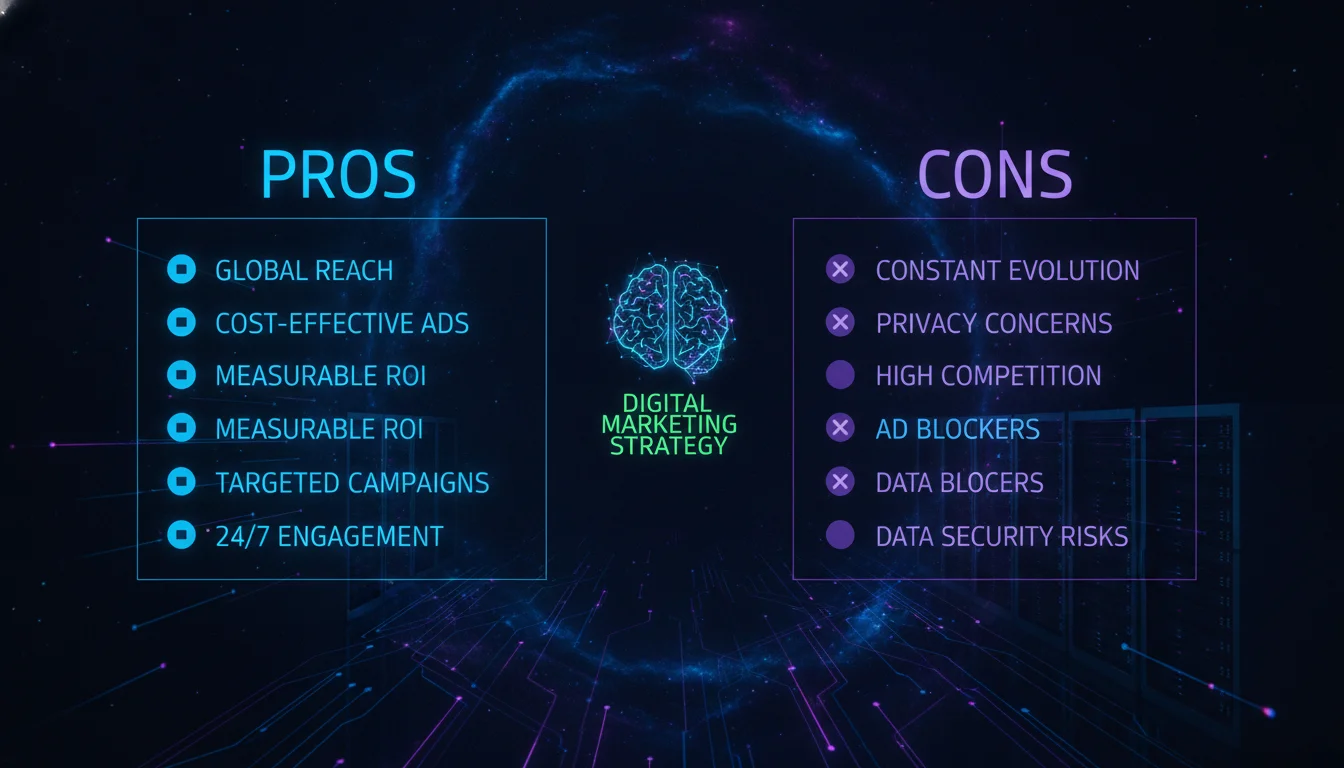
- Measurable results: Digital channels offer trackable KPIs – conversion rates, cost per acquisition, return on ad spend – that traditional media simply can’t match.
- Audience precision: You reach the right people at the right moment, using behavioral data, demographics, and intent signals to sharpen targeting.
- Scalable growth: A well-built strategy compounds over time. SEO traffic grows without proportional cost increases. Email lists become more valuable as they grow.
- Agility: Unlike a print campaign locked in for six months, digital plans can pivot in days based on real performance data.
- Competitive edge: According to HBS, only 17% of organizations clearly define their strategies – meaning a structured approach immediately separates you from the majority.
Cons
- Talent gap: The Digital Marketing Institute reports that many organizations lack the analytical talent to act on the data they collect.
- Channel complexity: Managing SEO, paid ads, social, email, and content simultaneously requires either a large team or smart prioritization.
- Constant change: Algorithm updates, platform shifts, and new AI tools mean your approach needs regular review – what worked last year may underperform today.
- Upfront investment: Building the infrastructure (analytics, CRM, content systems) takes time and budget before results materialize.
Strategy vs. Campaigns vs. Tactics: Why the Difference Matters
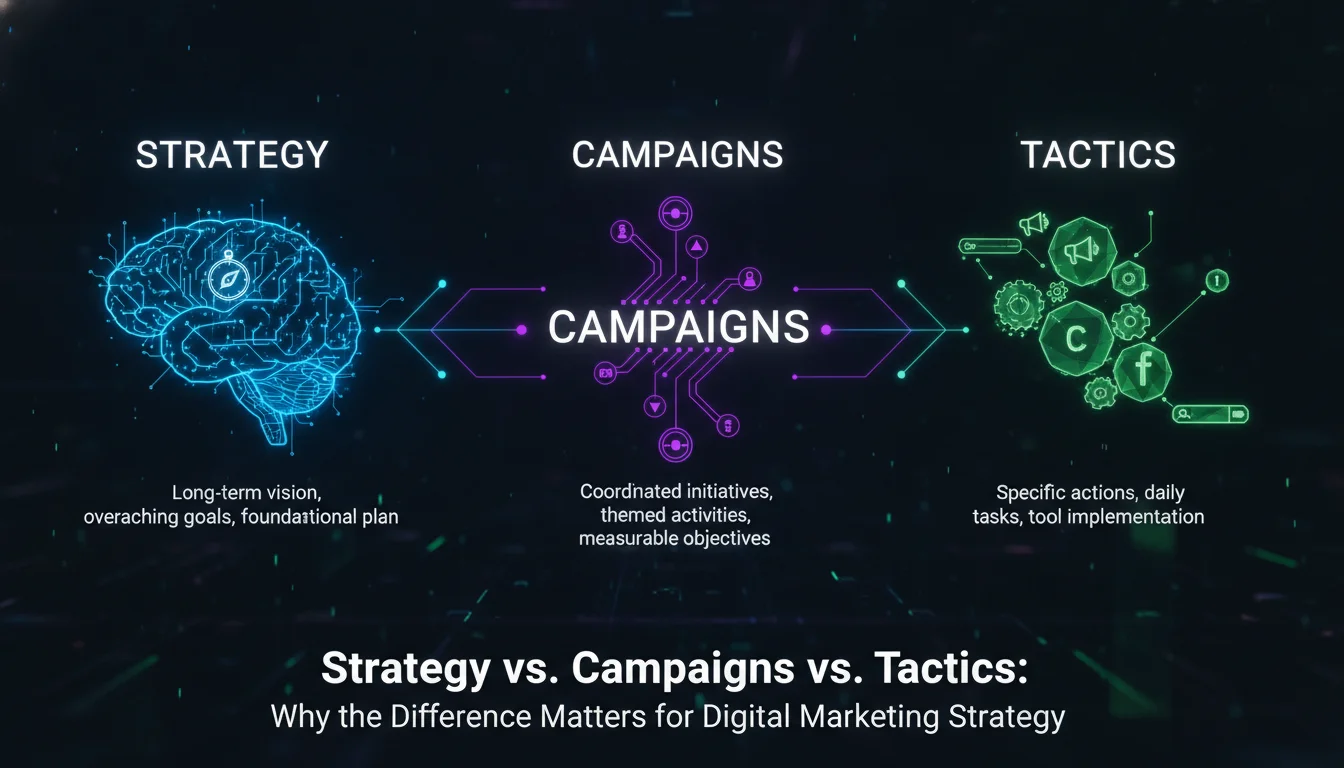
While many use these terms interchangeably, the distinction is vital for building something that actually performs. Adobe’s breakdown illustrates the differences clearly:
| Aspect | Marketing Strategy | Marketing Campaigns | Marketing Tactics |
|---|---|---|---|
| Definition | Long-term plan aligned with business goals | Targeted effort for a specific goal | Granular actions within campaigns |
| Scope | Broad and multi-channel | Focused on specific objectives | Narrow and task-specific |
| Timeframe | Long-term (months to years) | Medium-term (weeks to months) | Short-term or immediate |
Aligning these three layers prevents isolated efforts and ensures your entire operation works cohesively. A campaign to boost brand awareness might rely on tactical SEO improvements and influencer partnerships – all governed by the strategic goal of increasing organic traffic within a defined timeframe.
Without a Unifying Strategy, Budgets Leak
A business might pour money into Facebook ads without considering how they fit into a broader customer acquisition funnel. This leads to wasted spend and missed opportunities. The strategy is what connects the dots.
Brand Spotlight: Coca-Cola
Coca-Cola’s digital approach showcases this hierarchy in action. According to Adobe, their overarching goal is to increase brand engagement with a measurable benchmark. Campaigns featuring Gen Z creators are activated across Instagram and TikTok, while tactics like designing Reels and optimizing hashtags bring each campaign to life. Adobe notes that Coca-Cola dedicates $5M to influencer partnerships and digital ads, illustrating how strategy guides resource allocation at scale.
Types of Digital Marketing Strategies
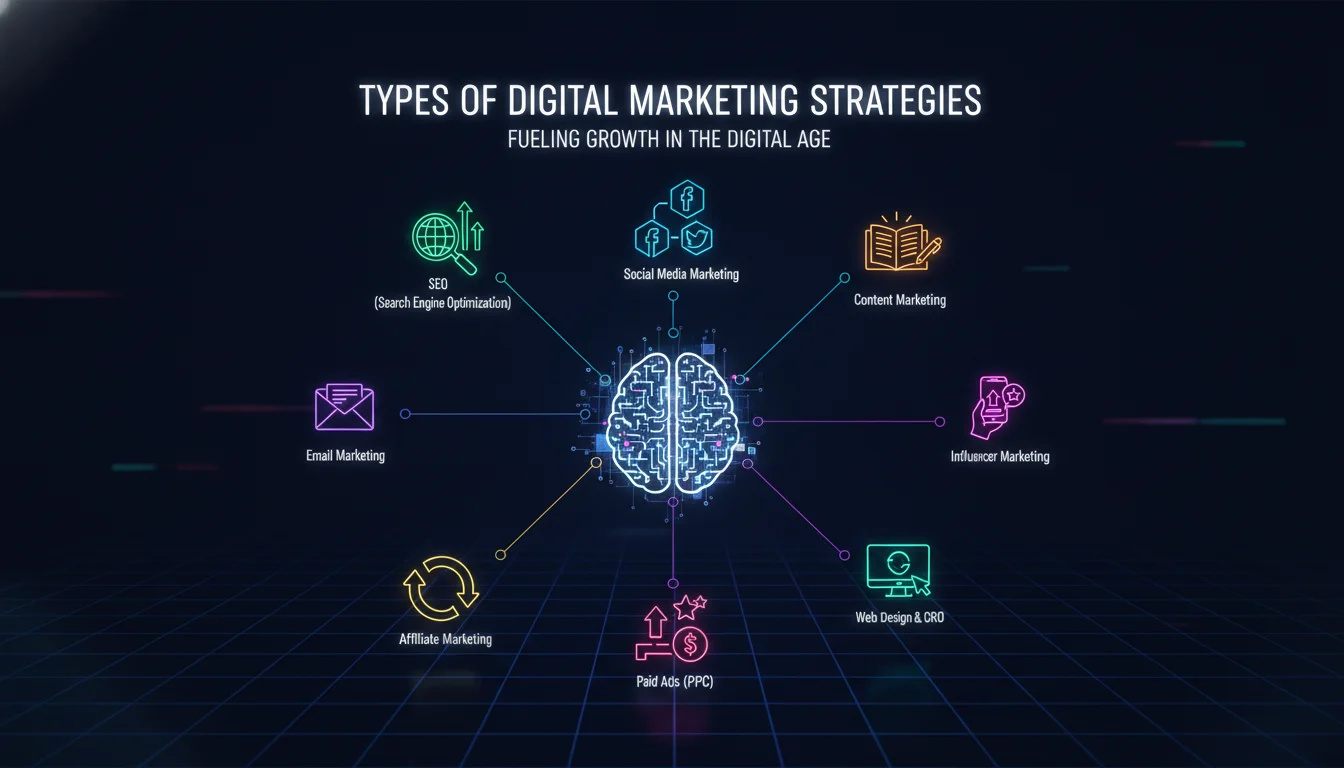
A comprehensive approach often combines several specialized methods. Here are the most impactful types, each serving distinct goals within the overall plan.
Search Engine Optimization (SEO)
SEO is a foundational method that improves your website’s visibility in organic search results. By researching keywords, optimizing on-page elements, and building authoritative backlinks, you attract qualified traffic that converts over time. As Flippingbook notes, SEO “generates leads that in turn convert to sales” by ensuring your site appears when prospects search for solutions.
Content Marketing
Content marketing uses blogs, videos, infographics, and case studies to educate and engage audiences. It supports the wider plan by driving awareness and nurturing leads through the funnel. Whether you’re a B2B SaaS company publishing whitepapers or an ecommerce brand using shoppable posts, consistent high-quality content establishes thought leadership and fuels other channels like SEO and social media.
Social Media Marketing
Social platforms are indispensable for building communities and amplifying brand messages. A plan that includes social media uses both organic and paid tactics to engage target demographics. Adobe’s example of Coca-Cola targeting Gen Z globally through social campaigns demonstrates how channel selection must align with audience insights, not assumptions.
Email Marketing
Email remains one of the highest-ROI channels, driving personalization and direct communication at scale. Within a robust plan, email nurtures leads, promotes content, and re-engages lapsed customers. Segmentation and automation let you deliver timely, relevant messages without proportional increases in effort.
Pay-Per-Click (PPC) Advertising
PPC, such as Google Ads or social media ads, provides immediate visibility and complements organic efforts. Use it for time-sensitive promotions, retargeting, or testing new markets while measuring cost-per-acquisition rigorously. Forbes Advisor notes that businesses should invest in high-impact areas first and adjust quarterly based on performance data.
Influencer Marketing
Influencer marketing has matured from a novelty into a core channel for brands targeting specific communities. Rather than broadcasting to a mass audience, you partner with creators whose followers already trust their recommendations. The Digital Marketing Institute highlights influencer partnerships as a key tactic within audience-first strategies, particularly for reaching demographics that tune out traditional advertising. The key is alignment: the creator’s voice must feel native to your brand, not like a paid interruption.
Affiliate Marketing
Affiliate marketing turns external publishers, bloggers, and content creators into a performance-based distribution network. You pay only when a desired action occurs, making it one of the most cost-controlled acquisition channels available. For ecommerce brands and SaaS companies especially, a well-managed affiliate program can generate consistent revenue without the overhead of a large paid media budget.
Core Components of a Successful Digital Marketing Strategy
A winning plan is built on four pillars: clear goals, deep audience understanding, smart budgeting, and measurable metrics.
SMART Goals and Objectives
Goals give your plan direction. They should be Specific, Measurable, Achievable, Relevant, and Time-bound. “Increase website traffic in 12 months” is more actionable than “get more visitors.” Harvard Business School Professor Sunil Gupta, who teaches the Digital Marketing Strategy course at HBS, advises that companies must “prioritize and balance multiple objectives” because resources are always finite.
Audience Research and Personas
Knowing who you’re marketing to is non-negotiable. Your plan must include detailed buyer personas that capture demographics, pain points, and preferred channels. The Digital Marketing Institute suggests using data to “speak your customer’s language” and “understand their pain points,” which then informs content creation and channel selection across every touchpoint.
Budget Allocation and Resource Planning
Even the best plan fails without adequate resources. Allocate budgets based on channel performance, competitive landscape, and potential ROI. Prioritize SEO and content for long-term growth, and PPC for quick wins. Adjust quarterly as performance data comes in.
KPI Selection and Tracking
Metrics turn your plan into a measurable system. Vanity metrics like raw page views matter far less than conversion rates, cost per lead, and customer lifetime value. Use tools like Google Analytics and CRM dashboards to monitor progress and iterate with confidence.
How to Build a Digital Marketing Strategy Step by Step
Creating a plan from scratch can feel overwhelming, but a structured process ensures nothing gets missed. Here’s a proven six-step framework.
Step 1: Audit Your Current Digital Presence
Before planning forward, look backward. Conduct a full audit of owned, paid, and earned media: your website, social profiles, email lists, and any existing content. The American Marketing Association advises evaluating each asset’s performance and mapping it to revenue. This reveals what’s working and where the gaps are.
Step 2: Define Your Target Audience and Buyers’ Journey
Use data analytics, surveys, and CRM insights to build detailed personas. Map out the customer journey: awareness, consideration, decision. Your plan should specify which channels and content types address each stage. SEO blogs capture top-of-funnel traffic, while case studies and free trials close deals.
Step 3: Set Measurable Goals and KPIs
Translate business objectives into specific digital goals. If you aim to grow revenue, break that down into lead generation targets, conversion rates, and average order value. Each goal needs a corresponding KPI your team can track weekly, not just quarterly.
Step 4: Choose Channels and Tactics
With goals and personas in hand, decide where to focus. A B2B plan might lean heavily on LinkedIn, SEO, and email. A B2C ecommerce brand might prioritize Instagram, TikTok, and Google Shopping. Always prioritize channels that align with audience behavior and have a track record of ROI in your category.
Step 5: Create a Content and Campaign Calendar
Outline monthly themes, content formats, and publishing schedules. Align campaigns with product launches, seasonal events, or industry trends. A clear calendar keeps your team aligned and ensures consistent execution across every channel.
Step 6: Implement, Measure, and Optimize
Launch campaigns, monitor real-time data, and iterate. No plan is static. Set regular check-ins, monthly at minimum, to review performance against goals and adjust budgets, messaging, or channels as needed. The brands that win are the ones that treat their strategy as a living document, not a PDF that collects dust.
Digital Marketing Strategy Frameworks and Templates
Frameworks simplify the creation process by providing ready-made structures. Here are two widely used models worth knowing.
The RACE Framework by Smart Insights
The RACE framework (Reach, Act, Convert, Engage) is a customer-centric planning tool that moves prospects through each stage of the funnel. At the Reach stage, you use SEO, social media, and display ads to drive traffic. Act involves optimizing user experience to encourage interactions like form fills. Convert focuses on closing sales via retargeting and personalized offers. Engage uses email and community management to retain customers post-purchase. This framework integrates well with data dashboards, making it a favorite among performance-driven marketers.
The SOSTAC® Model
SOSTAC (Situation, Objectives, Strategy, Tactics, Action, Control) is a classic planning methodology. You begin with a situation analysis (where are we now?), then set SMART objectives. Strategy defines how you’ll achieve them, tactics list the specific tools and channels, action plans the execution steps, and control measures success via KPIs. It’s a complete approach that ensures nothing is missed from planning through to measurement.
Choosing the Right Framework
Whether you adopt RACE, SOSTAC, or a custom hybrid, the key is alignment with your team’s capabilities and business goals. Many companies start with a simple template, then mature into a more tailored approach over time. The framework is scaffolding, not a cage.
“There are certain aspects of marketing that remain true no matter how technology changes. One of these aspects is the importance of developing a plan to effectively use your marketing resources.” – Professor Sunil Gupta, Harvard Business School
Mobile-First Digital Marketing
A modern digital marketing strategy that ignores mobile is already behind. Consumers now spend more time on mobile devices than desktops, and search engines rank mobile-friendly experiences higher in results. Mobile-first thinking means more than a responsive website. It means designing emails for small screens, creating vertical video content for Stories and Reels, optimizing page load speed for cellular connections, and building landing pages where a thumb can navigate without pinching. If your current plan doesn’t include a mobile audit, that’s the first gap to close.
The Role of AI in Digital Marketing Strategy
As of 2026, AI tools are embedded in most major digital platforms, and their influence on planning and execution is significant. Google Ads uses automated bidding to optimize toward your conversion goals in real time. Email platforms use predictive send-time optimization to improve open rates. Content tools assist with ideation, drafting, and SEO optimization at a pace no human team can match alone.
But AI amplifies strategy – it doesn’t replace it. The brands getting the most value from these tools are the ones with clear goals, defined audiences, and strong brand voices already in place. Feed a vague strategy into an AI tool and you’ll get vague output at scale. Feed it a sharp, well-researched plan and the results compound quickly.
“AI in digital marketing is most powerful when it operates within a clear strategic framework. Without that framework, automation just accelerates mediocrity.” – Digital Marketing Institute, 2025 research findings
Digital Marketing Strategy for Small Businesses
Small businesses don’t need to do everything. They need to do the right things with the resources they have. The most effective approach for a small business is to pick one or two channels where their audience is most active, build genuine expertise there, and expand only after seeing consistent results.
A local service business might start with Google Business Profile optimization and a simple email newsletter. A direct-to-consumer product brand might focus entirely on Instagram and a well-structured product page. The principles are identical to enterprise strategy: know your audience, set measurable goals, track what matters, and iterate. The scale is different. The discipline is the same.
For more on building brand presence from the ground up, explore our guide to brand identity development and our overview of Emin Media’s full-service digital marketing offerings.
Measuring and Optimizing Your Digital Marketing Strategy
No plan is complete without a system for measurement and refinement. Continuous improvement separates high-performing organizations from the rest.
Essential KPIs to Track
Focus on metrics that directly tie to revenue: conversion rate, cost per acquisition (CPA), customer lifetime value (CLV), and return on ad spend (ROAS). For upper-funnel activities, monitor organic traffic growth, bounce rate, and social engagement. The Digital Marketing Institute warns against “vanity metrics” like raw follower counts, which rarely correlate with business results.
Using Data to Refine Your Approach
Review performance data weekly for tactical adjustments and monthly for strategic shifts. If a content pillar isn’t driving leads, pivot to formats or topics with higher resonance. A/B testing landing pages, email subject lines, and ad creatives yields incremental gains that compound over time. Small wins, stacked consistently, produce significant results.
How Often Should You Update Your Strategy?
Review your plan quarterly and conduct a thorough update annually. That said, rapid market shifts, new platform features, or competitive moves may trigger more frequent adjustments. Build the habit of treating your strategy as a living document, not a one-time deliverable.
Frequently Asked Questions
What is a digital marketing strategy?
A digital marketing strategy is a long-term, high-level plan that uses online channels to achieve specific business goals. It defines audiences, messaging, and measurable objectives while guiding campaigns and tactics across every channel your brand uses.
What are the 5 main strategies of digital marketing?
The five core types are SEO, content marketing, social media marketing, email marketing, and pay-per-click advertising. A well-rounded plan often blends several of these based on audience behavior and business goals, with influencer and affiliate marketing increasingly common additions.
How do beginners start digital marketing?
Beginners should start by auditing their current online presence, defining their target audience, and setting one or two clear objectives. Focus on one channel, like SEO or social media, before expanding. Building a simple plan step-by-step is far more effective than trying to do everything at once.
What are examples of digital marketing strategies?
Coca-Cola’s influencer-driven social media campaigns targeting Gen Z are a well-documented example, as cited by Adobe. A B2B company using SEO and white papers to generate leads is another. Any structured plan that ties online activities to measurable business outcomes qualifies.
How is a digital marketing strategy different from a digital marketing plan?
The strategy is the overarching vision and direction, while the plan is a detailed roadmap with timelines, budgets, and specific tactics. The strategy answers “what and why.” The plan answers “how and when.”
How often should you update your digital marketing strategy?
Review it quarterly and update it thoroughly on an annual basis. Rapid market shifts, new technologies, or competitive moves may trigger more frequent adjustments. Treat it as a living document, not a static deliverable.
Ready to build something that actually moves the needle? Contact Emin Media for a free brand consultation and let’s build a digital marketing strategy that’s built for your business, not borrowed from a template.
Enjoyed this article?
Contact Emin Media for a free brand consultation and let's create something amazing together.
Get in TouchRelated Articles
Digital Storytelling for Brands: The Complete Guide
Digital storytelling for brands builds real audience connections through narrative. Learn proven techniques, formats, and…
Design Thinking for Marketing: A 2026 Guide
Design thinking for marketing builds campaigns around real user needs. Learn the 5 phases, common…

Creative Direction for Video Shoots: A Complete Guide
Master creative direction for video shoots with proven steps, tools, and strategies that build brand…