Digital Marketing Automation Tools: 2026 Buyer’s Guide
Digital marketing automation tools are software platforms that automate repetitive marketing tasks like email campaigns, social posting, and lead nurturing. The right tool blends workflow automation, analytics, and integrations to scale personalized customer experiences without burning out your team.
Key Takeaways
- Marketing automation saves time and improves ROI by automating repetitive work across email, social, ads, and more.
- The strongest tools offer drag-and-drop workflow builders, lead scoring, and multi-channel campaigns.
- No single platform fits every business. Choose based on your use case: email-first, CRM-integrated, or AI-powered workflows.
- Top contenders as of 2026 include HubSpot, ActiveCampaign, Zapier, and Brevo, each strong in a different lane.
- Successful rollouts depend on clear goals, clean data, and continuous testing, not just picking software.
What Are Digital Marketing Automation Tools?
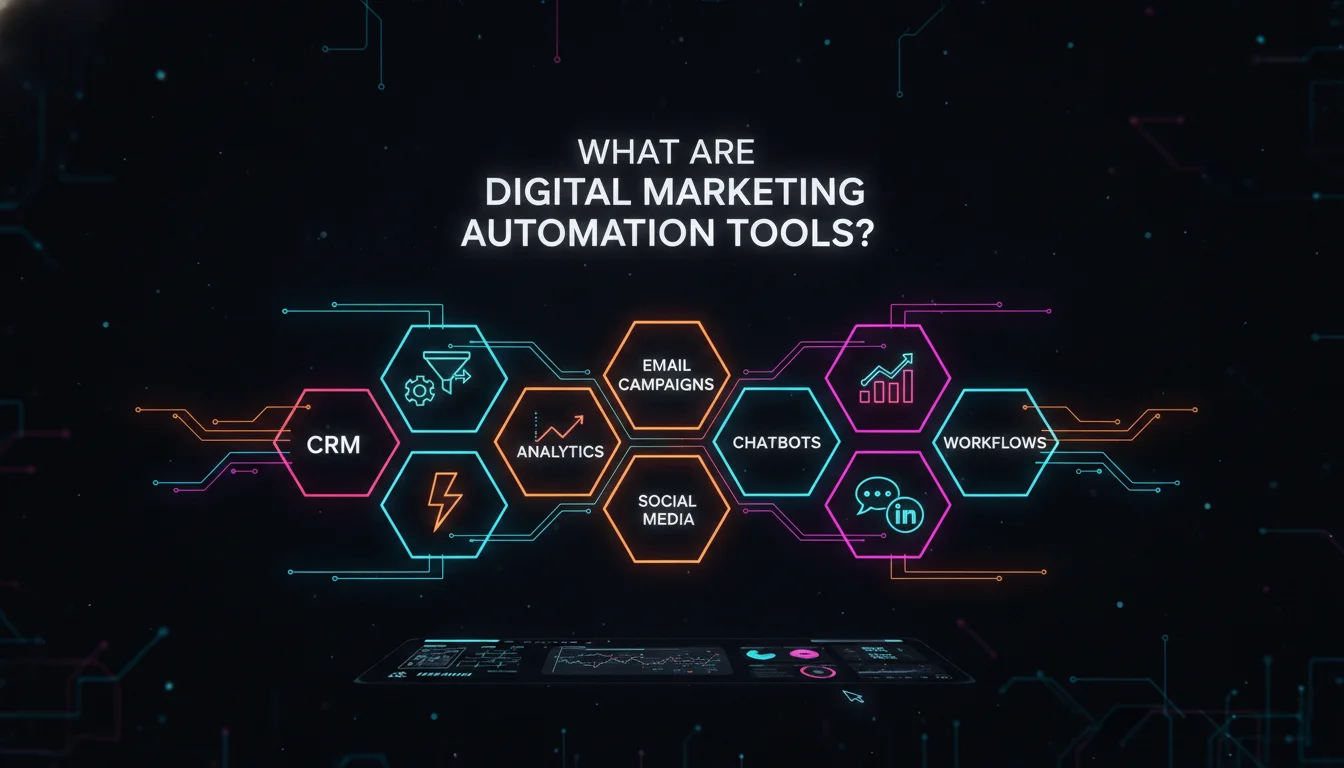
automation tools are software platforms that automate repetitive marketing tasks like email campaigns, social media posting, and lead nurturing so teams can focus on strategy instead of busywork. According to HubSpot, this kind of software lets businesses deliver personalized experiences at scale while saving time and improving ROI. What started as simple email autoresponders has grown into full platforms that orchestrate entire customer journeys across channels.
“If the marketing agency I work for didn’t automate some of our more tedious tasks, we’d waste a lot of time doing things that software could take off our hands.” – Dylan Reber, Zapier
The Core Components of Marketing Automation
Every serious platform in this space runs on three moving parts: a workflow builder that defines triggers and actions, a segmentation engine that groups contacts by behavior and demographics, and an analytics dashboard that tracks performance. ActiveCampaign is particularly good at visual automation maps, letting marketers design branching, multi-step sequences with zero code. Oracle reports that businesses implementing marketing automation see qualified lead growth of 451%, a figure HubSpot cites directly in its own product education content.
Why Automation Has Become Indispensable
The global marketing automation tools market was valued at $3.3 billion in 2019 and was projected to reach $6.4 billion by 2024, according to Markets and Markets data cited by Encharge. That growth tracks a bigger shift: manual marketing simply can’t keep pace with what customers expect now. When automation handles lead nurturing, a prospect who downloads an ebook gets a thank-you email, then a drip of educational content, with zero human intervention required.
Types of Digital Marketing Automation Tools
Not all this type of tools play the same game. Some specialize in one channel, like email or social scheduling, while others go all-in-one across email, SMS, ads, and CRM. Then there are connector platforms like Zapier, which link thousands of apps to pass data and trigger actions across your whole stack. Your best fit depends on scale and complexity: a small business might start with Brevo’s budget-friendly suite, while an enterprise team may need Marketo’s deeper attribution modeling.
Why Invest in Digital Marketing Automation Tools?
Investing in this kind of automation tools pays off by cutting manual effort while lifting campaign performance at the same time. When repetitive tasks get automated, teams get their creative and strategic hours back. These platforms also enforce consistency: every lead gets the same quality of follow-up, no matter when they show up in the funnel.
Operational Efficiency and Time Savings
The most immediate win is killing the manual grind. Instead of sending emails one by one or posting to social in real time, marketers build workflows that run themselves. HubSpot‘s automation can send thousands of personalized emails triggered by a contact’s behavior, something no human team could pull off by hand. Zapier’s own testing criteria note that the strongest tools automate at least two marketing mediums, like email and SMS, cutting down on tool-switching for the whole team.
Improved Lead Management and Personalization
Lead scoring is where digital marketing automation tools earn their keep: points get assigned based on engagement, like email opens and site visits, so sales knows exactly who to call first. ActiveCampaign stands out here with behavioral triggers that shift messaging automatically based on what a contact does. Sending a discount code the moment someone abandons a cart is the kind of personalization that reliably lifts conversions. Segmenting by purchase history, location, or interest ensures the right message lands with the right person at the right moment.
Data-Driven Decision Making
Every platform worth paying for comes with real analytics and reporting. Dashboards surface open rates, click-throughs, and revenue attribution so teams can keep sharpening their campaigns instead of guessing. Ortto has built its whole offering around marketing analytics as the center of gravity. Connect campaign data directly to your CRM and you can calculate true ROI instead of pitching marketing spend on faith.
“A marketing platform needs data analytics. If I stumbled upon an app that didn’t, it went straight to my ‘nope’ pile.” – Dylan Reber, Zapier
How to Choose the Right Marketing Automation Tools
Choosing the right marketing automation tools starts with mapping your use case, tech stack, and budget before you ever look at a demo. Follow these steps to narrow the field fast.
Step 1: Define Your Use Case and Channels
Start by listing exactly what you want automated. Is it mostly email, or do you need multi-channel coverage across SMS, social, and ads? Klaviyo is built for ecommerce email and SMS, while Brevo covers a wider net including live chat and CRM. Nailing your must-have channels immediately filters out tools that can’t deliver them.
Step 2: Evaluate Integration Requirements
Your automation tool needs to fit smoothly into your CRM, CMS, and other core software, or it becomes another silo. Platforms like HubSpot ship with a built-in CRM, which cuts down on external integration headaches. If you’re running a patchwork stack, a connector like Zapier can bridge the gaps, though it adds cost and another layer to manage. Check the native integration library first, and test the API docs if custom development is on the table.
Step 3: Assess Ease of Use and Support
A tool that demands weeks of training defeats its own purpose. Look for drag-and-drop builders, clear documentation, and support that actually responds. Gumloop and ActiveCampaign both get praised for intuitive interfaces. Sign up for a free trial and build one real automation before committing, and check reviews on G2 or Capterra for the unfiltered version of the story.
Step 4: Compare Pricing and Scalability
Pricing swings wildly across this category. Some tools offer free tiers, others charge per contact or seat, with enterprise plans stretching into the thousands monthly. Brevo starts at $9/month, making it approachable for small teams, while Marketo Engage is built for large enterprises with custom pricing. Project your contact growth and feature needs over the next 12 to 24 months so you don’t outgrow your tool in year one.
Top Digital Marketing Automation Tools Compared
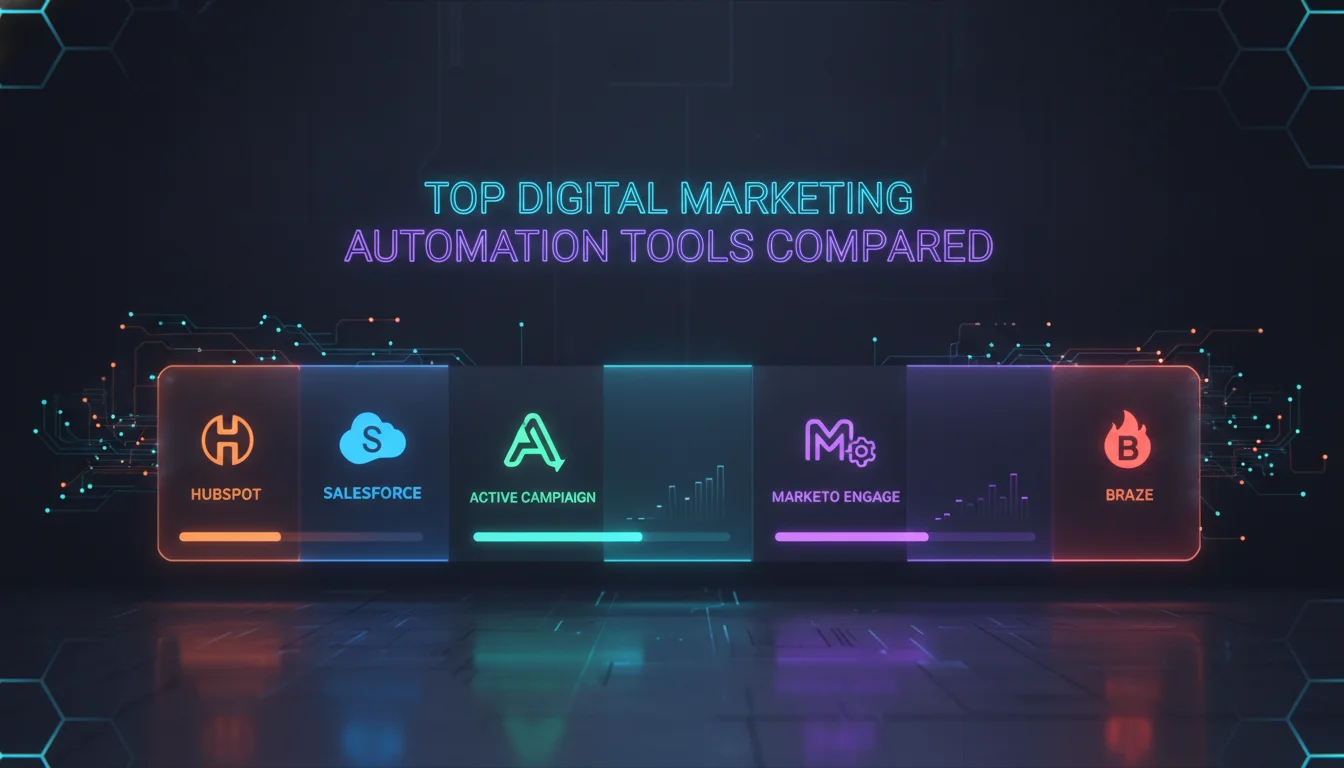
We compared six leading platforms on use case, pricing, and core features. Use this table to spot the right fit for your team quickly.
| Tool | Best For | Starting Price (per month) | Key Features | Integrations |
|---|---|---|---|---|
| HubSpot Marketing Hub | Premium all-in-one inbound marketing | $20 | CRM, email, social, ads, landing pages, analytics | 1,000+ native integrations |
| ActiveCampaign | AI-powered campaign building for SMBs | $15 | Visual automation map, behavioral triggers, CRM, lead scoring | 850+ integrations |
| Zapier | Connecting apps and automating workflows | $19.99 | 6,000+ app connections, multi-step Zaps, AI features | 6,000+ apps |
| Brevo (formerly Sendinblue) | Affordable all-in-one marketing suite | $9 | Email, SMS, chat, CRM, transactional emails | 150+ integrations |
| Gumloop | AI-powered automations without coding | $37 | Drag-and-drop flow builder, connects to any LLM, templates | Custom via API and LLMs |
| Klaviyo | User-friendly ecommerce email and SMS | $45 | Deep segmentation, predictive analytics, A/B testing | 300+ ecommerce integrations |
Zapier: The Connector for Building Safely with AI
Zapier isn’t a traditional marketing platform. It’s an automation layer that ties your entire stack together. You can build automated workflows (Zaps) that, say, add new leads from a Facebook ad straight into your CRM and trigger a welcome email. Per the Zapier blog, the platform now includes AI features that let you safely fold tools like ChatGPT into your sequences, which makes it a favorite for teams that want custom automation without a dev team on standby.
ActiveCampaign: AI-Powered Campaign Building
ActiveCampaign earns its spot by combining email marketing, CRM, and machine learning in one place. Predictive sending and win-probability scoring help marketers fine-tune campaigns without guesswork. The visual automation builder handles complex, branching logic about as well as anything on the market. At $15/month to start, it delivers a strong power-per-dollar ratio for small and mid-size teams.
Brevo: Affordable All-in-One Solution
Brevo bundles email, SMS, chat, and CRM into one platform starting at $9/month. It’s a natural fit for businesses that want multi-channel marketing without a big line item. It lacks some of the depth of competitors like HubSpot, but its simplicity and generous free tier make it a smart entry point for startups getting serious about digital marketing automation tools for the first time.
Implementation Best Practices
Successful automation rollouts depend on strategy and clean data, not just the software you buy. These practices help you avoid the most common pitfalls.
Start with a Clear Strategy and Goals
Decide what success actually looks like before you build a single workflow. Are you trying to lift lead conversion, cut churn, or boost engagement? Tie your automation work to specific KPIs from day one. If lead nurturing is the goal, map the content journey a prospect should get from first touch to sales-ready, because without a plan, automation just amplifies disorganized marketing into spammy, irrelevant noise.
Maintain Clean, Organized Customer Data
Automation is only as sharp as the data behind it. Deduplicate contacts, standardize field names, and clean your lists on a regular schedule. Tools with built-in CRMs, like ActiveCampaign or HubSpot, help keep that data honest. Bad data breaks personalization fast, picture an email greeting a contact by their company name because a field got mis-mapped. Run quarterly audits and this problem mostly disappears.
Test, Monitor, and Optimize Continuously
Run A/B tests on subject lines, content, and send times. Watch your dashboards for unsubscribe spikes and dips in performance. Klaviyo, for instance, builds A/B testing straight into its email flows. Treat automation as something you tune, not something you set and walk away from: track what’s working, kill what isn’t, and refine. Even the best digital marketing automation tools need a human checking in as customer behavior shifts.
Emerging Trends in Marketing Automation for 2026
Marketing automation is evolving fast as of 2026, driven by AI advances and shifting consumer expectations around privacy and personalization. Staying current on these shifts can be the difference between a stack that compounds and one that stagnates.
AI and Large Language Models Reshape Automation
AI isn’t a buzzword anymore, it’s baked into how these platforms work. Gumloop lets you connect any LLM, like ChatGPT or Claude, to your marketing tools for content generation, sentiment analysis, and predictive recommendations inside automated workflows. ActiveCampaign similarly uses machine learning to optimize send times and subject lines. The direction is clear: hyper-personalization at scale, and this trend will only accelerate as AI tooling gets cheaper and easier to plug in.
All-in-One Platforms vs. Best-of-Breed Stacks
There’s real tension between all-in-one suites like HubSpot and specialized tools stitched together with Zapier. All-in-one platforms simplify data flow and reduce complexity, while best-of-breed stacks let you pick the single best tool for each job. This year, more teams are landing on a hybrid: one core platform plus a handful of specialized apps, glued together with no-code automation. It’s the best of both worlds if you set it up with discipline.
Privacy and Compliance Take Center Stage
With regulations like GDPR in force and third-party cookies fading out, digital marketing automation tools are adapting fast. Platforms are building in consent management, data anonymization, and first-party data capture as standard features, not add-ons. Brevo, for example, ships GDPR-compliant features by default. Marketers now lean on zero-party and first-party data for personalization, and the platforms that make this easy without cutting corners on privacy will be the ones that win market share.
Social Media Automation as Its Own Category
Social scheduling and engagement automation have grown into a distinct category rather than a bolt-on feature. Many all-in-one suites now bundle social publishing, comment monitoring, and performance tracking alongside email and SMS workflows. If social is a major channel for your brand, weigh whether a dedicated social tool paired with a connector like Zapier beats a generalist platform’s built-in (often shallower) social features.
Pros and Cons
Pros
- Automates repetitive tasks across email, SMS, social, and ads, freeing teams for strategy and creative work
- Improves lead scoring and personalization, helping sales prioritize the right prospects
- Centralizes analytics so teams can prove ROI and optimize campaigns with real data
- Scales personalized outreach to volumes no manual process could match
Cons
- Poor data hygiene breaks personalization and can damage customer trust
- Learning curves and setup time can eat into the promised time savings early on
- Costs escalate quickly as contact lists and feature needs grow, especially with per-contact pricing
- Over-automating without strategy can produce generic, spammy-feeling communication
Ready to turn your marketing stack into an actual growth engine instead of a pile of half-used software? Contact Emin Media for a free brand consultation, and let’s build something bold together.
Frequently Asked Questions
What are digital marketing automation tools?
Digital marketing automation tools are software that automates repetitive marketing tasks like email campaigns, social media posting, and lead nurturing across multiple channels. They help businesses scale personalized marketing and improve ROI without adding headcount.
How much do marketing automation platforms cost?
Costs range from free limited plans to thousands per month for enterprise deployments. Entry-level plans start around $9 to $20 per month with tools like Brevo and HubSpot, while ActiveCampaign starts at $15/month and enterprise platforms like Marketo use custom pricing.
Which is the best marketing automation tool for small businesses?
For small businesses, Brevo and ActiveCampaign offer strong value at accessible price points. Brevo’s $9/month plan covers email and SMS, while ActiveCampaign’s $15/month plan adds advanced automation and a built-in CRM.
Can I use free digital marketing automation tools?
Yes, several tools offer free tiers with limits on contacts or features, and Mailchimp and Brevo both have free plans suitable for very small lists. For more advanced multi-channel automation, though, you’ll likely need to move to a paid plan eventually.
How do I choose the right marketing automation tool?
Define your use case across email, ads, or social, evaluate integration needs with your existing CRM, test ease of use through a free trial, and compare pricing as your list grows. Reading independent reviews and running a small pilot campaign before committing helps you avoid an expensive mismatch.
What’s the difference between CRM and marketing automation?
A CRM manages customer relationships and data, while marketing automation focuses on automating marketing tasks like email sends and lead scoring. Many modern platforms, like HubSpot and ActiveCampaign, combine both so data flows smoothly from lead capture to sales hand-off.
Enjoyed this article?
Contact Emin Media for a free brand consultation and let's create something amazing together.
Get in TouchRelated Articles

Digital Marketing for Creatives: A Bold Guide
Digital marketing for creatives builds real visibility and sales. Learn strategies for social media, SEO,…

Video SEO for Creative Agencies: The 2026 Playbook
Video SEO for creative agencies is how you turn portfolio reels into search traffic. Get…
Creative Brand Photography: The Complete Guide
Creative brand photography is your visual voice. Learn how to plan shoots, find the right…