Creative Branding Strategy 2026: Build Brands That Last
Creative branding strategy 2026 is the structured plan that turns a business objective into a creative idea audiences actually feel and act on. It bridges brand identity and consumer engagement across every platform, format, and cultural moment your audience inhabits.
Key Takeaways
- Creative branding strategy 2026 centers on emotional engagement and sensory experience, not just visual polish.
- Brands that align creative narratives with measurable objectives consistently outperform those that treat design as decoration.
- Adobe’s 2026 Creative Trends Report identifies four defining themes: All the Feels, Connectioneering, Surreal Silliness, and Local Flavor.
- Data analytics and creative intuition must work together: neither alone is enough.
- Collaboration between creative and marketing teams is the structural requirement for cohesive, high-performing branding.
- Adaptive brand systems, not rigid single identities, are the new standard for brands operating across multiple platforms and cultures.
Understanding Creative Branding Strategy
Creative branding strategy is the structured approach that transforms business objectives into compelling narratives that resonate with audiences. It serves as a bridge between brand identity and consumer engagement, ensuring that every creative output aligns with the overarching goals of the business.
What is a Creative Branding Strategy?
A creative branding strategy is a complete plan that outlines how a brand communicates its values, engages its audience, and differentiates itself from competitors. It encompasses visual identity, messaging, customer experience, and the human insight that makes all of it land. As the team at Storyflow describes it, creative strategy is not the creative idea itself. It is the constraint that narrows the space of acceptable work until the right idea is easy to recognize and the wrong idea is obvious to everyone in the room.
Think of it as a spine. Every strong creative branding strategy runs from a specific business objective at the base, up through a human insight, into a single organizing idea, and out to the expressions that reach people across channels. Pull any piece out and the whole body of work collapses into decoration that looks like marketing but moves nothing.
The Importance of Emotional Connection
Brands that succeed in 2026 are the ones that build genuine emotional connections with their audiences. According to a report by WGSN, nearly 50% of consumers say they are more likely to purchase from brands that make them feel joy. Adobe’s 2026 Creative Trends Report reinforces this: 70% of consumer decisions are driven by emotion, according to the Connectioneering trend data. This is not a soft metric. It is the engine behind purchase behavior.
The implication for brand builders is direct. Emotional resonance is not a finishing touch you add after the strategy is set. It is the strategy.
“Our lives are so screen focused that since the Covid shutdown people have had an insatiable desire to have all their senses engaged.” – Brenda Milis, Principal of Consumer and Creative Insights, Adobe
Framework for Developing a Creative Branding Strategy
To develop a successful creative branding strategy, brands should follow a structured framework that includes:
- Define Objectives: Clearly outline what the brand aims to achieve. Not “awareness” as a vague goal, but a specific business change you can measure after the work runs.
- Identify Target Audience: Understand the demographics, preferences, and behaviors of the audience. More importantly, find the tension they live with that your brand can resolve.
- Craft a Unique Value Proposition: Distinguish the brand from competitors by highlighting unique benefits and a clear point of view.
- Develop Messaging: Create consistent messaging that aligns with the brand’s identity across every channel and format.
- Measure Success: Establish metrics to evaluate the effectiveness of branding efforts, from reach and engagement to conversion and brand recall.
How Creative Branding Strategy Actually Works
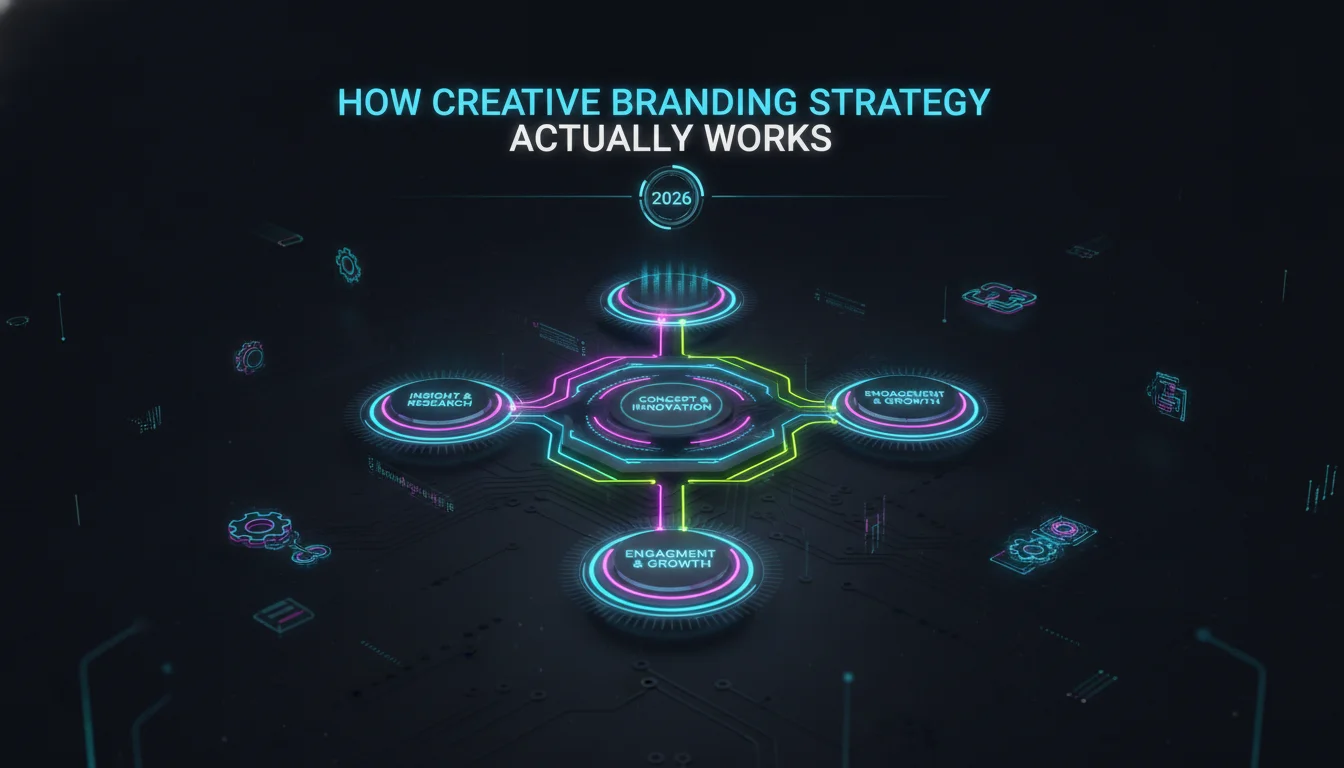
Creative branding strategy works by connecting a business objective to a human insight, then expressing that insight through a single organizing idea that every piece of creative can trace back to. Understanding the mechanics prevents the most common failure mode: starting with an execution and working backward, hoping a reason appears.
The Insight vs. The Fact
Most teams confuse facts with insights. A fact is “our buyers are busy.” An insight is the named tension that makes you feel something and that the work can actually resolve. The insight is what separates creative branding strategy 2026 from generic content production. It is the human truth that makes an audience stop scrolling and think: “That is exactly me.”
Finding a real insight requires primary research, customer interviews, social listening, and honest internal debate. It cannot be generated by a committee or a prompt. AI tools can fill a board with options, but the choosing stays a human judgment call. A model will hand you a confident, well-written, wrong insight with equal ease.
The Single Organizing Idea
Once the insight is locked, the creative team needs one organizing idea to build every film, ad, post, and page around. Not five ideas. One. This is the discipline that separates brands with coherent identities from brands that look different every quarter. Nike’s “Just Do It” is an organizing idea. Airbnb’s “Belong Anywhere” is an organizing idea. Both trace directly back to a human insight about their audience’s real emotional state.
Adaptive Brand Systems in 2026
As Elena Peneva writes in her LinkedIn analysis of branding in 2026, brands now exist everywhere simultaneously: across platforms, formats, cultures, interfaces, feeds, summaries, and AI-mediated discovery. Branding is no longer about broadcasting one coherent identity. It is the design of adaptive meaning, systems that hold together while being interpreted, fragmented, remixed, and regenerated by both machines and people.
This means your creative branding strategy 2026 must be built for flexibility without losing its spine. The visual identity, tone of voice, and core insight must remain consistent. The expressions of those elements must adapt to each platform’s native language.
Key Trends Shaping Creative Branding in 2026
As of 2026, four creative trends identified by Adobe’s Content team are defining the visual culture and marketing approach that high-performing brands are building around. These are not abstract forecasts. They are observable shifts in what audiences respond to right now.
1. All the Feels: Sensory Engagement
Brands are designing content that appeals to multiple senses simultaneously, not just sight. This trend, which Adobe calls “All the Feels,” encourages brands to create visuals with depth, texture, and sensory cues that the brain latches onto. Food and beverage brands are using ASMR techniques, hyper-textural imagery, and first-person POV shots that drop audiences directly into the scene. Glow Recipe’s social feed is a practical reference: a symphony of squeezes, taps, and pumps that lets you feel the product through the screen.
For AI-assisted creative work, this means writing prompts that go beyond describing how something looks. Include texture, temperature, sound, and movement. That is what takes an image from pretty to memorable.
2. Connectioneering: Engineering Relatability
Connectioneering is the practice of building emotional connections through instantly relatable content that reflects the real lives of your audience. Food rituals. Dating stories. New-parent exhaustion. Office humor. The goal is the head-nod moment: audiences see the content and think “Same” or “I know that feeling exactly.” B2B creators like Corporate Natalie have built entire branded campaigns on this principle, tapping into work culture humor that feels painfully accurate.
3. Surreal Silliness: Playful Creativity
Gen Z gravitates toward absurdity, preferring surreal over sensible. Nutter Butter’s TikTok channel, a psychedelic series of anthropomorphic cookies in scenarios that make no sense, earned Social Campaign of the Year at the 2025 Ad Age Creativity Awards. Not every brand should go fully unhinged. But if you are a lighthearted brand targeting younger audiences, the payoff for leaning into maximalist, chaotic creativity can be significant.
4. Local Flavor: Cultural Authenticity
In a world of deepfakes and digital exhaustion, audiences are craving what is real and what is local. Local Flavor as a creative trend encourages brands to incorporate genuine local culture, real people, and grounded stories into their branding. This is not about adding a regional hashtag. It is about building creative that could only come from a specific place, community, or cultural moment.
How to Apply Creative Branding Strategy 2026: Step-by-Step
Applying a creative branding strategy 2026 effectively requires moving through a clear sequence of steps, not jumping straight to execution. Here is how we approach it at Emin Media.
Step 1: Audit Your Current Brand Narrative
Before scaling anything, clarify your narrative foundation. Many brands attempt to optimize campaigns before their message has clarity. Amplification only spreads confusion faster. Audit your messaging alignment across web, social, and email. Check visual identity consistency. Review tone of voice across long-form and short-form content. Research from the Ehrenberg-Bass Institute, cited by C&I Studios, emphasizes that consistent brand assets and distinctive positioning significantly impact long-term brand growth.
Step 2: Define a Specific Business Objective
Not “awareness.” Awareness is a metric, not an objective. Write an objective you can test: “Get lapsed customers to reconsider us at their next renewal” or “Increase branded search volume among 25-34 year olds in Q3.” Every creative decision that follows must trace back to this statement.
Step 3: Find the Human Insight
Talk to real customers. Run social listening. Look for the tension they live with that your brand is positioned to resolve. An insight is not a fact about your audience. It is a fact that makes you feel something. This step takes longer than most teams budget for, and it is the most important one.
Step 4: Build One Organizing Idea
From the insight, develop a single creative idea that every piece of content can express differently. Write it in one sentence. If you cannot say it in one sentence, it is not sharp enough yet. This idea becomes the filter for every creative decision: does this execution express the idea, or does it just look nice?
Step 5: Align Creative With Layered Objectives
Structure your campaigns around layered goals. Awareness metrics include reach, impressions, and branded search growth. Engagement signals include watch time, click-through rates, and interaction depth. Conversion markers include lead submissions, purchases, and demo requests. According to HubSpot’s State of Marketing report, video-driven campaigns consistently generate stronger engagement and conversion metrics compared to static formats. Build your production plan around that reality.
Step 6: Measure, Learn, and Adapt
Set your measurement framework before the campaign launches, not after. Track the metrics that connect to your specific objective. Review performance data at regular intervals and use what you learn to sharpen the next creative cycle. Data analytics does not replace creative judgment. It informs it.
Comparison: Creative Branding Approaches in 2026
Choosing the right creative branding approach depends on your audience, objectives, and brand personality. This table compares the four dominant approaches shaping creative branding strategy 2026.
| Approach | Core Mechanic | Best For | Primary Risk | 2026 Trend Alignment |
|---|---|---|---|---|
| Sensory-Led Creative | Multi-sense engagement through texture, sound, and movement | Food, beauty, travel, lifestyle brands | Overproduction that feels artificial | All the Feels |
| Relatable Storytelling | Content that mirrors audience’s lived experience | B2B, consumer brands, community-driven products | Becoming too niche or too broad | Connectioneering |
| Playful Absurdism | Surreal, maximalist, humor-driven content | Gen Z-facing brands, entertainment, snack/food | Alienating older or premium audiences | Surreal Silliness |
| Local Authenticity | Grounded in specific culture, place, or community | Regional brands, global brands seeking local trust | Tokenism or superficial localization | Local Flavor |
Worked Example: Applying the Framework to a Real Scenario
A creative branding strategy 2026 framework becomes clearest when you walk it through a realistic scenario. Here is how we would apply it for a mid-sized specialty coffee brand entering a competitive urban market.
The Scenario
A specialty coffee brand with strong product quality but low brand recognition wants to grow its direct-to-consumer subscription base among urban professionals aged 28-40. They have a modest production budget and a small in-house team.
Step 1: Narrative Audit
The audit reveals inconsistent tone across channels: the website sounds premium and distant, the Instagram is casual and warm, and the email sequences read like a logistics company. The visual identity is consistent in color but inconsistent in photography style. The first job is alignment, not amplification.
Step 2: Objective
Increase subscription trial sign-ups among urban professionals by driving branded search and social referral traffic over a 90-day campaign window.
Step 3: The Insight
Customer interviews reveal a recurring tension: urban professionals love the ritual of great coffee but feel guilty about the time it takes. They want permission to slow down without feeling unproductive. That tension is the insight.
Step 4: The Organizing Idea
“The most productive five minutes of your day.” Every piece of creative expresses this idea differently: a 15-second video of someone watching steam rise from a cup before a big meeting, a social post about the one moment that belongs entirely to you, an email subject line that reads “You’ve earned this.”
Step 5: Execution Across Trends
The sensory-led approach (All the Feels) drives the video content: close-up shots of pouring, steam, and texture. The relatable storytelling approach (Connectioneering) drives the social copy: real moments, real people, no stock-photo energy. Local Flavor grounds the campaign in specific city neighborhoods and coffee culture references that feel earned, not generic.
The Result
This is a realistic scenario, not a fabricated case study with invented numbers. The point is structural: when every creative decision traces back to one insight and one organizing idea, the work feels coherent across every touchpoint. That coherence is what builds brand memory over time.
Common Mistakes to Watch Out For
Even experienced teams make predictable errors when building a creative branding strategy 2026. Knowing these patterns in advance is the fastest way to avoid them.
Mistake 1: Starting With Execution
“Let’s do a TikTok series” is not a strategy. It is a channel preference. Most weak creative starts with an execution and works backward, hoping a reason appears. The Spine framework forces the opposite order: objective first, insight second, idea third, execution last.
Mistake 2: Scaling Before Clarifying
Many brands attempt to optimize campaigns before their narrative foundation is clear. If the message lacks clarity, amplification only spreads confusion faster and at greater cost. Audit before you scale.
Mistake 3: Treating Insight as a Fact
“Our buyers are busy” is a fact. It describes a condition. An insight names the tension that the work can resolve and makes you feel something when you read it. Teams that skip this distinction produce technically correct creative that moves nobody.
Mistake 4: Chasing Every Trend
Not every brand should attempt Surreal Silliness. Not every brand should go hyper-local. Trend adoption without strategic fit produces content that feels forced and erodes brand trust. Apply trends selectively, only where they genuinely express your organizing idea.
Mistake 5: Siloing Creative and Marketing Teams
When creative teams build without performance context and marketing teams optimize without creative input, the result is neither artistically compelling nor commercially effective. Collaboration between these teams is not a nice-to-have. It is the structural requirement for creative branding strategy 2026 to function at all.
Mistake 6: Measuring the Wrong Things
Vanity metrics feel good and prove nothing. If your objective is subscription trial sign-ups, measuring follower growth tells you almost nothing useful. Set your measurement framework against your specific objective before the campaign launches, and resist the temptation to swap metrics mid-flight when early numbers look uncomfortable.
“Creative without objectives becomes decoration. Objectives without creative become noise. Strategy exists at the intersection.” – C&I Studios, How to Improve Your Brand Creative Marketing Strategy in 2026
Pros and Cons of a Structured Creative Branding Strategy
Pros
- Clarity across teams: A defined organizing idea gives every team member, from copywriters to media buyers, a shared filter for creative decisions.
- Stronger emotional resonance: Insight-driven creative connects with audiences on a level that execution-first work rarely reaches.
- Measurable performance: Aligning creative with specific objectives makes it possible to evaluate what is working and improve it systematically.
- Brand consistency over time: A strong spine keeps the brand recognizable across campaigns, channels, and years, building the memory structures that drive long-term growth.
- Adaptability: A clear organizing idea can be expressed differently across platforms without losing coherence, which is essential for creative branding strategy 2026’s multi-platform reality.
Cons
- Time investment upfront: Finding a genuine human insight requires research, interviews, and debate. Teams under deadline pressure often skip this step, which undermines everything that follows.
- Requires cross-functional buy-in: A creative branding strategy only works if leadership, marketing, and creative teams are aligned. Organizational silos can kill even the sharpest strategy.
- Risk of over-constraint: A single organizing idea can feel limiting to creative teams used to more freedom. Managing this tension requires strong creative leadership.
- Measurement complexity: Layered objectives across awareness, engagement, and conversion require sophisticated tracking setups that smaller teams may not have in place.
Case Studies: Successful Creative Branding Strategies
Examining real brand examples provides the clearest picture of how creative branding strategy 2026 principles operate in practice.
Coca-Cola
Coca-Cola has consistently built emotional branding around a single organizing idea: joy. Their campaigns evoke nostalgia and happiness, reinforcing their brand identity as a source of positive feeling across generations and cultures. The consistency of that idea across wildly different executions is what makes the brand instantly recognizable anywhere in the world.
Nike
Nike’s creative branding strategy centers on empowerment and the belief that athletic identity belongs to everyone, not just elite athletes. Their campaigns feature relatable stories of ordinary people pursuing extraordinary goals. The organizing idea, “Just Do It,” is simple enough to apply to any execution and sharp enough to filter out anything that does not belong.
Airbnb
Airbnb emphasizes local authenticity by showcasing unique accommodations and genuine experiences in specific destinations. This approach directly aligns with the Local Flavor trend defining creative branding strategy 2026. It builds a sense of community and belonging that a hotel chain cannot replicate, because the insight behind it is real: people want to feel like they live somewhere, not just visit it.
Nutter Butter on TikTok
Nutter Butter’s TikTok channel earned Social Campaign of the Year at the 2025 Ad Age Creativity Awards by leaning fully into Surreal Silliness. A psychedelic series of anthropomorphic cookies in scenarios that defy logic captured Gen Z’s attention precisely because it committed completely to its absurdist organizing idea. The lesson: half-hearted playfulness reads as awkward. Full commitment reads as a brand with a genuine personality.
Challenges in Creative Branding Strategy
Building a creative branding strategy 2026 is not without friction. Understanding the real challenges helps teams prepare for them rather than be surprised by them mid-campaign.
1. Fragmented Attention
Consumer attention is distributed across more platforms, formats, and content types than at any previous point. Brands must find ways to capture and hold attention without relying on volume alone. The answer is not more content. It is sharper, more resonant content that earns attention rather than demanding it.
2. Evolving Consumer Expectations
Consumer expectations shift continuously, driven by technological change and cultural acceleration. Brands must stay responsive without abandoning their core identity. The brands that manage this best are the ones with the clearest organizing ideas: they can adapt their expressions while keeping their spine intact.
3. Balancing Creativity With Consistency
Creativity without consistency produces novelty that does not compound. Consistency without creativity produces recognition without engagement. The right balance is a clear brand spine expressed through continuously fresh executions. This is harder than it sounds and requires ongoing creative leadership, not a one-time strategy document.
4. AI Integration Without Losing Brand Voice
As of 2026, AI tools are embedded in most creative workflows. The risk is not that AI produces bad work. The risk is that AI produces competent, generic work that sounds like every other brand using the same tools. The human judgment call, especially at the insight and organizing idea stages, is what keeps creative branding strategy 2026 distinctive rather than averaged.
The Near-Term Outlook: Creative Branding Beyond 2026
The trajectory of creative branding strategy 2026 points toward several developments that brand builders should be preparing for now. Brands will increasingly operate as adaptive meaning systems rather than fixed identities, designed to hold together while being interpreted by both human audiences and AI-mediated discovery platforms. The brands that invest in a clear spine today will be the ones whose identity survives translation across whatever new surfaces emerge next.
Sustainability and purpose-driven positioning are moving from differentiators to baseline expectations. Brands that acknowledge and address environmental and social concerns will connect more deeply with audiences who treat those values as non-negotiable. Predictive analytics and data science are also reshaping how brands approach market timing, enabling creative decisions that anticipate consumer needs rather than just responding to them.
The creative teams that will lead in this environment are the ones building systems, not just campaigns. Systems that connect insight to execution, performance data to creative iteration, and brand identity to measurable business outcomes.
Frequently Asked Questions
What is a creative branding strategy?
A creative branding strategy is a structured plan that transforms a business objective into a creative idea an audience actually feels and acts on. It encompasses visual identity, messaging, human insight, and a single organizing idea that every piece of creative can trace back to. The strategy is the constraint, not the concept: its job is to narrow the space of acceptable work until the right idea is obvious.
What are the best branding trends for 2026?
According to Adobe’s 2026 Creative Trends Report, the four defining trends are All the Feels (sensory engagement), Connectioneering (relatable emotional content), Surreal Silliness (playful absurdism), and Local Flavor (cultural authenticity). Brands should apply these selectively based on their audience and organizing idea, not chase all four simultaneously.
What are the creative trends for 2026?
Creative trends for 2026 center on human, tactile, and emotionally grounded content as a response to AI saturation and digital exhaustion. Audiences want content that feels real: real textures, real people, real stories, and real local culture. The four Adobe-identified trends capture this shift across sensory, relational, playful, and cultural dimensions.
How can brands measure the success of their branding strategy?
Brands should measure success through layered metrics tied to specific objectives: awareness metrics like reach, impressions, and branded search growth; engagement signals like watch time and click-through rates; and conversion markers like lead submissions and purchases. The key is setting the measurement framework before the campaign launches, not after, and tracking metrics that connect directly to the stated objective.
Why is collaboration important in branding?
Collaboration between creative and marketing teams ensures that every branding effort is both artistically compelling and commercially effective. When these teams work in silos, creative work loses performance context and marketing work loses emotional resonance. Integrated collaboration is the structural requirement for creative branding strategy 2026 to function at its full potential.
How can data analytics improve branding strategies?
Data analytics helps brands understand consumer behavior, identify what content resonates, and make informed decisions about where to invest creative resources. It does not replace creative judgment: it informs it. The most effective approach combines data-driven insight about audience behavior with human judgment about the emotional truth that will move that audience to act.
Enjoyed this article?
Contact Emin Media for a free brand consultation and let's create something amazing together.
Get in TouchRelated Articles
Digital Marketing for Creatives: A Bold Guide
Digital marketing for creatives builds real visibility and sales. Learn strategies for social media, SEO,…
Branding & Design Agency Tips That Actually Work
Discover branding and design agency tips to choose the right partner, set clear goals, and…
Creative Agency Pitch Deck Tips That Win Clients
Master creative agency pitch deck tips that win clients in 2026. Learn storytelling, design, and…