Content Marketing for Brands 2026: The Trust Playbook
Content marketing for brands 2026 is the shift from producing more assets to earning trust, surfacing in AI answer engines, and orchestrating multi-channel experiences that answer real buyer questions before competitors do.
Key Takeaways
- Trust and credibility now outweigh content volume. Brands that answer real buyer questions consistently win attention.
- Zero-click content and Generative Engine Optimization (GEO) are now as important as traditional SEO.
- AI-powered personalization works only when it preserves human authenticity and expert validation.
- The Big 5 buyer questions (cost, problems, comparisons, reviews, and best) must anchor every content plan.
- Video-first, multi-channel distribution and content repurposing turn single assets into full-funnel experiences.
- Measurement must connect content directly to revenue impact, not just traffic.
This article synthesizes the most cited strategic frameworks from the Content Marketing Institute, IO Digital, IMPACT, M&R Marketing, and Jobaaj Learnings into one operating model for leaders who need measurable results.
The Strategic Reset Behind Content Marketing for Brands 2026
Why 2026 Is a Turning Point, Not Another Trend Cycle
Content marketing for brands 2026 is not a content production race. It is a trust-building system that must work across search engines, AI assistants, social feeds, and direct buyer conversations. If 2024 and 2025 were years of experimentation with generative AI, 2026 is the year of integration and accountability. According to the Content Marketing Institute, 42 experts contributed to its 2026 trends research, and the dominant themes were not about publishing more frequently or chasing a single new platform. They were about AI integration and optimization, making human connections, adopting a video-first strategy, treating data as a decision layer, exploring new search and rediscovery, and owning media to understand the audience.
Those themes share a common thread: the unit of competitive advantage has moved from content volume to content credibility. The brands winning right now are not the ones publishing the most. They are the ones being cited the most.
“In 2026, visibility of content will no longer be enough. As AI transforms how content is made, discovered, and consumed, B2B companies that earn trust and inspire belief will be the best answer brands that lead.”
– Lee Odden, via the Content Marketing Institute
From Content Volume to Best Answer Brand Strategy
A best answer brand is the organization that customers, influencers, media, platform algorithms, and large language models repeatedly select as the day-one shortlist choice in its category. Lee Odden describes the path as creating “irrefutable brand credibility with multi-channel content experiences that are data-informed, validated by experts, and available everywhere buyers are looking.” That definition changes the content mandate entirely: instead of producing assets for every channel, brands must produce consensus.
Building consensus means aligning customer evidence, influencer commentary, media coverage, and technical signals so that both human buyers and AI systems see the same credible pattern. This is a multi-channel experience strategy, not an editorial calendar strategy. It requires content teams to plan for full-funnel visibility, from first question to final comparison.
The Four Fundamentals That Never Change
According to IO Digital’s Patrick Severein, four fundamentals will remain crucial in content marketing for brands 2026: strategy, authenticity, human emotion, and quality. These are not trends. They are operating principles. Strategy is the discipline of aligning content with business outcomes rather than reacting to every new feature. Authenticity is the refusal to let AI sameness erode brand character. Human emotion is the connective tissue that makes content memorable. Quality is the baseline that prevents zero-click snippets from becoming zero-credibility snippets.
Trend lists can obscure the fact that fundamentals are what make trends work. A brand can adopt zero-click content and GEO, but if the underlying strategy, authenticity, emotion, and quality are missing, the result is just more noise in an AI-saturated feed.
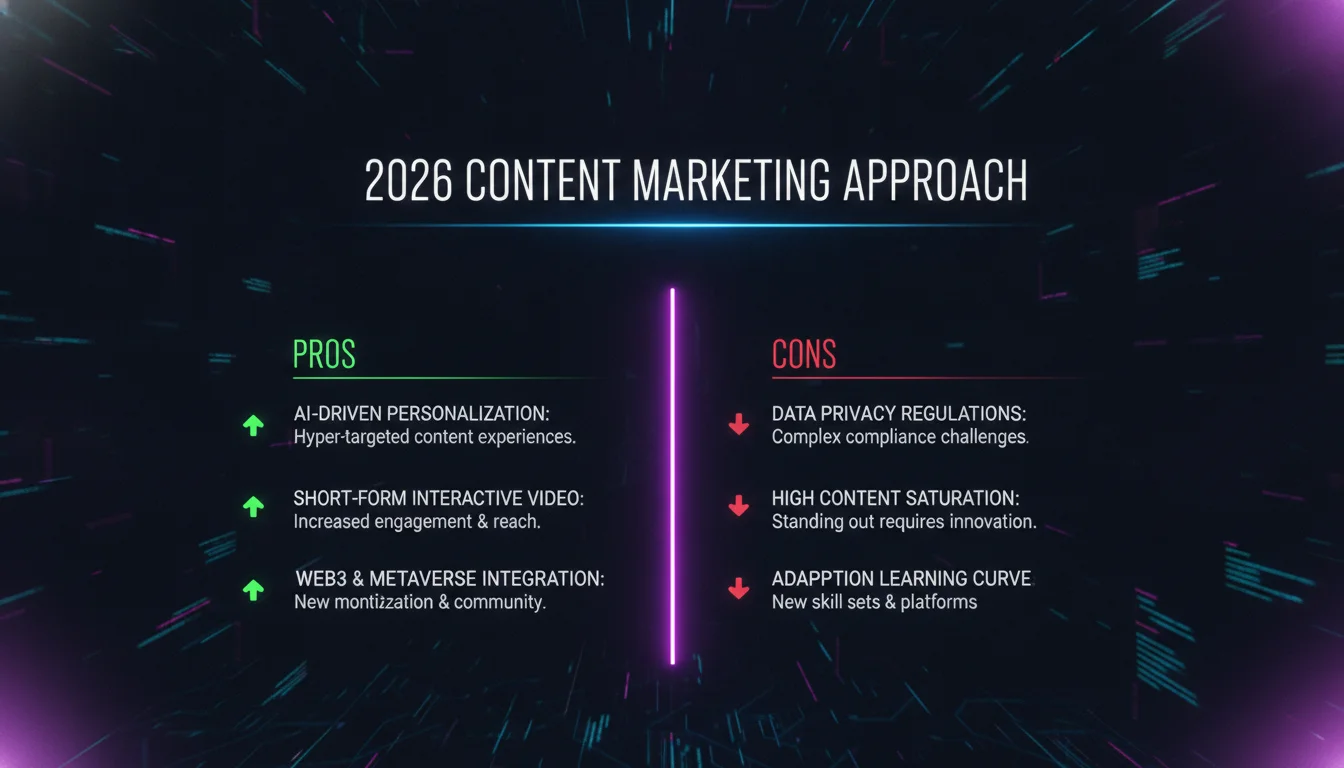
Pros and Cons of the 2026 Content Marketing Approach
Pros
- Trust compounds over time. Brands that consistently answer real buyer questions build authority that paid ads cannot replicate quickly.
- AI tools reduce production costs. Repurposing and personalization at scale are now accessible to teams of any size, not just enterprise budgets.
- Multi-channel distribution extends reach. A single expert interview can become a video clip, a blog post, a social asset, and an FAQ answer simultaneously.
- Revenue-connected measurement justifies investment. Tying content to pipeline influence makes the case for in-house production and expert resources far easier.
- GEO and AEO open new discovery surfaces. Brands optimized for AI answer engines get cited even when users never click through to the site.
Cons
- Trust takes time to build. Brands expecting immediate traffic spikes from a trust-first approach will be disappointed. The payoff is long-cycle.
- AI efficiency can erode authenticity. Over-relying on AI-generated content risks producing work that sounds like everyone else, which is the opposite of differentiation.
- GEO optimization requires structural discipline. Rewriting existing content libraries to satisfy AI answer engines is a significant editorial lift, especially for large sites.
- Revenue attribution is still messy. Connecting a blog post to a closed deal requires CRM access and cross-team alignment that many organizations have not built yet.
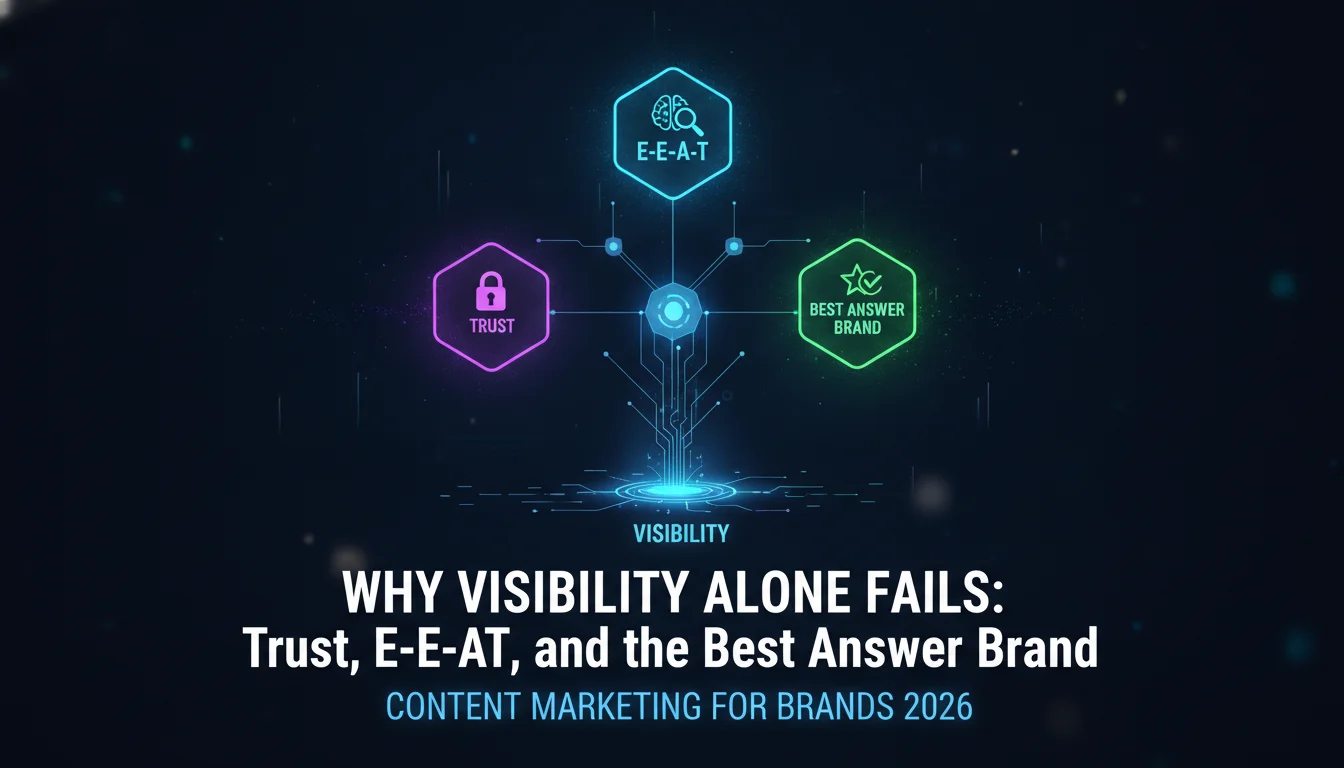
Why Visibility Alone Fails: Trust, E-E-A-T, and the Best Answer Brand
E-E-A-T as the New Ranking Signal for Humans and Machines
E-E-A-T is Google’s framework for evaluating experience, expertise, authoritativeness, and trustworthiness. As of 2026, content marketing for brands 2026 will continue to favor these signals even more than in previous years, according to M&R Marketing. This is not an isolated prediction. It aligns with the CMI expert consensus that trust is the new differentiator.
For content teams, E-E-A-T means that bylines, expert review, first-hand experience, and verifiable sources are no longer optional. They are the technical and editorial signals that help both Google and AI answer engines decide which brand deserves to be cited. A piece of content that answers a question correctly but lacks demonstrable experience or authoritative sourcing will struggle to rank, regardless of keyword density.
The Credibility Gap AI Cannot Fill
AI can help produce content, but it cannot by itself create the trust that makes content work long-term. As Susanna Hayrapetyan noted in the CMI expert discussion, “trust is becoming the real differentiator because credibility is what makes content work long-term.” The credibility gap emerges when brands treat AI as a replacement for subject matter expertise. They publish plausible-sounding content that lacks the nuance, data, or customer proof a skeptical buyer needs.
Closing that gap requires expert validation at every stage: internal specialists, external contributors, customer evidence, and media citations. This is why the CMI research emphasizes content that is validated by experts. It is also why the best answer brand concept is not about shouting louder. It is about being consistently accurate, transparent, and useful enough that algorithms and audiences return.
Building Consensus Across Customers, Influencers, Media, and LLMs
Lee Odden frames the 2026 mandate as creating consensus amongst customers, influencers, media, and algorithms plus LLMs. Consensus is the state in which all these independent sources converge on the same conclusion: this brand is the safe, credible choice. It is not a single viral moment. It is a sustained pattern of evidence across channels.
To build that pattern, content marketers should coordinate owned media, earned media, customer stories, and structured data. Each element reinforces the others. A customer review on a third-party site is more powerful when it aligns with a detailed comparison guide on the brand’s own site. An expert quote in a trade publication is more powerful when the same expert appears in the brand’s video series. This is multi-channel storytelling with a trust objective.
| Framework / Source | Core Focus | Signature Tactic | Primary Success Signal |
|---|---|---|---|
| CMI 42 Experts | Trust and best answer brands | Multi-channel, expert-validated content | Brand chosen as day-one shortlist |
| IO Digital 8 Trends | Zero-click, GEO, and hero content | Storytelling and repurposing at scale | Authority and visibility in AI and social |
| IMPACT Endless Customers | The Big 5 buyer questions | Radical transparency and in-house production | Content turned into pipeline |
| M&R Marketing | Human-centered integrated strategy | SEO, GEO, AEO alignment | Differentiated customer experience |
| Jobaaj Learnings | Goal-first tactical roadmap | SMART goals tied to business objectives | Measurable goal attainment |
These frameworks do not disagree on the destination. They disagree on emphasis. The unifying insight is that content must be trusted, findable, and revenue-connected at the same time.
Zero-Click Content and the Rise of Generative Engine Optimization
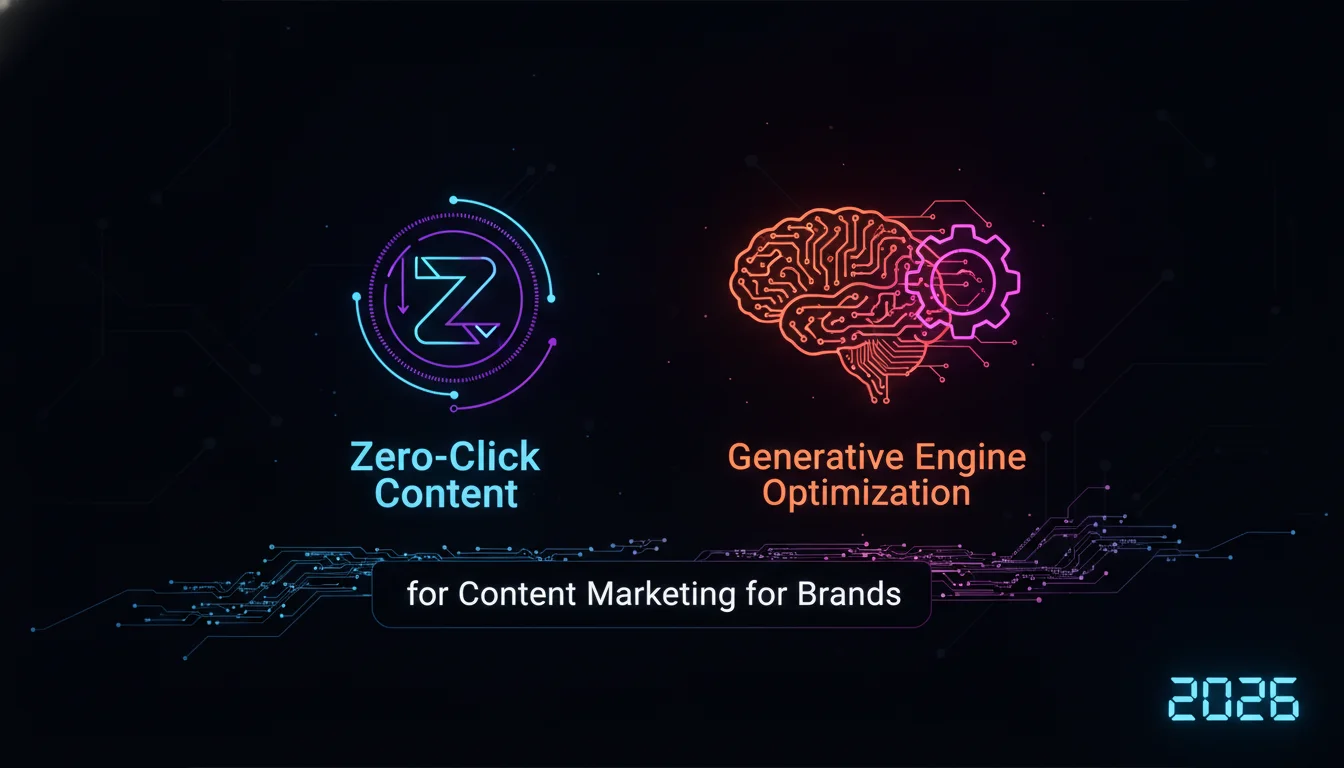
What Zero-Click Content Actually Means for Brands
Zero-click content delivers value without requiring a click-through. According to IO Digital, consumers now want instant answers via AI chatbots, Google, or social platforms, and they expect the story, entertainment, or solution to be immediately visible. That does not mean websites become irrelevant. It means content must be structured so that the most important answer appears in the snippet, panel, or feed itself.
For brands executing content marketing for brands 2026, zero-click content changes the success metric. A piece that earns a featured snippet or becomes the source for an AI response may generate less direct traffic but more brand reinforcement. The goal shifts from click volume to citation volume. If a brand is cited by the answer engine, it is winning the zero-click moment even when the user never visits the site.
GEO Is the New SEO Standard
Generative Engine Optimization is the practice of structuring content so AI answer engines can parse, cite, and recommend it. IO Digital argues that making content SEO-proof is no longer enough and that GEO is king even for content. Today’s audiences search via social platforms and AI chatbots as well as traditional search engines, so content must be optimized for all three discovery surfaces.
M&R Marketing adds a related term: AEO, or Answer Engine Optimization. Their 2026 guidance is that content needs to satisfy SEO, GEO, and AEO simultaneously. Structure is not a nice-to-have. It is a visibility requirement. Clear headings, concise first paragraphs, definitional statements, and source attributions all help machines extract the answer.
A Practical Framework for Answer Engine Optimization
The following principles synthesize the GEO and AEO guidance from IO Digital and M&R Marketing. First, write the direct answer in the first paragraph, under 45 words, as a standalone response to the search intent. Second, use semantic HTML with clear H2 and H3 hierarchy so crawlers and AI models understand the relationship between sections. Third, include named entities, expert sources, and real-world examples to increase citation probability.
Fourth, create definitional statements that explain concepts in a format AI engines can lift. Fifth, place a comparison table or step-by-step process near the top so the content qualifies for featured snippets. These are not secret hacks. They are the structural signals that answer engines reward consistently.
AI-Powered Personalization Without Losing the Human Signal
Hyper-Personalization at Scale Is Finally Feasible
Personalization is the practice of tailoring content to a specific audience segment at a specific point in the customer journey. According to IO Digital, advances in AI and technology now make hyper-personalization within reach: brands can efficiently produce large volumes of high-quality content for diverse, even niche audiences. The phrase “content at scale” is central to this shift.
But personalization is not just about dynamic fields. It is about relevance. In applying content marketing for brands 2026, a brand that serves a mid-market operations leader a different comparison guide than it serves an enterprise procurement team is not doing extra work. It is doing the baseline work. The risk is that AI-driven personalization becomes so efficient that it sacrifices the human signal entirely.
Where to Use AI and Where to Keep Human Judgment
M&R Marketing’s guidance is direct: use AI as an enhancer, not a replacement. Let AI optimize targeting and workflows, while keeping messaging and creativity rooted in real human insight. AI can generate variations, summarize transcripts, repackage content, and identify gaps. It should not own the point of view.
Human judgment belongs at the edges: choosing which customer story to tell, deciding how transparent to be about pricing, and determining when a claim needs expert review. These decisions require context, ethics, and brand memory that AI models do not have. The brands that win will combine AI efficiency with human authenticity, not choose one over the other.
Expertise Content as the Counterbalance to AI Sameness
As AI makes it easier to produce generic content, expertise content becomes the natural counterbalance. IO Digital predicts that expertise-driven content will surge in 2026, with brands showcasing the knowledge, experts, and specialists within their organizations to build reputation as thought leaders. This applies to both B2B and B2C contexts.
Expertise content includes bylined articles, interviews with internal specialists, technical breakdowns, proprietary frameworks, and customer outcome stories. It signals to Google’s E-E-A-T algorithm and to AI answer engines that the brand has first-hand experience, not just recycled information. It is also the content most likely to be cited by journalists and LLMs.
The Big 5 Buyer Questions Every Brand Must Answer
What Are The Big 5?
The Big 5 are the five categories of buyer questions that IMPACT identifies as the foundation of a trust-driven content strategy: cost, problems, comparisons, reviews, and best. These are the questions real buyers ask before they ever talk to sales. Cost content addresses pricing transparency and total cost of ownership. Problems content addresses the pains buyers are trying to solve. Comparisons content pits the brand against alternatives. Reviews content surfaces customer proof. Best content answers who the best option is for a specific situation.
According to IMPACT, the best content marketing strategy is to publish clear, honest content that answers these questions and use it across marketing and sales. This is a significant departure from content that only celebrates the brand or avoids pricing because sales wants to control the conversation. When content marketing for brands 2026 is anchored in The Big 5, it becomes a pipeline asset rather than a top-of-funnel afterthought.
Mapping The Big 5 to the Buyer Journey
The Big 5 map naturally to awareness, consideration, and decision stages. Problems and best content tend to serve early research. Comparisons and reviews serve active evaluation. Cost content often accelerates the final decision or disqualifies unfit buyers. By publishing all five categories, a brand covers the entire buyer journey without forcing every asset to do everything.
This mapping also supports sales enablement. Sales teams can share cost guides to speed up pricing conversations, comparison pages to defend against competitors, and review roundups to build proof. Content becomes a shared revenue instrument, not a marketing deliverable that lives on a blog.
Radical Transparency and In-House Content Production
Radical transparency is the practice of publishing the answers buyers are afraid to ask, including cost, limitations, and trade-offs, before a competitor does. IMPACT argues that bringing production in-house is part of this shift because it gives brands the speed, consistency, and subject matter access needed to publish honest content at scale. Shipping consistently matters more than shipping occasionally.
In-house production does not mean abandoning external expertise. It means building a system where content creation is connected to the people who actually talk to customers. That connection reduces the gap between what buyers ask and what content answers. It also makes measurement easier because content is tied directly to revenue conversations.
Customer Experience as a Competitive Differentiator
Why CX Is Now a Content Strategy Decision
Customer experience is a competitive differentiator on par with price or product, according to M&R Marketing’s 2026 strategy guidance. That means content marketing for brands 2026 is not just a visibility play. It is a customer experience design decision at every touchpoint.
Think about what a buyer encounters before they ever speak to your team: a search result, an AI-generated answer, a social post, a comparison page, a review site. Each of those touchpoints is a content decision. Brands that design those moments intentionally, with the buyer’s specific question and emotional state in mind, create experiences that feel personal even at scale. Brands that treat those moments as SEO checkboxes create friction instead of trust.
“Brands that align data, creativity, and customer experience across every channel will outperform those still operating in silos.”
– M&R Marketing, 2026 Strategy Report
Strategic Partnerships Over Vendor Relationships
M&R Marketing makes a point worth stating plainly: the agencies and brands that win in 2026 will operate as strategic partners who are aligned, accountable, proactive, and integrated with their clients, not as vendors executing briefs. That distinction matters for content marketing specifically because content strategy requires access to business goals, sales data, and customer insight that a transactional vendor relationship rarely provides.
If your content agency does not know your close rate, your top objections, or your average sales cycle length, they are producing content in the dark. The best content marketing for brands 2026 comes from teams, internal or external, who are embedded in the revenue conversation, not just the editorial calendar.
Multi-Channel Content Experiences and Video-First Storytelling
Why Video-First Is Now a Default
Among the CMI expert themes, adopting a video-first strategy stands out as a practical response to how buyers consume content in 2026. Video-first means planning content as a video narrative first and then adapting it into text, audio, and social assets. It is not about producing only video. It is about making video the source asset.
Video works because it compresses trust signals: face, voice, body language, and demonstration. In a landscape saturated with AI text, seeing a real person explain a concept or demonstrate a product becomes a differentiator. For B2B brands, short expert clips, customer interviews, and product walkthroughs often outperform long PDFs in both engagement and citation.
Brand Storytelling vs. Brand Telling
Brand storytelling is the practice of telling genuine, human, and immersive narratives that reflect a brand’s true character. Brand telling is the old habit of talking about the brand’s features, awards, and superiority without a story. IO Digital argues that 2026 will finally move away from mere brand telling and embrace authentic brand storytelling.
This connects to the return of hero content. Hero content is high-quality, in-depth, and personal storytelling that takes the time to get to the heart of a matter. It can be longform or shortform, but it must resonate. In a zero-click world, hero content serves as the destination experience that justifies deeper attention when a buyer moves from quick answer to serious evaluation.
Owning Your Media and Listening to Your Audience
The CMI research highlights two related themes: own your media and understand your audience. Owning media means building first-party channels, including email lists, communities, websites, and apps, that do not depend entirely on algorithm changes. Listening means systematically gathering what buyers actually need, what they are waiting for, and what would genuinely help them.
IO Digital elevates listening as a simple truth many brands overlook. When combined, owned media and listening create a feedback loop: brands publish on channels they control, collect direct audience signals, and refine content based on real questions. This loop is harder for competitors to copy than any single AI tool.
How to Build a Content Marketing Operating Model for 2026
Step 1: Set SMART Goals Tied to Business Outcomes
Align content objectives with business outcomes using the Specific, Measurable, Achievable, Relevant, and Time-bound framework recommended by Jobaaj Learnings. Without specific objectives, it is easy to lose direction and waste resources. Goals give your team a target and give your content a focus that resonates with the audience you are actually trying to reach.
Step 2: Audit Before You Add
Before adding channels, M&R Marketing advises auditing existing content, team capacity, and data to identify what is working and what is not. Strategic clarity beats tactic-chasing. Most brands have more useful content than they realize. They just have not structured or distributed it effectively.
Step 3: Map The Big 5 Content Gaps
Use IMPACT’s buyer question framework to inventory cost, problems, comparisons, reviews, and best content gaps. This is the fastest way to identify where buyers are falling out of the funnel because the content they need does not exist yet.
Step 4: Design Multi-Channel Experiences from the Start
Plan video-first source assets, zero-click snippets, social proof, and owned media distribution from the beginning, as the CMI experts recommend. Do not create a blog post and then figure out distribution. Start with the distribution plan and work backward to the asset.
Step 5: Optimize for SEO, GEO, and AEO Together
Structure every asset to rank in traditional search, AI answer engines, and voice assistants simultaneously. These are not three separate workflows. They are three lenses applied to the same structural decisions: clear headings, direct answers, named entities, and source attributions.
Step 6: Measure Revenue Impact and Repurpose Relentlessly
Track pipeline influence, not just traffic, and repurpose content at scale to extract maximum value from each piece. These six steps are not a linear formula. They are a recurring cycle. Each quarter, brands should revisit the audit, refresh The Big 5 gaps, and refine the multi-channel mix based on revenue signals.
Aligning Paid and Organic as One Integrated System
M&R Marketing advises that paid and organic efforts should work as one integrated system, not separate budgets. In practice, that means content that performs organically should be amplified with paid distribution to the same buyer personas, and paid landing pages should be supported by organic answer content that warms up the visitor.
An integrated system also changes reporting. Instead of asking whether SEO or paid generated a lead, the better question is whether the combined content journey shortened the sales cycle or increased close rate. That is the revenue impact mindset IMPACT describes.
Treating Data as a Decision Layer, Not a Dashboard
Data is useful only when it is interpreted well and used to create action steps, according to M&R Marketing. A dashboard that shows traffic, rankings, and impressions is not a strategy. It is an inventory. The decision layer comes from asking why a metric moved and what content action follows.
For content marketing for brands 2026, the most important data points are often qualitative: the questions sales reps hear, the objections prospects raise, and the pages buyers visit before a deal stalls. These signals reveal The Big 5 gaps faster than any automated report.
Measurement, Repurposing, and the Path Forward
From Traffic Metrics to Revenue Impact
IMPACT’s guidance is blunt: measure revenue impact. That does not mean abandoning all engagement metrics, but it means connecting content to pipeline. A blog post that attracts thousands of visitors and generates zero sales conversations is less valuable than a comparison page that attracts a fraction of that traffic and becomes a required step in the sales process.
Revenue impact measurement requires content teams to have access to CRM data, sales conversations, and closed-won reasons. Without that access, content remains a cost center. With it, content becomes a revenue function that can justify in-house investment and prove its contribution to the business.
Content Repurposing at Scale
Content repurposing is the process of adapting existing content across platforms and formats to extract maximum value from every piece. According to IO Digital, repurposing is back in 2026, powered by AI and content at scale. A single expert interview can become a video clip, a quote card, a blog post, an FAQ answer, and a comparison section.
The key is to repurpose with intent, not just resize. Each adaptation should be optimized for the platform and the answer format. A LinkedIn post may need a zero-click hook. A YouTube short may need a fast demonstration. A website article may need the full structured answer. The source asset remains the anchor, but the repurposed versions extend its reach into every discovery surface.
The Four Fundamentals Revisited
As 2026 progresses, the brands that lead in content marketing for brands 2026 will be those that never abandon strategy, authenticity, human emotion, and quality. These fundamentals, highlighted by IO Digital, are what prevent trend adoption from becoming trend fatigue. They also ensure that AI efficiency does not erode the trust that answer engines and audiences reward.
The path forward is disciplined: answer real buyer questions, structure content for humans and machines, use AI as an enhancer, prove credibility with experts and customers, and measure revenue impact. That is the content marketing for brands 2026 operating system in one paragraph.
Ready to build a content strategy that earns trust and drives revenue? Contact Emin Media for a free brand consultation and let’s build something bold together.
Frequently Asked Questions
What is content marketing for brands in 2026?
Content marketing for brands 2026 is a trust-driven, multi-channel practice that answers real buyer questions across search engines, AI chatbots, and social platforms while prioritizing E-E-A-T, zero-click visibility, and revenue impact. It shifts the success metric from content volume to content credibility and citation frequency.
What is Generative Engine Optimization (GEO)?
Generative Engine Optimization is the practice of structuring content so AI answer engines can parse, cite, and recommend it. It complements traditional SEO and AEO by optimizing for AI chatbots and social search, making structure and named entities as important as keywords.
What are The Big 5 buyer questions?
The Big 5 are cost, problems, comparisons, reviews, and best. These are the five categories of questions real buyers ask before engaging with sales, and according to IMPACT, they should anchor every content plan for brands that want to build pipeline through trust.
How much AI should brands use in content marketing?
AI should be used as an enhancer, not a replacement. It can optimize targeting and workflows, but messaging, creativity, and expert validation must remain rooted in human insight to preserve authenticity and trust, as M&R Marketing advises for 2026.
What is zero-click content?
Zero-click content delivers value without requiring a click-through. It appears as featured snippets, AI answers, or social posts that satisfy the query instantly, building brand authority even without a site visit, according to IO Digital’s 2026 content marketing trends research.
How do brands measure content marketing success in 2026?
Brands measure content marketing success by connecting content directly to revenue impact, pipeline influence, and sales cycle acceleration, not just traffic or impressions. IMPACT recommends tying content to closed revenue conversations and giving content teams access to CRM data to prove contribution.
Enjoyed this article?
Contact Emin Media for a free brand consultation and let's create something amazing together.
Get in TouchRelated Articles
Digital Storytelling for Brands: The Complete Guide
Digital storytelling for brands builds real audience connections through narrative. Learn proven techniques, formats, and…
Design Thinking for Marketing: A 2026 Guide
Design thinking for marketing builds campaigns around real user needs. Learn the 5 phases, common…
Creative Direction for Video Shoots: A Complete Guide
Master creative direction for video shoots with proven steps, tools, and strategies that build brand…