Brand Value Proposition: Definition, Framework & Examples
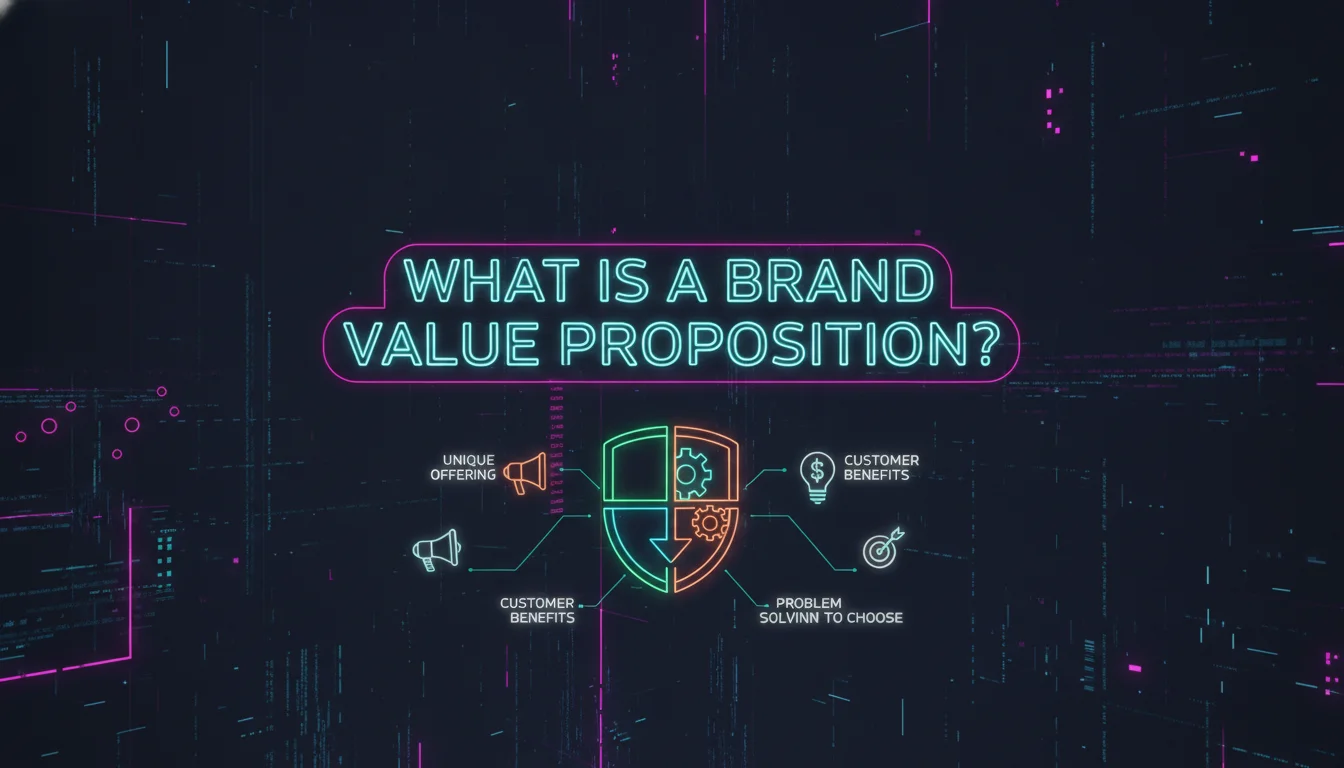
A brand value proposition is a concise statement explaining the specific benefits customers gain by choosing a product or service over competitors. It answers what the brand does, for whom, and why it’s distinctively valuable.
Key Takeaways
- A value proposition defines the tangible and emotional value a customer receives in exchange for time, money, or attention.
- The strongest statements are specific, pain-focused, and exclusive to the brand, according to Mailchimp’s value proposition criteria.
- Kantar research shows consumers are willing to pay 37% more for brands they regard as meaningfully different.
- A this type of proposition is not a slogan or a purpose statement. It sits between positioning and execution.
- Extending the proposition to employees, investors, and partners creates internal alignment and strategic coherence.
- The Business Model Canvas treats the value proposition as a central element of how a brand communicates its entire business model.
What Is a Brand Value Proposition?
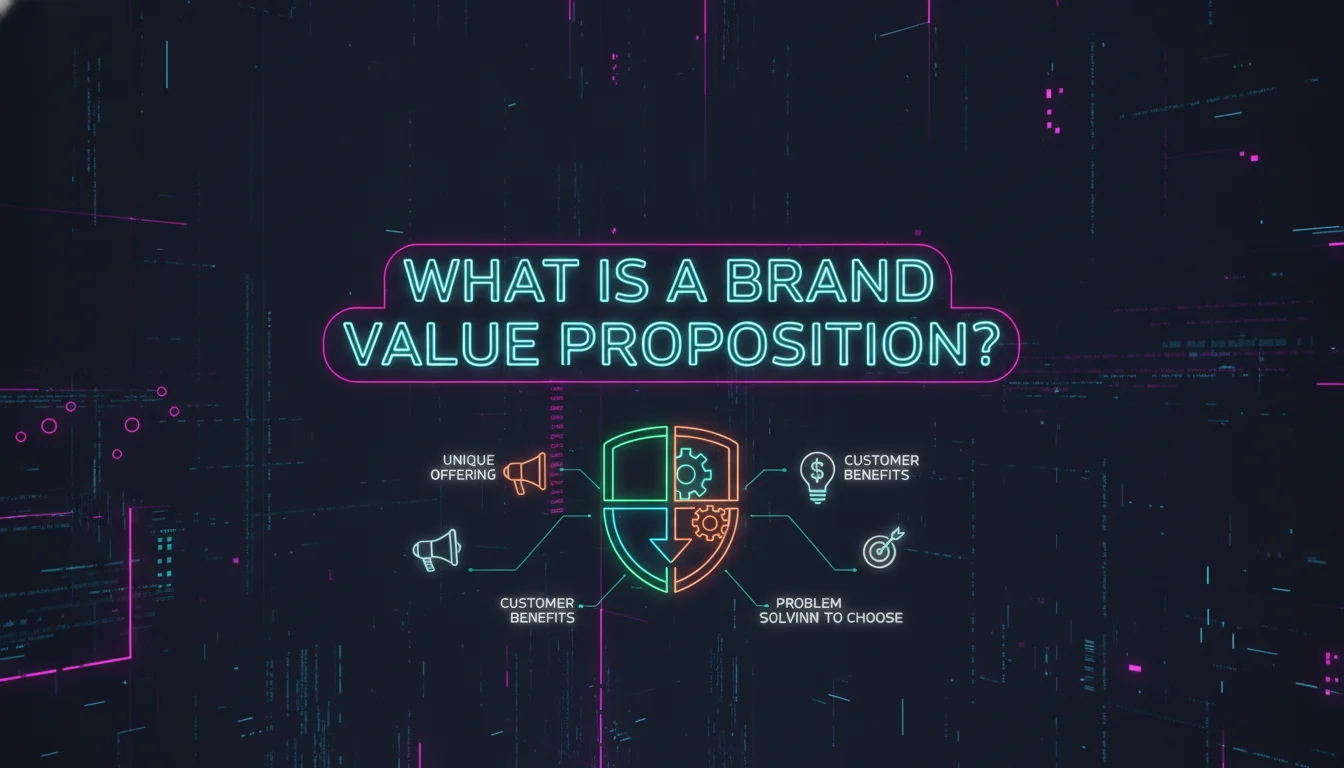
The Core Definition and Function
A this kind of proposition is a short statement explaining the benefits customers will gain from choosing a product or service, according to The Branding Journal. It shows why the offering is different and more valuable than competitors. This clarity isn’t a marketing nicety. It’s the core of a viable business model.
Think of it as a value exchange. Customers give money, time, or attention. The brand gives a specific problem solved, a need met, or an experience delivered. Without that exchange made explicit, every downstream decision – from website copy to product roadmap – becomes harder to get right.
The Branding Journal also identifies the value proposition as a central element of the Business Model Canvas, the strategic tool that maps how an organization creates, delivers, and captures value. That placement matters: it signals that the brand value isn’t a marketing artifact. It’s a structural component of how the business works.
Functional vs. Emotional Value
Most strong value propositions combine two types of value. Functional value focuses on the practical benefits and features of the products or services. Emotional value taps into the feelings and emotions of consumers, often through storytelling. The Branding Journal identifies these two dimensions as the building blocks of a customer-facing proposition. A brand that leads only with features may fail to connect, while a brand that leads only with emotion may struggle to justify its price.
Why a Brand Value Proposition Is Not the Same as a Slogan or Purpose
A this type of proposition is not a tagline. A tagline like “Think Different” or “Just Do It” is a creative expression, but it doesn’t specify what the customer receives. The this kind of proposition must be specific enough to guide product, sales, and service decisions. It also differs from a purpose statement, which explains why the organization exists. The value proposition explains what the company does and how it does it, as Bailey GP notes in its comparison of brand purpose and value proposition.
Why a Brand Value Proposition Determines Competitive Advantage

The Economics of Being Meaningfully Different
Competitive advantage isn’t created by being slightly better. It’s created by being meaningfully different. Kantar research, cited by Brand Strategy Sarah, found that consumers are consistently willing to pay more for brands they regard as meaningfully different. Among people who are primarily brand-driven, consumers are content to pay, on average, 37% more than for other brands. Even among price-driven consumers, the willingness to pay a premium exists when the brand delivers a relevant and distinct benefit.
That single finding reframes the entire conversation. A strong brand value isn’t a soft creative exercise. It’s a pricing instrument.
Internal Alignment and External Clarity
A clearly articulated value proposition aligns marketing, sales, product, and customer service around the same promise. The Branding Journal emphasizes that the message helps everyone in the company – marketing, sales, and staff – understand their role in delivering that value. When the proposition is vague, each team invents its own version of the truth, and customers experience inconsistency. External clarity follows internal alignment: if every employee can state the same value exchange, the market hears it clearly.
The Value Exchange Framework
The value exchange framework treats a this type of proposition as a two-sided transaction: the customer gives something of value, the brand gives something of value. This keeps the statement anchored in customer reality rather than company pride. If the customer isn’t receiving more value than the cost – monetary, time, effort, or risk – the proposition is unlikely to drive choice.
“Customers aren’t concerned with our problems, they just insist on capturing as much customer value as possible, and will go wherever the value seems greatest.” – Paul Fifield, via The Branding Journal
How to Create a Brand Value Proposition: A Step-by-Step Framework

Multiple methodologies exist, but the underlying logic is consistent. The table below compares three credible approaches before we outline a practical five-step process.
| Source | Core Question | Key Criteria | Output |
|---|---|---|---|
| The Branding Journal | What value are you giving in exchange for the customer’s money? | Functional value, emotional value, multi-audience adaptation | Short statement plus variants for employees, investors, partners |
| Harvard Business School Online | What market need does your offering fulfill, and what separates it from alternatives? | Clarity on who you serve, unique strengths, differentiation | Value proposition for product, service, idea, or skill set |
| Mailchimp | Why should your target market benefit from your product or service? | Specificity, pain-focus, exclusivity | Positioning statement that boosts conversion and marketing |
Step 1: Audit Customer Needs and Pain Points
Start with the customer, not the product. Harvard Business School Online advises entrepreneurs to determine what market need their product or service fulfills before launching. Identify the specific pain points, jobs to be done, and unmet needs. A this kind of proposition that doesn’t respond to a real pain point is a statement about the company, not a promise to the customer.
Step 2: Inventory Your Differentiated Capabilities
Next, list what the brand does that competitors can’t easily copy. This includes proprietary technology, process advantages, unique partnerships, or a distinctive service model. Mailchimp’s exclusivity criterion asks: What makes your company different from others? The answer must be true, defensible, and relevant to the customer’s pain point. If the differentiation isn’t meaningful to the customer, it doesn’t belong in the brand value.
Step 3: Draft the Statement Using Functional and Emotional Value
Combine the pain point and the differentiated capability into a short statement. Use the functional and emotional value framework: state the practical benefit and the emotional payoff. DuckDuckGo’s value proposition positions the search engine as “truly private web browsing,” which directly conveys the functional benefit (privacy) and the emotional relief from being tracked. The statement should be one to three sentences, specific enough to guide decisions.
Step 4: Test Against Specificity, Pain-Focus, and Exclusivity
Evaluate the draft against Mailchimp’s three criteria. Is it specific about the benefit? Does it target a pain point? Does it explain why the brand is the only or best choice? If the statement could be claimed by any competitor, it isn’t exclusive. Iterate until the this type of proposition passes all three tests.
Step 5: Adapt for External and Internal Audiences
A this kind of proposition isn’t only for customers. The Branding Journal explains that once the customer-facing version is defined, it can be adapted for employees, investors, partners, suppliers, and communities. The core promise stays intact, but the emphasis shifts to the value relevant to each audience.
Audiences Beyond the Customer: Extending Your Value Proposition

Employer Value Proposition
An employer value proposition highlights what makes a company an attractive place to work. It includes company culture, benefits, career development opportunities, and work-life balance. According to The Branding Journal, this variant explains why a talented person should invest their career in the organization. The employer brand value isn’t a separate document from the customer proposition. It’s a translation of the same underlying value into the language of employment.
Bailey GP notes that brand purpose has been proven to increase productivity and employee retention when communicated effectively. That makes the employer value proposition more than a recruitment tool. It’s a retention system.
Investor and Partner Value Propositions
An investor value proposition emphasizes potential returns, financial performance, growth potential, and strategic advantages. A partner value proposition targets potential business partners or collaborators, explaining mutual benefits such as access to new markets, shared resources, or technological advantages. These extensions matter because a value proposition that only speaks to customers may fail to attract the capital and alliances needed to deliver on the customer promise.
Community and Supplier Value Propositions
A community value proposition focuses on the brand’s impact on local communities and social responsibility efforts, including sustainability initiatives and charitable contributions. A supplier value proposition communicates advantages for suppliers such as reliable partnerships, payment terms, and growth opportunities. These variants reduce friction across the entire value chain, making the brand easier to do business with at every touchpoint.
Brand Value Proposition vs. Positioning vs. Purpose: What’s the Difference?
Positioning Sets the Mental Slot
Positioning is about identifying the associations you want to build in people’s minds. Al Ries and Jack Trout introduced the concept in 1969, defining positioning as “a strategy for staking out turf or filling a slot in the mind of target customers.” A literature review identified 1,557 articles on the topic of positioning, but the core idea remains: what do you want associated with your brand when a customer thinks of you? Positioning answers the question of mental availability.
Purpose Defines Why You Exist
Brand purpose explains why an organization exists and what it stands for. According to Bailey GP, purpose provides a foundation for the value proposition and brand strategy, as well as company culture, behavior, and core values. Purpose is broader and longer-term. It’s not the same as the this type of proposition, which is the tangible value delivered to customers.
Value Proposition Defines What and How You Deliver
A this kind of proposition explains what an organization does and how it does it. It includes every touchpoint up to, including, and after purchase. In the brand strategy stack, purpose sits at the top as the reason for being, positioning defines the mental space to occupy, and the brand value makes the promise concrete. Marketers who confuse the three often duplicate the same statement across the business, creating confusion. The point of articulating each is to set out what you want to stand for in people’s minds and then operationalize it.
Brand Value Proposition Examples and What They Teach
DuckDuckGo’s Privacy-Centric Value Proposition
Bailey GP highlights DuckDuckGo’s value proposition as a practical example worth studying. The privacy-centric search engine positions itself as “truly private web browsing.” The homepage asks, “Tired of being tracked online? We can help,” then explains: “We don’t store your personal info. We don’t follow you around with ads. We don’t track you. Ever.” This works because it answers both what the brand does (private web browsing) and how it does it (no tracking, no personal info storage).
Notice the structure. It opens with a pain-focused question that identifies exactly who it’s for. It follows with a functional benefit. Then it delivers the emotional payoff: certainty. That three-part rhythm is a template worth borrowing.
What Amazon and Starbucks Illustrate Qualitatively
The competitor sources reviewed don’t quote a specific, verified Amazon or Starbucks this type of proposition, so any exact wording would be speculative. The structural patterns are still instructive. Amazon is widely associated with convenience, selection, and fast delivery – a value proposition focused on saving time and reducing friction. Starbucks is often associated with consistent premium coffee and a comfortable third-place environment. Both demonstrate the principle that a this kind of proposition should be simple enough to be understood instantly and specific enough to guide the experience.
What to Learn from the Examples
Strong examples share three traits. First, they’re specific: DuckDuckGo names privacy, not “better search.” Second, they’re pain-focused: tracking anxiety, wasted time, inconsistent coffee. Third, they’re exclusive: few brands can credibly claim the same promise. A brand value that passes those tests becomes a filter for messaging, product decisions, and customer experience design.
Pros and Cons of Building a Formal Brand Value Proposition
Pros
- Pricing power: Kantar research confirms that meaningfully different brands command a premium. A clear proposition is the foundation of that differentiation.
- Internal alignment: When every team understands the same value exchange, marketing, sales, and product stop pulling in different directions.
- Faster decision-making: A strong proposition acts as a filter. Features, campaigns, and partnerships that don’t reinforce the promise get cut faster.
- Multi-audience scalability: One well-crafted core proposition can be adapted for customers, employees, investors, and partners without starting from scratch each time.
- Conversion clarity: According to Mailchimp, an effective value proposition can boost conversion rates and maximize marketing strategies.
Cons
- Hard to get specific enough: Most first drafts are too broad to be useful. The iteration process takes real time and honest customer research.
- Risk of internal resistance: A focused proposition means saying no to audiences and use cases outside its scope. That’s politically uncomfortable in many organizations.
- Requires ongoing maintenance: Markets shift, competitors move, and customer pain points evolve. A proposition written in 2022 may be stale by 2026 if it isn’t revisited.
- Easy to confuse with adjacent concepts: Conflating the value proposition with a tagline, a purpose statement, or a positioning statement is a common mistake that dilutes all three.
Measuring, Refining, and Avoiding Mistakes in Your Brand Value Proposition
Qualitative Signals of Relevance
A brand value proposition is working if customers can repeat the core benefit without prompting and if sales conversations spend less time explaining what the brand does. The Branding Journal suggests that the proposition should help marketing, sales, and staff understand their role in delivering value. If internal teams can’t articulate the same value exchange, the statement isn’t operational. Qualitative signals include customer interviews, sales call recordings, and employee feedback.
Quantitative Indicators Backed by Research
The clearest quantitative support in the competitor evidence is Kantar’s finding that consumers are willing to pay 37% more for brands they regard as meaningfully different, according to Brand Strategy Sarah. This single figure justifies investment in a strong brand value proposition: the payoff isn’t just volume but pricing power. Other indicators – conversion rate lift, marketing efficiency, and retention – are common in practice but aren’t cited in the provided competitor excerpts, so treat them as hypotheses rather than established benchmarks.
“Strategic positioning matters just as much for individuals as it does for companies. Standing out requires clarity around what you offer, who you serve, and your unique strengths.” – Harvard Business School Online
Common Mistakes: Company-Centric, Feature-Heavy, and Internally Invisible
Three mistakes recur across brands of every size. First, making the statement about the company instead of the customer. Second, confusing features with benefits: “military-grade encryption” is a feature, while “your data stays private” is the benefit. Third, ignoring internal audiences. A brand value proposition that only lives in the marketing department is incomplete, because every employee, supplier, and partner either proves or disproves the promise at each touchpoint.
Embedding the Brand Value Proposition Across the Organization
Sales and Marketing Alignment
A brand value proposition is a working document, not a poster on the office wall. Sales teams should use it to qualify leads and structure pitches. Marketing teams should use it to create campaigns and content. Harvard Business School Online notes that clarity around what you offer, who you serve, and your unique strengths matters just as much for organizations as it does for individuals. The same applies to every customer-facing function.
Product Development and Customer Experience
The brand value proposition should guide product roadmap decisions and customer experience design. If a proposed feature doesn’t reinforce the promised value exchange, it may be a distraction. Bailey GP notes that the value proposition includes every touchpoint up to, including, and after purchase. That means onboarding, support, billing, and renewal all either prove or disprove the promise.
As of 2026, the brands winning on customer experience aren’t the ones with the most features. They’re the ones whose every interaction reflects a single, clear promise made at the proposition level.
The Brand Value Proposition as a Strategic System
Ultimately, a brand value proposition isn’t a one-time deliverable. It’s a strategic system. It starts with a clear value exchange, extends to every audience, and gets measured and refined over time. Brands that treat it as a living promise – specific, pain-focused, and exclusive – earn the right to be chosen. As Kantar shows, they also earn the right to charge more. The work is to make the brand value proposition so clear that every employee, partner, and customer can say it back in their own words.
Ready to build something that actually means something? Contact Emin Media for a free brand consultation and let’s craft a value proposition your market can’t ignore.
Frequently Asked Questions
What are the 5 key values of a value proposition?
While definitions vary, widely cited criteria include specificity, pain focus, exclusivity, clarity, and alignment with customer needs. Mailchimp explicitly names three of these – specificity, pain-focus, and exclusivity – and The Branding Journal adds functional and emotional value dimensions as the structural building blocks.
Can you give me an example of a value proposition?
Yes. DuckDuckGo’s value proposition is “truly private web browsing.” According to Bailey GP, this is reinforced by homepage copy stating the search engine doesn’t store personal info, doesn’t follow users with ads, and doesn’t track them. It’s a textbook example of a specific, pain-focused, and exclusive statement.
What is Starbucks’ customer value proposition?
The competitor sources reviewed don’t provide a documented Starbucks customer value proposition, so specific wording can’t be confirmed here. In general, a value proposition for a large coffee chain often centers on convenience, consistency, and premium experience, but without a verified source, any exact statement would be speculative.
What is Amazon’s value proposition?
The provided competitor content doesn’t cite a specific Amazon value proposition. Amazon is commonly associated with convenience, broad selection, and fast delivery, which could be expressed as a proposition focused on saving time and reducing friction. Exact wording should be sourced directly from Amazon.
What is the difference between brand positioning and value proposition?
Positioning identifies the associations you want to build in people’s minds – the mental slot. A brand value proposition states the tangible value the customer receives: what you do and how you do it. Positioning sets the space. The value proposition makes the promise concrete.
How long should a brand value proposition be?
It should be a short statement, typically one to three sentences. The goal is clarity, not exhaustive detail. A statement that’s too long becomes unusable for employees and invisible to customers.
Enjoyed this article?
Contact Emin Media for a free brand consultation and let's create something amazing together.
Get in TouchRelated Articles

Digital Storytelling for Brands: The Complete Guide
Digital storytelling for brands builds real audience connections through narrative. Learn proven techniques, formats, and…

Design Thinking for Marketing: A 2026 Guide
Design thinking for marketing builds campaigns around real user needs. Learn the 5 phases, common…

Creative Direction for Video Shoots: A Complete Guide
Master creative direction for video shoots with proven steps, tools, and strategies that build brand…