Brand Strategy Trends 2026: What Actually Works
Key Takeaways
- Brand strategy trends 2026 shift from isolated campaigns to connected, AI-native systems that serve both human customers and AI agents.
- First-party data is no longer optional. It is infrastructure that lowers acquisition costs and improves retention.
- Generative Engine Optimization (GEO) is as important as traditional SEO. According to Kantar, 74% of AI assistant users regularly seek AI-driven recommendations.
- Trust and authenticity are economic assets, not soft branding. Micro-communities are becoming a strategic moat.
- Winners will map the full customer journey, from first touch to post-purchase, and build brand presence that algorithms can parse.
Brand strategy trends 2026 are the structural shifts in how organizations build, position, and activate brands as AI agents, privacy regulation, and attention fragmentation reshape every stage of the customer journey.
Marketing is changing faster than at any point in the last decade. According to Deloitte Digital, the combined impact of artificial intelligence, economic pressures, and changing consumer behavior means that tried and tested marketing strategies will no longer work. This article examines the trends 2026 that matter most and gives you a practical framework for acting on them.
“AI rewrites creativity. Trust becomes currency. Channels collapse. Pressure intensifies.”
– Deloitte Digital, Marketing Trends of 2026
Why 2026 Marks a Strategic Breakpoint
this type of 2026 matter because several forces are converging at once, and none of them are reversible. The proliferation of fake digital content has placed a premium on trust and authenticity, according to Deloitte Digital. At the same time, attention is fragmenting across platforms and discovery is becoming algorithmic.
Kantar identifies ten trends for 2026, including purchasing agents, synthetic data, AI-native decision making, brand building in the age of algorithms, and the rise of micro-communities. The old playbook – create a campaign, push it out, measure clicks – no longer holds. A systems mindset is now required: every channel, every data point, and every community touchpoint must work together to build both mental availability and machine legibility.
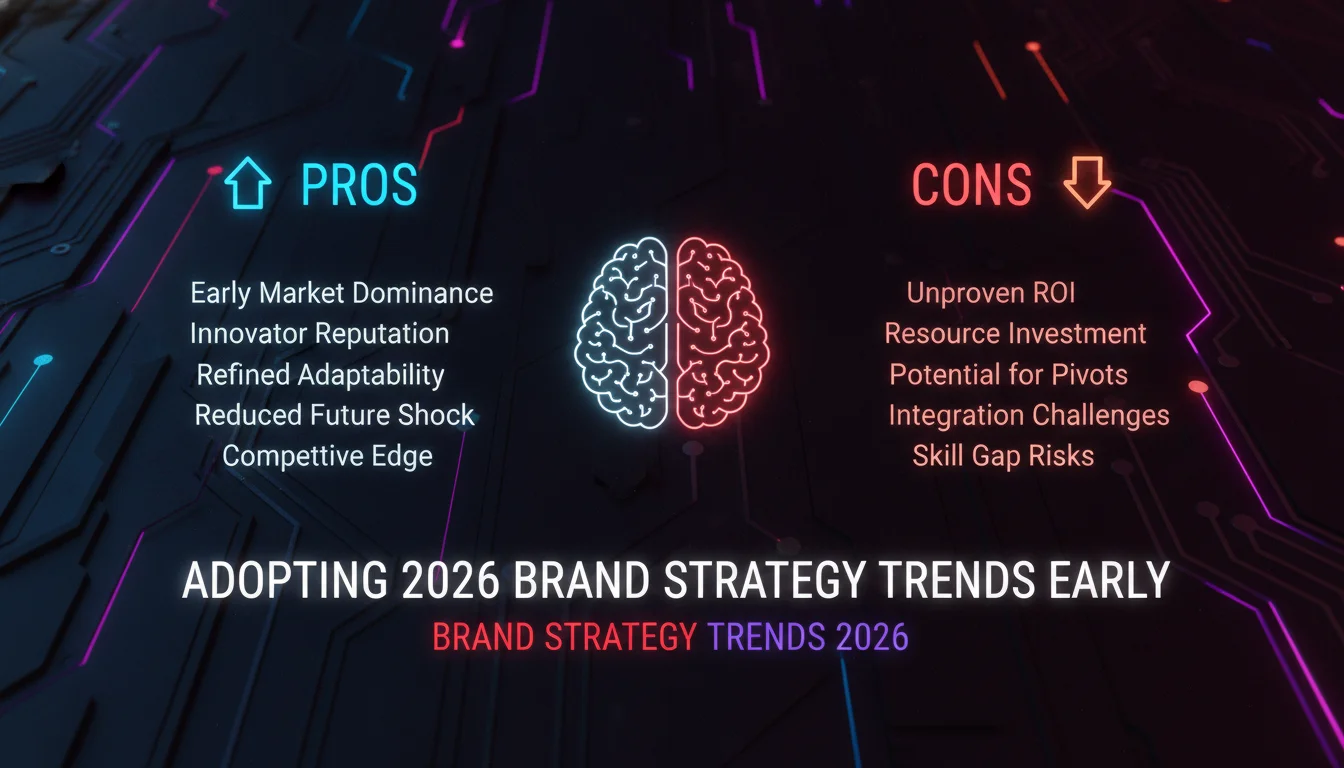
Pros and Cons of Adopting 2026 Brand Strategy Trends Early
Pros
- Early movers build AI visibility before competitors establish algorithmic preference
- First-party data compounds over time, reducing paid acquisition dependency
- Micro-communities create loyalty that is structurally difficult for competitors to replicate
- Connected customer journey mapping reduces wasted spend and closes conversion gaps
- GEO positions your brand as the default answer in AI-generated responses
Cons
- Transitioning from campaign thinking to systems thinking requires organizational change, not just new tools
- First-party data infrastructure takes time to build and requires ongoing governance
- GEO best practices are still evolving, making it harder to benchmark success
- Micro-community management demands consistent human attention and editorial judgment
AI Agents and Generative Engine Optimization Are Redefining Brand Discovery
AI agents are fundamentally changing where and how brands get discovered, making GEO one of the most urgent this kind of trends 2026 has produced.
From Search Engines to Answer Engines
Search behavior is shifting from typed queries to conversational prompts answered by AI assistants. OpenAI’s announcement that its new browser will incorporate AI agents signals a major change in how consumers find and evaluate brands. According to Kantar’s Connecting with the AI Consumer report, 24% of AI users already use an AI shopping assistant. More critically, 74% of those who use AI assistants regularly seek out AI-driven recommendations.
Brand visibility no longer depends solely on ranking in a search results page. It depends on whether an AI model knows your brand, understands what you offer, and chooses to cite you in a generated answer. Generative Engine Optimization (GEO) is the practice of structuring and publishing content so large language models and AI assistants cite, recommend, or select a brand in generated answers. This is one of the defining brand strategy trends 2026 demands you address first.
Optimizing for Machine Selection
Salience alone won’t make a brand algorithmically preferred. Kantar’s research is clear: AI assistants mediate purchase decisions, but humans still make the final buy. The CMO’s job is to build brands that people love and to be more present so models prioritize those brands.
Practical GEO actions include creating clear, structured, machine-legible content, publishing product details and how-to guides, and ensuring your brand’s meaning is explicit across owned and third-party sites. This is not about tricking AI. It is about making your brand the obvious answer when an agent runs a query on behalf of a customer.
“If the model doesn’t know you, it won’t choose you. Prepare to create clear, structured, machine-legible and relevant content. Models must be primed with the meaning of your brand and what you offer.”
– Kantar, Marketing Trends 2026
First-Party Data Becomes the Foundation of Customer Acquisition
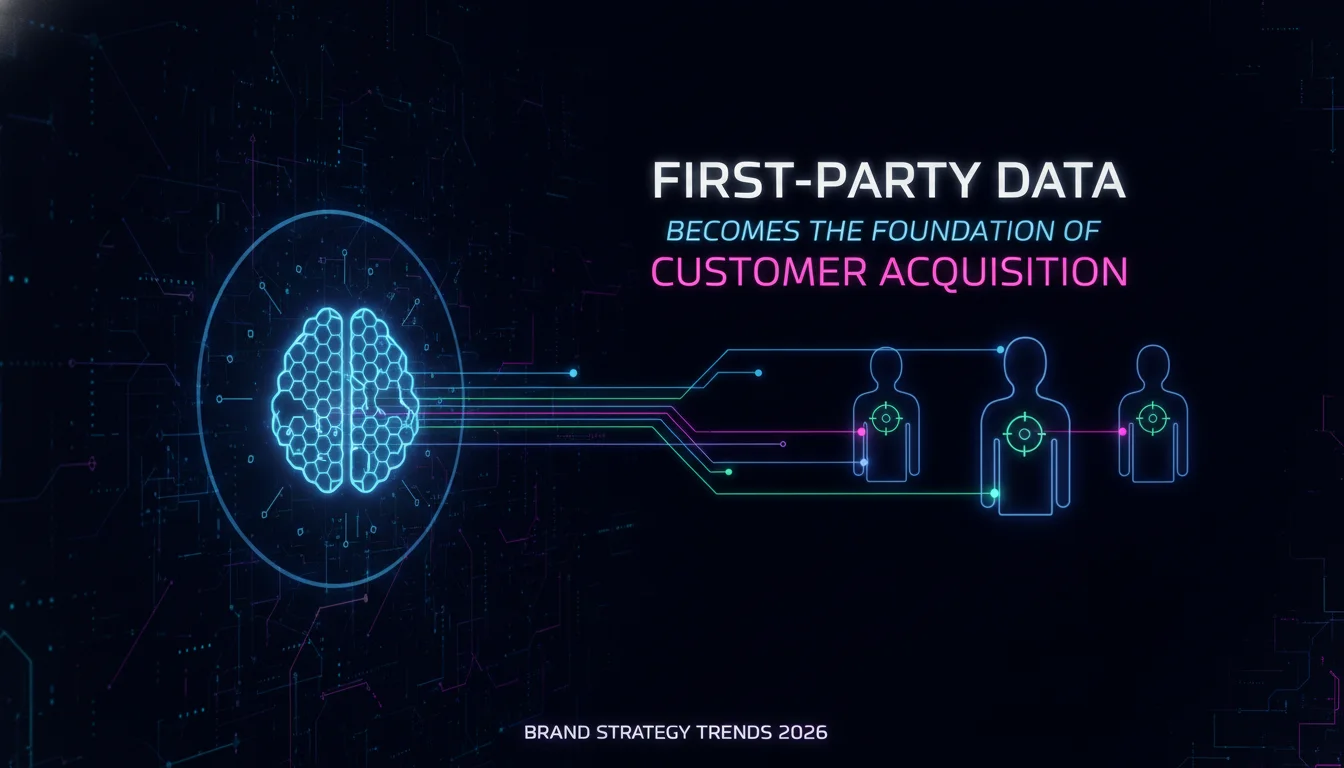
First-party data is the owned infrastructure that lets brands communicate directly with people who have already shown interest, without paying to reintroduce themselves every time.
What Counts as First-Party Data
First-party data is information collected directly from customers and prospects through owned channels. According to the Rhode Island Small Business Development Center, this includes email addresses, phone numbers, website behavior through analytics, purchase history, inquiry forms, and survey responses.
Unlike third-party data, this information is an owned asset. You do not have to pay to use it again and again. That financial reality alone makes first-party data a defining pillar of brand strategy trends 2026.
Turning Data into Infrastructure
Collecting data is no longer optional. It is infrastructure. Businesses that actively grow and manage their contact lists tend to see lower customer acquisition costs, higher retention rates, and more repeat business, according to the Rhode Island Small Business Development Center’s 2026 marketing trends analysis.
But collection alone is not enough. Data must feed segmentation, personalization, and long-term nurturing. The goal is to communicate with people who have already shown interest, rather than constantly paying to reintroduce yourself to cold prospects. That shift from renting attention to owning the relationship is one of the clearest economic arguments for acting on brand strategy trends 2026 now.
Customer Journey Mapping Replaces One-Off Campaign Thinking
Customer journey mapping is the practice of visualizing every touchpoint a prospect moves through, from initial awareness to post-purchase, so that marketing becomes a connected system rather than a series of guesses.
Mapping the Four Critical Stages
A typical journey includes consideration, decision, post-purchase experience, and repeat engagement. Many businesses still treat marketing as a series of standalone promotions. Growth-oriented organizations in 2026 are designing connected systems where each stage supports the next and moves prospects forward intentionally.
When stages are not designed deliberately, customers feel confused about next steps, drop off before converting, or forget about the brand after purchase. Each of those outcomes is a revenue leak that journey mapping makes visible.
Closing Gaps Strategically
Mapping the journey helps identify where prospects get stuck, where information is missing, and where follow-up is inconsistent. Once those gaps are visible, improvements become strategic instead of reactive. Instead of asking “What should we try next?”, the question becomes “How does this tactic fit into our overall growth engine?”
This systems view reduces wasted effort and increases the return on every marketing activity. It is what separates brands that treat brand strategy trends 2026 as a connected discipline from those still running disconnected campaigns.
Trust, Authenticity, and the Rise of Micro-Communities
Trust is an economic asset in 2026, not a soft brand value. Brands that earn it reduce decision friction, increase willingness to pay, and build communities that competitors cannot easily copy.
Why Trust Is an Economic Asset
The proliferation of fake digital content has placed a premium on trust and authenticity, according to Deloitte Digital. Consumers are more likely to choose brands they recognize as genuine, transparent, and consistent. Reviews, user-generated content, employee advocacy, and a consistent brand voice all contribute to both algorithmic and human preference.
MarketerMilk‘s 2026 trends report highlights that marketers are becoming internal influencers and that network effects are becoming a marketing moat. Both outcomes depend entirely on authenticity. You cannot manufacture either one.
Micro-Communities as a Brand Moat
Micro-communities are small, interest-based digital groups where members share high-trust interactions. Kantar includes the rise of micro-communities as one of its top ten trends for 2026. These communities are powerful because they combine reach with relevance: members act as advocates, not just audiences.
Leading brands are building dedicated spaces, such as Slack groups, Discord servers, private newsletters, or subreddits, where their most engaged customers can interact. This creates a layer of loyalty that is structurally difficult for competitors to replicate and aligns directly with where brand strategy trends 2026 are heading.
Emerging Angles Worth Watching in 2026
Beyond the core pillars, several adjacent forces are reshaping how brands compete this year.
Data Privacy as a Differentiator
Spinutech’s 2026 marketing trends guide identifies data privacy as a differentiator, not just a compliance requirement. Brands that communicate clearly about how they collect and use data build a trust advantage that compounds over time. This connects directly to the first-party data shift: the brands that handle data responsibly are the ones customers willingly share more with.
Social Commerce and Influencer Marketing
Social commerce, where discovery and purchase happen inside the same platform, is accelerating. Spinutech and Coursera both flag social commerce and influencer marketing as significant forces in 2026. The distinction that matters: micro-influencers with tight, relevant audiences consistently outperform broad-reach celebrity partnerships on trust and conversion. Authenticity, again, is the variable that determines outcome.
AI-Powered Personalization and Conversational Commerce
AI-powered personalization and conversational commerce are reshaping the customer experience layer. Spinutech highlights both as defining B2C trends for 2026. Brands that use AI to deliver genuinely relevant experiences, rather than just faster generic ones, will see the clearest gains. The risk is using AI as a cost-cutting tool rather than a customer-understanding tool.
Synthetic Data and AI-Native Decision Making
Kantar flags synthetic data and AI-native decision making as two of its ten trends. Synthetic data allows brands to train models and run scenario planning without exposing real customer information, which matters as privacy regulation tightens. AI-native decision making means building brand systems that AI agents can evaluate and act on, not just systems designed for human browsing behavior.
Brand Strategy Trends 2026: A Practical Implementation Roadmap
The following six steps translate the trends above into a sequenced action plan any brand can start this quarter.
Step-by-Step Framework
- Step 1: Audit your AI visibility. Search for your brand in ChatGPT, Google’s AI Overviews, and other AI assistants. Note whether the model cites you accurately and whether it recommends you for relevant queries.
- Step 2: Consolidate first-party data. Identify every touchpoint where you collect customer information, including website forms, email signups, purchase records, and surveys. Centralize these into a single accessible system.
- Step 3: Map the customer journey. Document how prospects move from awareness to consideration, decision, purchase, and post-purchase. Highlight drop-off points and missing follow-up.
- Step 4: Launch or join a micro-community. Choose one platform where your most engaged customers already gather. Create a reason for them to stay: exclusive content, early access, or peer support.
- Step 5: Implement GEO basics. Publish clear, structured content that answers common questions. Use descriptive headings, FAQ sections, and detailed product information so AI models can parse your offering accurately.
- Step 6: Measure what matters. Track not just clicks and impressions, but AI citations, first-party list growth, journey stage conversion rates, and community participation.
Measuring What Matters
Traditional metrics like impressions and clicks still have value, but they obscure the full picture. Brand strategy trends 2026 demand a broader scorecard: share of AI citations, first-party database growth, customer journey stage conversion, and micro-community engagement.
Use these metrics to decide where to focus next. If AI assistants ignore your brand, invest in GEO. If your list is stagnant, improve first-party data collection. If customers drop off between consideration and decision, fix that journey gap before spending more on acquisition.
Comparison Table: Brand Strategy Priorities in 2026
The table below contrasts pre-2026 approaches with the priorities embedded in brand strategy trends 2026. Use it to identify where your current strategy may be misaligned.
| Dimension | Pre-2026 Approach | 2026 Brand Strategy Trend | Expected Impact |
|---|---|---|---|
| Search Visibility | Chasing individual keywords | Generative Engine Optimization and topic authority | AI assistants cite and recommend the brand |
| Customer Data | Relying on third-party cookies and rented audiences | First-party data collection and owned relationships | Lower acquisition costs, higher retention |
| Campaign Structure | Standalone promotions and one-off pushes | Connected customer journey mapping | Fewer drop-offs, more repeat engagement |
| Community Engagement | Broad influencer reach and mass broadcasting | Micro-communities and internal influencer advocacy | Higher trust, stronger brand moat |
| AI Usage | Efficiency tool for content generation | AI-native decision making and machine-legible brand building | Better model selection and human preference |
| Data Privacy | Compliance checkbox | Privacy as a trust differentiator | Stronger customer willingness to share data |
Implications for Your Brand Strategy
If your current approach still centers on third-party data, isolated campaigns, or keyword volume, you are building on a shifting foundation. The transition may feel disruptive, but each shift has a clear payoff in lower costs, higher relevance, and stronger defensibility.
Prioritize the highest-gap dimension first. For most brands, that will be AI visibility and first-party data. Then layer in journey mapping and community building as you go.
The Core Shift: What Winning Looks Like in 2026
The defining characteristic of brand strategy trends 2026 is a move from interruption-based, channel-specific marketing to connected systems that serve both human decision-makers and AI agents. Trust, first-party data, customer journey mapping, and micro-communities are not separate initiatives. They are reinforcing layers of the same strategy.
Deloitte Digital’s framing captures the pressure precisely: AI rewrites creativity, trust becomes currency, channels collapse, and pressure intensifies. Brands that accept this and reorganize accordingly will be the ones that grow. Those that treat it as a list of tactics to bolt onto existing campaigns will keep getting the same results they are getting now.
Start with an audit of your AI visibility and your first-party data infrastructure. Map the customer journey and identify the biggest drop-off point. The window to build algorithmic preference and owned relationships is open right now, and it will not stay open indefinitely.
Ready to act on what you have read? Contact Emin Media for a free brand consultation and let’s build something that both humans and AI agents choose.
Frequently Asked Questions
What are the major marketing trends for 2026?
Major marketing trends for 2026 include AI agents and Generative Engine Optimization, first-party data infrastructure, customer journey mapping, micro-communities, social commerce, and trust as a competitive differentiator. These are the core elements of brand strategy trends 2026 that Deloitte Digital, Kantar, and Spinutech all identify as structurally significant.
What will be the biggest trend in 2026?
The biggest trend is the shift toward AI-native brand visibility. With 74% of AI assistant users regularly seeking AI-driven recommendations, according to Kantar, brands must be discoverable by AI agents, not just search engines. GEO is the practice that makes that possible.
What are the key trends in marketing strategy for 2026?
Key trends in marketing strategy include the move from campaigns to connected customer journeys, first-party data collection, Generative Engine Optimization, micro-community building, and data privacy as a differentiator. Together, these shifts define brand strategy trends 2026 and separate growing brands from stagnating ones.
What are the key trends for 2026?
Key trends for 2026 include AI-mediated purchasing, synthetic data, social commerce, conversational commerce, and data privacy as a differentiator. Kantar, Spinutech, and Coursera all highlight AI integration and short-form video as significant forces reshaping how brands compete.
How do I prepare my brand for AI search and GEO?
Start by auditing your AI visibility: search for your brand in ChatGPT and Google’s AI Overviews and note what comes back. Then publish clear, structured content with FAQ sections and detailed product information so AI models can parse your offering. GEO is the practice of optimizing content so AI models cite and recommend your brand rather than a competitor’s.
Why is first-party data important in 2026?
First-party data is important because privacy changes and reduced tracking make third-party data unreliable and increasingly expensive to act on. It reduces acquisition costs, improves personalization, and builds owned relationships that compound over time. These are the foundational economic arguments for treating first-party data as infrastructure rather than a nice-to-have.
Enjoyed this article?
Contact Emin Media for a free brand consultation and let's create something amazing together.
Get in TouchRelated Articles
Digital Storytelling for Brands: The Complete Guide
Digital storytelling for brands builds real audience connections through narrative. Learn proven techniques, formats, and…
Design Thinking for Marketing: A 2026 Guide
Design thinking for marketing builds campaigns around real user needs. Learn the 5 phases, common…
Creative Direction for Video Shoots: A Complete Guide
Master creative direction for video shoots with proven steps, tools, and strategies that build brand…