Brand Storytelling Trends 2026: What Actually Works
Key Takeaways
- Authenticity and human connection are the defining forces behind brand storytelling trends 2026.
- AI accelerates production but cannot replace the emotional specificity that makes stories stick.
- Brands must shift from demographic targeting to psychological and situational context.
- Community-driven marketing builds retention that paid media alone cannot buy.
- Storytelling frameworks like ABT (And, But, Therefore) give structure to narratives that convert.
- Measuring trust signals, not just clicks, is how serious teams track storytelling ROI in 2026.
Brand storytelling trends 2026 are the strategic narrative shifts brands must adopt to earn attention, trust, and loyalty from audiences who can now detect synthetic content on sight. As of 2026, the brands winning market share are not the loudest. They are the most believable.
Understanding Brand Storytelling
Brand storytelling is the strategic use of narrative to connect a brand with its audience on an emotional level. It moves beyond listing product features to conveying a brand’s values, mission, and purpose through compelling narratives. Effective brand storytelling builds lasting relationships, drives loyalty, and differentiates a brand in a crowded market.
What is Brand Storytelling?
Brand storytelling is a marketing strategy that uses narratives to create emotional connections with consumers. It involves crafting a story that reflects the brand’s identity and resonates with the target audience. This approach helps brands stand out in a saturated market by making their messages more relatable and memorable. According to brand storytelling expert Park Howell, author of Brand Bewitchery, if a company does not clearly tell its own story, someone else will do it for them, and it likely will not be the story they intended.
The Importance of Storytelling in Marketing
Storytelling engages consumers on a deeper level than feature lists or promotional copy ever can. People buy emotionally first, then justify the decision with logic later. Story speaks to the heart before the head gets involved. That is why narrative-driven brands consistently outperform those relying on rational argument alone, a pattern confirmed across branding research and creative industry analysis.
“If you’re using AI to mass produce social content that’s nothing more than a digital billboard, your audience will burn out, engagement will wane, and yes, even sales will suffer. But if you use it to improve efficiency and focus efforts on authentic brand storytelling, the rewards will follow.” – Ryan Mainville, Sr. Social Media Manager, The Point Group
Key Elements of Effective Brand Storytelling
- Authenticity: Stories must be genuine and reflect the brand’s true values.
- Emotional Resonance: Effective stories evoke emotions that connect with the audience.
- Relatability: Stories should connect to the audience’s real experiences and aspirations.
- Specificity: Vague stories vanish. Concrete details create memory anchors.
- Vulnerability: Brands willing to show imperfection earn more trust than those projecting perfection.
Brand Storytelling Trends 2026: The Full Picture
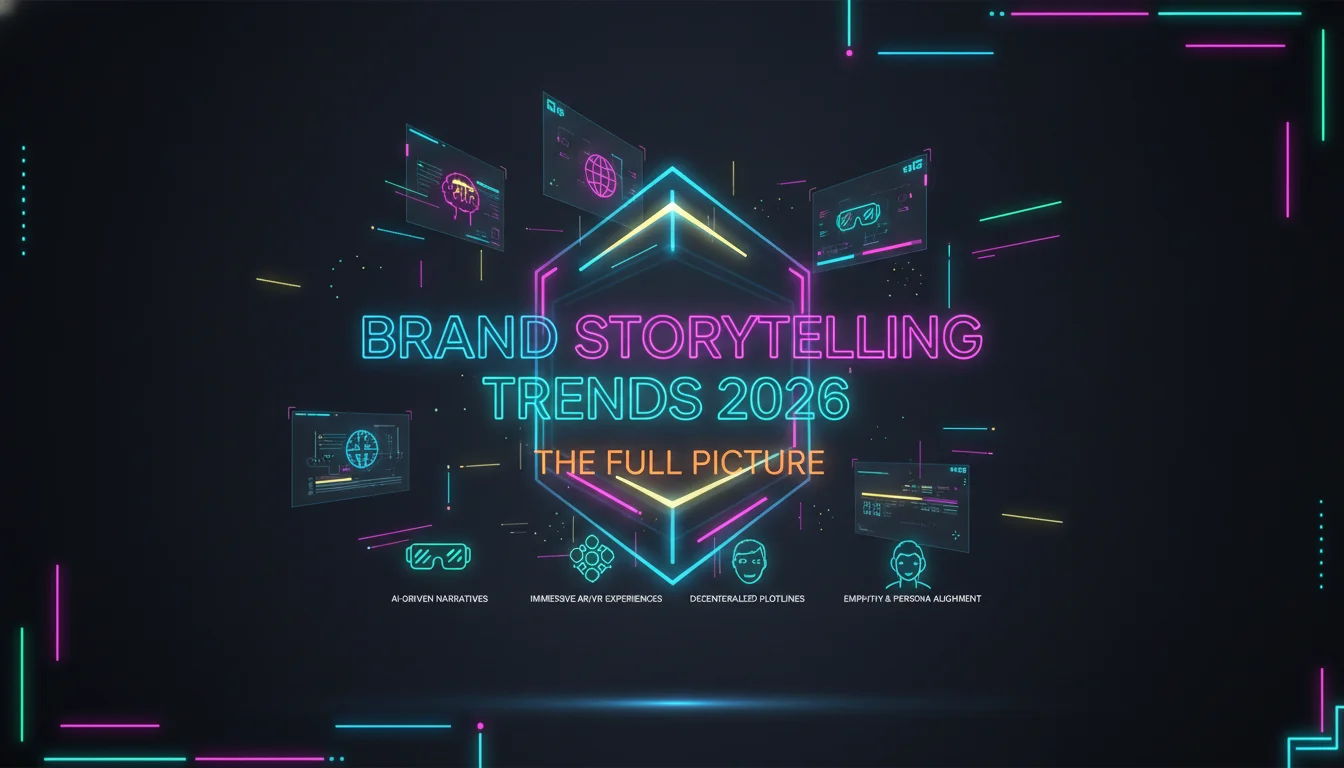
Brand storytelling trends 2026 reflect a clear industry-wide correction. After years of scaling content volume through automation, brands are discovering that output quantity without narrative quality produces diminishing returns. Several key shifts are reshaping how marketers approach story this year.
1. Authenticity Over Automation
Authenticity is the single most important differentiator in brand storytelling trends 2026, precisely because automation has made generic content nearly free to produce. Audiences have adapted fast. They recognize synthetic tone, detect templated persuasion, and scroll past it without a second thought.
According to Erahaus, brands that focus on authentic storytelling will outperform those relying solely on automated messaging. The logic is straightforward: when every brand can generate content with similar tools, output volume stops being a competitive edge. Differentiation shifts from format to perspective, from production to point of view.
Real stories carry specificity, vulnerability, imperfection, and context. Generic advice creates scroll behavior. Specific, human stories create memory anchors. That gap is widening in 2026, and brands that close it with genuine narrative will pull ahead.
2. Human-Centered Marketing
Human-centered marketing places the audience’s psychological and situational context at the core of every campaign, not just their demographic profile. This approach starts with a different set of questions: What does the audience fear right now? What decision pressure are they under? What risk are they trying to reduce? What identity are they trying to protect or build?
Campaigns built around those questions outperform those built around age brackets and zip codes. This is one of the most consequential brand storytelling trends 2026 because it requires a genuine shift in how strategy gets built, not just how copy gets written.
3. The Rise of Community-Driven Marketing
Community-driven marketing focuses on building connections among consumers rather than solely between the brand and the consumer. Brands that invest in making their channels a space for audiences to connect with each other will see deeper retention, stronger advocacy, and more resilience against algorithm changes.
As The Point Group notes, today’s consumers are not just buying goods. They are buying into the people, values, and experiences that surround them. Platforms built for community, including Reddit, Twitch, trade publications, and local blogs, are becoming serious brand channels in 2026. The counterintuitive truth: the more your brand acts as a facilitator of community rather than the center of attention, the stronger your long-term position.
4. Sensory and Tactile Creative Storytelling
Adobe’s 2026 Creative Trends Report identifies a powerful creative direction it calls “All the Feels”: content that engages all the senses, not just sight. As sophisticated AI and AR technology floods feeds, audiences are gravitating toward the messy, the tactile, and the analog. Real textures, real people, real stories.
For brand storytellers, this means designing content that communicates how something sounds, smells, or feels, not just how it looks. Sound-led video formats, hyper-textural imagery, and first-person POV shots are all expressions of this trend. Brands in food, beauty, and travel are leading the way, but the principle applies across categories.
5. “Human-Made” as a Badge of Honor
Lippincott’s 2026 brand trend analysis predicts that as AI backlash grows, “human-made” will resurface as a genuine value signal and a driver of price premiums. We are already seeing audiences celebrate the ability to toggle off AI content on platforms like Pinterest. Public sentiment toward AI-generated creative is shifting from novelty to skepticism in many categories.
Smart brands are getting ahead of this by making their human creative process visible. Behind-the-scenes content, founder-led storytelling, and expert commentary are outperforming polished corporate messaging across channels. The craft is the story.
“Human-made will resurface as a badge of honor and a driver of price premiums for knowledge workers and craftspeople alike.” – Eric Tsytsylin, Lippincott
How Brand Storytelling Actually Works: The Mechanics
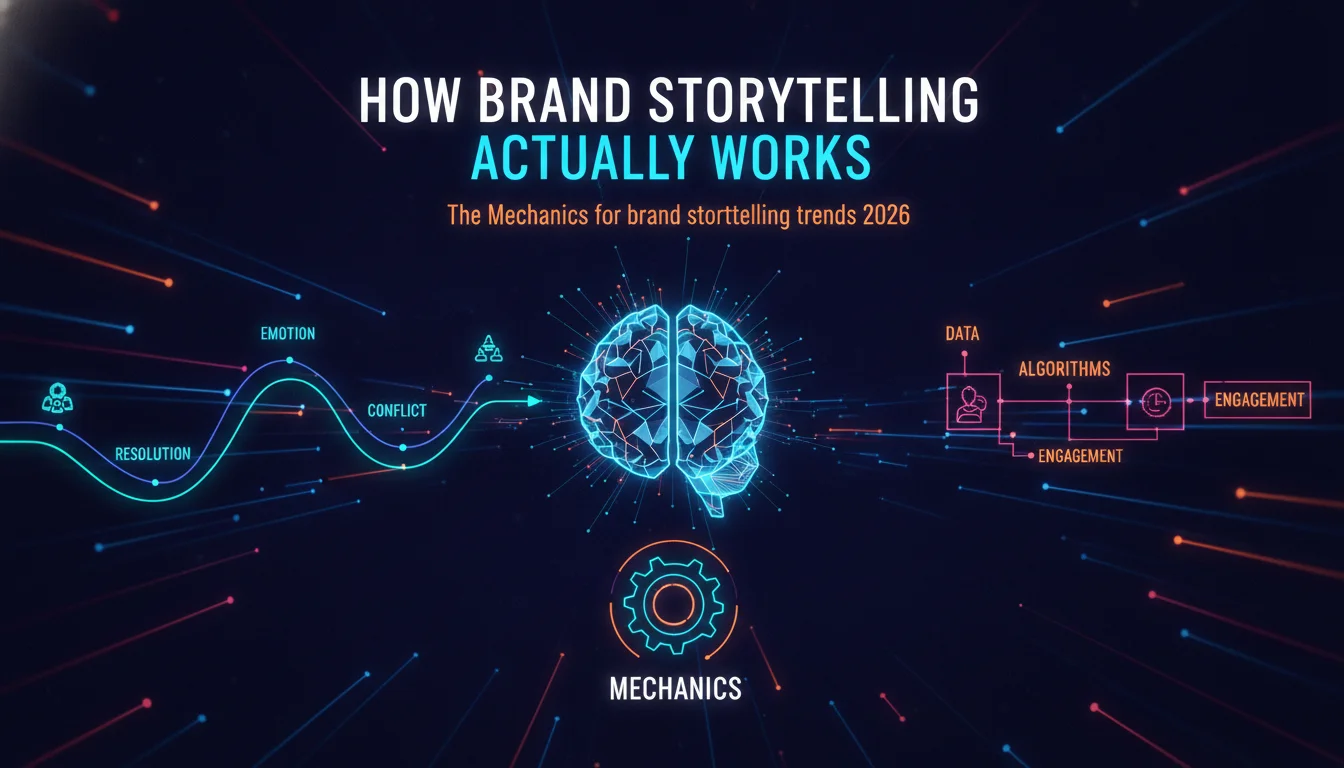
Understanding the mechanics behind effective brand storytelling helps marketers move from instinct to repeatable system. The process has three interlocking layers: narrative structure, emotional architecture, and distribution context.
Narrative Structure: The ABT Framework
The ABT (And, But, Therefore) framework, developed and popularized by Park Howell, is one of the most practical storytelling tools available to marketers. It works because it mirrors the natural shape of human thought: setup, complication, resolution.
- And: Establish the world as it is. Introduce your audience and their situation.
- But: Introduce the tension, problem, or conflict that disrupts the status quo.
- Therefore: Deliver the resolution, the transformation your brand enables.
This structure works on landing pages, social captions, video scripts, pitch decks, and email subject lines. It is not a template to fill in mechanically. It is a thinking tool that forces clarity about what actually changes for the customer when they choose your brand.
Emotional Architecture: What Makes Stories Stick
Stories stick when they trigger recognition. The audience needs to see themselves in the narrative, not the brand. This is where most corporate storytelling fails: it centers the brand as the hero when the customer should be the hero. Your brand is the guide. The customer is the one who transforms.
Effective emotional architecture includes a relatable protagonist (your customer), a clearly named problem, a moment of tension or stakes, and a resolution that feels earned. Remove any of those elements and the story loses its grip.
Distribution Context: Where the Story Lives
The same story told in different formats performs differently. A founder’s origin story lands differently as a 60-second Instagram Reel than as a 1,200-word LinkedIn post. Neither is wrong. But the format shapes what emotional beats you can hit and how much context you can provide. Brand storytelling trends 2026 emphasize matching story depth to platform behavior, not forcing one format across all channels.
How to Apply Brand Storytelling Trends 2026: A Practical Playbook
Applying brand storytelling trends 2026 to your actual marketing calendar requires more than inspiration. It requires a repeatable process. Here are six concrete steps our team uses with clients.
Step 1: Audit Your Current Story
Before building new narratives, document what story your brand is currently telling in the market. Pull your last 30 days of social content, your homepage copy, and your most recent email campaigns. Ask: Is there a consistent protagonist? Is there a named problem? Is there a clear transformation? Most brands discover they are listing features, not telling stories.
Step 2: Define Your Audience’s Psychological Context
Go beyond demographics. Interview five to ten recent customers and ask what they were afraid of before they found you, what almost stopped them from buying, and what changed after they did. These answers are your raw story material. They reveal the emotional stakes that no survey can surface.
Step 3: Apply the ABT Framework to Your Core Message
Take your brand’s core value proposition and run it through the ABT structure. Write it out in three sentences: the And (their world before you), the But (the problem or tension), and the Therefore (what becomes possible). This becomes your narrative spine. Every piece of content you create should connect back to this spine.
Step 4: Build a Community Touchpoint
Identify one platform or channel where your audience already gathers and where your brand can add value without dominating the conversation. This could be a subreddit, a LinkedIn group, a Discord server, or a recurring Twitter Space. Show up consistently as a contributor, not a broadcaster. Community trust compounds over time in ways that paid reach does not.
Step 5: Make Your Process Visible
In 2026, the creative process is content. Share behind-the-scenes moments, creative decisions, and even mistakes. This is how brands signal “human-made” without saying the words. A short video of your team debating a design choice tells a more compelling brand story than a polished product reveal.
Step 6: Measure Trust, Not Just Traffic
Set up a simple trust dashboard alongside your standard analytics. Track saves and shares (signals of genuine value), comment sentiment (qualitative trust indicators), direct message volume (relationship depth), and repeat engagement rates (loyalty signals). These metrics tell you whether your storytelling is building something durable or just generating impressions.
Common Mistakes in Brand Storytelling (And How to Avoid Them)
Even experienced marketing teams fall into predictable traps when executing brand storytelling trends 2026. Knowing what to watch for saves significant time and budget.
Mistake 1: Making the Brand the Hero
The most common storytelling error is centering the brand as the protagonist. Your brand is not the hero of the story. Your customer is. The brand’s role is the guide: knowledgeable, trustworthy, and focused on the customer’s transformation. Flip the framing and your stories immediately become more compelling.
Mistake 2: Chasing Volume Over Depth
High-volume automated content floods feeds. Most of it is technically correct and strategically useless. In 2026, fewer stronger stories beat endless thin content. A single well-crafted narrative that earns shares and saves outperforms 30 posts that generate passive scrolling.
Mistake 3: Ignoring Platform Context
Copying and pasting the same story across every channel is a fast way to underperform everywhere. Each platform has its own emotional register and audience behavior. LinkedIn rewards professional vulnerability and specific insight. Instagram rewards visual texture and brevity. Long-form editorial rewards depth and nuance. Match your story format to the platform’s native behavior.
Mistake 4: Over-Automating the Human Moments
AI is a powerful production tool. It is not a replacement for human judgment, lived experience, or creative taste. The brands that are struggling in 2026 are those that handed their entire content operation to AI without maintaining a human editorial voice. The output sounds identical to every other AI-assisted brand, which means it sounds like no brand at all.
Mistake 5: Skipping the Measurement Step
Storytelling without measurement is just content creation. Brands that treat storytelling as a performance strategy track its impact rigorously. If you cannot connect your narrative investment to trust signals, retention rates, or conversion quality, you cannot improve it systematically.
Brand Spotlight: How a B2B Software Brand Transformed Its Storytelling
Consider a scenario that plays out regularly across B2B marketing teams. A software company has been running feature comparison ads for two years. Click-through rates are acceptable. Conversion quality is not. The sales team reports that prospects arrive informed about features but unconvinced about fit.
The marketing team shifts strategy. Instead of comparison ads, they publish a series of operator-led video walkthroughs where real users walk through actual decision mistakes they made before finding the product, and what they learned. No polished spokesperson. No scripted testimonial. Real people, real context, real stakes.
The result, consistent with what Erahaus documents in their 2026 marketing trends analysis, is that conversion quality increases because buyers see lived experience rather than polished claims. The stories are specific, vulnerable, and contextually rich. They answer the question every buyer is actually asking: “Will this work for someone like me?”
This is brand storytelling trends 2026 in practice. Not a campaign. A system of trust-building narratives that compound over time.
The Role of AI in Brand Storytelling
AI’s role in brand storytelling trends 2026 is best understood as infrastructure, not strategy. Automation handles the repeatable, scalable parts of content production. Human creativity handles the parts that actually differentiate.
1. Enhancing Storytelling with AI
AI can analyze consumer data, surface insight patterns, generate first drafts, and accelerate production timelines. These are genuine advantages. Brands that use AI to handle research synthesis, content repurposing, and distribution scheduling free up their human creative teams to focus on the narrative decisions that matter: what story to tell, whose voice to center, and what emotional truth to surface.
2. Maintaining Human Connection
While AI can enhance storytelling production, the emotional specificity that makes stories memorable cannot be automated. Consumers value authenticity and emotional connection, which disappear in overly automated content. Brands must ensure their stories reflect genuine human experiences. The creative director’s judgment, the founder’s perspective, the customer’s actual words: these are irreplaceable inputs.
3. Frameworks for Effective Storytelling
Frameworks like the ABT model give both human and AI-assisted content a reliable structure. When using AI tools to generate story drafts, feeding them an ABT framework prompt produces significantly stronger output than open-ended generation. The framework acts as a quality filter, ensuring the narrative has tension and resolution rather than just information.
Pros and Cons of Current Brand Storytelling Approaches
Pros
- Builds durable brand equity that paid media cannot replicate or erase.
- Drives emotional connection that accelerates purchase decisions and reduces buyer hesitation.
- Creates community around shared values rather than just shared product use.
- Differentiates effectively in markets where product features are increasingly similar.
- Compounds over time: strong brand narratives attract press, partnerships, and word-of-mouth without additional spend.
Cons
- Requires sustained investment in creative talent and editorial judgment, not just tools.
- Harder to measure in the short term compared to direct response metrics.
- Risk of inauthenticity if storytelling is treated as a campaign tactic rather than a brand-wide commitment.
- Slower to scale than automated content production, especially for teams without strong creative infrastructure.
- Vulnerable to inconsistency when multiple teams or agencies contribute without a shared narrative framework.
Measuring the Impact of Brand Storytelling
Measuring brand storytelling impact is essential for continuous improvement, and the metrics that matter most in 2026 go beyond standard traffic and impression counts.
1. Tracking Engagement Metrics
Brands should monitor engagement metrics including comments, shares, and saves to gauge storytelling effectiveness. These signals indicate genuine resonance, not passive exposure. A post with strong save rates tells you the audience found it worth returning to. That is a trust signal, not just an engagement metric.
2. Assessing Brand Trust
Brand trust is becoming a measurable asset in 2026. Smart teams track trust signals through audience interactions, feedback sentiment, and direct message volume. According to Erahaus, brands are now treating trust as an operational metric alongside reach and conversion, tracking comment quality, save and share behavior, and the ratio of returning visitors to new ones.
3. Adapting to Consumer Feedback
Listening to consumer feedback is essential for refining storytelling approaches. Brands should treat audience responses as editorial input, not just performance data. When a particular story format generates unusually high engagement or direct responses, that is a signal to go deeper in that direction, not to rotate away from it in pursuit of variety.
Comparison of Brand Storytelling Approaches
| Approach | Focus | Benefits | Best For | Watch Out For |
|---|---|---|---|---|
| Authentic Storytelling | Genuine narratives reflecting brand values | Builds trust and emotional connection | Brand awareness and long-term loyalty | Requires consistent creative investment |
| Community-Driven Marketing | Fostering connections among consumers | Enhances customer retention and advocacy | Retention and word-of-mouth growth | Takes time to build; cannot be rushed |
| AI-Enhanced Storytelling | Utilizing data insights for personalized narratives | Improves production speed and relevance | Content scaling and personalization | Risk of sameness if over-automated |
| Sensory and Tactile Creative | Multi-sensory content that evokes physical experience | Drives emotional recall and purchase intent | Food, beauty, travel, lifestyle brands | Requires strong visual and audio production |
| Founder and Expert-Led Content | Human voice and lived experience at the center | Builds credibility and personal brand equity | B2B, professional services, thought leadership | Dependent on individual availability and consistency |
The 5 C’s of Business Storytelling
The 5 C’s of business storytelling give marketers a practical checklist for evaluating any narrative before it goes live. Each element strengthens the story’s ability to connect and convert.
- Character: Every strong story has a protagonist the audience can identify with. In brand storytelling, that protagonist is your customer, not your product.
- Conflict: Without tension, there is no story. Name the problem, obstacle, or fear your audience faces. This is what creates emotional stakes.
- Context: Ground the story in a specific situation. Vague stories do not resonate. Specific, recognizable contexts do.
- Climax: The moment of transformation or decision. This is where your brand’s role becomes clear, as the guide that enables the customer’s breakthrough.
- Conclusion: The resolution that shows what life looks like after the transformation. This is where you make the outcome tangible and desirable.
The Four Pillars of Brand Storytelling
The four pillars of brand storytelling provide the structural foundation every narrative needs to perform across channels and formats.
- Purpose: Why does the brand exist beyond profit? A clear purpose gives the story moral weight and direction.
- People: Whose lives does the brand affect? Centering real people, customers, employees, and community members, makes abstract brand values concrete.
- Plot: What is the arc of change the brand enables? Every strong brand narrative has a before, a tension, and an after.
- Platform: Where and how does the story get told? The right story in the wrong format reaches no one. Platform-native storytelling is a core competency in 2026.
Near-Term Outlook: What to Expect Through the Rest of 2026
Brand storytelling trends 2026 are not a static list. They are a moving target shaped by platform changes, AI development, and shifting consumer sentiment. Here is what we expect to see through the remainder of the year.
The “human-made” signal will intensify. As more platforms give users control over AI content visibility, brands that can credibly claim human creative authorship will command attention premiums. This is not a niche preference. It is a mainstream consumer behavior shift already visible in platform data.
Community channels will attract serious brand investment. The brands that built Reddit presences, Discord communities, and niche newsletter audiences in 2024 and 2025 are now seeing compounding returns. Expect more brands to follow in the second half of 2026, which means early movers still have a meaningful window.
Storytelling measurement will mature. The gap between brands that track trust signals and those that track only impressions will widen. Expect new platform-native analytics tools to make trust measurement more accessible, and expect sophisticated marketing teams to build trust dashboards as standard practice.
Traditional media will re-enter the storytelling mix. As The Point Group notes, traditional TV is experiencing renewed interest as a brand storytelling anchor, particularly for brands seeking consistent reach in a fragmented digital environment. The channel has evolved with addressable TV and cross-channel attribution capabilities that make it far more measurable than its reputation suggests.
Frequently Asked Questions
What are the key brand storytelling trends 2026 marketers should prioritize?
The key brand storytelling trends 2026 center on authenticity over automation, human-centered marketing that addresses psychological context rather than demographics, community-driven engagement, sensory and tactile creative content, and founder or expert-led narratives. Brands that combine these approaches with a clear storytelling framework like ABT will outperform those relying on volume-based content strategies.
How does AI influence brand storytelling in 2026?
AI enhances storytelling by accelerating production, surfacing data insights, and enabling content personalization at scale. However, the emotional specificity and human judgment that make stories genuinely resonant cannot be automated. The most effective approach treats AI as production infrastructure while keeping human creative direction at the center of narrative decisions.
What is the ABT framework in storytelling?
The ABT (And, But, Therefore) framework is a narrative structure developed by brand storytelling expert Park Howell that creates clear, engaging stories with built-in tension and resolution. “And” establishes the world as it is, “But” introduces the conflict or problem, and “Therefore” delivers the transformation. It works across landing pages, video scripts, social content, and pitch decks.
What are the 5 C’s of business storytelling?
The 5 C’s of business storytelling are Character, Conflict, Context, Climax, and Conclusion. Together they form a checklist for evaluating whether a brand narrative has the structural elements needed to connect emotionally and drive action. Missing any one of them typically produces a story that informs but does not move the audience.
What are the four pillars of brand storytelling?
The four pillars of brand storytelling are Purpose, People, Plot, and Platform. Purpose gives the story moral direction. People make abstract values concrete. Plot creates the arc of transformation. Platform determines how and where the story reaches its audience. Strong brand narratives are built on all four simultaneously.
Why is community-driven marketing important for brand storytelling in 2026?
Community-driven marketing builds the kind of audience loyalty that algorithmic reach cannot replicate. When brands create spaces for consumers to connect with each other around shared values and experiences, they generate advocacy, retention, and resilience against platform changes. According to The Point Group, brands that facilitate community rather than dominating it see stronger long-term results than those focused solely on broadcast messaging.
How can brands measure the impact of their storytelling efforts?
Brands can measure storytelling impact by tracking engagement quality metrics including saves, shares, comment sentiment, and direct message volume alongside standard traffic data. Brand trust is increasingly treated as an operational metric in 2026, with teams building dedicated trust dashboards that track returning visitor ratios, qualitative feedback patterns, and conversion quality rather than conversion volume alone.
Ready to build a brand narrative that actually earns trust and drives results? Contact Emin Media for a free brand consultation and let’s build something bold together. Explore our full range of branding and storytelling services to see how we approach narrative-driven growth for brands at every stage.
Enjoyed this article?
Contact Emin Media for a free brand consultation and let's create something amazing together.
Get in TouchRelated Articles
Digital Storytelling for Brands: The Complete Guide
Digital storytelling for brands builds real audience connections through narrative. Learn proven techniques, formats, and…
Design Thinking for Marketing: A 2026 Guide
Design thinking for marketing builds campaigns around real user needs. Learn the 5 phases, common…
Creative Direction for Video Shoots: A Complete Guide
Master creative direction for video shoots with proven steps, tools, and strategies that build brand…