Brand Naming Process: 7-Phase Framework
The brand naming process is a structured sequence of strategy, creative generation, evaluation, trademark screening, and validation that turns positioning into a memorable, ownable name. Most credible frameworks share these phases, though experts split them into four, five, or six steps.
Key Takeaways
- The naming process is a repeatable system, not a one-off brainstorm.
- Lexicon Branding’s 5-step process, Startup Stash’s 4-step UBA framework, and Agency Fifty3’s 6-step method all converge on five core phases.
- Memorability, trademark availability, cultural safety, and phonetic clarity are non-negotiable filters.
- Trademark screening should happen early, not as a final admin hurdle.
- A registered brand name is protected intellectual property, just as much as a patent, according to Lexicon Branding.
- Small teams consistently outperform large group brainstorms in naming quality, per Lexicon’s research.
Why the Brand Naming Process Is a Strategic System, Not a Brainstorm
The Cost of a Marginal Name
The this type of process exists because a name is not a decorative label. Lexicon Branding states that nothing in your brand identity is more important than your name. It’s the first step in a brand’s launch and the first step in making an idea tangible. The firm also notes that consumers are exposed to 6,000 to 10,000 ads every day, each promoting a different brand personality. In that environment, people only pay attention to what is new or noteworthy. A marginal name, according to Lexicon, dictates marginal success. This process is therefore a risk-reduction system as much as a creative exercise.
Brand names are not simple labels. When done right, they serve as powerful marketing tools for creating or changing consumer perceptions. The name is the one thing competitors cannot take away from you.
Why Traditional Brainstorming Fails
Many teams treat naming as a large group brainstorm. Lexicon Branding explicitly warns against groupthink in the first step of its five-step model. Traditional brainstorming isn’t effective in naming because groups default to predictable, overly clever ideas. Research cited by Lexicon indicates that small teams significantly outperform larger groups in the naming process. That finding changes the structure of a naming project: fewer people, clearer decision rights, and more rigor.
Comfort and logic can be traps. Many internal teams default to names that sound safe, but safe names tend to be forgettable. Lexicon’s advice to avoid the need for comfort or logic is a warning against premature convergence.
The Name as Intellectual Property
Another reason a structured this kind of process matters is legal ownership. Lexicon Branding points out that a registered brand name is protected intellectual property, just as much as a patent. More than 569,270 names were registered in the US in a single year, according to the same source. That volume means fitting in will not work. A strong process must include trademark screening, not as a final hurdle but as a concurrent filter.
“A brand does not exist without a name. The name of your company or product will be spoken, written, and shared countless times across digital and physical touchpoints in perpetuity. It is the Energizer Bunny of brand assets.” – Rob Meyerson, Brand Naming, as quoted by Startup Stash
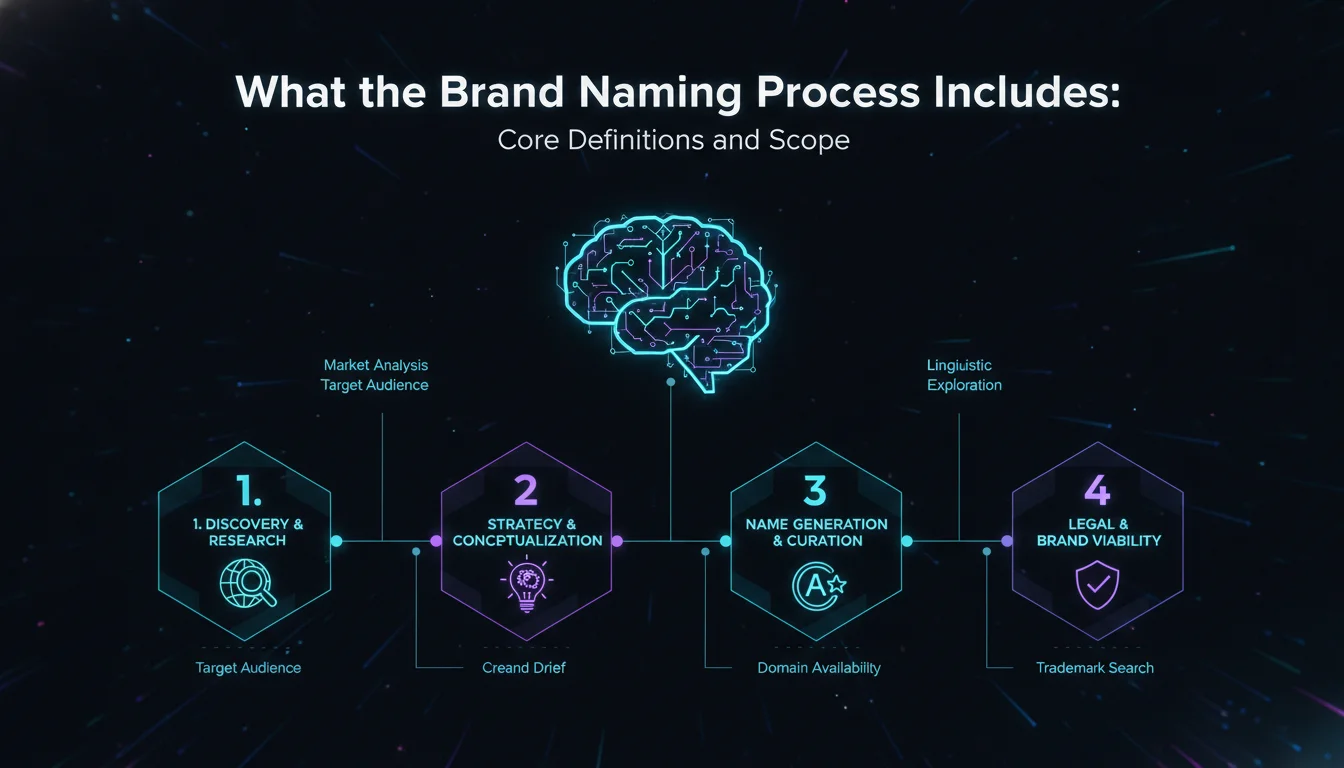
What the Brand Naming Process Includes: Core Definitions and Scope
A Working Definition
A brand naming is a structured method for moving from strategic inputs to a legally available, linguistically sound, culturally acceptable, and strategically aligned name. It begins with positioning and ends with a validated shortlist, not with a clever whiteboard list.
A naming brief is a written document that defines uniqueness, brand context, and architecture before creative work begins. This definitional step prevents the team from generating names that sound interesting but don’t support the business strategy.
The Name Is Not the Whole Story
Lexicon Branding cautions that a good company name does not tell the full brand story. The name is the foundation, but the full brand story is built on the unique value proposition, visual identity, brand voice, customer experiences, and consistent messaging across touchpoints. This distinction prevents teams from overloading a name with too much narrative. A name should open a doorway, not describe the entire house.
Art Meets Science
According to Atlassian, brand naming is as much a science as it is an art. Karan Baboota, Senior Manager of Brand Strategy at Atlassian, helped establish the company’s naming principles and worked with his team to name Atlassian’s new AI product. Smashbrand makes a stronger claim: in 99% of cases, creating a solid brand name requires a deep understanding of naming science and applying it systematically. A naming process should therefore include both creative divergence and analytical convergence.
“Brand naming is as much a science as it is an art. Like baking, naming has a science to it – a set of recipes and essential ingredients. But the winning treat has your unique flavor and signature sprinkles mixed in.” – Karan Baboota, Senior Manager of Brand Strategy, Atlassian
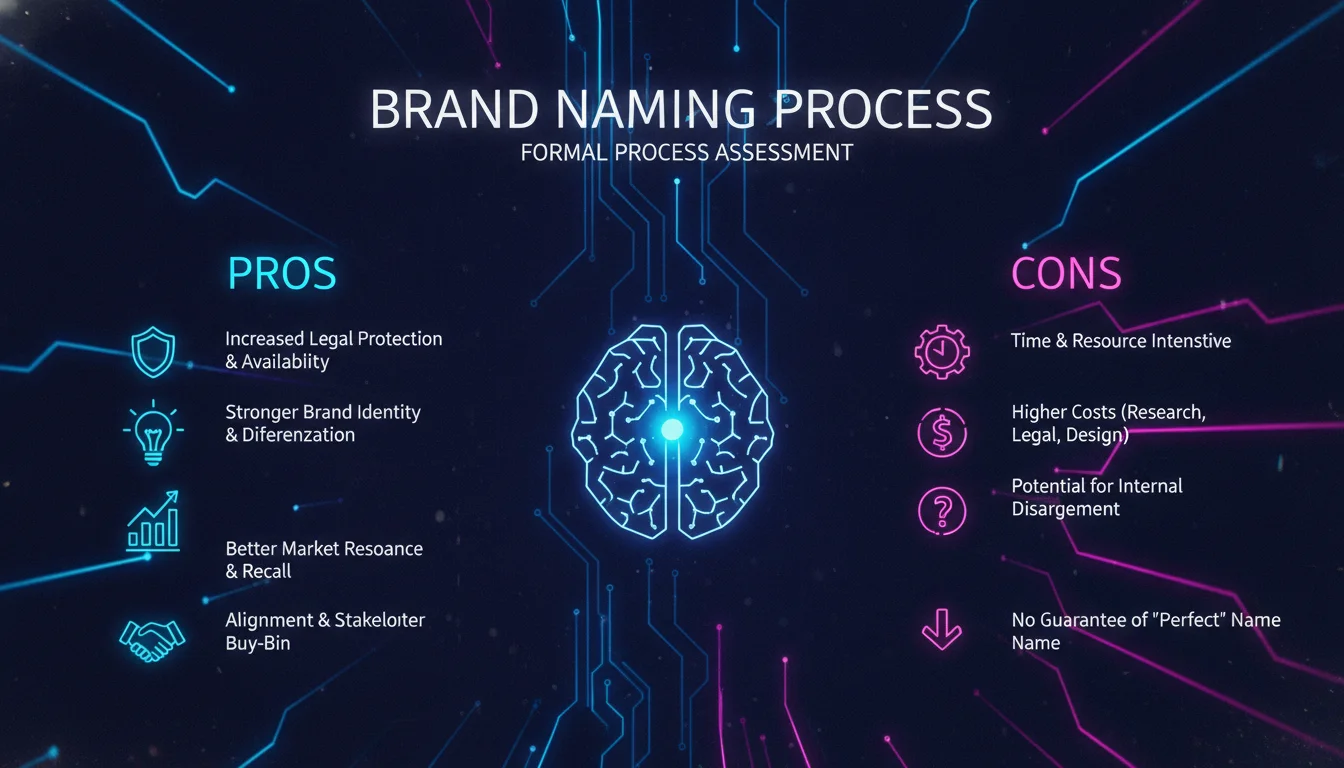
Pros and Cons of Running a Formal Brand Naming Process
Pros
- Reduces legal risk. Early trademark screening catches conflicts before you invest in full brand identity development.
- Produces stronger creative output. A strategy brief constrains brainstorming in the right ways, pushing teams toward names that are both distinctive and strategically aligned.
- Creates a repeatable system. Whether you’re naming a startup, a product line, or a sub-brand, a documented process scales across projects.
- Builds stakeholder confidence. A structured process with clear decision filters is easier to defend to founders, boards, and clients than a gut-feel shortlist.
- Improves memorability outcomes. Applying memory science principles, like Lexicon’s visualization test, produces names that consumers actually retain.
Cons
- Takes more time upfront. A rigorous process with audience research, competitor analysis, and trademark screening can span multiple weeks, which frustrates teams with tight launch timelines.
- Can feel constraining creatively. A tight naming brief sometimes narrows the creative field too early, especially for teams that prefer open-ended exploration.
- Requires cross-functional coordination. Legal, marketing, and leadership all need to be aligned, and misaligned stakeholders can stall the process at any phase.
- Trademark availability is never guaranteed. Even a thorough screening process can miss conflicts, especially across international markets.
The Four-Step Brand Naming Process: A Lean Framework
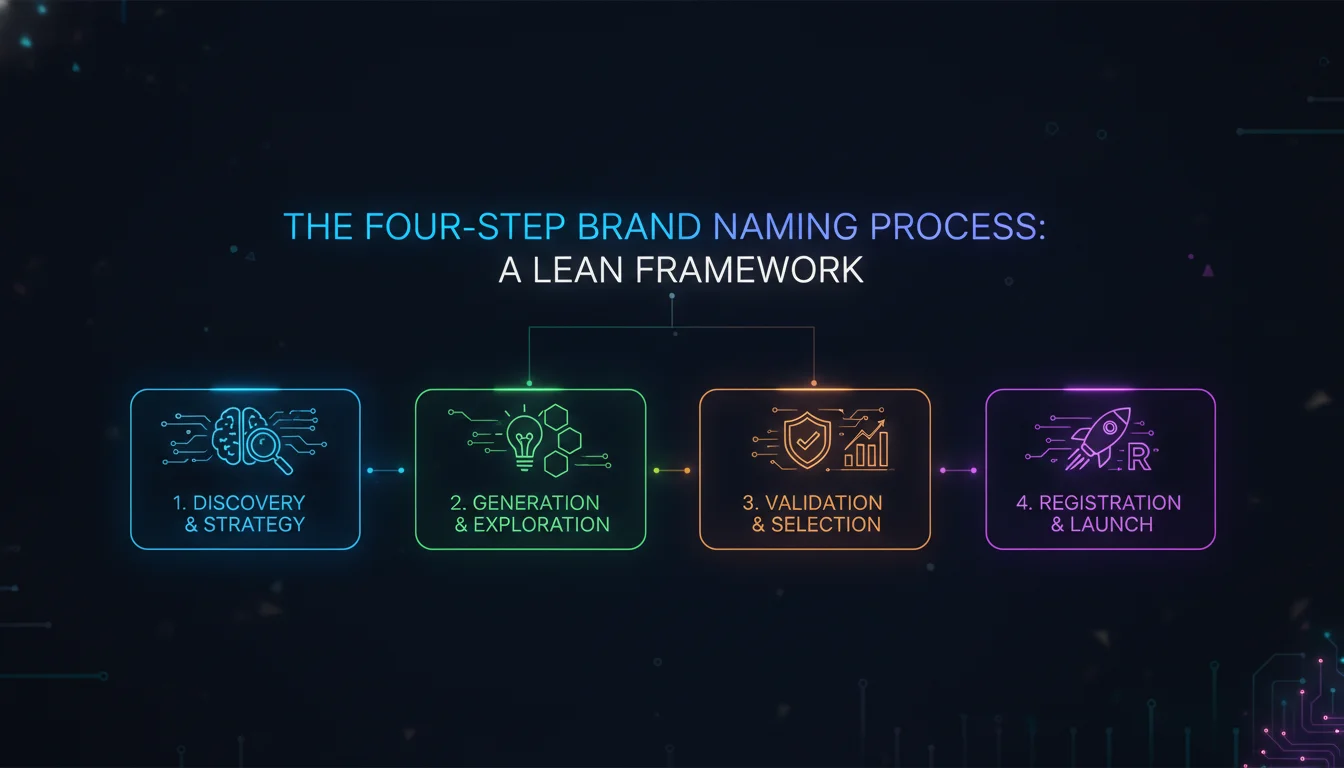
Establish a Naming Strategy Before Creative Work
The four-step this type of process starts with strategy, not a blank whiteboard. Startup Stash contributor Devesh Uba recommends beginning with a clear naming brief structured around his UBA Framework: Uniqueness, Brand Context, and Architecture & Construction. Uniqueness captures the differentiator and key messages. Brand context covers personality, audience, and naming conventions. Architecture and construction asks whether the name should be descriptive, suggestive, abstract, a real word, compound, or coined. Uba suggests sticking with suggestive and compound names because real words are often taken, while coined and abstract names require significant financial investment to build recognition.
This framework answers three questions before creative work begins: what makes the brand different, who will use and say the name, and what structural type fits the market.
Brainstorm Related Words and Concepts
The second step in the Startup Stash process is brainstorming related words and concepts. It follows strategy, not precedes it. The sequence matters: a naming brief constrains the brainstorm so that generated names map to the brand’s unique value proposition and desired emotional response. Naming expert Alexandra Watkins, as quoted in the Startup Stash article, says names that make us smile are infectious because they are the ones we talk about, tweet, and repeat.
When the Four-Step Process Works Best
The four-step this kind of process is useful for startups, internal product launches, and projects with tight timelines. It also aligns with Al Ries and Jack Trout’s argument, cited by Startup Stash, that naming is the single most important marketing decision a company can make. The four-step model is leanest on trademark, cultural, and SEO checks, so teams may need to add those screens explicitly.
The Five-Step Brand Naming Process: Lexicon’s Method
Avoid Groupthink as the Entry Point
Lexicon Branding’s five-step brand naming begins with avoiding groupthink. The agency argues that large group brainstorming leads to predictable, overly clever name ideas. In subjective exercises such as naming, it is critical to remove groupthink from the equation. Small teams significantly outperform larger groups in the naming process, which means the work should be run by a focused core team rather than a consensus workshop.
Memory Science and the Mad Cow Test
Step two in Lexicon’s process is to make the name easy to remember. There is science behind memory: people remember what they understand and can visualize. Lexicon uses the example of Mad Cow disease, which is memorable, versus Bovine Spongiform Encephalopathy, the scientific expression, which is not. This principle is central to any naming process because a complex name will be ignored by consumers. Our brains don’t like complex ideas; they like to think fast.
What the Five-Step Sequence Reveals
Lexicon describes the full process as grounded in a deep understanding of the brand’s essence and target audience. The outcome should be a name that is easy to remember, trademarkable, linguistically and culturally sound, and resonant with the target audience. The five-step structure treats trademark and cultural screening as core, not optional. The public excerpt of the Lexicon article focuses on the first two steps, so teams should consult the full source before adopting the model.
The Six-Step Brand Naming Process: Agency Fifty3’s Expansion
Meet Your Audience
Agency Fifty3 lists meeting your audience as the first essential step. The agency explains that brands that are authentically like us are the brands we’re most comfortable having in our lives. A this type of process should therefore start with audience knowledge: the voice that will connect, the colors and visuals they will relate to, and the vibe the brand should create. This knowledge shapes naming structures, parts of speech, and linguistics.
Understand Your Competition and Recognize Naming Conventions
Competitor research reveals patterns that are familiar to the audience, examples to like or avoid, and words to avoid because they look similar or confusing. Agency Fifty3 gives a real-world example: The Heights, The Bryn, The Park, The Retreat, and The Valley. All follow a “The xx” structure, use a short second word, and draw on natural or geographic inspirations. The brand owner must decide whether to follow these patterns or break them.
Speak, Trademark, SEO, and Story
The remaining essential steps in the six-step model are to speak (test how the name sounds aloud), make time for trademark availability, consider SEO, and use the name to tell a story. Trademark availability is not a final admin task; Agency Fifty3 frames it as one of the six essentials. SEO consideration includes keyword and digital asset checks. Storytelling connects the name back to the audience and differentiation.
A Synthesized Seven-Phase Brand Naming Process
The Seven Phases at a Glance
- Define strategic positioning and naming brief. Write down the brand’s unique value proposition, target audience, desired emotional response, and naming style preferences. This corresponds to Startup Stash’s UBA framework and Atlassian’s discovery phase.
- Research audience, culture, and competitor patterns. Use competitor examples like The Heights and The Bryn to map conventions. Check cultural influences to avoid offensive or insensitive names, as Smashbrand advises.
- Generate candidate names. Run a structured creative session with a small team, not a large group. Aim for suggestive and compound names first because real words are often taken and abstract names require more investment to build recognition.
- Screen for memory, pronunciation, and linguistic clarity. Apply Lexicon’s test: if the name is harder to process than “Mad Cow” versus “Bovine Spongiform Encephalopathy”, simplify it.
- Check trademark availability and legal clearance. Screen the shortlist early and concurrently. More than 569,270 names were registered in the US in a single year, so availability is scarce.
- Consider SEO and digital asset availability. Check domain, social handles, and search visibility alongside legal clearance.
- Validate with target audiences. Test the final shortlist with representative consumers or buyers before finalizing, as Swiffer was tested with busy parents before launch.
Why Seven Phases Rather Than Five or Six
Seven phases are not inherently better; they’re a synthesis. The four-step model compresses strategy and creative. Lexicon’s five-step model emphasizes memory science and group dynamics. Agency Fifty3’s six-step model adds SEO and storytelling. A seven-phase brand naming process makes the validation loop explicit and includes digital asset checks without treating them as a separate strategy.
Decision Filters Within Each Phase
- Strategic fit: Does the name reflect the unique value proposition?
- Memorability: Is it easy to understand and visualize?
- Trademark availability: Is it legally clear?
- Cultural safety: Is it free from offensive interpretations?
- Digital availability: Are domain and social handles obtainable?
Comparing the 4-Step, 5-Step, 6-Step, and Seven-Phase Frameworks
How the Frameworks Overlap
| Framework | Source | Steps | Distinctive Emphasis |
|---|---|---|---|
| UBA naming process | Startup Stash | 4 | Strategy brief before brainstorming; uniqueness, brand context, architecture |
| Brand naming: 5-step process | Lexicon Branding | 5 | Avoiding groupthink; memory science; trademark and cultural soundness |
| Brand naming strategy essentials | Agency Fifty3 | 6 | Audience fit; competitor patterns; speech; trademark; SEO; storytelling |
| Synthesized seven-phase framework | This article | 7 | Reconciled sequence with explicit validation and digital asset filters |
Case Patterns: Swiffer, Dasani, Google, Nike
Swiffer, developed for P&G, was tested with busy parents. Before learning product features or benefits, parents heard the name Swiffer and imagined an easier, more joyful cleaning experience. Lexicon Branding uses this example to show that when you make it easy to imagine, you make it easy to purchase. Dasani was invented using the Latin word for health, San, in the middle. In a category filled with Crystal Springs, Deer Park, and Poland Spring, Dasani created differentiation and noteworthiness.
Google stood out in a sea of mundane search engine brands like Infoseek and Web Crawler because it looked different, sounded different, and acted different. Nike renamed from Blue Ribbon Company to a name representing the Greek goddess of victory, according to Smashbrand. The Heights, The Bryn, The Park, The Retreat, and The Valley show that even small naming pattern decisions can create a recognizable category convention.
The Human Psychology Behind Great Brand Names
Human psychology shapes every phase of the brand naming process in ways most teams underestimate. According to Smashbrand, a well-crafted brand name can evoke emotions, create a sense of identity, and establish a brand’s positioning in the minds of consumers. When people hear “Nike,” the first thing that comes to mind is sports and athletes. That association didn’t happen by accident. It was built through a name that carries meaning, backed by consistent brand behavior over decades.
Cultural influences matter just as much. A name that is offensive or insensitive to a particular culture can damage reputation, reduce sales, and create legal exposure, per Smashbrand’s naming science framework. This is why cultural screening belongs inside the brand naming process, not as an afterthought once a name is already loved internally.
The practical takeaway: test your shortlist across the cultures and languages of your target markets before you fall in love with any single option.
Brand Naming Process vs. Brand Naming Generator: What’s the Difference?
A brand naming generator produces word combinations quickly. A brand naming process produces strategically defensible names that survive legal, cultural, and audience scrutiny. These are not the same thing, and confusing them is one of the most common mistakes early-stage brands make.
Generators are useful for sparking ideas in the early creative phase, specifically step three of our seven-phase framework. They are not a substitute for a naming brief, trademark screening, or audience validation. Think of a generator as one tool inside a larger system, not the system itself.
If you’re searching for a brand naming process template or a brand naming framework to structure your work, start with the UBA Framework from Startup Stash or Agency Fifty3’s six-step essentials. Both are documented, repeatable, and free to adapt.
Make the Brand Naming Process Repeatable
The brand naming process is not a single brainstorm. It’s a structured system that connects positioning, creative generation, legal screening, and validation. Whether you use four, five, six, or seven phases, the non-negotiables are the same: strategic clarity, memorable structure, trademark availability, cultural safety, and audience resonance. Start with a written brief, involve a small team, screen early, and test before you invest in the full brand identity.
At Emin Media, we’ve run this process for brands across industries, and the results are consistent: names built on strategy outperform names built on instinct. If you’re ready to build something that lasts, explore our branding services or read our guide on brand identity development to see how naming fits into the bigger picture.
Ready to name something bold? Contact Emin Media for a free brand consultation and let’s build a name worth owning.
Frequently Asked Questions
How do I start a brand naming process?
Start with a naming brief that defines uniqueness, brand context, and architecture before any creative work begins. Then research your audience and competitor naming patterns. Only after that foundation is set should you generate candidate names.
How long does a brand naming process take?
The timeline varies by team size, trademark complexity, and number of decision-makers. Plan for multiple weeks rather than a single afternoon. Projects that rush the process tend to skip trademark screening or audience validation, which creates expensive problems later.
What is the most important step in a brand naming process?
Al Ries and Jack Trout argue naming overall is the single most important marketing decision a company can make. Operationally, the most critical step is the written strategy brief. Without it, brainstorming drifts into groupthink and produces predictable, forgettable ideas.
Can a brand naming process guarantee trademark availability?
No process can guarantee availability. A structured approach can screen names early and reduce risk significantly, but final clearance requires a professional trademark attorney. Lexicon Branding notes that more than 569,270 names were registered in the US in a single year, so conflicts are common and early screening is essential.
What is the difference between a brand name and a trademark?
A brand name is the verbal identity used in marketing and customer experience. A trademark is the legal registration that protects that name as intellectual property, similar in protection to a patent. You can use a brand name without registering it, but registration gives you enforceable rights.
What are the 7 types of brand names?
The reviewed sources reference three primary categories from Jeremy Miller’s framework: descriptive, suggestive, and abstract. Startup Stash also notes compound and coined names as structural variants. For a complete taxonomy of all seven types, consult Miller’s book Brand New Name directly, as the sources reviewed here cover only a subset of his full classification system.
Enjoyed this article?
Contact Emin Media for a free brand consultation and let's create something amazing together.
Get in TouchRelated Articles
Digital Storytelling for Brands: The Complete Guide
Digital storytelling for brands builds real audience connections through narrative. Learn proven techniques, formats, and…
Design Thinking for Marketing: A 2026 Guide
Design thinking for marketing builds campaigns around real user needs. Learn the 5 phases, common…
Creative Direction for Video Shoots: A Complete Guide
Master creative direction for video shoots with proven steps, tools, and strategies that build brand…