Brand Identity vs Logo: Key Differences Explained
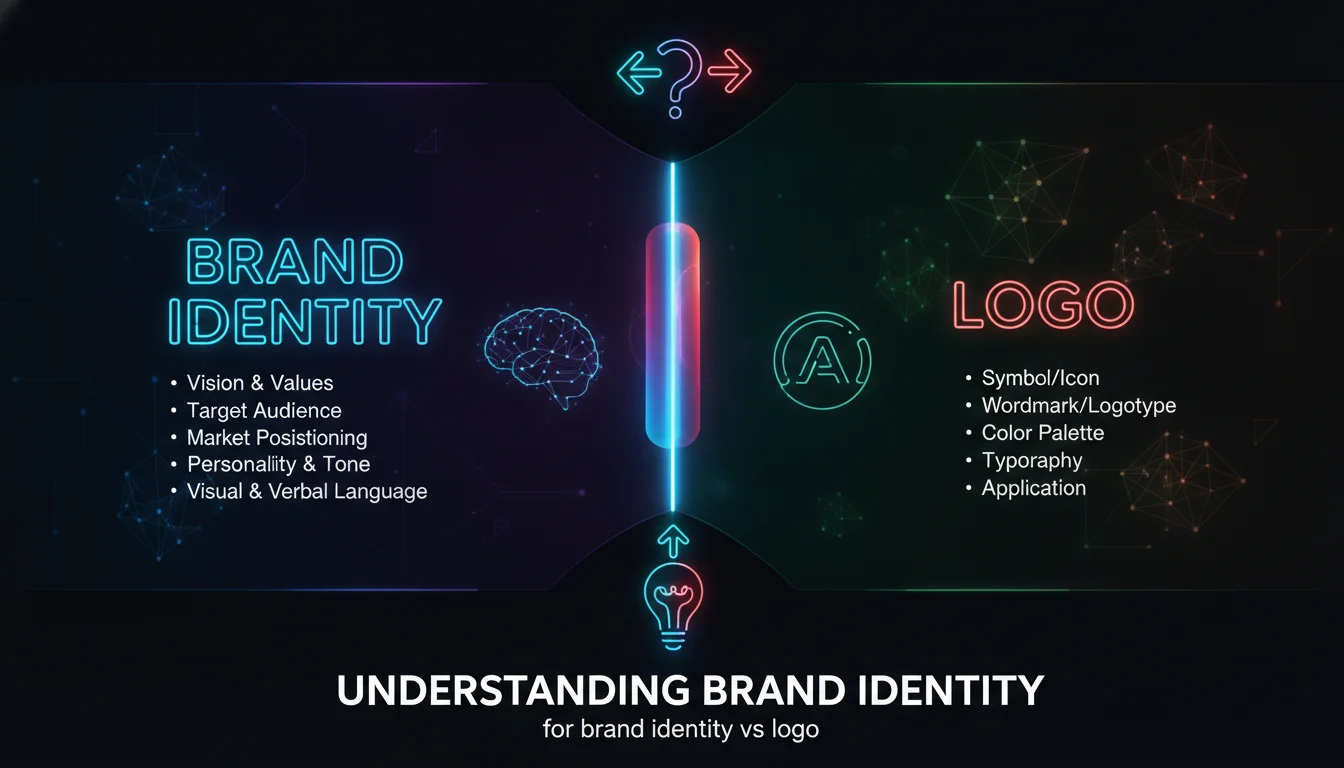
Brand identity vs logo is a distinction that separates brands that last from marks that get forgotten. Brand identity is the complete system of visual, verbal, and emotional elements a company uses to shape perception. A logo is one graphic symbol within that system.
Key Takeaways
- Brand identity encompasses the overall perception of a brand, including visual and verbal elements.
- A logo is a specific graphic symbol representing a brand, serving as its visual anchor.
- Understanding brand identity vs logo is critical for building branding strategies that actually hold up over time.
- Both elements must work together to create a strong, consistent brand presence.
- Brand identity includes multiple components. A logo is just one part of that ecosystem.
- As of 2026, AI-generated visuals and rapid brand scaling make this distinction more urgent than ever.
Understanding Brand Identity
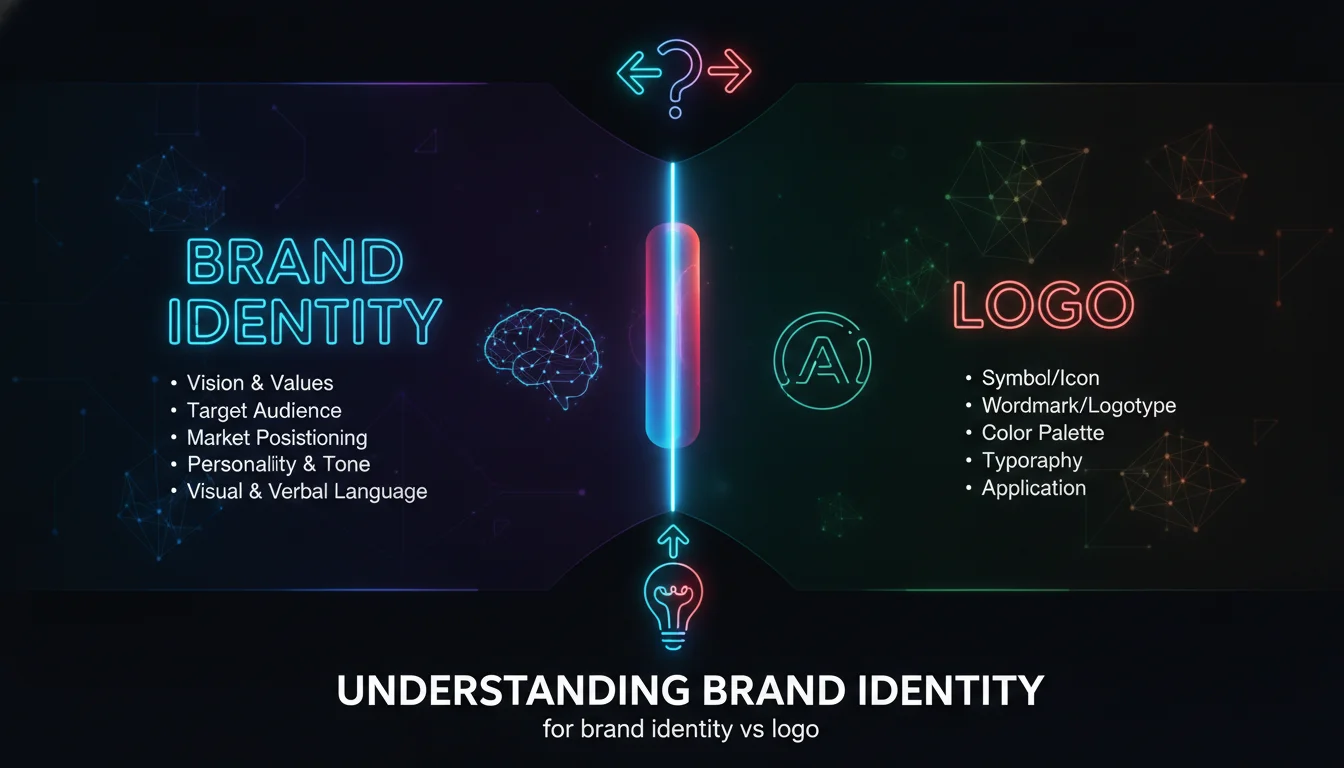
Brand identity is the full collection of elements a company builds to shape how its audience perceives it. It includes visual assets like color palettes, typography, and imagery, alongside verbal elements like tone of voice, messaging, and the values that guide every communication decision.
Components of Brand Identity
- Visual Elements: Logos, color schemes, typography, and imagery that represent the brand visually across every touchpoint.
- Verbal Elements: The tone of voice and messaging style used in communications, reflecting the brand’s personality.
- Brand Values: The core principles that guide the brand’s actions, decisions, and public communications.
- Brand Voice: Whether professional, playful, or bold, the consistent communication style that audiences recognize across channels.
- Mission and Purpose: What the business stands for and why it exists beyond making revenue.
Importance of Brand Identity
A strong brand identity differentiates a company from its competitors and builds the kind of customer loyalty that survives market shifts. According to Forbes, a well-defined brand identity significantly increases customer recognition. Per Seth Godin, cited by MarketingProfs: “A brand is a set of expectations, memories, stories, and relationships that, taken together, account for a consumer’s decision to choose one product or service over another.” That definition makes clear why identity runs so much deeper than a single graphic mark.
Defining a Logo
A logo is an easily recognizable graphic symbol used by companies, organizations, and individuals to create instant public recognition. It is the visual entry point to a brand’s full identity, and often the first impression a consumer forms.
Characteristics of a Logo
- Simplicity: A good logo is clean and immediately recognizable, making it easy to remember across contexts.
- Versatility: Logos must work across mediums, from business cards to billboards to app icons.
- Relevance: The logo should communicate something true about the brand’s industry, audience, and values.
Role of a Logo in Branding
The logo is the face of the brand. It is typically the first point of contact for consumers and plays a significant role in recognition and recall. A well-designed logo evokes emotions and associations that align with the broader brand identity. The Nike swoosh, for example, is not just a mark. It carries decades of associations with athleticism, performance, and aspiration. The CHANEL interlocking C’s work the same way: the symbol alone triggers a full emotional response rooted in luxury and French fashion heritage. That response is brand identity doing its job. The logo is just the trigger.
Brand Identity vs Logo: Key Differences
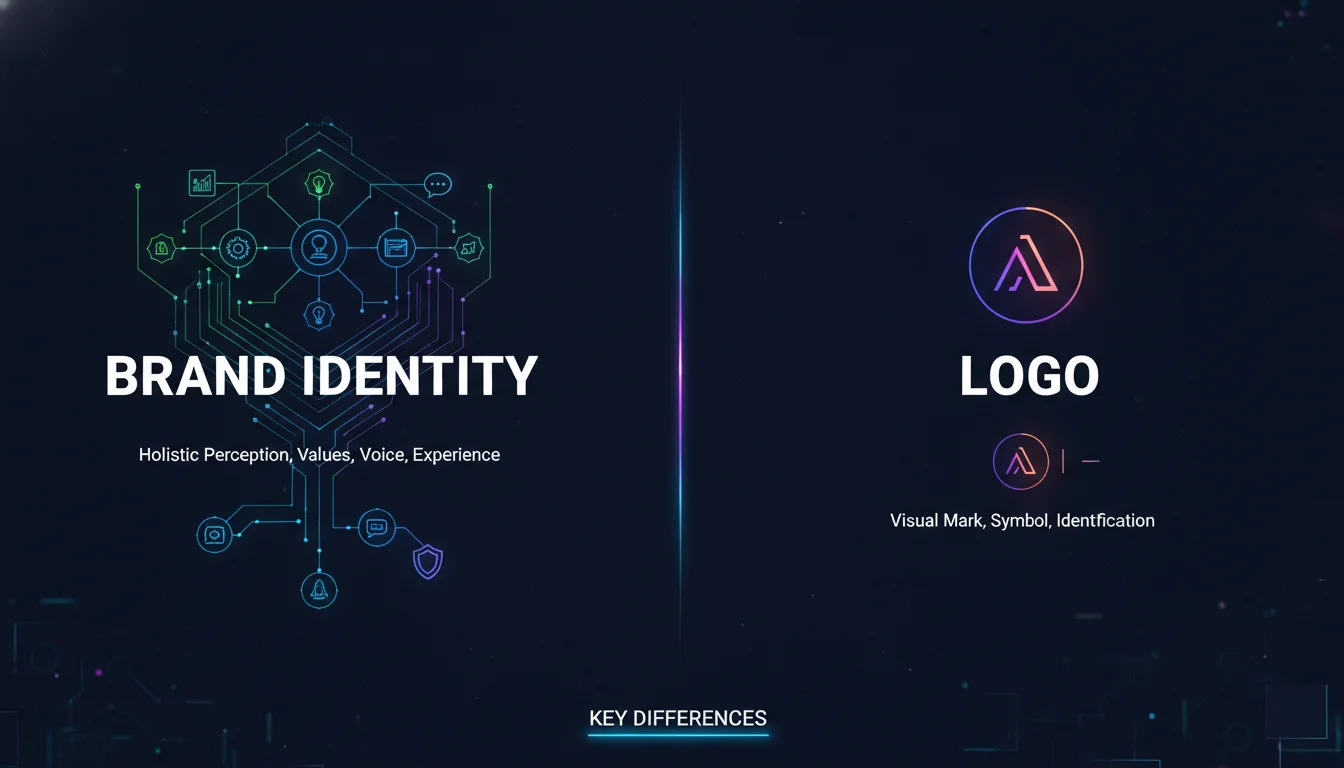
The brand identity vs logo distinction comes down to scope, function, and emotional depth. Both are essential. Neither replaces the other.
| Dimension | Brand Identity | Logo |
|---|---|---|
| Scope | Complete system: visuals, voice, values, mission | Single graphic mark |
| Function | Shapes overall brand perception | Triggers recognition and recall |
| Emotional Role | Builds deep connection across multiple touchpoints | Serves as a visual cue for stored associations |
| Tangibility | Expressed through stationery, tone, campaigns, packaging | A single file: SVG, PNG, or wordmark |
| Longevity | Evolves with the business over years | Can be refreshed without full rebrand |
| Investment Level | Higher: strategy, design system, guidelines | Lower: focused design project |
Scope
Brand identity encompasses a wide range of elements, including the logo, while the logo is a singular component of that identity. Brand identity is about the overall perception of the brand. The logo is a specific visual representation within that larger system.
Function
Brand identity creates a comprehensive image of the brand that resonates with consumers across every channel and interaction. The logo functions as a recognizable symbol that represents the brand in its most simplified form, designed for instant recall.
Emotional Connection
Brand identity builds emotional connection through multiple touchpoints: packaging, customer service tone, social media voice, and campaign storytelling. The logo primarily serves as a visual cue that triggers the recognition and recall those touchpoints have already built.
How Brand Identity Actually Works: The Mechanics
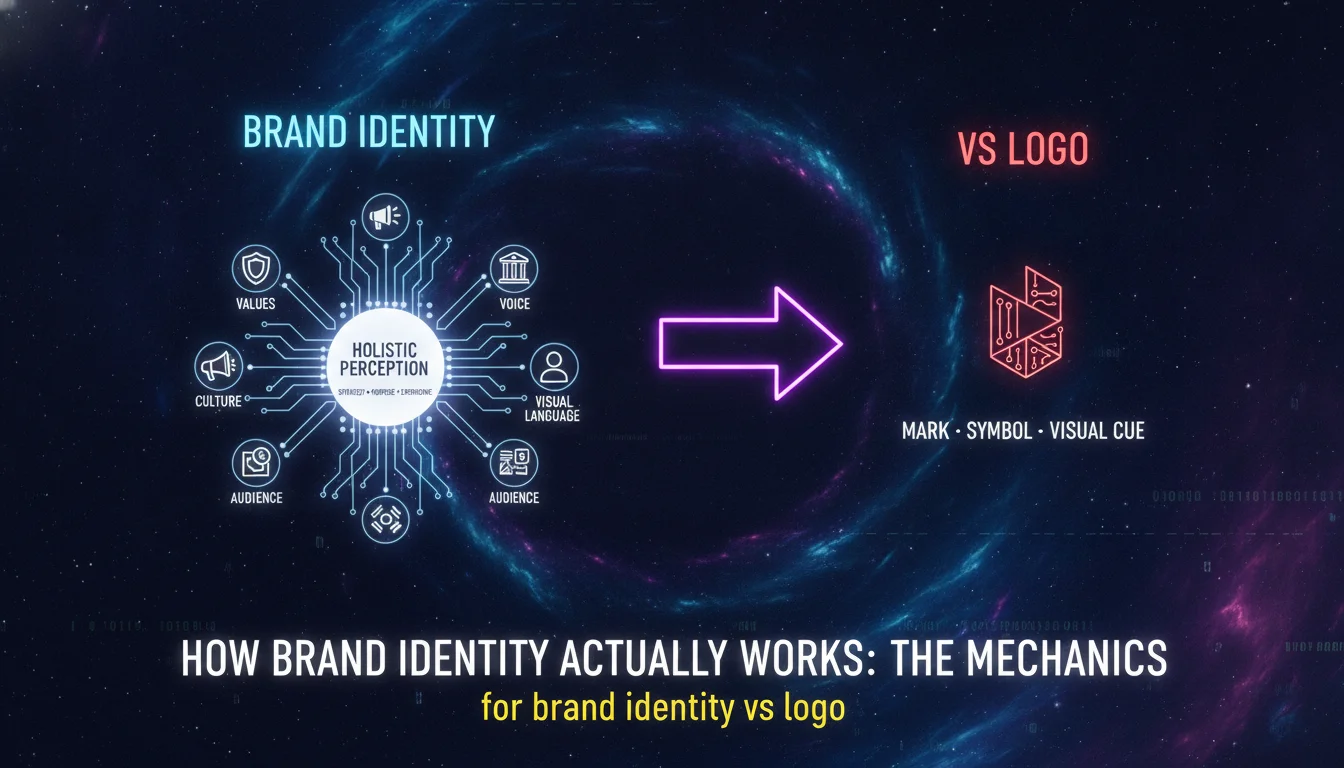
Brand identity works by creating a consistent sensory and emotional experience across every place a customer encounters the brand. Think of it as a system with interdependent parts, each reinforcing the others.
Start with brand strategy: the positioning, target audience, and core values. From that foundation, a creative team develops the visual language: color palette, typography hierarchy, photography style, and illustration approach. Then comes the verbal layer: tone of voice guidelines, messaging frameworks, and taglines. Finally, all of these elements get documented in a brand style guide, the rulebook that keeps every designer, copywriter, and social media manager aligned.
The logo lives inside this system. It does not define the system. When Apple uses its bitten apple mark, the mark works because decades of product design, retail experience, advertising, and packaging have loaded it with meaning. Strip away all of that context and the logo is just a shape.
“A brand is no longer what we tell the consumer it is – it is what consumers tell each other it is.” – Scott Cook, Co-founder of Intuit
This is why brand identity requires ongoing management. According to MarketingProfs, branding is an active endeavor: sending campaigns, publishing content, and shaping every customer interaction. The logo is static. Brand identity is alive.
How to Apply This: Building Brand Identity vs Logo in Practice
Applying the brand identity vs logo distinction means making deliberate decisions at each stage of your brand’s development. Here are the concrete steps we walk clients through at Emin Media.
- Audit what you have. List every visual and verbal asset your brand currently uses. Note inconsistencies in color, font, tone, and messaging. This audit reveals whether you have a brand identity system or just a logo floating in a vacuum.
- Define your brand strategy first. Before any design work begins, clarify your positioning, your audience, and your core values. These decisions drive every visual and verbal choice that follows.
- Build your visual system. Develop a color palette, typography scale, and imagery style that express your brand strategy. The logo comes out of this system, not before it.
- Write your brand voice guidelines. Document how your brand sounds: formal or casual, technical or accessible, warm or authoritative. Apply this consistently across social media, email, and customer service.
- Create a brand style guide. Consolidate all visual and verbal rules into one document. This is the tool that keeps your brand identity consistent as your team and your channels grow.
- Test across touchpoints. Apply your brand identity to a business card, a social post, a website header, and an email signature. If it holds together visually and tonally across all four, your system is working.
Common Mistakes to Watch Out For
Most brand identity vs logo confusion leads to predictable, costly errors. Here are the ones we see most often.
- Treating a logo redesign as a rebrand. Changing your logo without updating your messaging, color system, and brand voice is like repainting a house with a cracked foundation. The surface looks different. The problems remain.
- Building a logo before defining strategy. A logo designed without a clear brand strategy is just decoration. It cannot communicate values that were never defined.
- Inconsistent application. A strong logo paired with inconsistent fonts, random color choices, and a shifting tone of voice destroys the trust the logo was meant to build. Consistency is the product.
- Confusing brand image with brand identity. Brand identity is what you put out. Brand image is what your audience perceives. The gap between the two is where brand problems live. Closing that gap requires ongoing attention to both your identity system and your audience’s actual experience.
- Skipping the brand style guide. Without documented guidelines, every new hire, freelancer, or agency partner will interpret your brand differently. The style guide is not optional. It is the infrastructure.
- Over-investing in logo, under-investing in identity. A beautifully crafted logo sitting inside a weak brand system will underperform every time. The system amplifies the mark. Without the system, the mark is just a pretty shape.
A Real-World Scenario: What This Looks Like in Practice
Consider a sustainable skincare startup launching in 2026. They commission a logo: a clean, minimal leaf mark in deep green with a modern sans-serif wordmark. It looks sharp. It photographs well. They put it on their packaging and call it done.
Six months later, their Instagram feels disconnected from their website. Their email newsletters use a different shade of green. Their captions swing between clinical and casual depending on who wrote them that week. Customers recognize the logo but cannot describe what the brand actually stands for.
The problem is not the logo. The logo is fine. The problem is the absence of a brand identity system. There are no color hex codes documented. No typography rules. No tone of voice guidelines. No photography style. The logo is doing all the work alone, and a single mark cannot carry that weight.
When we work with brands like this at Emin Media, the fix is not a new logo. It is building the system around the one they already have: defining the full color palette, locking in typography, writing voice guidelines, and creating templates that make consistency effortless. Within a quarter, the brand feels cohesive. The logo starts to mean something because the system around it has given it context.
“The way a company brands itself is everything. It will ultimately decide whether a business survives.” – Sir Richard Branson
Brand Identity vs Logo: The 2026 Context
As of 2026, the brand identity vs logo question has become more urgent, not less. AI design tools can generate a logo in seconds. That means a distinctive mark is no longer a competitive advantage on its own. What AI cannot replicate is the strategic depth of a real brand identity: the values, the voice, the cultural positioning, the consistent human experience across every channel.
Creative industry observers note that brands winning attention this year are the ones with systems, not just symbols. The Cannes Lions creative community has increasingly recognized campaigns built on coherent brand worlds rather than clever one-off visuals. The mark matters. The world around it matters more.
For startup founders and marketing managers building brands right now, this means the investment calculus has shifted. A logo is table stakes. Brand identity is the actual differentiator.
When to Focus on Brand Identity vs Logo
Choosing where to focus in the brand identity vs logo equation depends on your business stage and your specific branding goals.
When to Focus on Brand Identity
- If you are launching a new brand, establishing a strong brand identity should come before any logo work begins.
- During a rebrand, align all identity elements to reflect your new strategic direction, not just the visual mark.
- If your audience is not connecting with your brand, revisiting your full identity system will reveal where the disconnect lives.
When to Focus on Logo Design
- If you already have a strong brand identity system but your logo feels dated or off-strategy, a focused logo refresh makes sense.
- When entering a new market, a logo update can signal the shift without requiring a full identity overhaul.
- If your logo is not performing across digital formats (too complex for app icons, illegible at small sizes), a technical redesign is warranted.
Pros and Cons
Pros of Investing in Full Brand Identity
- Creates consistent, recognizable experiences across every customer touchpoint
- Builds emotional connection that drives loyalty beyond individual transactions
- Gives your team clear guidelines, reducing creative guesswork and off-brand decisions
- Positions the brand to scale without losing coherence
- Makes the logo itself more powerful by giving it a system to live within
Cons of Investing in Full Brand Identity
- Requires more upfront time, strategic thinking, and budget than a logo-only project
- Demands ongoing management to stay current as the business and market evolve
- Can feel overwhelming for early-stage startups with limited resources
Frequently Asked Questions
What is the main difference between brand identity and logo?
Brand identity is the complete system of visual, verbal, and emotional elements that define how a brand is perceived. A logo is one graphic symbol within that system. The brand identity vs logo distinction matters because a logo alone cannot build the consistent experience that earns customer trust.
What are the 5 P’s of brand identity?
The 5 P’s of brand identity are Purpose, Positioning, Personality, Perception, and Promotion. Together they define why the brand exists, where it sits in the market, how it communicates, how audiences experience it, and how it reaches them. Each P informs the visual and verbal decisions that make up the full identity system.
What is the difference between brand identity and brand image?
Brand identity is what a company intentionally puts out: its logos, colors, voice, and values. Brand image is what the audience actually perceives and feels. The gap between the two is where brand problems live, and closing it requires consistent identity management over time.
What is an example of a strong brand identity?
Apple is a frequently cited example. The brand identity includes the minimalist product design, the clean retail environment, the specific typography, the tone of its advertising, and the values of simplicity and creativity. The logo is one element of that system. Remove the system and the logo loses most of its meaning.
Can a brand have a strong identity without a logo?
Yes, though it is rare in practice. A brand can build strong recognition through voice, values, and consistent experience even before a logo is finalized. That said, a logo serves as a critical visual anchor that makes recognition faster and more durable across channels.
Is it necessary to invest in both brand identity and logo design?
Yes. A logo without a brand identity system is a mark without meaning. A brand identity without a strong logo lacks a visual anchor for recognition. Both work together, and the most effective approach is to build the identity strategy first, then design the logo as an expression of that strategy.
Enjoyed this article?
Contact Emin Media for a free brand consultation and let's create something amazing together.
Get in TouchRelated Articles
Brand Identity Design Trends 2026: Bold Moves
Explore 2026 brand identity design trends: motion-first systems, expressive type, AI-human craft, and sensory branding…
Brand Identity Design Packages: Full Guide 2026
Explore brand identity design packages: what's included, how much they cost, and how to choose…