Brand Differentiation Strategy: Build Your Moat
A brand differentiation strategy is the deliberate process of identifying and communicating unique brand qualities that set your business apart from competitors. It combines positioning, messaging, and experience to make your brand the obvious choice in a crowded market.
Key Takeaways
- A differentiation strategy must be real, relevant, and consistently expressed across every touchpoint to work.
- According to Gartner research cited by Frontify, 46% of customers cannot tell the difference between most brands’ digital experiences, making distinctiveness a survival priority.
- The strongest strategies layer a vertical proof point (measurable quality) with a horizontal emotional or identity appeal.
- Pricing power is the clearest signal that your this type of strategy is working: if you can raise prices without losing customers, you have a moat.
- AI-generated sameness is the defining competitive risk of 2026. Original research, proprietary language, and operational choices are the antidote.
- Most differentiation strategies fail not because they were wrong, but because they were never fully operationalized into daily behavior.
“Brand differentiation is not a tactic. It is not a visual exercise. It is the single strategic decision that determines whether everything else you do in marketing, design, culture, and communication works.” – David Brier, branding expert and author of Brand Intervention
That framing from Rising Above The Noise captures the stakes precisely. As of 2026, AI-generated content floods every channel, and the competitive landscape has become a mirror maze. Without a clear this kind of strategy, brands fade into sameness faster than ever before.
What Is a Brand Differentiation Strategy?
Definition and Core Components
A brand differentiation is the structured approach a company uses to identify, articulate, and amplify the characteristics that make its offering distinct. According to Frontify, brand differentiation is “the process through which a company identifies and communicates the unique qualities and characteristics of its brand.” Those unique qualities can include product features, visual identity, tone of voice, customer experience, pricing architecture, or a deeper emotional and functional promise.
The strategy has three core components. First, differentiation must be based on a real and defensible source of difference, not just a tagline. Second, it must be relevant to the target audience’s priorities. Third, it must be consistently expressed across every touchpoint, from packaging and website to sales scripts and customer support. A differentiation strategy without all three components is a slogan, not a strategy.
Why Brand Differentiation Strategy Matters in 2026
Consumer choice has expanded, and digital experiences have become increasingly interchangeable. The Frontify guide cites Gartner research showing 46% of customers cannot tell the difference between most brands’ digital experiences. When nearly half of your audience sees little distinction between you and your competitors, the revenue risk is direct: choice becomes arbitrary, loyalty erodes, and price becomes the default tiebreaker.
A well-executed this type of strategy counters this by giving customers cognitive shortcuts. It reduces the effort required to choose, builds memory structures, and creates emotional anchors that transcend functional comparison. In a marketplace where attention is the scarcest resource, clarity of difference is the most persuasive asset.
Differentiation vs. Positioning vs. Branding
These terms are related but not interchangeable. Positioning is the space a brand occupies in the customer’s mind relative to competitors. Branding is the full system of identity, voice, and experience that expresses that position. Brand differentiation is the strategic act of choosing and proving the difference that makes positioning credible. In practice, this kind of strategy is the input; positioning and branding are outputs. Without a clear differentiation strategy, positioning becomes an empty claim and branding becomes decoration.
The Strategic Foundation of Differentiation
Synthesizing Multiple Differentiation Lenses
Most brands search for a single differentiator and stop. The more robust approach is to synthesize multiple lenses from the competitive evidence. Simon-Kucher distinguishes between vertical differentiation, being objectively better on measurable quality or features, and horizontal differentiation, appealing to subjective preferences such as taste, aesthetics, or values. A strong brand differentiation often layers a vertical proof point with a horizontal emotional or identity appeal.
Rolex is the clearest illustration of this synthesis. The brand combines vertical differentiation through engineering precision, including more than 500 patents since 1905 and the creation of the first fully waterproof watch, with horizontal differentiation through Swiss luxury heritage and design language. Neither alone would be as powerful; together they create a nearly unassailable brand position. This synthesis principle applies across categories: B2B software companies can differentiate on measurable uptime while also owning a distinctive point of view about the future of work.
The Role of Consumer Psychology
Differentiation works because human decision-making relies on contrasts, not absolute evaluations. According to Branding Strategy Insider, choosing among multiple options is always based on differences, implicit or explicit. Psychologists note that vividly differentiated differences anchored to a product can enhance memory because they can be appreciated intellectually.
This is why a differentiation strategy must go beyond feature lists. It must create a perceptual distinction that sticks in memory. The most memorable brands encode their difference in stories, sensory cues, and consistent rituals. The sound of a Harley-Davidson engine or the unboxing experience of an Apple product are sensory differentiators that reinforce the brand promise at a subconscious level. These elements cannot be copied without seeming derivative.
The Moat Principle: Differentiation as Defense
Warren Buffett frames brands as moats: competitive defenses that protect the economic castle. His investment approach at Berkshire Hathaway, which owns Coca-Cola, GEICO, Dairy Queen, See’s Candies, and Duracell, is built on finding businesses with wide and long-lasting moats. For Buffett, the ultimate test of a moat is pricing power: the ability to raise prices without losing customers to a competitor.
Translated to brand strategy, your this type of strategy is your moat. Build it wide and deep, or competitors will flood the castle. If you hesitate to raise prices because you fear customer defection, you are likely operating as a commodity, not a differentiated brand. The moat principle turns differentiation from a marketing exercise into a financial imperative.
“The single most important decision in evaluating a business is pricing power. If you’ve got the power to raise prices without losing business to a competitor, you’ve got a very good business.” – Warren Buffett
10 Proven Brand Differentiation Strategies
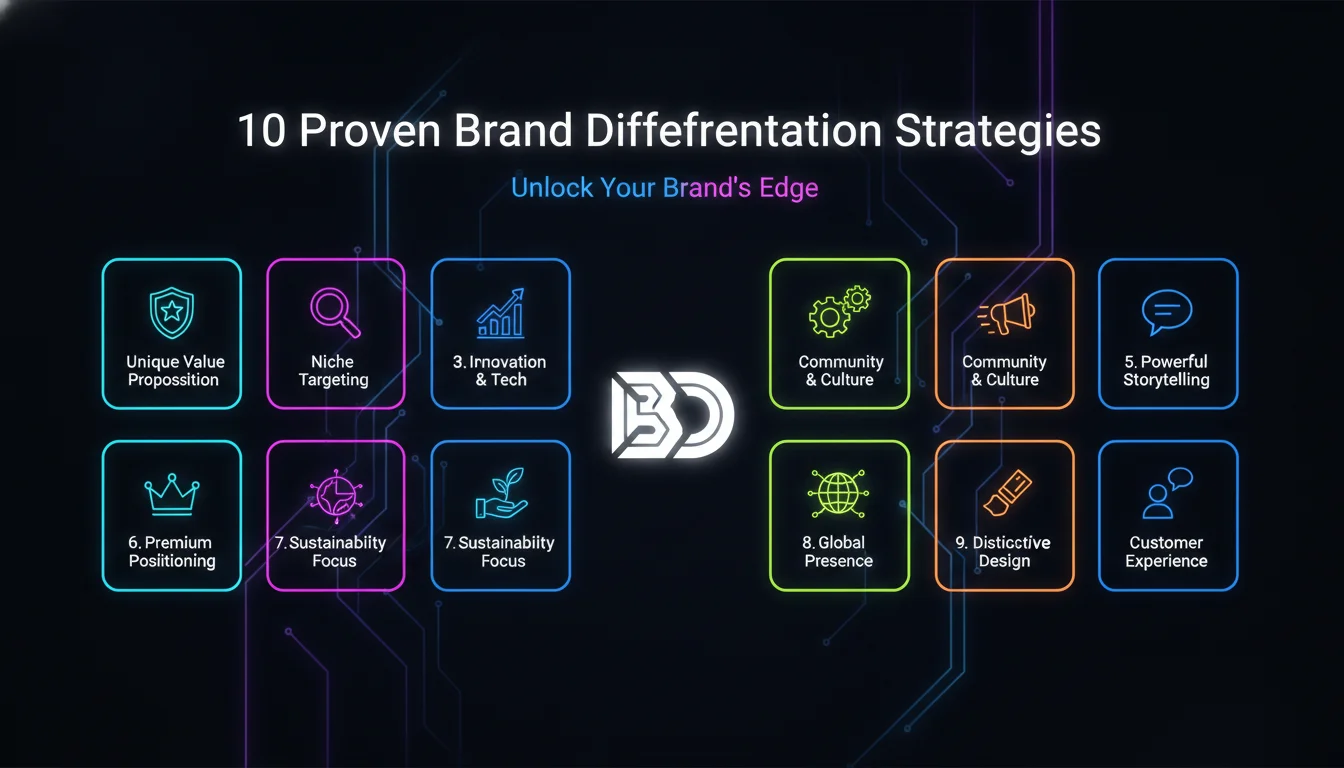
The following ten strategies appear across the competitive landscape. None is universally correct; the right mix depends on your customer research and authentic strengths. Use this list as a menu, not a mandate.
1. Product Quality and Craftsmanship
For many customers, the product is the brand. Differentiation based on quality can include premium materials, added functionality, sustainable manufacturing, broader product range, or customization options. Rolex is the canonical example: in operation since 1905, the brand has registered more than 500 patents, including creating the first fully waterproof watch. Its Swiss-made reputation for accuracy and durability forms the foundation of a premium this kind of strategy.
To use quality as a differentiator, brands must prove it. That means publishing specifications, demonstrating durability tests, sharing patented innovations, and aligning pricing with the evidence of superiority. A brand differentiation built on quality fails if customers cannot see or verify the difference.
2. Unique Visual Identity and Voice
Visual identity and brand voice can create instant recognition in crowded categories. Oatly needed to differentiate on two fronts: from dairy milk brands and from other plant-based alternatives. It developed a chatty, irreverent voice and a bold visual style that stands out on shelves and online. The packaging itself became a canvas for personality, transforming a commodity into a cult brand.
A distinctive visual system includes color, typography, layout, photography style, and motion behavior. When executed consistently, it reduces recognition time and strengthens memory encoding. The key is coherence: every visual and verbal cue must reinforce the same brand identity, or the distinctiveness becomes noise.
3. Emotional Response
Emotional differentiation ties a brand to feelings that transcend functional value. Coca-Cola’s “Share A Coke – Share a feeling” and “Hug me” campaigns, cited by Radius Insights, intentionally link the product to moments of connection, happiness, and belonging.
Emotional differentiation requires measurement beyond traditional metrics. Brand love studies and emotional mapping help identify which feelings your brand evokes and whether those feelings translate into loyalty and advocacy. A differentiation strategy rooted in emotion works only if the emotion is authentic and consistently reinforced over time.
4. Innovation as a Differentiator
Innovation can be expressed through physical product characteristics or through the delivery system. James Dyson positioned his company as an innovation leader by developing a novel vacuum cleaner and then repeatedly bringing unexpected products to market. Innovation differentiation works only when customers perceive genuine value in the novelty.
Jobs-to-be-Done research uncovers the underlying needs customers hire products to fulfill. Testing concepts with real customers before launch ensures your innovation solves problems people actually have. Innovation for its own sake is a costly form of vanity; innovation tied to unmet needs is a durable differentiator.
5. Brand Presentation and Character
How a brand presents itself can be a differentiator. Brands that employ a consistent character or mascot are often more easily remembered, as Radius Insights notes. This presentation layer includes packaging, spokesperson choice, campaign style, and the overall personality projected to the market. A consistent character gives a brand cultural presence and narrative continuity, making abstract attributes tangible.
A this type of strategy built on presentation must be distinctive enough to be memorable but flexible enough to evolve. The character or style should act as a shorthand for the brand promise, not a gimmick that wears out.
6. Unique Experience
Experience-based differentiation shifts the focus from what you sell to how customers feel at every interaction. This can include onboarding, customer support, physical environments, digital UX, and post-purchase follow-up. A deliberate, delightful experience becomes a reason to choose and a reason to stay.
The experience must be designed deliberately. Map every touchpoint, identify moments of truth, and remove friction where competitors tolerate it. Experience differentiation is especially powerful in service industries, but it applies to any brand that touches customers multiple times over the relationship.
7. Pricing Architecture
Pricing can differentiate, but only when it signals value rather than simply undercutting competitors. Premium pricing signals quality and exclusivity; value pricing signals accessibility. The key is to align price with the overall this kind of strategy. A premium brand that discounts erodes its moat; a value brand that overprices loses its reason to exist.
Pricing power, as Buffett notes, is the single most important decision in evaluating a business. If you can raise prices without losing customers, you have proof of differentiation. Treating price as a lever requires linking it to perceived value; otherwise, price becomes a race to the bottom.
8. Purpose and Worldview
Brands can differentiate by championing a worldview or a hope for the future. According to Branding Strategy Insider, the goal is to ditch the Unique Selling Proposition in favor of the Unique Brand Perspective: an outlook that drives everything the brand does. Purpose-based differentiation works when the worldview is authentic, action-backed, and relevant to the target audience.
A brand differentiation strategy built on worldview must be willing to alienate some customers to attract others. That trade-off is the source of its power. If everyone agrees with the worldview, it is not distinctive enough to differentiate.
9. Niche Focus
Differentiation through focus means serving a narrow segment better than anyone else. Brands like Spanx, Google, and Fenty Beauty disrupted their markets by zeroing in on underserved needs. Fenty Beauty built a following by offering inclusive shade ranges that challenged a one-size-fits-all standard. A focused strategy allows for deeper customer intimacy and clearer word of mouth.
Niche focus does not mean limiting growth; it means establishing dominance in a beachhead market before expanding. This sequencing creates credibility that broad-market competitors cannot easily replicate.
10. Service and Support
Exceptional service can be a durable differentiator because it is hard to copy. Rapid response times, knowledgeable staff, generous return policies, and proactive outreach create switching costs. Service differentiation is especially powerful in B2B contexts where post-sale support drives lifetime value. A brand differentiation strategy built on service must be embedded in hiring, training, and performance incentives, not just a customer service script.
Choosing the Right Mix for Your Brand
No brand should attempt all ten strategies at once. The most common failure mode is spreading resources too thin. Instead, begin with market research to identify which dimensions matter most to customers and where competitors are weak. Select one primary differentiation lever and no more than two secondary levers. Then align operations, messaging, and budget behind those choices. The resulting brand differentiation strategy will be focused enough to execute and flexible enough to adapt.
| Strategy | How It Differentiates | Real-World Example | Best For |
|---|---|---|---|
| Product Quality | Superior materials, patents, durability | Rolex | Premium or high-consideration categories |
| Visual Identity | Bold, recognizable design and voice | Oatly | Commodity categories with low functional difference |
| Emotional Response | Associations with feelings and memories | Coca-Cola | Consumer goods with broad appeal |
| Innovation | New functionality or delivery model | Dyson | Technology and problem-solving categories |
| Brand Presentation | Consistent character, mascot, style | Various B2C brands | Categories where personality drives recall |
| Unique Experience | Superior interactions across touchpoints | Service leaders | High-touch or relationship-driven businesses |
| Pricing Architecture | Price as signal of value | Luxury vs. value brands | Markets with clear price-quality expectations |
| Purpose and Worldview | Shared values and perspective | Fenty Beauty | Mission-driven or activist audiences |
Sustainability as a Standalone Differentiator

Sustainability deserves its own conversation, not just a bullet point inside product quality. Frontify specifically calls out eco-friendly and fully recyclable materials and manufacturing processes as a distinct path to differentiation. This is not about slapping a green label on packaging. It is about building operational choices that customers can verify and competitors cannot quickly replicate.
Brands that make sustainability central to their brand differentiation strategy tend to attract audiences who treat purchasing as a values statement. The key is specificity: vague claims about being “eco-conscious” register as noise. Concrete commitments, certified materials, and transparent supply chains register as proof. Proof is what builds the moat.
A Step-by-Step Brand Differentiation Strategy Framework
The following framework turns abstract principles into a repeatable process. Use it in sequence; each step builds on the previous one.
Step 1: Audit Your Current Brand Position
- Inventory all brand assets. List your current product features, visual identity elements, tone of voice, customer service standards, and pricing architecture.
- Map competitor positions. Identify how competitors present themselves. Note overlaps and gaps in their messaging.
- Assess internal alignment. Ask whether your team agrees on what the brand stands for. Misalignment will sabotage any differentiation effort.
The audit produces a baseline. Without it, you cannot measure progress or identify true distinctiveness. This first step often reveals that the brand has no clear brand differentiation strategy at all, only a collection of disconnected tactics.
Step 2: Research Customer Priorities and Competitor Gaps
- Conduct qualitative interviews. Uncover the language customers use, the problems they face, and the outcomes they seek.
- Run quantitative surveys. Measure which attributes drive purchase decisions across your category. Attribute importance vs. competitor performance mapping reveals opportunities.
- Synthesize the findings. Create a shortlist of potential differentiators that are both important to customers and underserved by competitors.
This step prevents differentiation based on internal assumptions rather than market evidence. A brand differentiation strategy built on evidence is far more likely to succeed than one built on executive intuition alone.
Step 3: Select and Validate Your Differentiation Levers
- Score each candidate lever on relevance, authenticity, defensibility, and profitability.
- Pressure-test the top choices with customer panels or concept tests.
- Document the chosen differentiation approach in a one-page brief that includes the target audience, the desired perception, the proof points, and the emotional benefit.
Validation is critical. A differentiator that fails customer testing is a liability, not an asset. At this stage, be willing to kill your favorite idea if the evidence does not support it.
Step 4: Embed the Strategy Across Every Touchpoint
- Translate the strategy into messaging guidelines. Write a brand voice guide, key messages, and proof point library.
- Redesign priority touchpoints. Update your website, packaging, sales scripts, and customer service training to reflect the differentiation.
- Launch internal training. Every employee must understand the brand promise and how to deliver it.
- Monitor consistency. Use brand audits and customer feedback loops to catch drift.
A brand differentiation strategy that exists only in a document is worthless. It must be operationalized into daily decisions. This final step is where most strategies die, not because they were wrong, but because they were never fully implemented.
Real-World Examples of Differentiation Done Right
Rolex and Oatly: Quality and Visual Voice
Rolex illustrates vertical differentiation through engineering and heritage. Since its founding in 1905, the brand has registered more than 500 patents and remains headquartered in Geneva, Switzerland. Its differentiation is reinforced by geographic origin, production precision, and a controlled distribution model. Rolex does not just claim quality; it proves it through verifiable patents and a century-long track record.
Oatly illustrates horizontal differentiation through voice and visual identity. Instead of competing solely on oat milk’s functional benefits, Oatly used a bold, irreverent style that made the brand feel like a personality. The result is recognition and advocacy even in a crowded plant-based category. Together, Rolex and Oatly show that a brand differentiation strategy can be built on either objective superiority or subjective identity, or both.
Coca-Cola and Dyson: Emotion and Innovation
Coca-Cola differentiates through emotional response. Its campaigns consistently link the product to happiness, sharing, and human connection. That emotional territory is difficult for competitors to copy because it has been built over decades. Dyson differentiates through innovation. By rethinking the vacuum cleaner, a category most brands treated as mature, Dyson established a reputation that extends to hair care, air purification, and other categories. Innovation becomes a brand promise, not just a product feature.
These examples highlight that effective differentiation is rarely a single attribute. It is a system of reinforcing proofs and associations that accumulate into a moat over time.
Fenty Beauty and Spanx: Market Disruption Through Gaps
Fenty Beauty and Spanx are modern examples of niche focus and customer obsession. Fenty Beauty identified an underserved need for inclusive shade ranges and built a brand around it. Spanx created a new category by solving a problem many customers experienced but few brands addressed. Both demonstrate that a brand differentiation strategy does not require inventing a new product category; it requires seeing a gap that incumbents ignored.
Measuring Brand Differentiation Success
Metrics to Track
Effective brand differentiation strategy is measurable. Core metrics include aided and unaided brand awareness, brand recall, consideration, purchase intent, net promoter score, and price sensitivity. Tracking these over time reveals whether your distinctiveness is strengthening. Perceptual mapping is especially useful: chart your brand and competitors on the attributes that matter most. The greater the distance from competitors on high-importance attributes, the stronger your differentiation.
The Gartner Warning: Digital Sameness
Gartner’s finding that 46% of customers cannot distinguish between most brands’ digital experiences is a warning sign. It means that even brands with strong offline differentiation are failing to translate it digitally. Websites, apps, and marketing automation often default to the same templates, the same language, and the same UX patterns. To avoid digital sameness, audit your entire digital presence against your brand differentiation strategy. Does your website’s visual hierarchy, copy, imagery, and interaction design express the unique brand? If not, customers will not see the difference where most of their evaluation happens.
Avoiding the AI Sameness Trap
AI-generated sameness is the defining competitive risk of 2026. As David Brier argues, when every brand outsources its thinking to the same tools, every output looks the same. The way out is a brand differentiation strategy grounded in specific customer evidence, proprietary language, and operational choices that AI cannot replicate.
This means investing in original research, unique point-of-view articulation, and experiences that generate real-world customer data. Generic content and generic messaging accelerate commodity status. This year, the brands that thrive will be those that treat differentiation as a continuous discipline, not a one-time workshop output.
Pros and Cons
Pros
- Pricing power. A well-built brand differentiation strategy lets you raise prices without losing customers, the clearest signal of a real competitive moat.
- Customer loyalty. Differentiated brands create emotional anchors that reduce churn and increase lifetime value.
- Reduced comparison shopping. When customers see you as distinct, they stop comparing you on price alone.
- Word-of-mouth growth. Memorable brands get talked about. Generic brands get scrolled past.
- Resilience against AI sameness. A brand built on proprietary research and operational proof points cannot be replicated by a competitor prompting the same AI tools.
Cons
- Resource intensity. Building genuine differentiation requires sustained investment in research, design, training, and consistent execution.
- Risk of misalignment. A differentiation lever that resonates in research can still fail if internal teams do not deliver on the promise at every touchpoint.
- Audience trade-offs. A sharp point of view will attract some customers and repel others. That is the intended mechanism, but it requires confidence to commit.
- Erosion over time. Competitors observe and adapt. A differentiation strategy requires ongoing monitoring and periodic reinvention to stay ahead.
Common Pitfalls and How to Avoid Them
Copycat Syndrome
The temptation to copy what works is strong. According to Branding Strategy Insider, everyone benchmarks against each other, optimizes the same way, and copies the same best practices. The result is brand clones. To avoid this, institutionalize a rule: if a competitor could say the same thing, it is not a differentiator.
Different for Different’s Sake
Differentiation without relevance is noise. A brand can be memorable for the wrong reasons, which damages trust and sales. Before committing to a differentiation lever, validate that the difference matters to the target audience and is credible coming from your brand. The goal is meaningful distinctiveness, not novelty. A brand differentiation strategy that ignores relevance will generate attention without conversion.
Failing to Operationalize
Many companies craft a brilliant brand differentiation strategy and then fail to execute it consistently. Sales teams default to old pitches, customer service scripts ignore the brand promise, and packaging updates never happen. Operationalize through training, incentives, brand guidelines, and regular audits. If the strategy does not change daily behavior, it does not exist.
For a deeper look at how brand identity connects to visual systems, explore our work on branding and creative services at Emin Media. And if you want to see how differentiation plays out in social and digital campaigns, our blog covers real-world examples across industries.
Your Brand Differentiation Strategy Is Your Moat
A brand differentiation strategy is not a luxury for creative industries. It is the foundational decision that determines whether every other marketing investment pays off. The evidence from Gartner, Rolex, Coca-Cola, Dyson, Oatly, and Fenty Beauty points in one direction: brands that own a meaningful difference win disproportionately. In a 2026 landscape shaped by AI sameness and digital clutter, the only sustainable path is to build a moat through distinctiveness grounded in customer evidence and operationalized with discipline. Start with an audit, validate your levers, and commit to consistency. Your brand differentiation strategy is the difference between being chosen and being ignored.
Ready to build something that actually stands out? Contact Emin Media for a free brand consultation and let’s build something bold together.
Frequently Asked Questions
What is a brand differentiation strategy?
A brand differentiation strategy is a planned approach to identify and communicate the unique qualities that make a brand distinct from competitors. It aligns product, messaging, and experience around a meaningful difference that customers value and competitors cannot easily copy.
Why is brand differentiation important?
Differentiation reduces customer confusion, builds memory, and creates pricing power. Gartner research, cited by Frontify, found that 46% of customers cannot tell the difference between most brands’ digital experiences, which increases the urgency for distinctiveness in every channel.
What are examples of brand differentiation?
Examples include Rolex’s quality and heritage backed by more than 500 patents, Oatly’s irreverent visual identity, Coca-Cola’s emotional campaigns, Dyson’s innovation, and Fenty Beauty’s inclusive product range. Each brand owns a specific, defensible difference in its category.
How do you create a brand differentiation strategy?
Audit your current position, research customer priorities and competitor gaps, select differentiation levers, validate them with testing, and embed the approach across all touchpoints through training and guidelines. The process is sequential: each step builds on the one before it.
What is the difference between differentiation and positioning?
Positioning is the mental space a brand occupies relative to competitors. Differentiation is the strategic act of proving that space with unique qualities. Positioning is the result; differentiation is the method that makes the result credible.
Can pricing be a brand differentiation strategy?
Yes, pricing can differentiate when it signals value consistently. Premium pricing can signal quality, and value pricing can signal accessibility. The key is alignment with the overall brand promise: as Warren Buffett notes, genuine pricing power is the clearest proof that a brand differentiation strategy is working.
Enjoyed this article?
Contact Emin Media for a free brand consultation and let's create something amazing together.
Get in TouchRelated Articles
Digital Storytelling for Brands: The Complete Guide
Digital storytelling for brands builds real audience connections through narrative. Learn proven techniques, formats, and…
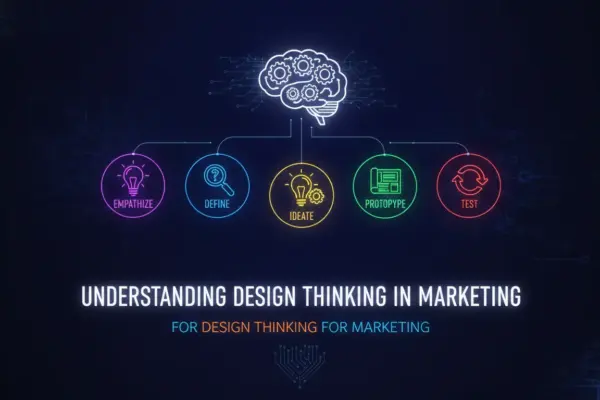
Design Thinking for Marketing: A 2026 Guide
Design thinking for marketing builds campaigns around real user needs. Learn the 5 phases, common…

Creative Direction for Video Shoots: A Complete Guide
Master creative direction for video shoots with proven steps, tools, and strategies that build brand…