Brand Design Trends 2026: Motion, AI & Imperfection
Brand Design Trends 2026: Motion, AI, and Imperfection
Brand design trends 2026 are defined by motion-first identities, humanized imperfection, AI-assisted exploration, and expressive typography. Brands are balancing technological capability with tactile, emotionally resonant visual systems to stay authentic and engaging.
Key Takeaways
- Motion-first identity systems are replacing static logos as primary brand assets across every screen-based touchpoint.
- AI is maturing from novelty shortcut to generative collaborator, with human judgment remaining central to brand authorship.
- Hand-crafted imperfection and tactile textures directly counter AI polish and signal authentic human creativity.
- Typography is becoming elastic, expressive, and identity-defining rather than merely functional infrastructure.
- Bento grids, mixed media, and neo-brutalist layouts structure brand storytelling with modular clarity.
- Sensory and immersive experiences drive engagement in screen-saturated environments where presence beats perfection.
Across major trend reports and design community analyses, a consistent theme has emerged: the most effective brand design in 2026 is not the most polished, but the most present. According to Digital Synopsis, design now feels less concerned with perfection and more interested in presence. Adobe’s 2026 Creative Trends Forecast similarly notes that heavy AI, AR, and gaming influence may be driving a backlash away from hi-tech design toward organic, analog, and human-centered visual language. This piece synthesizes those perspectives into an actionable overview for brand managers, creative directors, and marketing leaders.
Pros and Cons of Following Brand Design Trends 2026
Pros
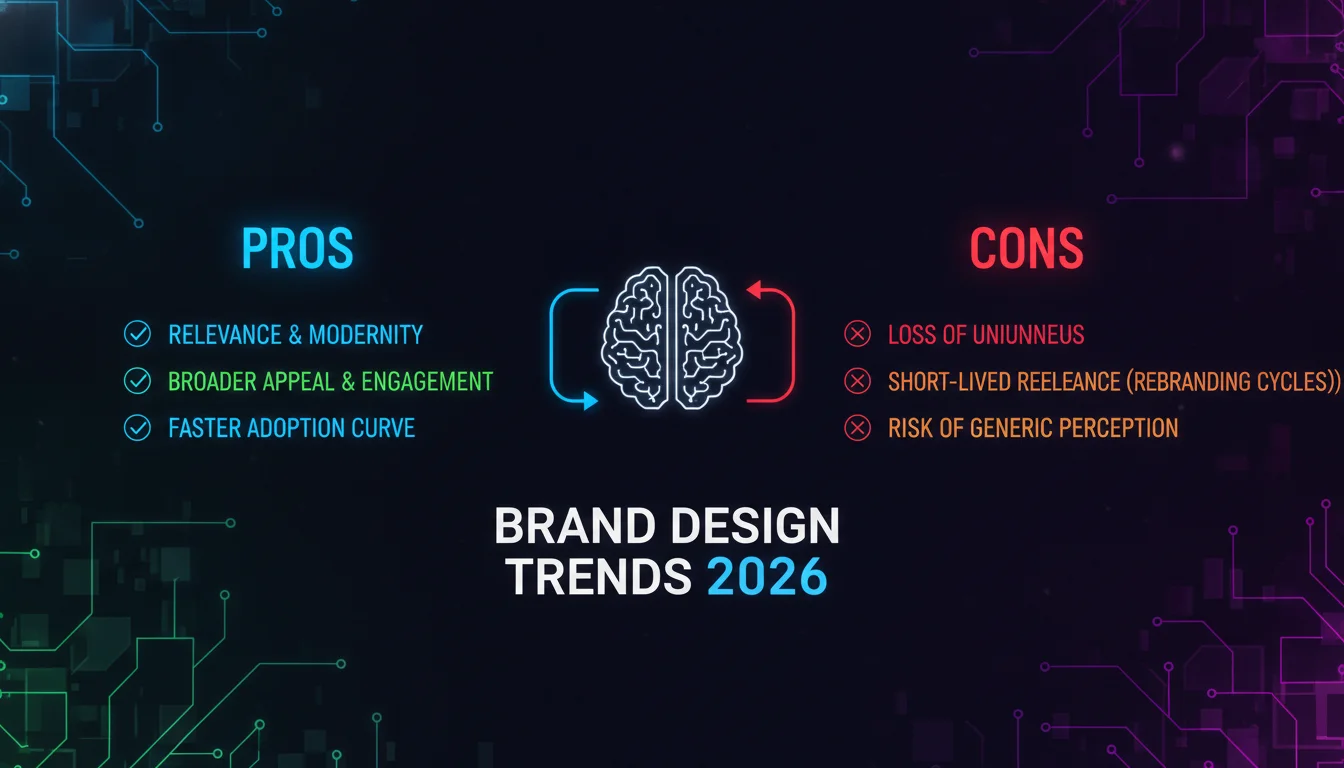
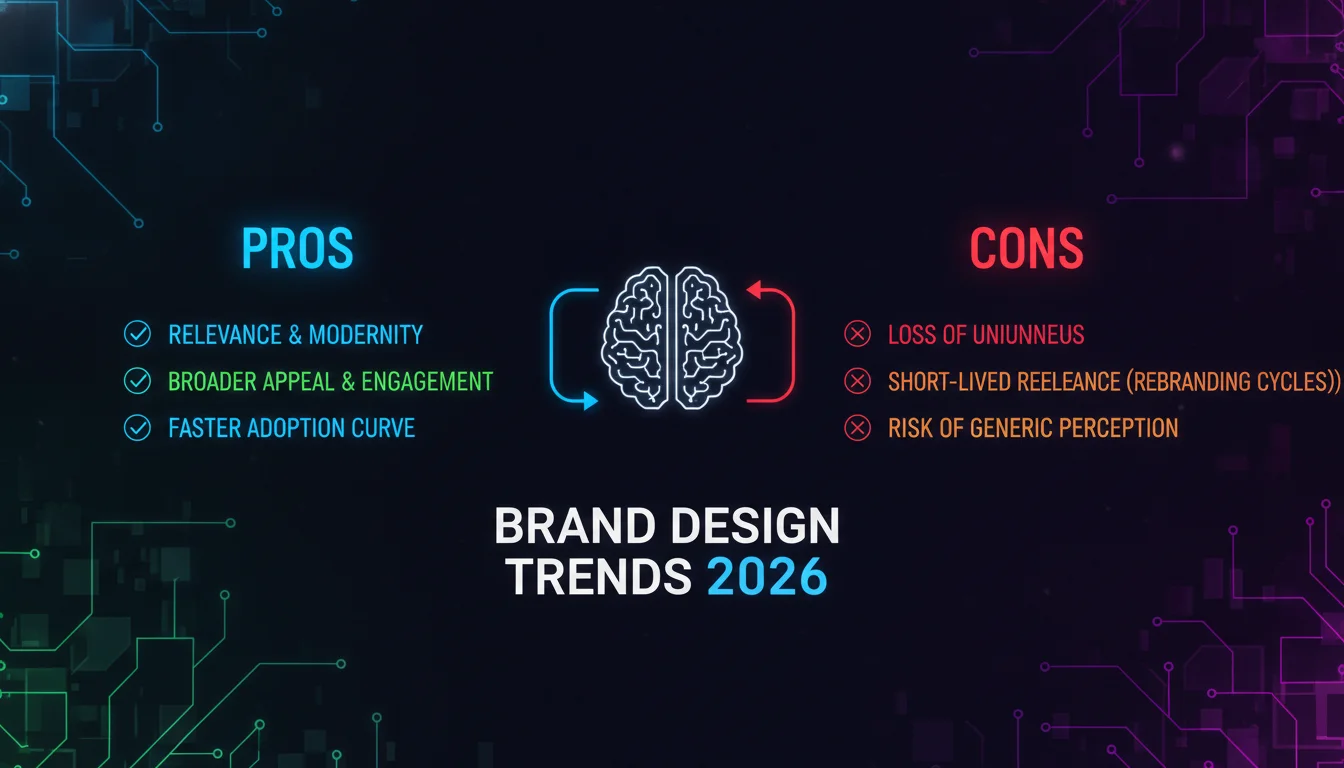
- Staying current with brand design trends 2026 signals cultural awareness and keeps your identity feeling fresh and relevant.
- Motion-first and sensory design create stronger emotional memory structures than static, polished visuals.
- AI-assisted workflows speed up concept exploration without sacrificing human creative direction.
- Humanized imperfection differentiates brands in categories saturated with AI-generated polish.
- Expressive typography and vibrant color systems can carry brand recognition even in simplified layouts.
Cons
- Trend over-adoption creates visual noise. Layering motion, collage, brutalist type, and tactile texture simultaneously undermines coherence.
- Motion and 3D assets can degrade website performance if not carefully optimized for different bandwidths.
- Naive design and imperfection must look intentional. Executed poorly, they read as careless rather than considered.
- Playful type and vibrant color palettes can fail accessibility standards if contrast and legibility are not tested rigorously.
The Core Shift: Why 2026 Brand Design Rejects Perfection
Brand design trends 2026 represent a philosophical reset away from seamless, ultra-refined digital aesthetics toward designs that communicate intentionally and expressively rather than looking flawless. The shift is captured in the contrast between AI-generated polish and human-led imperfection. ThreeRooms argues that brand identity in 2026 prioritizes kinetic, motion-first systems over static visuals to meet the demands of an AI-driven digital landscape. The goal is no longer to look perfect, but to feel real.
This realness shows up in visible brush strokes, uneven line work, subtle grain, and layouts that refuse to sit too neatly. The underlying logic is audience psychology: when every touchpoint feels automated, a hand-crafted detail stands out as proof of human authorship. Brands that embrace this tension can differentiate without shouting.
The Pendulum Swing from Digital Minimalism
Design moves in cycles, and 2026 is the counterweight to years of sterile minimalism. Lindsay Marsh, in her Design Trends 2026 analysis, describes naive design as a counter-movement similar to Brutalism in 2018, but with a softer and more emotional tone. The pendulum has swung from severe rigidity to playfulness and visible human error. Brand strategists should interpret this not as abandoning clarity, but as injecting warmth.
This shift is especially relevant for B2B brands that have historically relied on conservative corporate aesthetics. Even in regulated or professional sectors, small touches like a hand-drawn icon set or a textured background can signal approachability without compromising trust.
Brand Strategy Implications
For leadership teams, the core takeaway is that brand design investments should prioritize emotional resonance over surface polish. A carefully imperfect identity can build stronger memory structures than a flawless but forgettable one. The trend data from Behance highlights neo-minimalism and micro-maximalism as a balance between clarity and personality. One strong element takes the spotlight while the rest stays clean.
Practical applications include revisiting visual audits with a human lens, testing motion concepts early, and measuring brand perception qualitatively through customer interviews rather than only aesthetic approval. The brands that win will be those that use design to signal presence, not perfection.
Motion-First Identities and Kinetic Brand Systems
Motion is no longer an enhancement layered onto a logo after completion. In 2026, motion is a foundational design principle. According to ThreeRooms, motion is becoming just as essential as color palettes and typefaces, with screens now the primary point of brand interaction. A static logo alone cannot hold attention in feed-based and interface-driven environments. Movement communicates tone, pace, and attitude.
This shift aligns with the broader preference for presence: brands must respond, react, and adapt in real time. Animated logos, kinetic typography, and motion-led UI behavior are now core brand assets, not afterthoughts. Digital Synopsis also identifies motion-led branding as one of its top trends, noting that logos and graphic systems are conceived with movement in mind.
Types of Motion-Led Brand Assets
Motion-first branding breaks into several actionable asset categories:
- Animated logos: a static mark gains a short, repeatable sequence that conveys rhythm and personality.
- Kinetic typography: letterforms that stretch, shift, or flow in response to context.
- Motion-led UI behavior: micro-interactions, transitions, and hover states that guide attention.
- Dynamic brand systems: visual identities that adapt across formats, from social posts to product interfaces.
Each of these should be designed with restraint. As Digital Synopsis notes, even minimal animation contributes to a sense of presence. The goal is not spectacle, but clarity with expression.
Balancing Performance and Presence
A practical concern for brand teams is performance. Motion-heavy experiences can slow down websites and apps, harming usability. Adobe Express and Behance both caution that realism and motion should never compromise speed. The best motion-first systems in brand design trends 2026 are lightweight by design: short loops, purposeful animations that inform rather than distract, and scalable versions for different bandwidths.
For brands beginning this journey, start with one signature motion element, such as an animated logo or a consistent micro-interaction. Test it across devices and measure engagement before expanding the system. This incremental approach prevents visual clutter and technical debt.
AI as Generative Collaborator, Not Replacement
AI’s role in brand design has matured significantly. Digital Synopsis describes AI-generated design in 2026 as a generative collaborator rather than a novelty or shortcut. The most compelling work uses AI to surface unexpected forms, compositions, and textures, which are then refined through human judgment.
Node-Based AI Workflows
A key emerging skill is node-based AI design, where designers connect models, prompts, data, and logic in a visual interface. Behance emphasizes that node-based workflows give designers full control and transparency over AI pipelines, making complex processes adjustable and reusable. This approach allows brand teams to remix AI output without surrendering authorship. It is particularly useful for rapid concept exploration and brand system variations, but the final decisions remain human.
Human Oversight and Authorship
Authorship is central to the 2026 AI trend. The visual language emerging right now shows designers negotiating AI’s influence without giving up creative control. Digital Synopsis notes that AI expands the field of possibility but human judgment is what shapes the result into a coherent brand expression. This has implications for brand governance: AI-assisted design should not be treated as a fully automated production line.
Brands should establish clear guidelines for AI use, including which stages of the creative process benefit most from AI exploration and which require human sign-off. This protects intellectual property and maintains a distinct brand voice.
AI-Polished vs. Human Imperfect
Ironically, as AI-generated visuals become more polished, the market is responding with the opposite: human imperfection. ThreeRooms and Adobe both note that audiences crave human touch in an overly synthetic digital environment. Hand-drawn details, candid photography, and imperfect copywriting are becoming differentiators. Behance calls this emotion-led, humanized design. The human factor is now a differentiator precisely because AI is everywhere.
This does not mean rejecting AI. It means using AI to handle repetitive or exploratory work while intentionally preserving human quirks in final brand assets. The synthesis of high-efficiency AI and low-fi human texture can create a brand that feels both sophisticated and approachable.
Humanized Imperfection: Tactile, Naive, and Hand-Crafted Aesthetics
Humanized imperfection is one of the most striking currents within brand design trends 2026. Lindsay Marsh describes naive design as embracing imperfection, awkward proportions, and visible human error to reintroduce warmth and individuality. It is a countermovement to the polished brand visuals that have dominated recent years, similar to Brutalism but softer and more emotional. This style uses childlike drawings, uneven typography, and intentionally crooked layouts to signal authenticity.
For brands, naive design works best when the product or service benefits from approachability, such as food and beverage, lifestyle, education, and community-focused organizations. It should look intentional, not careless. A deliberate choice to prioritize personality over precision.
Tactile Textures and Grain Overlays
Tactile texture is another core expression of humanized imperfection. Canva’s 2026 trend carousel includes Texture Check, which captures design so tactile you want to reach out and feel it. Adobe similarly points to puffy, soft, and squishy textures combined with playful distortions, noting that materials mimicking touch are becoming more prevalent. Subtle grain overlays, paper textures, and blemishes soften digital sleekness and add depth.
ThreeRooms highlights that hand-drawn uneven lines, brush strokes, and scribbles build emotional connection by expressing warmth and individuality. These elements are especially effective in packaging, social media content, and brand identity systems where physicality can be simulated.
Retro, Brutalist, and 90s Nostalgia
Retro and brutalist aesthetics are back, but with a 2026 twist. Behance lists retro, brutalist, and imperfect aesthetics as a key trend, featuring rough textures, asymmetry, visible grids, and 90s nostalgia. Digital Synopsis also includes neo-brutalism, describing it as raw layouts, oversized typography, and intentional friction that prioritizes clarity and impact over refinement. This aesthetic thrives in spaces where bold positioning is essential.
The 90s nostalgia component adds a cultural layer: brands can mine familiar visual codes from the era, chunky type, clashing colors, and low-fi interfaces, while updating them for contemporary accessibility. The result is a nostalgic yet fresh identity that stands out in feed-based environments.
Expressive Typography and Liquid Letterforms
Typography has shifted from functional necessity to the hero of brand personality. ThreeRooms notes that custom type and experimental forms differentiate saturated markets, with typography acting as a voice with character. Bespoke letterforms and typographic logos are increasingly common. Digital Synopsis adds that ink trap fonts, originally a functional print solution, have become a stylistic choice to introduce rhythm and character into typographic systems.
This means brand teams should invest in type as a strategic asset, not just a style choice. A distinctive type system can carry brand recognition even when other visual elements are simple.
Liquid, Playful, and Exaggerated Letterforms
Playful and exaggerated type is a defining characteristic of brand design trends 2026. Adobe highlights oversized sans-serifs, bubbly and puffy letterforms, and wavy, distorted, bubble-like fonts, along with handwritten scripts and loopy cursives. Digital Synopsis describes liquid and experimental typography as letterforms that stretch, soften, and flow, suggesting movement even in still compositions. These are typically reserved for display type and brand moments where emotion matters more than strict neutrality.
Brands should use playful type strategically: a wordmark with liquid distortion can convey creativity and energy, but body copy must remain legible. The contrast between expressive display type and restrained supporting type creates a balanced system.
Ink Trap Fonts and Functional Expression
Ink trap fonts represent a bridge between function and expression. Originally designed to prevent ink from filling corners during print, ink traps are now amplified as stylistic elements. Digital Synopsis describes these amplified details as introducing rhythm, character, and subtle disruption into typographic systems. The result is type that feels engineered yet expressive. This trend suits technology, industrial, and editorial brands that want a precise but distinctive voice.
When adopting ink trap fonts, consider trust and readability. They work best in large sizes and headlines, while body text can remain in a more conventional family to maintain clarity.
Structure and Layout: Bento Grids, Mixed Media, and Neo-Brutalism
Layout choices in brand design trends 2026 reflect a broader desire for modular clarity without sacrificing creative richness. Three distinct approaches are leading the way: bento grids, mixed-media collage, and neo-brutalism.
Bento Grid Layouts for Modular Clarity
Bento grid layouts are a practical response to multi-device content needs. Digital Synopsis describes bento-style layouts as compartmentalizing content into balanced sections that feel structured without being rigid. They are especially effective in digital environments, offering flexibility while maintaining visual order across devices and formats. This modular clarity suits brand systems that must adapt to social cards, app screens, and presentations.
For brand designers, bento grids provide a framework for content hierarchy without sacrificing creativity. Each module can contain different media types, enabling a mix of product shots, typography, and data visualizations within a cohesive layout.
Mixed-Media Collage and Layered Storytelling
Mixed-media design rejects flatness. Digital Synopsis notes that photography, illustration, typography, and texture coexist within single compositions, creating visuals that feel rich and dimensional. Adobe adds collage and layered visual elements as a trend, and Canva includes Zinegeist and Explorecore as layered storytelling formats. This approach reflects a broader cultural desire for complexity and nuance.
Brands can adopt mixed-media by combining brand photography with hand-drawn overlays, cut-out shapes, and varied textures. The key is to maintain a unifying color palette or recurring motif so the collage feels intentional rather than chaotic.
Neo-Brutalism and Utilitarian Design
Neo-brutalism continues to assert itself through raw layouts, oversized typography, and intentional friction. Digital Synopsis emphasizes clarity and impact over refinement, creating visuals that feel confrontational yet confident. Utilitarian design, influenced by signage systems and industrial graphics, values hierarchy, legibility, and efficiency. This pair of trends appeals to brands that want to project no-nonsense authority.
However, neo-brutalism can alienate if applied too broadly. It works best as a campaign-level or product-level aesthetic, paired with a more accessible core identity. The tension between raw and refined can create memorable brand moments without undermining usability.
Color, Sensory, and Immersive Experience Design
Color and sensory design are two of the most commercially potent forces within brand design trends 2026. Both push brands to engage audiences beyond the purely visual.
Vibrant Color Systems and Chromatic Expression
Color is bold again. Behance points to vibrant color systems and chromatic expression, including dynamic palettes, gradient layering, duotones, and reactive color schemes that adapt to mood or context. Color becomes a storytelling device, representing brand emotion, energy, and inclusivity. Adobe highlights bright, saturated color palettes combined with realistic textures and surreal elements to create immersive experiences.
Brand teams should think of color as a system, not a static palette. Accessible vibrancy matters: balance saturation with contrast for legibility, and test palettes across screen modes and print materials.
Sensory Design That Triggers Touch, Sound, and Motion
Sensory design is about engaging more than the eyes. Adobe names “All our senses, to the max” as a key 2026 trend, noting that materials mimicking touch, sound, and motion are becoming more prevalent. Puffy, soft, and squishy textures are almost a delicacy. This trend maps directly to brand experiences: packaging with tactile finishes, digital interfaces with haptic feedback, and motion design that evokes physical sensations.
For brands, sensory design can differentiate in crowded categories. Even in digital-only contexts, the illusion of texture through lighting, shadow, and material simulation can create a lasting impression that helps consumers feel transported.
Immersive 3D and Spatial Interfaces
Three-dimensional design is integrating rather than dominating. Digital Synopsis notes that 3D elements are used with restraint, adding depth, tactility, and spatial logic to brand systems and interfaces. Behance adds that immersive 3D and spatial interfaces range from micro-3D interactions to full immersive environments, making 3D native to web and apps. Stylization often takes precedence over realism, keeping visuals expressive without becoming heavy.
Performance remains critical. Behance advises that depth and motion enhance storytelling and engagement, but realism should never slow usability. Brand designers should optimize 3D assets for web and create scalable versions for different bandwidths.
Surreal and Absurdist Imagery
Surreal and absurdist imagery is earning its own place within brand design trends 2026. Adobe identifies surreal and absurdist imagery as a distinct trend, describing visuals that distort reality with warped photography and otherworldly compositions. Canva’s Reality Warp trend captures the same energy: distorting the familiar to create something that stops the scroll and lodges in memory.
For brand campaigns, surrealism works best when it connects to a clear emotional truth. A product floating in an impossible landscape, or a logo dissolving into organic matter, creates intrigue without confusion, provided the brand’s core message anchors the visual. This is a trend for brands confident enough to be strange.
Regional and Cultural Design Trends: Granny Wave and Block Party
One of the most distinctive angles within brand design trends 2026 is the rise of regionally specific visual languages. Global design is fragmenting into local pride.
Granny Wave: Heritage Maximalism
Canva’s Granny Wave trend describes a maximalist remix of Indian heritage and modern design. Think layered patterns, rich color combinations drawn from traditional craft, and a deliberate celebration of cultural density over minimalist restraint. For brands operating in South Asian markets or targeting diaspora communities, this aesthetic offers a powerful way to signal cultural fluency and respect.
The broader lesson for brand strategists is that cultural specificity is becoming a competitive advantage. Generic global aesthetics are losing ground to identities rooted in place, memory, and community.
Block Party: Cinematic Regional Identity
Canva’s Block Party trend reclaims Spain’s regional aesthetic through cinematic stylization. Bold typography, warm color palettes, and a cinematic sense of scale combine to create identities that feel rooted in a specific geography and cultural moment. This is not nostalgia for nostalgia’s sake. It is a strategic choice to stand for something specific in a world of visual sameness.
Both Granny Wave and Block Party signal a wider shift: audiences are rewarding brands that know where they come from. Cultural authenticity, expressed through design, is becoming as important as product quality in building lasting brand loyalty.
“Design in 2026 feels less concerned with perfection and more interested in presence, whether it is branding or product design shaped by human experiences.” – Digital Synopsis, Graphic Trend Report 2026
“The digital-design landscape of 2026 is about balance: between AI and human creativity, between polished and imperfect, between experiential richness and performance. Designers who embrace new tools while holding tight to purpose will lead.” – Behance, Design Trends 2026
Implementing Brand Design Trends 2026: A Step-by-Step Framework
Putting brand design trends 2026 into practice requires a structured approach to avoid brand fragmentation. Start by comparing what the major sources emphasize, then build a phased adoption plan.
Compare Trend Reports Before You Invest
With multiple sources offering different trend lists, the first implementation step is to compare and select. The table below summarizes how four major sources prioritize 2026 brand-relevant design trends.
| Source | Primary Emphasis | Signature Trends | Brand Application |
|---|---|---|---|
| Digital Synopsis | Presence over perfection; AI authorship | Motion-led branding, bento grids, ink traps, neo-brutalism | Integrated brand systems with human judgment |
| Adobe Express | Sensory, human backlash to hi-tech | Tactile textures, exaggerated type, surreal imagery | Emotionally immersive campaigns |
| ThreeRooms | Motion-first identity systems | Kinetic logos, expressive typography, humanized hybrid intelligence | Authentic brand storytelling |
| Canva | Imperfect by design; cultural remix | Texture Check, Opt Out Era, Zinegeist, Notes App Chic | Regional and tactile brand expressions |
This comparison helps brand teams align trend adoption with strategic goals rather than adopting all trends simultaneously.
Step 1: Audit Current Brand Assets
Review your existing visual system against the core currents in brand design trends 2026: motion, human imperfection, AI collaboration, expressive type, and sensory depth. Identify gaps and quick wins.
Step 2: Select Two to Three Trends
Choose trends that align with your brand archetype and audience expectations. Avoid adopting more than three at once to maintain visual coherence.
Step 3: Prototype in a Sandbox Environment
Test motion loops, type explorations, and texture overlays before rolling out to all touchpoints. This is where AI-assisted concept generation earns its keep.
Step 4: Create Governance Guidelines
Define where AI may be used, which elements require human authorship, and how motion and texture standards will be maintained across the system. This protects both intellectual property and brand voice.
Step 5: Launch in Phases
Start with high-visibility touchpoints such as social media, website hero sections, and product packaging. Collect feedback and iterate before expanding to the full brand system.
Common Pitfalls and Qualitative Measurement
Several pitfalls can undermine implementation. Trend over-adoption is the most common: layering motion, collage, brutalist type, and tactile texture simultaneously creates noise rather than identity. Ignoring performance is the second: 3D and motion can degrade user experience if not optimized. Forced imperfection is the third: hand-drawn elements must look intentional, not careless. Neglecting accessibility is the fourth: playful type and vibrant color must remain legible. Forgetting brand fit is the fifth: a law firm adopting naive design may confuse its audience rather than charm it.
Because many brand design trends 2026 prioritize emotional resonance, measurement should include qualitative indicators. Customer interviews, social listening, and brand perception surveys can capture how audiences respond to humanized imperfection and motion-first identities. Digital analytics such as engagement time and interaction rates supplement these insights. The brands that track these signals over time will refine their systems and stay competitive.
Brand Design Trends 2026 as a Balancing Act
Brand design trends 2026 are defined by balance: between AI and human creativity, polished and imperfect, motion and stillness, sensory richness and performance. According to Adobe, the 2026 creative forecast points to content that touches all our senses, sparks connection, engages playfully, and is grounded in local culture. Behance similarly frames the future as a balance between AI and human creativity, between polished and imperfect, between experiential richness and performance.
Brands that embrace these tensions will build identities that are not only current but enduring. The winners will use AI as a collaborator, motion as a core asset, and imperfection as a strategic differentiator. By applying the step-by-step framework above, marketing leaders can translate trend awareness into measurable brand equity. The future of brand design is not about looking perfect. It is about being present, human, and unmistakably alive.
Ready to apply brand design trends 2026 to your own identity? Contact Emin Media for a free brand consultation and let’s build something bold together.
Frequently Asked Questions
What are the best branding trends for 2026?
The strongest branding trends include motion-first identities, humanized imperfection, AI-assisted generative design, expressive typography, and sensory-rich experiences. Together these create brands that feel present, authentic, and emotionally resonant rather than merely polished.
What are the hottest design trends for 2026?
The hottest design trends span liquid and exaggerated letterforms, bento grid layouts, mixed-media collage, neo-brutalism, vibrant color systems, and immersive 3D elements. Each trend prioritizes expression and presence over sterile polish, according to sources including Adobe, Behance, and Digital Synopsis.
What are the key product design trends for 2026?
Key product design trends include tactile and sensory interfaces, spatial 3D interactions, node-based AI workflows, and utilitarian layouts focused on legibility and efficiency. Performance remains critical to ensure usability is never sacrificed for visual ambition.
What are the key trends in brand experiences for 2026?
Brand experiences are shifting toward sensory immersion, kinetic motion systems, and tactile textures that simulate touch. Immersive 3D and dynamic, context-aware visual systems help consumers feel transported and genuinely engaged rather than passively observed.
How can B2B brands adopt 2026 brand design trends without losing trust?
B2B brands should start with motion-first micro-interactions, subtle tactile textures, and expressive typography rather than full naive design. Pair these elements with clear governance and performance optimization to maintain professional authority while still feeling human.
Are 2026 brand design trends a reaction against AI?
Partially, yes. As AI-generated visuals become more polished, audiences and designers are embracing hand-crafted imperfection, visible human error, and tactile textures as differentiators. AI is still used across brand design trends 2026, but as a collaborator rather than a replacement for human authorship.
Enjoyed this article?
Contact Emin Media for a free brand consultation and let's create something amazing together.
Get in Touch