2026 Social Media Design Trends: Human Meets AI
2026 Social Media Design Trends: Human Meets AI
Social media design trends in 2026 are the visual strategies shaping how brands show up on Instagram, TikTok, LinkedIn, and YouTube: bold type, raw authenticity, vibrant color, and transparent AI use. Brands that balance machine efficiency with human creative choices are the ones cutting through crowded feeds.
Key Takeaways
- design trends are the recurring visual styles that shape brand content across every major platform.
- 2026 marks a clear shift away from ultra-slick digital minimalism toward authentic, imperfect, and culturally rooted visuals.
- Motion graphics, bold oversized typography, vibrant color, and tactile textures are the dominant techniques this year.
- AI-assisted design is now standard practice, but disclosure and custom human touches are what earn audience trust.
- Choose only two or three trends that align with your brand rather than chasing all of them at once.
- Accessibility-first design is no longer optional: captions, contrast, and readable fonts directly affect reach and algorithm performance.
What Are Social Media Design Trends?
The Definition
this type of trends are the recurring visual and creative styles that shape how brands present content on platforms like Instagram, TikTok, LinkedIn, and YouTube. They cover color, typography, motion, layout, and the balance between polished and raw. According to Manypixels’ 2026 social media trends report, these trends shift roughly every year as platforms, tools, and audience taste evolve. A trend is not a passing fad. It’s a directional signal of how audiences expect to be engaged.
Why Trends Shift Annually
Trends shift because the underlying technology and user behavior evolve together. When AI can generate a flawless image in seconds, flawless stops being remarkable. Adobe’s 2026 Creative Trends Forecast notes that the heavy influence of AI, AR, and gaming may be driving a backlash toward organic, analog, realistic, and human-centered design. This pendulum swing is predictable, but the specific expressions change each year. Brands that understand why a trend emerges can apply it with intention instead of imitation.
Platform-Specific Design Considerations
Not every set of this kind of design trends works on every platform. Instagram rewards high-aesthetic stills, carousels, and reels with strong cover images. TikTok favors raw, motion-heavy, personality-driven clips. LinkedIn remains more conservative but increasingly embraces bold type and clean motion graphics. YouTube depends on thumbnail design and visual pacing. A trend like imperfect-by-design may thrive on TikTok but feel off-brand on a corporate LinkedIn page. The key is to translate each trend through a platform’s native format and audience expectation.
The Human Imperfection vs. AI Polish Tension
Imperfect by Design
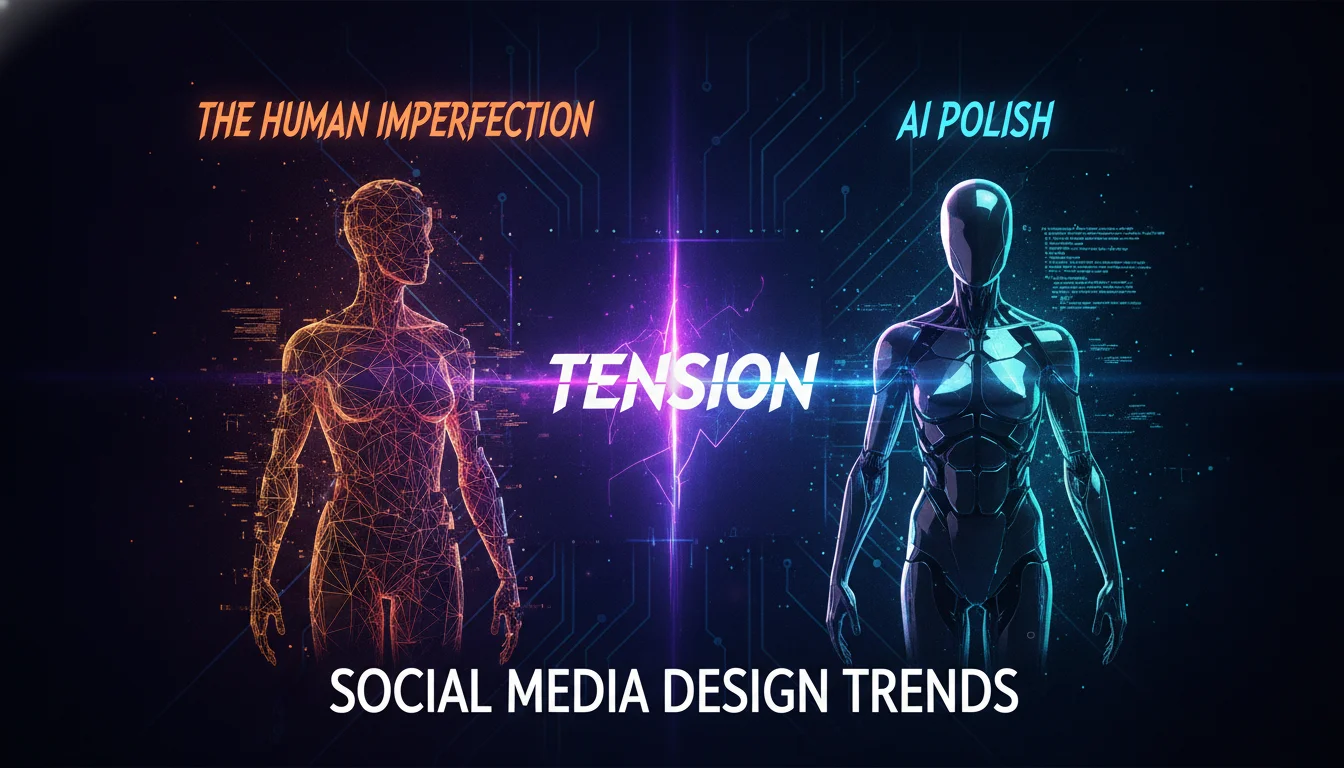
One of the defining the media design trends of 2026 is the rise of imperfect-by-design content: raw, unpolished, human-looking visuals over glossy perfection. Manypixels explicitly names Duolingo’s chaotic TikToks as a leading example. VistaPrint’s Top 10 Graphic Design Trends 2026 report similarly observes that brands with personality and a sense of imperfect realness are standing out against a sea of sameness. The aesthetic includes visible grain, hand-rendered marks, awkward crops, and candid photography that feels authentically made rather than machine-generated.
“What makes this style stand out is its emotional and cultural depth. It’s not just visually appealing, but it also tells meaningful stories rooted in local identity and heritage. Blending timeless motifs with contemporary layouts, it creates an authentic look that resonates in branding, packaging and editorial work where personality and storytelling matter most.”
– Kaleya, Designer on 99designs by Vista
AI Visuals and Disclosure
AI-generated imagery is now common, but the catch is disclosure. Manypixels points out that AI visuals with honest labeling can maintain trust, while undisclosed AI content invites backlash, citing Coca-Cola’s AI holiday ad controversy as a cautionary example. The trend is not about avoiding AI. It’s about signaling to audiences when AI is used. This transparency aligns with the broader human-imperfection movement: audiences value knowing that a real person is behind the creative choices.
Why Authenticity Outperforms Polish
The reason this tension defines 2026 is simple. When every brand can produce clean, on-brand, algorithm-friendly content, the content that gets noticed is the content that feels made by a person. Adobe’s forecast describes an ironic outcome: as AI becomes more pervasive, design is leaning toward messy, chaotic, and gloriously human. Authenticity is a strategic differentiator because it reduces the cognitive distance between brand and audience. A poorly lit, candid photo with honest typography can outperform a hyper-rendered 3D graphic if it feels real.
2026 Social Media Design Trends Shaping Feeds
| Trend | What It Is | Brand Example |
|---|---|---|
| Imperfect by Design | Raw, unpolished, human-looking content over glossy perfection | Duolingo’s chaotic TikToks |
| AI Visuals with Disclosure | AI-generated imagery labeled honestly to keep trust | Coca-Cola’s AI holiday ad backlash |
| Bold, Oversized Typography | Type as the main visual, readable at thumbnail size | Spotify Wrapped |
| Vibrant Color Returns | Saturated, unexpected palettes replacing muted neutrals | Charli XCX’s “Brat” green |
| Tactile Textures | Grainy overlays, earthy surfaces, letterpress-inspired type | Organic and analog branding |
| Motion as Default | Subtle animation and micro-transitions as baseline expectation | Looping text reveals, animated icons |
| Custom Illustration | Hand-drawn assets that communicate brand personality | Unique illustrated brand systems |
| Accessibility-First | Captions, alt text, readable fonts, and high contrast | Platform-native closed captions |
| Zero-Click Content | Posts that deliver value without requiring a tap or click | Carousel infographics, story slides |
| Social Commerce | Product-focused visuals with clear in-feed purchasing cues | Shoppable posts with product tags |
Bold, Oversized Typography
Bold typography is no longer an accessory. It is the main visual. According to Versa Creative, bold typography continues to define social media design because it communicates quickly and clearly, even on small screens. Designers are pushing type further with scale, layering, and unexpected alignment. Spotify Wrapped graphics are a prime example of oversized type as storytelling. This trend works because text becomes both the message and the visual hook in a feed where users scroll fast.
Vibrant Color Makes a Comeback
Neutral palettes had a strong presence in recent years, but 2026 is seeing a return to vibrant color and energetic combinations. Versa Creative notes that bright hues, unexpected pairings, and gradient blends help brands stand out in feeds saturated with muted tones. Manypixels echoes this, using Charli XCX’s “Brat” green as a cultural marker of the saturated palette resurgence. The key is not chaotic color but strategic contrast: one vibrant field can anchor a composition while neutrals recede.
Tactile, Textured Surfaces
Tactile and sensory design is one of Adobe’s ten major trends for 2026. Adobe describes materials that mimic touch, sound, and motion becoming more prevalent, with puffy, soft, and squishy textures almost a delicacy. This includes grainy overlays, paper-like backgrounds, letterpress-inspired type, and earthy textures like sand, stone, and bark. It’s Nice That highlights a related tendency: images that look like they were made on an office printer, with visible misregistration and analog artifacts. These textures create a sense of physical presence in a digital feed, which captures attention through novelty.
Elemental Folk and Cultural Flavor
VistaPrint’s 99designs community identifies “Elemental Folk” as a standout 2026 graphic design trend rooted in folk art and regional craft traditions. After years of ultra-slick digital minimalism, design is shifting back toward something slower, warmer, and rooted in heritage. Folk motifs, ornamental borders, jewel color palettes, and rustic artisanal typography are showing up in branding, packaging, and social content. Adobe’s forecast frames this as “local and cultural flavor”: patterns and symbols rooted in heritage, documentary-style photography, and typography inspired by regional traditions. For brands with a strong sense of place or community, this is one of the most differentiated trends available right now.
“We’re seeing a return to crafty old folklore patterns but expressed in a more fresh and contemporary way. This modern take draws from Northern European historical elements which feels warm, inviting and joyous.”
– Mary Pho, Art Director, VistaPrint
Collage, Cut-Outs, and Layered Visuals
Collage-style compositions are gaining serious traction across social feeds. Adobe lists collage and layered visual elements as a distinct 2026 trend, noting that visible imperfections of overlapping layers create depth and narrative. It’s Nice That goes further, identifying cut-out trinket collections and pick-and-mix lettersets as emerging graphic tendencies worth watching. These approaches feel handmade and editorial, which is exactly why they stand out against algorithmically smooth content. Think zine-style layouts, asymmetric compositions, and unexpected juxtapositions that give a brand a point of view rather than just a look.
Motion as Default and Interactive Content
Motion Graphics and Micro-Moments
Motion graphics continue to dominate the feed. Versa Creative states that static posts still have their place, but subtle animation, looping text movement, animated icons, and micro-transitions bring a post to life. The trend has shifted from flashy effects to purposeful movement that guides the viewer’s eye and highlights key information. Even a pulsing headline or sliding text reveal can measurably improve engagement. Motion is now the default expectation for social media content, not an exception.
Interactive, Zero-Click Content
Interactive, zero-click content is a social media design trend that acknowledges how people actually browse. Manypixels defines zero-click content as posts that deliver value without requiring a tap or click, such as infographics, carousel tips, and text-based story slides. This trend is driven by social platforms acting as search engines. Users often search in-app for answers, and a well-designed zero-click post can satisfy that query directly. Interactive elements like polls, quizzes, and tap-through carousels increase dwell time and signal relevance to algorithms.
Social Commerce in the Feed
Social commerce is part of the broader social media ecosystem because design directly influences purchase behavior. Manypixels highlights social commerce that sells in the feed as a major trend. This requires product-focused visuals that balance aesthetic appeal with clear purchasing cues. Shoppable posts, product tags, and in-app checkout rely on clean, persuasive design. The visual must communicate the product’s value at a glance, often through overlays, badges, and consistent template systems that build recognition over time.
AI-Assisted Design and the Transparency Imperative
AI-Powered Design Tools Are Everywhere
AI-assisted design is standard practice in 2026. According to Versa Creative, the conversation is no longer about whether to use AI tools but how to use them responsibly. AI-powered design tools help teams generate layouts, resize assets, suggest color palettes, and streamline production. Bazaart’s social media design trends report notes that creators and businesses turn to AI to change backgrounds, create custom visuals, and edit content faster than ever. The efficiency gain is real, but it does not eliminate the need for human creative direction.
Custom Illustration as a Human Signal
As AI-generated imagery becomes ubiquitous, custom illustration emerges as a clear human signal. Manypixels lists custom illustration as one of its twelve trends, arguing that hand-drawn or uniquely illustrated assets communicate brand personality in a way that stock or AI images cannot. This aligns with Adobe’s observation that hand-rendered and letterpress-inspired aesthetics are on the rise. A custom illustration system, even a simple one, creates a recognizable visual language that builds trust over time.
Accessibility-First Design
Accessibility-first design is one of the most important social media design trends for 2026. Manypixels includes it as a top trend, emphasizing captions, alt text, readable fonts, and color contrast. This means designing for how people actually consume content: on mute, on small screens, with screen readers, and in bright or dark environments. Accessibility-first design improves both reach and usability, and it aligns with platform algorithms that reward longer watch times and lower bounce rates.
Pros and Cons of Following Social Media Design Trends
Pros
- Audience relevance: Trend-aligned content feels current and signals that your brand is paying attention to culture.
- Algorithm advantage: Platforms tend to surface content that matches native user behavior, and trends often reflect exactly that.
- Creative momentum: A clear trend direction gives your design team a focused brief, which speeds up production and reduces revision cycles.
- Differentiation: Applied with brand specificity, a trend can make your content instantly recognizable in a crowded feed.
- Efficiency gains: AI-assisted design tools, now a trend in themselves, genuinely reduce production time for teams of any size.
Cons
- Brand dilution: Chasing trends without anchoring them to your identity can make your feed look like everyone else’s.
- Short shelf life: What reads as fresh in Q1 can feel dated by Q3. Trends move fast, and over-investment in one aesthetic is risky.
- Team fatigue: Constantly pivoting creative direction burns out designers and creates inconsistent output.
- Misalignment risk: A trend that works brilliantly on TikTok may feel completely wrong on LinkedIn or in a B2B context.
How to Choose the Right Social Media Design Trends
Step-by-Step Process for Trend Selection
Selecting the right social media design trends requires a structured approach. Follow these steps:
- Audit your current content. Identify which posts performed best and which visual styles are already consistent with your brand identity.
- Define your audience’s platform habits. Determine whether they are on TikTok, LinkedIn, Instagram, or YouTube, and how they browse there.
- Review the trend list. Look at the twelve trends from Manypixels and the ten from Adobe, and shortlist those that align with your brand voice.
- Run a small pilot. Test two or three trends in a time-bound campaign, measuring engagement, saves, and click-through rates.
- Document what works. Create a visual playbook that records which trends delivered results so you can scale or retire them intentionally.
Avoiding Trend Burnout
Chasing every social media design trend leads to inconsistent branding and team fatigue. Manypixels advises picking the two or three that fit your brand, not all twelve. Trend burnout happens when brands abandon their visual identity to mimic a viral aesthetic. The antidote is to anchor each trend in a core brand element, such as a signature color, typeface, or photographic style. This keeps the feed recognizable even as seasonal trends change.
Measurement and Iteration
Design trends only matter if they move measurable outcomes. Track engagement rate, watch time, link clicks, and follower growth for trend-based posts versus baseline content. A trend that generates high impressions but low saves may not be worth continuing. Use platform analytics to see whether imperfect-by-design content retains viewers longer than polished alternatives. Iterate monthly, not quarterly, because social media design trends evolve quickly and responsiveness is a competitive advantage.
Putting It All Together: Social Media Design Trends in Practice
The 2026 Shift in Plain Terms
The 2026 social media design trends are not a random list. They are a coherent reaction to AI saturation. Adobe’s forecast shows a turn toward sensory, playful, and culturally rooted design. VistaPrint highlights personality and sincerity. Manypixels frames the shift plainly: “polish no longer stands out.” The synthesis is clear. Brands that lead with human imperfection, bold visual clarity, and transparent AI use will earn attention in crowded feeds.
If you want to see how these principles translate into real brand work, explore our thinking on brand storytelling and visual strategy or learn more about our creative and digital marketing services.
A Practical Action Plan
Start with a content audit and select two or three trends. Assign each trend to a specific platform and format. Use AI tools for production efficiency, but always disclose AI-generated elements and add a custom human touch. Design for accessibility and zero-click consumption. Measure performance against baseline content and adjust monthly. The brands that treat design trends as strategic signals, not cosmetic decorations, will build durable audience relationships in 2026 and beyond.
Ready to build something bold? Contact Emin Media for a free brand consultation and let’s figure out which of these trends belongs in your visual strategy.
Frequently Asked Questions
What are the design trends for social media in 2026?
The top social media design trends for 2026 include bold oversized typography, vibrant color palettes, imperfect-by-design authenticity, tactile textures, motion graphics as default, and AI-assisted design with transparency. Human imperfection and culturally rooted visuals are replacing ultra-polished minimalism across every major platform.
What are the biggest trends in social media right now?
Right now, motion graphics, bold typography, vibrant colors, and authentic raw content dominate. AI tools are widely used, but audiences respond best when AI is disclosed and human creative touches remain visible in the final output.
What are 2026 graphic design trends?
According to Adobe’s 2026 Creative Trends Forecast, major graphic design trends include exaggerated playful letters, surreal imagery, organic imperfect design, freeform storytelling layouts, warm personal style, local cultural flavor, collage and layered visuals, and maximalist chaotic layouts. VistaPrint adds Elemental Folk and Hyper-Individualism to that list.
What are some trending social media post design ideas?
Trending post designs include carousel infographics, looping text animations, meme formats, collage-style compositions, retro filters, hand-drawn illustrations, and cut-out silhouette graphics. Duolingo’s chaotic TikToks and Spotify Wrapped graphics are the most commonly referenced real-world examples.
Should brands adopt every social media design trend?
No. Brands should choose only two or three trends that align with their existing identity and audience platform habits. Chasing all trends leads to inconsistent branding and team burnout without measurable return on creative investment.
How do AI tools affect social media design trends?
AI tools streamline layout generation, asset resizing, and color palette suggestions, making production faster for teams of any size. The key trend, however, is disclosure: brands that honestly label AI-generated content maintain audience trust, while undisclosed AI visuals can trigger backlash, as Coca-Cola’s AI holiday ad demonstrated.
Enjoyed this article?
Contact Emin Media for a free brand consultation and let's create something amazing together.
Get in TouchRelated Articles
Social Media Design Best Practices 2026
Master social media design best practices in 2026. Bold visuals, platform specs, and brand strategy…
Brand Design Trends 2026: Motion, AI & Imperfection
Explore brand design trends 2026: motion-first identities, AI collaboration, tactile imperfection, and expressive type shaping…