2026 Branding Trends: The Creative Director’s Playbook
2026 branding trends are the creative and strategic forces reshaping how brands look, feel, and connect with audiences across every screen, surface, and touchpoint. This year’s shift centers on humanized imperfection, adaptive identity systems, AI-augmented workflows, and sensory-rich storytelling.
Key Takeaways
- Imperfection is intentional. Rough textures, asymmetry, and hand-drawn details signal authenticity in an AI-polished landscape.
- Adaptive identity systems replace rigid logos. Brands need flexible visual components that perform across screens, sizes, and contexts.
- AI becomes a collaborative design partner. Node-based tools and agentic workflows let creators control AI processes with transparency.
- Sensory and immersive experiences drive engagement. 3D, motion, and tactile-inspired visuals create memorable brand moments.
- Local, cultural, and personal storytelling differentiates. Warm, imperfect, and culturally rooted visuals outperform generic over-stylized sameness.
‘Small businesses have the freedom to get weird, bold and let their individuality shine through in ways big brands often can’t.’ – Patrick Llewellyn, VP, Digital and Design Services, VistaPrint
The Strategic Context of 2026 Branding Trends
Why 2026 Is About Balance, Not Reinvention
The branding trends don’t represent a clean break from 2025. They amplify existing movements, particularly the growing influence of artificial intelligence and agentic AI. According to The Branding Journal’s January 2026 analysis, three major movements define the year: agentic AI is changing the rules of branding and marketing; personal branding is shifting from performance to ownership and real relationships; and visual identity is evolving into adaptive systems that focus on feelings and experiences rather than static visuals. This is not a reset. It’s a recalibration toward human connection.
Adobe’s 2026 Creative Trends Forecast echoes this balance. Adobe predicts four main creative themes: content that touches all our senses, sparks connection, engages playfully, and is grounded in local culture. The heavy influence of AI, AR technology, and gaming is paradoxically driving a backlash away from hi-tech design. Creative work is indexing more heavily on organic, analog, realistic, human-centered design. The more technology saturates brand communication, the more audiences crave the messy, chaotic, and glorious humanity that machines cannot replicate.
From Static Logos to Adaptive Identity Systems
A defining characteristic of this type of trends is the shift away from a single rigid logo toward adaptive visual identity systems. Adaptive visual identity is a flexible system of logo, color, and layout components designed to maintain brand recognition across contexts. According to The Brand Strategy Lab, brands are leaning into systems that stay clean, simple, and easy to adjust across any platform. That means logos that remain sharp at small screen sizes, tight but flexible color palettes, and layouts that can change quickly without losing the brand’s feel.
Apple is a prime example: its logo is minimal, but the system adapts from stark black-and-white to bold, colorful product campaigns without drifting from core identity. This adaptive approach matters because modern brands must perform across screens, motion systems, packaging, social feeds, and real-world applications. Digital Synopsis notes that a logo today must still feel intentional and recognizable while carrying meaning through subtle details rather than decorative excess. Eric Turney, President of The Monterey Company, puts it plainly: the strongest logos use clear shapes, strong contrast, and details that remain readable across embroidery, enamel, and metal products. The result is a wave of logos that feel crafted rather than manufactured, flexible without losing structure.
The Role of Agentic AI and Human Connection
Agentic AI is a class of artificial intelligence that can take actions and make decisions on behalf of a user, beyond simply generating text or images. In the context of this kind of trends, agentic AI is reshaping how brands approach strategy, content creation, and customer experience. The Branding Journal argues that agentic AI is changing the rules of branding and marketing, making it possible to automate more complex tasks while simultaneously raising the value of distinctly human contributions.
The human factor becomes a differentiator. Behance’s Design Trends 2026 gallery is direct about this: the future of digital design, meaning people manually crafting interfaces, illustrations, and visual systems, will shrink. Not disappear, but compress. Designers who embrace new tools while holding tight to purpose will lead. The balance between AI and human creativity, between polished and imperfect, between experiential richness and performance is the central challenge of the year.
Pros and Cons of Following 2026 Branding Trends
Pros
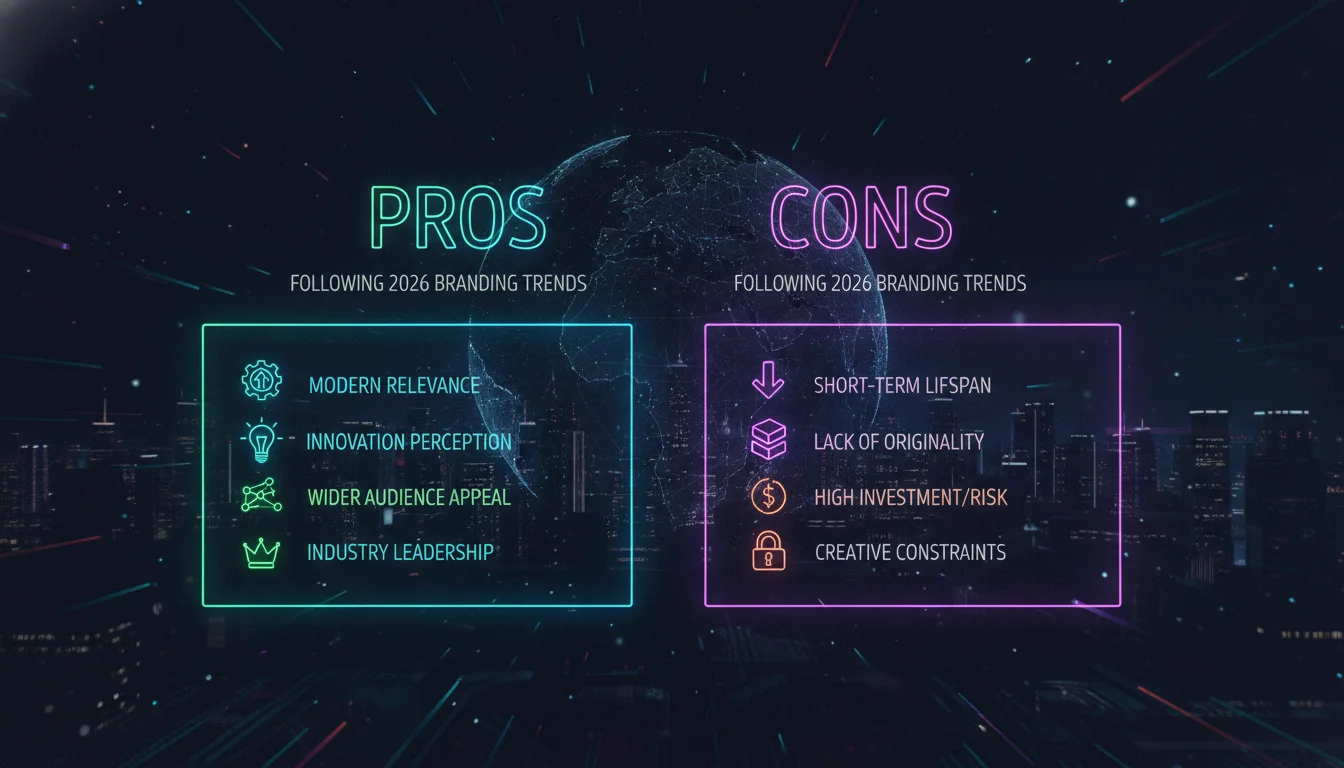
- Stronger audience connection. Humanized, imperfect aesthetics build trust and emotional resonance in a market saturated with AI-generated sameness.
- Competitive differentiation. Adaptive identity systems and local cultural flavor give brands a distinct visual voice that generic templates cannot replicate.
- Operational efficiency. AI-augmented workflows and node-based tools speed up production without sacrificing creative control.
- Future-proofed identity. Flexible visual systems perform across screens, motion, packaging, and real-world touchpoints without constant redesigns.
- Creative ownership. Personal branding trends favor direct audience relationships over algorithm dependency, giving founders and creators more control.
Cons
- Execution risk. Imperfection as a strategy requires skill. Poorly executed roughness reads as careless, not authentic.
- Governance complexity. Adaptive identity systems need modular assets, clear rules, and often motion guidelines, which demand more design infrastructure.
- Trend fatigue. Chasing every direction in 2026 branding dilutes brand identity. Choosing the wrong trend for your audience can backfire.
Humanized, Imperfect Aesthetics
Retro, Brutalist, and Organic Visuals
The visual language of branding trends embraces honesty. Behance’s trend forecast highlights retro, brutalist, and imperfect aesthetics as a leading direction. Expect rough textures, asymmetry, visible grids, and 90s nostalgia. Audiences crave human touch in an overly polished digital world, so imperfection must be used deliberately. It should look intentional, not careless. This aligns with the broader cultural shift VistaPrint identifies: people are craving something they can trust, designs that feel personal and approachable.
Organic and analog elements are showing up in hand-rendered and letterpress-inspired fonts, in earthy textures like sand, stone, and bark, and in low-contrast, minimal forms. When branding for authenticity, designs in 2026 will often show elements of imperfection. This is not a rejection of professional craft but a redefinition of quality, one that values emotional resonance over pixel-perfect polish.
Imperfect Letterforms and Hand-Drawn Typography
Typography is a primary vehicle for humanized expression in this type of trends. Behance notes that humanized and imperfect letterforms are gaining traction, favoring hand-drawn shapes, organic curves, and subtle flaws that add warmth to digital design. These character-rich letterforms counterbalance the precision of AI-generated visuals. Adobe’s 2026 trend forecast points to the same direction: hand-rendered and letterpress-inspired fonts appearing across branding, bringing personality and warmth back into digital design.
Designers are advised to add small, intentional imperfections to type while keeping it readable. This distinction matters: imperfection as a stylistic choice creates a sense of authenticity, but illegibility undermines usability. The line between deliberate roughness and sloppy execution is the line between a memorable brand and a forgotten one.
Warm, Personal Visual Style and Candid Photography
Beyond typography, the broader visual style is becoming warm and personal. Adobe’s forecast describes a shift toward flexible, human-centered design with gentle and inclusive tones, emotionally open branding, and welcoming aesthetics. Hand-drawn details, candid photography, and imperfect copywriting are all part of this shift. With AI everywhere, the human factor becomes a differentiator. Injecting empathy and story into each design layer creates a sense of authenticity and personal connection that automated content often lacks.
VistaPrint’s designers echo this: connection, personality, and imperfection are standing out in a market flooded with over-stylized sameness. Small businesses, in particular, have the freedom to get weird, bold, and let their individuality shine through in ways big brands often can’t. That’s a real strategic advantage. Smaller brands can lean into human quirks without the same risk of diluting a massive, uniform identity.
AI-Augmented Workflows and Node-Based Design Tools
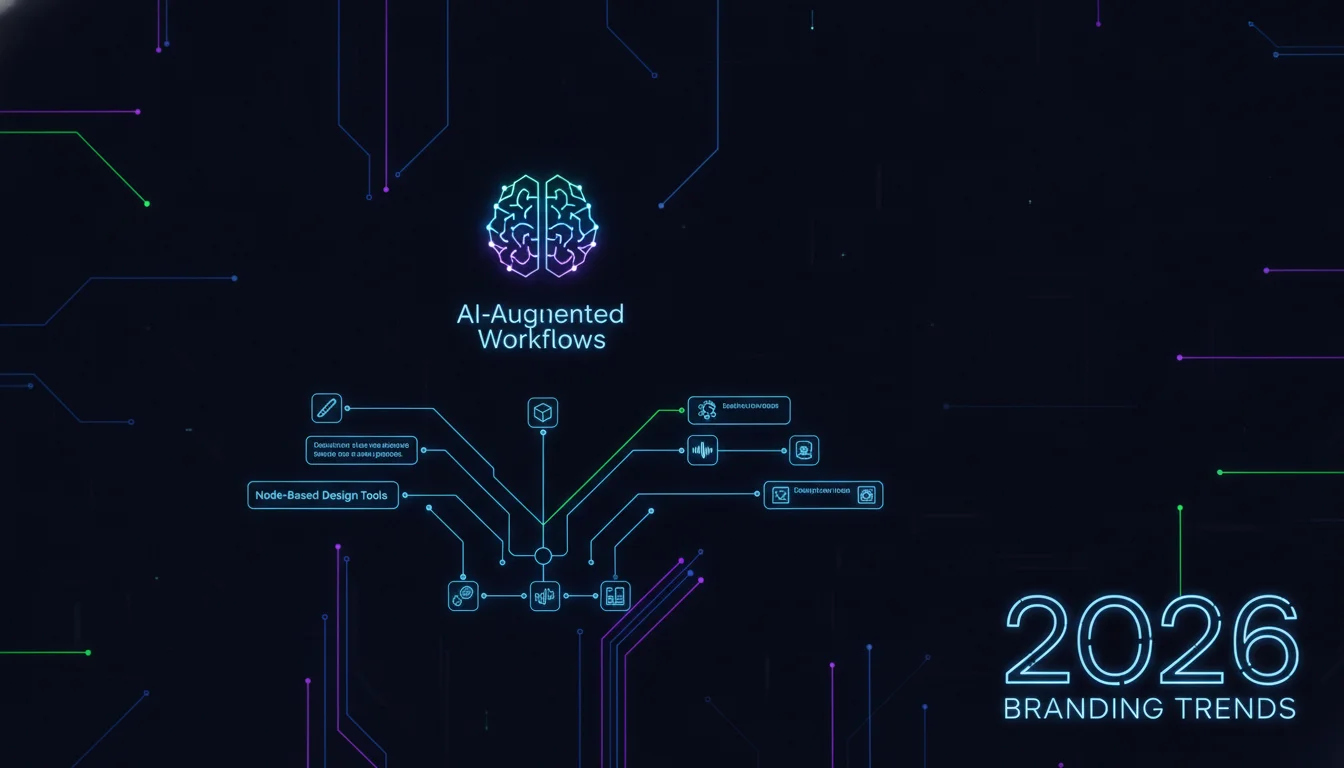
Node-Based AI Design Tools Explained
Node-based AI design tools are visual programming interfaces that let creators connect models, prompts, data, and logic in modular workflows. According to Behance’s 2026 forecast, designers increasingly use node-driven interfaces to build complex AI workflows with visual clarity. These tools give creators full control and transparency over AI workflows, making complex processes easy to adjust, remix, and scale. The flexibility encourages experimentation and speeds up production without sacrificing clarity.
The practical advice is to start with simple node chains and expand gradually so the system stays clear, organized, and reusable. This approach matters because AI-generated outputs can otherwise feel opaque or uncontrollable. Node-based tools restore a sense of craft by making the AI’s decision-making process visible and editable, which is exactly what the best this kind of trends demand.
Agentic AI and the New Branding Workflow
Agentic AI goes a step further than generative AI. It represents a workflow where AI systems can plan, execute, and iterate tasks with minimal human intervention. In 2026 branding, this means brand teams can automate research, competitive analysis, content variations, and real-time personalization at scale. The Branding Journal cautions that the brands that win will be those that use agentic AI to amplify human strategy rather than replace it. The human connection, felt experiences, emotional depth, and cultural sensitivity, remains the differentiator.
Canva’s 2026 Design Trends report reinforces this relationship. Their global survey of 1,000 creators found that 80% said 2026 is the year we regain creative control, while 77% described AI as an “essential partner.” This duality captures the heart of 2026 branding: the technology is indispensable, but the creative vision must stay human. As Canva puts it, the real magic happens when AI is paired with curiosity and courage to imagine the impossible.
Balancing Automation with Human Creativity
The challenge for brand leaders is not whether to use AI, but where to draw the line. Automate the repetitive, the data-intensive, and the iterative. Preserve human judgment for brand voice, ethical choices, and the moments of emotional connection that define a brand’s character. The 2026 branding trends suggest a filtering process: use AI to generate options, then apply human taste to select, refine, and imbue meaning. This balance is what separates brands that feel alive from brands that feel generated.
Digital Synopsis highlights that designers are responding to two parallel pressures: automation and AI-generated sameness on one side, and a growing desire for authenticity, tactility, and personality on the other. The strongest branding in 2026 will use AI for efficiency without letting it erase the human texture. It’s not a choice between technology and humanity. It’s a synthesis.
Typography and Color in 2026 Branding Trends
Exaggerated, Playful Letters and Text
Typography in 2026 branding trends is leaning toward excess and the absurd. Adobe’s trend forecast notes that instead of the uniform fonts of a computer, designers are using oversized sans-serifs, bubbly and puffy letterforms, and wavy, distorted, bubble-like fonts. Handwritten scripts and loopy cursives offer that personal touch and will show up in branding this year. This playful approach aligns with the broader theme of connection and personality.
Behance adds that neo-minimalism and micro-maximalism are also shaping type choices. Minimal doesn’t mean boring. Clean layouts are paired with bold type, color pops, or intricate micro-details. Let one strong element take the spotlight: an oversized wordmark, a single vibrant hue, or a detailed micro-interaction. The result is a balance between clarity and personality, a hallmark of effective 2026 branding.
Vibrant Color Systems and Chromatic Expression
Color is bold again in 2026 branding trends. Behance highlights vibrant color systems and chromatic expression, including dynamic palettes, gradient layering, duotones, and reactive color schemes that adapt to mood or context. Color becomes a storytelling device, representing brand emotion, energy, and inclusivity. The tip: experiment with accessible vibrancy. Balance saturation with contrast for legibility. This is crucial for brands that want to feel energetic without alienating users with visual noise.
Adobe describes an immersive, high-energy visual style built from bright, saturated color palettes. Realistic textures mixed with surreal elements create an immersive experience. Like last year, there’s a pendulum of nostalgic and futuristic aesthetics. Brands can lean into this by choosing a color story that feels both contemporary and emotionally resonant. The key is not novelty for its own sake, but color that supports the brand’s story and the audience’s expectations.
Neo-Minimalism and Micro-Maximalism
Neo-minimalism is a design approach that uses clean, simple structures but adds a single bold or intricate element to create personality. Micro-maximalism is the same idea in reverse: a mostly restrained layout that uses small, carefully placed details to reward close attention. Both are reactions to the extremes of bland corporate minimalism and overwhelming visual clutter. They work especially well in digital environments where users skim quickly but return to brands that offer a second look.
In the context of 2026 branding trends, these approaches give brands a practical toolkit. A startup might adopt neo-minimalism with a bold color pop to stand out in a crowded feed. An established brand might use micro-maximalism to add depth to an otherwise clean identity. The underlying principle is restraint with intention: every element earns its place.
Immersive 3D, Spatial Interfaces, and Motion Design
Immersive 3D and Spatial Brand Experiences
3D is becoming native to the web and apps, and it’s one of the most visually striking 2026 branding trends to watch. Behance’s forecast states that from micro-3D interactions to full immersive environments, depth and motion enhance storytelling and user engagement. This includes spatial interfaces where elements exist in simulated three-dimensional space, creating a feeling of physical presence. The performance caveat is important: realism should never slow usability. Brands must balance visual richness with load times and intuitive navigation.
Adobe’s immersive, high-energy style complements this with realistic textures mixed with surreal elements. Spatial branding can range from a 3D product viewer on an e-commerce site to a fully interactive brand world. The common thread is that the user moves through the brand, rather than simply viewing it.
Cinematic Motion and Micro-Interactions
Motion design becomes a primary branding language in 2026. Behance emphasizes cinematic motion and micro-interactions, from subtle micro-interactions to cinematic transitions. Movement guides attention, conveys personality, and creates flow. Every animation should have purpose: delight, inform, or direct. This principle prevents motion from becoming decorative noise.
Micro-interactions are small, functional animations that respond to user actions: a button that changes shape, a scroll-triggered fade, a hover effect that reveals information. In 2026 branding trends, these details are not afterthoughts but core components of the brand experience. They create a sense of responsiveness and care that static layouts cannot match.
Surreal and Absurdist Imagery in Branding
Playfulness is a defining emotional register of 2026. Adobe highlights surreal and absurdist imagery: visual jokes, Easter eggs, exaggerated scales, and dreamlike digital collages. Collage-style compositions with unexpected juxtapositions allow brands to show their fun side and tap into the emotions of their audiences. This is especially effective for brands targeting younger demographics or those wanting to break out of category conventions.
Behance’s emotion-led, humanized design trend reinforces this: hand-drawn details, candid photography, and imperfect copywriting feel authentic and personal in a world of automation. Surreal imagery is not arbitrary weirdness. It’s a tool for storytelling, inviting the viewer to linger and interpret. When done well, it makes a brand memorable without sacrificing clarity.
Personal Branding, Authenticity, and Local Cultural Flavor
Personal Branding from Performance to Ownership
The Branding Journal identifies a shift in personal branding that’s central to 2026 branding trends: from performance to ownership and building real relationships. This means less focus on curated, high-gloss personas and more on genuine, often imperfect, human expression. Personal brands, whether founders, executives, or creators, are turning toward owned platforms and direct audience relationships rather than renting reach from algorithms.
This shift is supported by Canva’s finding that 80% of surveyed creators said 2026 is the year we regain creative control. The desire for ownership is not just about data and distribution. It’s also about creative identity. Personal brands that embrace their quirks and show their process will stand out against the polished sameness of AI-generated content.
Local and Cultural Flavor as Brand Differentiation
Adobe’s forecast includes local and cultural flavor as a major trend within 2026 branding trends. This means designing with specific geographic, cultural, or community references rather than appealing to a bland global average. It could involve using local languages, traditional patterns, regional color meanings, or collaborating with local artists. The effect is a brand identity that feels rooted and trustworthy, especially when audiences are skeptical of generic corporate messaging.
Cultural flavor adds texture and specificity. It also creates storytelling opportunities that generic branding cannot match. For global brands, this might mean regional adaptations of the core identity. For local businesses, it’s a chance to own their heritage completely.
Freeform, Storytelling Layouts and Zine-Style Composition
Layouts are becoming more editorial and less rigid. Adobe predicts freeform and storytelling layouts, with loose, editorial-style compositions taking on a zine-style look. Overlapping elements, asymmetry, and dynamic rhythm create a sense of controlled chaos. This playful, unpredictable structure is a welcome departure from the grid-locked templates that dominated earlier digital design.
Behance’s retro and brutalist aesthetics intersect here. Visible grids, asymmetry, and raw textures evoke the spirit of independent zines and 90s web design. The key is to maintain readability while breaking symmetry. Brands can use freeform layouts for social campaigns, lookbooks, or editorial content to signal creativity and independence.
How to Implement 2026 Branding Trends: A Step-by-Step Framework
Implementation is where strategy meets execution. Use this ordered process to translate the 2026 branding trends into brand action.
- Audit every touchpoint where your brand appears, from website to packaging.
- Select trends that align with your brand’s emotional promise and audience expectations.
- Prototype and test with real users before committing to a full rollout.
Step 1: Audit Your Brand’s Current Touchpoints
Before adopting any trend, list every place your brand shows up: website, social profiles, packaging, email signatures, product UI, physical spaces, and sales collateral. Assess whether each touchpoint feels static, generic, or disconnected from the human qualities that define 2026 branding trends. Look for over-polished sameness: stock imagery, uniform typography, and rigid templates. This audit establishes a baseline and identifies the highest-impact areas for change.
Use a simple rubric: Is this touchpoint flexible across screen sizes? Does it feel human or machine-made? Does it support a story or just display a logo? According to The Brand Strategy Lab, adaptive identities require components that change without losing feel. If your logo and colors cannot flex across contexts, that’s your priority.
Step 2: Choose Trends That Align with Your Brand Strategy
Not every direction within 2026 branding trends is appropriate for every brand. A luxury law firm may not benefit from absurdist surreal imagery, but it can adopt warm, humanized letterforms and subtle micro-interactions. A youth-oriented beverage brand can lean fully into vibrant color systems and playful typography. The decision must be strategic, not purely aesthetic. Start by identifying the brand’s core emotional promise: Is it trust, excitement, nostalgia, innovation, or belonging? Then map trends to that promise.
Behance’s advice applies here: hold tight to purpose while embracing new tools. Choose one or two trends that reinforce your positioning, not five that dilute it. The Branding Journal’s three movements, agentic AI, personal branding ownership, and adaptive visual systems, provide a high-level filter. Decide which movement matters most for your market.
Step 3: Prototype, Test, and Iterate with Real Audiences
Trend adoption should be validated before full rollout. Create low-fidelity prototypes of new visual directions: an updated logo lockup, a revised color palette, a motion test for your website hero. Test these with real users, employees, or customers to gauge emotional response and recognition. The goal is to see whether the new direction feels authentic or forced. Iterate based on feedback before committing to a full brand refresh.
Remember that 2026 branding trends are directional signals, not static rules. A trend that works in a design gallery may fail in a crowded retail aisle. Use analytics and qualitative feedback to measure whether the change improves brand recall, engagement, or conversion. The best brands will treat these trends as hypotheses, not commandments.
Comparing Key 2026 Branding Trends: A Decision Table
AI-Augmented vs. Human-Led Branding Approaches
Brands face a strategic choice about the role of AI in 2026 branding trends. An AI-augmented approach uses node-based tools and agentic workflows to generate options, automate variations, and optimize performance. A human-led approach prioritizes hand-drawn details, candid photography, and imperfect copywriting. The trade-off is speed and scale versus authenticity and emotional depth. In practice, the strongest 2026 branding trends blend both: AI for efficiency, human judgment for soul.
The table below summarizes the comparison across four dimensions.
| Dimension | AI-Augmented Branding | Human-Led Imperfect Branding |
|---|---|---|
| Core focus | Efficiency, scale, consistency | Authenticity, emotional resonance, uniqueness |
| Typical outputs | Generated variations, adaptive assets, data-driven iterations | Hand-drawn type, candid imagery, rough textures |
| Speed | High – can produce many options quickly | Lower – requires time and craft |
| Risk | AI-generated sameness, perceived as generic | Inconsistent execution, scalability challenges |
| Best for | Brands with high-volume content needs, performance marketing | Brands built on personal connection, local heritage, or premium craft |
Static vs. Adaptive Visual Identity Systems
A static identity uses a fixed logo, a single color set, and rigid layout templates. An adaptive identity uses flexible components that can change shape, color, or layout while maintaining recognition. Apple is the classic example of adaptive done well. Static systems are easier to manage but increasingly fail in multi-context environments. Adaptive systems require more design governance but enable the kind of immersive, motion-rich, and responsive branding that 2026 demands.
The trade-off is not aesthetic but operational: adaptive systems need modular assets, clear rules, and often motion guidelines. The payoff is a brand that feels alive across every screen and surface.
Sensory-Rich vs. Minimalist Brand Experiences
Some brands will go maximal: tactile textures, vibrant colors, 3D environments, and cinematic motion. Others will stay minimal, using neo-minimalism and micro-maximalism to add personality through restraint. There is no one-size-fits-all answer in 2026 branding trends. The decision depends on category, audience, and brand promise. A meditation app might favor warm, minimal, organic textures. A gaming brand might embrace full sensory overload.
The common thread across all 2026 branding trends is intentionality. Whether maximal or minimal, the choices must serve the story and the user. The key is to avoid defaulting to the middle. Commit to a direction and execute it consistently.
‘Logo design in 2026 is less about visual novelty and more about meaningful distinction. Brands are no longer competing only on aesthetics – they are competing for attention, trust, and emotional connection across crowded digital environments.’ – Digital Synopsis, Top 10 Logo Design Trends For 2026
Making 2026 Branding Trends Work for You
The 2026 branding trends are not a list to copy. They’re signals of a deeper shift toward human-centered, technology-enabled brand building. Brands that treat AI as a partner, imperfection as a strategy, and adaptability as a default will lead. Start by auditing touchpoints, choose one or two trends that align with your story, and prototype before you commit. The future of branding belongs to those who balance the machine’s precision with the human’s soul.
Ready to build a brand identity that actually stands out in 2026? Contact Emin Media for a free brand consultation and let’s build something bold together.
Frequently Asked Questions
What are the top 2026 branding trends?
The top 2026 branding trends include humanized imperfection, adaptive identity systems, node-based AI design tools, vibrant color systems, immersive 3D and motion design, personal branding ownership, and local cultural flavor. These directions are drawn from forecasts by Adobe, Behance, Canva, and The Branding Journal.
How is AI affecting branding in 2026?
AI is becoming an essential partner in creative workflows. Canva’s global survey of 1,000 creators found that 77% described AI as an “essential partner,” while 80% said 2026 is the year to regain creative control. Brands are using AI for efficiency while keeping human judgment at the core of strategy and storytelling.
What does “Imperfect by Design” mean?
“Imperfect by Design” is Canva’s term for the 2026 trend of embracing rough textures, asymmetry, hand-drawn details, and human flaws in visual work. It’s a deliberate rejection of AI-polished sameness in favor of authentic, personal expression that feels raw, honest, and human.
Should every brand adopt adaptive identity systems?
Not necessarily, but brands that perform across many platforms benefit significantly from flexible logo, color, and layout components. Adaptive systems maintain recognition while allowing the brand to feel alive in different contexts, from social feeds to packaging to motion design.
Is retro or brutalist style still relevant in 2026?
Yes. Behance lists retro, brutalist, and imperfect aesthetics as a leading direction in 2026 branding trends. The key is to use imperfection intentionally and maintain readability so the style reads as deliberate craft, not careless execution.
How do I know which 2026 branding trend fits my brand?
Map the trend to your brand’s emotional promise. A luxury brand may use humanized letterforms and subtle micro-interactions, while a youth brand may use vibrant color and surreal imagery. Audit your touchpoints, choose one or two trends that reinforce your positioning, and prototype with real audiences before committing to a full rollout.
Enjoyed this article?
Contact Emin Media for a free brand consultation and let's create something amazing together.
Get in TouchRelated Articles
Digital Storytelling for Brands: The Complete Guide
Digital storytelling for brands builds real audience connections through narrative. Learn proven techniques, formats, and…
Design Thinking for Marketing: A 2026 Guide
Design thinking for marketing builds campaigns around real user needs. Learn the 5 phases, common…
Creative Direction for Video Shoots: A Complete Guide
Master creative direction for video shoots with proven steps, tools, and strategies that build brand…