What Do You Know About Digital Marketing? Full Guide
Key Takeaways
- What do you know about digital marketing? At its core, it’s the use of websites, social media, email, and other digital channels to reach and engage audiences with measurable, data-driven campaigns.
- It differs from traditional marketing by enabling two-way conversation, real-time measurement, and precise targeting instead of one-way broadcasting.
- The field covers multiple disciplines: SEO, content marketing, social media, email, PPC, and mobile marketing all work together.
- B2B and B2C businesses need distinct digital marketing strategies based on sales cycle length and how decisions get made.
- A strong strategy starts with clear goals, real audience research, sharp content, and constant testing.
- According to Salesforce, 80% of marketers say customer experience is the biggest competitive differentiator today.
What do you know about digital marketing? It is the strategic use of websites, social media, email, and other digital channels to promote brands and drive measurable business results.
We live in a hyper-connected world, and digital marketing has become the connective tissue between brands and the people who love them. It blends creative instinct with hard data, the kind of combination that separates campaigns people remember from ones they scroll past. A small boutique running a smart Instagram grid and a global brand running programmatic ads across three continents are playing the same game, just at different scales. This guide walks through what you actually need to know about digital marketing, from the fundamentals to the trends reshaping the field as of 2026. By the end, you’ll understand not just what digital marketing is, but how to make it work for your brand.
What Do You Know About Digital Marketing? The Fundamentals
Defining Digital Marketing
Digital marketing is the practice of promoting products, services, or brands through digital channels rather than print, TV, or radio. These channels include search engines, websites, social platforms, email, mobile apps, and even text messaging. According to Adobe, digital marketing uses these channels to boost brand awareness, drive traffic, and hit specific marketing goals. It relies on consumer data to pinpoint target audiences and deliver messaging that actually feels relevant. That data-driven backbone is what separates it from the broader, blunter strokes of traditional marketing.
The American Marketing Association frames it a bit differently: digital marketing refers to any marketing methods conducted through electronic devices that use some form of a computer. That covers online efforts on the internet, plus offline digital tactics like SMS campaigns and digital billboards. If the action happens on a digital platform, it counts. That’s the whole test.
“Unlike traditional marketing, which is static and often referred to as one-way communication, digital marketing is an ever-changing, dynamic process,” notes the American Marketing Association. The shift from broadcasting to conversation is the defining feature of the entire discipline.
Digital vs. Traditional Marketing
Traditional marketing, think TV commercials, radio spots, print ads, billboards, has long been the default. It’s mostly one-way: businesses broadcast to a passive audience with limited room for response. Digital marketing flips that script entirely. It builds a two-way dialogue between brands and the people they’re trying to reach. A social post can spark instant likes, comments, and shares. An email can trigger a direct reply within minutes. That interactivity doesn’t just boost engagement, it hands marketers a constant stream of feedback and data they can act on.
Digital also offers a level of measurability traditional channels simply can’t touch. You can track exactly how many people saw an ad, clicked it, and bought something. That transparency means real-time optimization and a much clearer read on return on investment.
Online Marketing: A Critical Subset
People often use “digital marketing” and “online marketing” interchangeably, but there’s a real distinction worth knowing. Online marketing specifically covers activities that require an internet connection, like email marketing, paid social ads, and search engine optimization. Digital marketing is the umbrella term, folding in online marketing plus offline digital channels like SMS and digital billboards. As Salesforce puts it, online marketing is simply a type of digital marketing. Getting this hierarchy straight helps teams pick the right mix of tactics instead of guessing.
Key Types and Channels of Digital Marketing
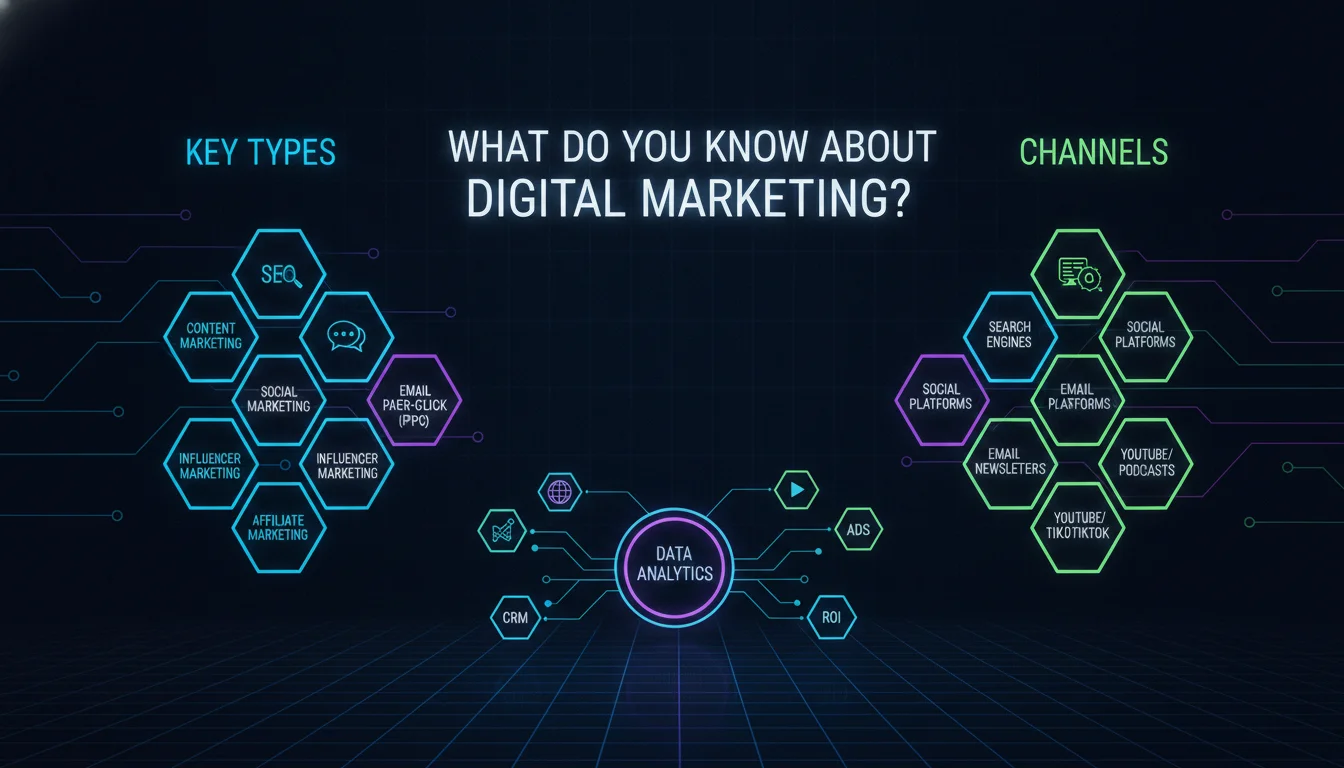
What do you know about digital marketing channels specifically? Each one serves a distinct purpose and meets your audience at a different point in their journey toward a purchase.
Search Engine Optimization (SEO) and Content Marketing
SEO is the practice of optimizing a website to rank higher in search results for relevant keywords, pulling in organic, unpaid traffic. It covers on-page elements like keyword usage and meta tags, off-page factors like backlinks from reputable sites, and technical details like site speed and mobile-friendliness. Content marketing runs alongside it: the strategic creation and distribution of genuinely useful content, blog posts, videos, infographics, guides, built to attract and hold a defined audience. Together, SEO and content marketing form the foundation of inbound marketing, pulling potential customers toward a brand instead of interrupting them.
A sharp SEO strategy builds visibility and authority, while strong content keeps visitors around long enough to convert. A B2B software company, for example, might publish detailed guides that rank for high-intent search terms, capturing leads who are already deep in research mode.
Social Media Marketing and Pay-Per-Click (PPC) Advertising
Platforms like Facebook, Instagram, LinkedIn, and TikTok let brands connect with people organically through posts, stories, and live video, plus paid advertising layered on top. Organic social builds community and brand personality. Paid social lets you target with real precision based on demographics, interests, and behavior. PPC advertising, like Google Ads, charges advertisers each time someone clicks their ad. It delivers fast traffic and works especially well for time-sensitive promotions or catching high-intent searchers right when they’re ready to buy.
Platform choice depends entirely on who you’re trying to reach. B2B companies often lean on LinkedIn for its professional network, while B2C brands lean into Instagram and TikTok for visual storytelling. A balanced approach usually blends organic and paid to maximize both reach and engagement.
Email Marketing and Mobile Marketing
Email marketing remains one of the most reliable digital marketing channels, consistently delivering strong returns compared to other digital tactics. It involves sending targeted, personalized messages to a subscriber list to nurture leads, promote products, and build loyalty over time. Automation tools let businesses send the right message at the right moment, triggered by actions like sign-ups or abandoned carts.
Mobile marketing reaches people on their phones and tablets through SMS, in-app ads, and mobile-optimized sites. With roughly 92% of Americans using the internet, according to Salesforce, and a large share of that time spent on mobile devices, this channel isn’t optional anymore. Push notifications, location-based offers, and responsive design are the tactics that actually move the needle here.
How Digital Marketing Differs for B2B and B2C
The B2B Digital Marketing Approach
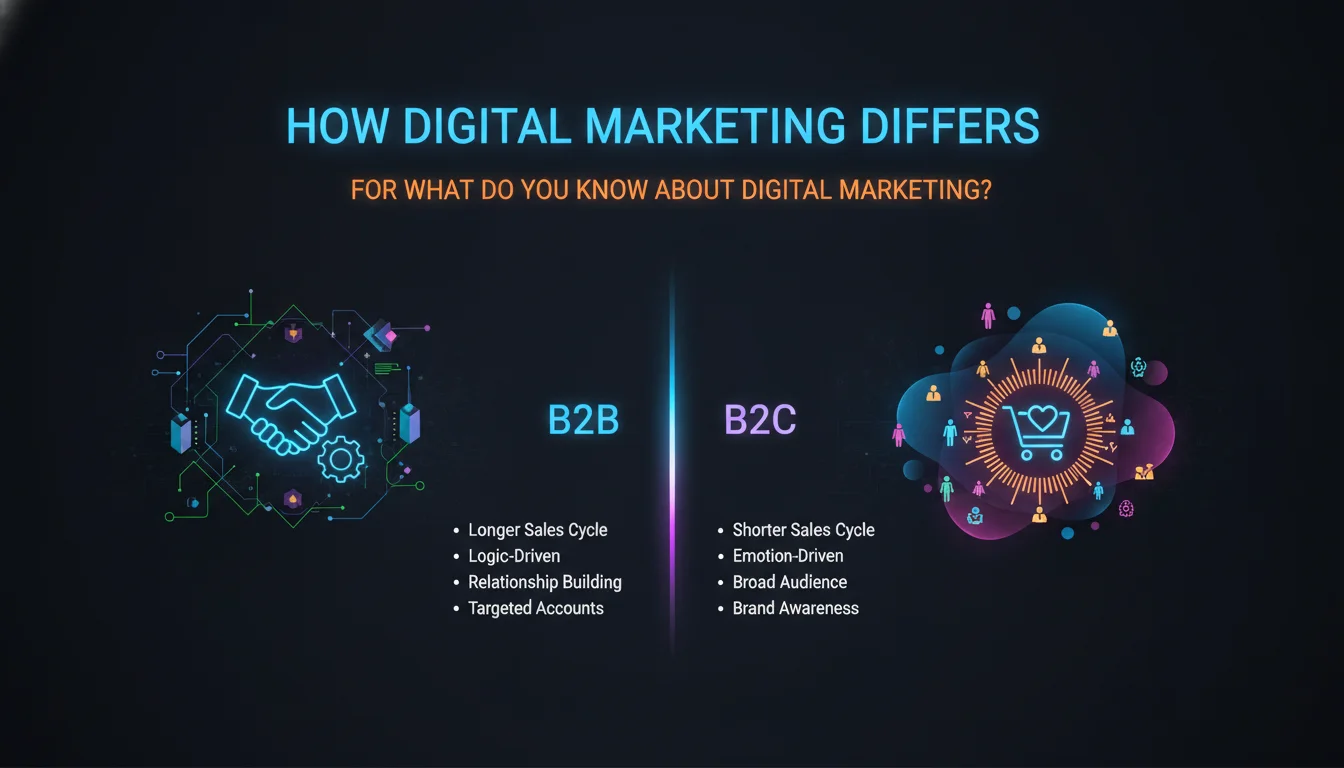
B2B digital marketing works differently because it targets other businesses, not individual consumers. The buying process typically involves multiple decision-makers, longer sales cycles, and a heavier emphasis on logic and ROI. Successful B2B strategies focus on building relationships and delivering value through educational content: whitepapers, case studies, webinars, and LinkedIn networking are the usual playbook. Lead nurturing through email sequences and personalized follow-ups is essential to guide prospects through a sales funnel that can stretch for months.
Many B2B companies lean on account-based marketing (ABM), where marketing and sales teams work together to target high-value accounts with tailored campaigns. Digital channels get used to serve specific, relevant content directly to key stakeholders within those target accounts.
The B2C Digital Marketing Approach
B2C digital marketing sells directly to individuals, and purchases here are often emotionally driven with much shorter decision cycles. B2C strategies aim to create immediate desire and make conversion frictionless. Social media promotions, influencer partnerships, and flash sales are the common tools. Content tends to be more entertaining and visually driven, built to grab attention in a scroll-heavy feed.
Personalization still matters here, but it usually shows up as product recommendations based on browsing history or location-based offers instead of long-term relationship building. E-commerce integration is critical, with a smooth path from social ad to checkout.
Comparison Table: B2B vs. B2C Digital Marketing
| Aspect | B2B Digital Marketing | B2C Digital Marketing |
|---|---|---|
| Decision-makers | Multiple stakeholders | Typically one person |
| Sales cycle | Longer, strategic | Shorter, transactional |
| Purchase driver | Logic, ROI | Emotion, desire |
| Content focus | Educational, detailed | Entertaining, concise |
| Primary channels | LinkedIn, email, webinars | Instagram, Facebook, TikTok |
| Example tactics | Case studies, free trials | Flash sales, influencer collabs |
This table is a good reminder that a one-size-fits-all approach rarely works in digital marketing. Recognizing these differences helps businesses put resources where they’ll actually count and craft messages that land with the right audience.
Steps to Build a Digital Marketing Strategy
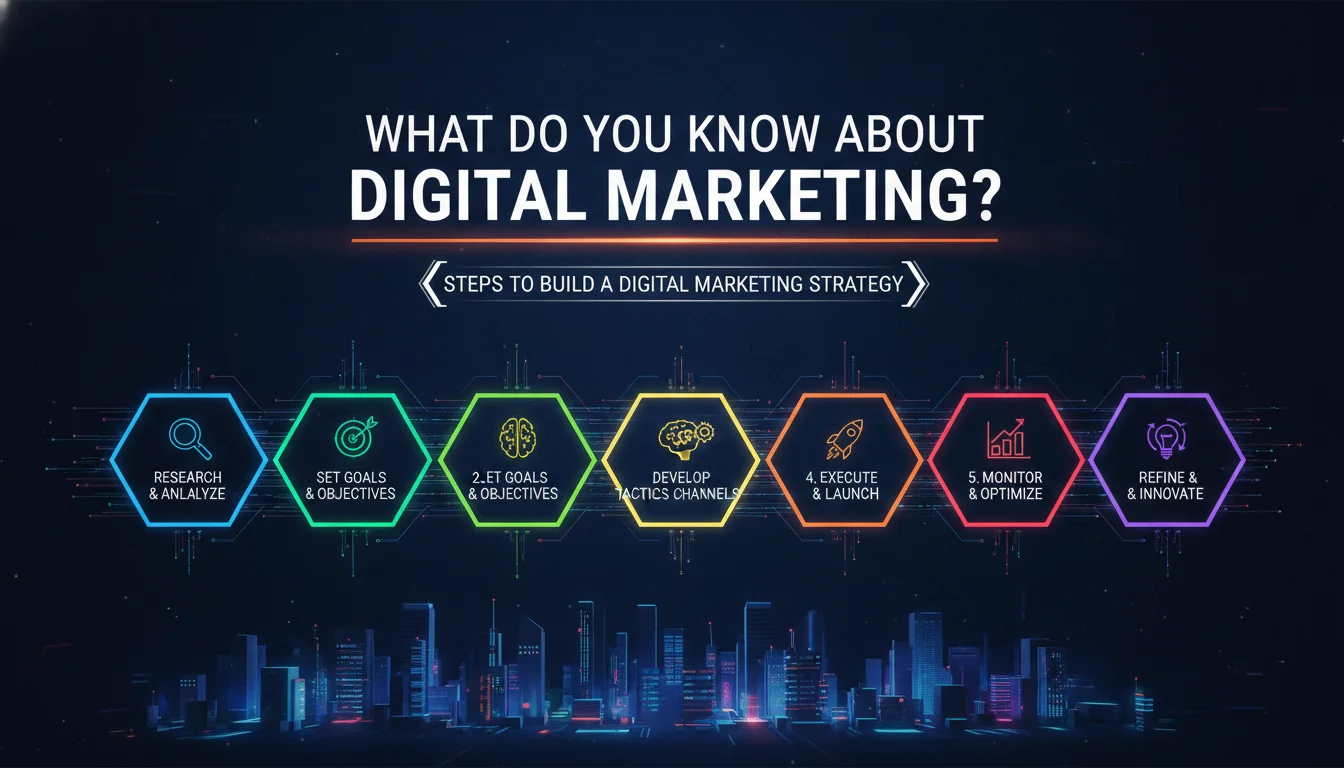
How do you build a digital marketing strategy? Start with clear goals and audience research, then move through content creation, distribution, and measurement in a repeatable cycle. Grow with Google outlines a four-phase framework that’s a solid starting point for any brand.
1. Define Your Goals and Audience
Start by setting clear, measurable goals. Are you trying to increase website traffic, generate leads, boost sales, or build brand awareness? Align those goals with your bigger business objectives, not just this quarter’s campaign. Then define your target audience through real research. Build detailed buyer personas with demographics, interests, pain points, and online behavior baked in. Tools like Google Analytics, social platform insights, and direct surveys all provide useful data here. Understanding your audience up front makes every following step sharper.
2. Create Content and Activate Channels
With goals and audience defined, build content that speaks to your personas at each stage of their journey. That might mean blog posts for awareness, guides for consideration, and case studies for the final decision. Choose channels based on where your audience actually spends time: younger consumers might mean Instagram and TikTok, while a senior executive audience likely means LinkedIn and email. Distribute with intention, and repurpose where you can. A single blog post can become a video, an infographic, and a handful of social updates.
3. Distribute and Promote With Intention
Great content that nobody sees doesn’t move a business forward. Use a mix of organic and paid tactics to amplify distribution. SEO builds long-term traffic, paid ads deliver immediate visibility, email nurtures leads already in your funnel, and social builds community around the brand. Influencer partnerships can extend reach into audiences you haven’t earned organically yet. Automation tools handle the scheduling and triggering so your team can focus on strategy instead of busywork.
4. Measure, Analyze, and Optimize
Digital marketing’s biggest advantage is that it’s measurable in ways traditional media never was. Track KPIs tied directly to your goals: traffic, conversions, click-through rates, return on ad spend, and more. Platforms like Google Analytics, HubSpot, or Salesforce Marketing Cloud help collect and visualize that data. Review performance regularly to see what’s working and what’s dragging. Then adjust: tweak targeting, rewrite copy, test new creative. This loop of continuous improvement is what separates forgettable campaigns from ones that actually build a brand.
Why Digital Marketing Matters in Today’s Economy
Why is digital marketing important? It gives businesses of any size the ability to reach global audiences, measure every dollar spent, and personalize experiences at a scale traditional media never allowed.
Unmatched Reach and Cost Efficiency
Digital marketing breaks down geographic barriers, letting even the smallest business reach a genuinely global audience. A well-optimized website or a sharp social campaign can pull in customers from across the world on a modest budget. Traditional channels like TV can cost tens of thousands of dollars for a single spot; digital channels are far more accessible by comparison. Organic social posts, blogs, and SEO cost time and effort rather than cash, while paid ads can start with just a few dollars a day. This has leveled the playing field for small and medium-sized businesses in a way that simply wasn’t possible a generation ago.
Measurable Results and Real-Time Insights
One of the most powerful things about digital marketing is the ability to track performance in real time. Every click, impression, and conversion can be monitored, giving marketers a precise read on ROI. That transparency means quick adjustments: if an ad underperforms, you pause it and reallocate the budget immediately. Traditional marketing offers no such visibility. You’ll never know exactly how many people saw a billboard and acted on it. Digital marketing’s measurability is what makes data-driven decisions possible in the first place.
Enhanced Customer Personalization
Digital marketing uses data to deliver personalized experiences at scale. By segmenting audiences based on behavior, demographics, or past purchases, marketers can craft messages that actually resonate instead of feeling generic. Personalization goes well beyond dropping a first name into an email subject line. It includes product recommendations, dynamic website content, and precisely targeted ads. These customized touches boost engagement, loyalty, and ultimately revenue. Salesforce reports that 80% of marketers agree customer experience is the key differentiating factor in today’s market, which puts real pressure on teams to get personalization right.
What Do You Know About Digital Marketing Metrics and Analytics?
Key Performance Indicators (KPIs) to Watch
To gauge success, you need to track the right metrics, not just the easy ones. Common digital marketing KPIs include:
- Website Traffic: Total visits, new vs. returning visitors, traffic sources.
- Conversion Rate: Percentage of visitors who complete a desired action (purchase, sign-up).
- Click-Through Rate (CTR): Ratio of clicks to impressions for ads or email links.
- Return on Ad Spend (ROAS): Revenue generated per dollar spent on advertising.
- Customer Acquisition Cost (CAC): Total marketing spend divided by number of new customers.
- Lifetime Value (LTV): Predicted net profit from a customer over the full relationship.
Choosing the right KPIs depends on the campaign’s objective. A brand awareness push might prioritize reach and impressions, while a lead generation campaign lives or dies by conversion rate.
Tools for Measuring Success
A wide range of tools exist to measure and analyze digital marketing efforts. Google Analytics remains the most widely used web analytics service, offering insight into site traffic, user behavior, and conversion tracking. Social platforms provide native analytics of their own, like Meta Insights. For email, tools like Mailchimp and Constant Contact report open rates, click rates, and bounces. CRM systems like Salesforce integrate marketing data with sales and service, giving a full view of customer interactions. Marketing automation platforms like HubSpot streamline campaign management with strong analytics dashboards built in.
Making Data-Driven Decisions
Data alone doesn’t tell you anything without interpretation. Review analytics regularly to spot trends: a sudden drop in traffic might signal a technical SEO issue, while a weak email open rate could point to poor subject lines. Use A/B testing to experiment with ad creative, landing pages, or email copy, and let the data pick the winner. The goal is moving away from gut-feel marketing toward evidence-based decisions. This iterative approach cuts waste and stretches every marketing dollar further.
Trends Shaping Digital Marketing This Year
Artificial Intelligence and Automation
AI is reshaping how digital marketing gets done. Generative tools help produce content ideas, draft copy, and speed up production timelines. Machine learning models analyze large datasets to predict customer behavior and automate ad bidding decisions. Chatbots provide instant support around the clock, guiding people through purchase decisions without a human on the other end. AI-driven personalization engines serve product recommendations tailored to individual browsing habits. Marketers who build fluency with these tools now will have a real edge in both speed and effectiveness as the technology matures further this year.
The Rise of Video and Interactive Content
Video content continues to dominate attention online. Platforms like YouTube, TikTok, and Instagram Reels reward short-form, genuinely engaging video over polished but static content. Live streaming builds authenticity and a sense of real-time connection with an audience. Interactive formats, quizzes, polls, calculators, augmented reality filters, encourage active participation, which increases dwell time and generates useful first-party data. Brands that build immersive experiences instead of static ads are the ones cutting through crowded feeds.
The Integration of Digital and Traditional Marketing
The line between digital and traditional marketing keeps blurring. Smart brands build integrated campaigns where a TV spot drives viewers to a website, an outdoor billboard carries a QR code, and an in-store experience connects back to a mobile app. This omnichannel approach keeps the brand experience consistent across every touchpoint a customer encounters. The future belongs to strategies that unify online and offline efforts around one cohesive customer journey, rather than treating them as separate budgets and separate teams.
Pros and Cons of Digital Marketing
Pros
- Reaches a global audience at a fraction of the cost of traditional media.
- Delivers measurable, real-time results down to the click and conversion.
- Enables precise personalization based on real customer data.
- Levels the playing field for small and medium-sized businesses competing against larger brands.
Cons
- Requires constant learning as platforms, algorithms, and trends shift quickly.
- Can create data overload without a clear framework for interpreting results.
- Ad fatigue and rising competition can push customer acquisition costs higher over time.
- Privacy regulations and cookie changes are making some tracking and targeting harder.
So, what do you know about digital marketing now that you didn’t before? You’ve walked through its definition, its channels, how B2B and B2C strategies diverge, and the metrics that actually matter. The field is broad and constantly shifting, but with this foundation, you can move through it with real confidence. Whether you’re a founder looking for growth or a future marketer building a career, digital marketing offers genuine opportunity for people willing to stay curious and keep testing. Updated for 2026, the fundamentals haven’t changed even as the tools have.
“Digital marketing is a big field that encompasses many functions, from email campaigns to website creation,” according to Grow with Google. “At its core, however, it’s about using online platforms to connect businesses with their target audiences.”
If your brand is ready to move past guesswork and build a digital marketing strategy with real creative teeth, explore our services or check out our take on brand storytelling frameworks and social media trends for more ways to sharpen your approach. Let’s build something bold. Contact Emin Media for a free brand consultation.
Frequently Asked Questions
What is digital marketing in simple words?
Digital marketing is promoting products or services using digital channels like websites, social media, email, and search engines. It differs from traditional marketing by enabling real-time interaction and precise measurement of results.
What are the main types of digital marketing?
The main types include search engine optimization (SEO), content marketing, social media marketing, pay-per-click advertising (PPC), email marketing, and mobile marketing. Affiliate marketing and marketing analytics also play important supporting roles.
How do beginners start digital marketing?
Beginners should start by learning the fundamentals through free online courses, then practice by building a personal project or landing an internship. Focus on one channel at a time, like SEO or social media, and get genuinely good at it before expanding into others.
Do digital marketers make a lot of money?
Salaries vary widely depending on experience, location, and specialization, but digital marketing roles are generally considered competitive within the broader marketing field. Demand for digital skills has remained strong as more budget shifts away from traditional media.
Why is digital marketing important for small businesses?
Digital marketing lets small businesses reach targeted audiences cost-effectively and compete with much larger brands on creativity rather than budget alone. It levels the playing field by offering scalable, data-driven methods that don’t require a massive ad spend to get started.
What is the difference between SEO and PPC?
SEO focuses on earning organic, unpaid traffic by ranking higher in search engines, which takes time but builds sustainable visibility. PPC pays for immediate placement at the top of search results, driving instant traffic but costing money per click. Most balanced strategies use both together.
Enjoyed this article?
Contact Emin Media for a free brand consultation and let's create something amazing together.
Get in TouchRelated Articles
Digital Marketing for Creatives: A Bold Guide
Digital marketing for creatives builds real visibility and sales. Learn strategies for social media, SEO,…
Video SEO for Creative Agencies: The 2026 Playbook
Video SEO for creative agencies is how you turn portfolio reels into search traffic. Get…
Creative Brand Photography: The Complete Guide
Creative brand photography is your visual voice. Learn how to plan shoots, find the right…