Good Digital SLR Camera Guide 2026: Top 5 DSLRs Worth Buying
Key Takeaways
- DSLRs still offer unmatched battery life and an optical viewfinder that mirrorless systems find hard to replicate.
- The Nikon D850 remains the benchmark for image quality, but the Pentax K1 II and Canon 90D deliver exceptional value.
- Used DSLR bodies and lenses have never been more affordable, making high‑quality photography accessible on a budget.
- Lens selection is vast and often cheaper than mirrorless equivalents, especially on the used market.
- A good digital SLR camera for you depends more on your photography style than on chasing the newest model.
What Defines a Good Digital SLR Camera in 2026?
Media” class=”wp-image-9707″ loading=”lazy” width=”1792″ height=”1024″ />A good digital SLR camera is a digital single‑lens reflex camera that combines a robust optical viewfinder, interchangeable lenses, and reliable autofocus to deliver high‑quality images.
Although mirrorless cameras now dominate the headlines, a slr camera still excels in areas that matter for both enthusiasts and professionals. It offers a direct optical path from the lens to your eye, zero‑lag composition, and a battery that can easily last through an entire day of shooting. The mature lens ecosystems of Canon EF, Nikon F, and Pentax K mount give photographers access to hundreds of optics at every price point.
Key Components of a DSLR
The core mechanism of a digital SLR is the reflex mirror that reflects light up to an optical viewfinder. When you press the shutter, the mirror flips up momentarily, exposing the sensor. This design provides a true through‑the‑lens view without any digital processing delay. High‑end models also include phase‑detection autofocus modules that deliver fast, accurate subject tracking even in dim light.
Why Optical Viewfinders Still Matter
Optical viewfinders offer a clarity and immediacy that electronic displays struggle to match. They use no battery while composing, they work flawlessly in bright sunlight, and they show the scene exactly as your eyes see it. For wildlife and sports photographers, the absence of any blackout or refresh lag makes it easier to follow fast‑moving subjects.
The Role of Sensor Size
DSLRs are available with two main sensor sizes: full‑frame (36 × 24 mm) and APS‑C (roughly 23.5 × 15.6 mm). A full‑frame sensor captures more light and yields better high‑ISO performance and shallower depth of field, while an APS‑C sensor makes lenses effectively 1.5‑1.6× longer – a bonus for telephoto work. Both can produce outstanding images; the key is matching the sensor size to your typical subjects.
Top 5 Good Digital SLR Cameras for Every Budget
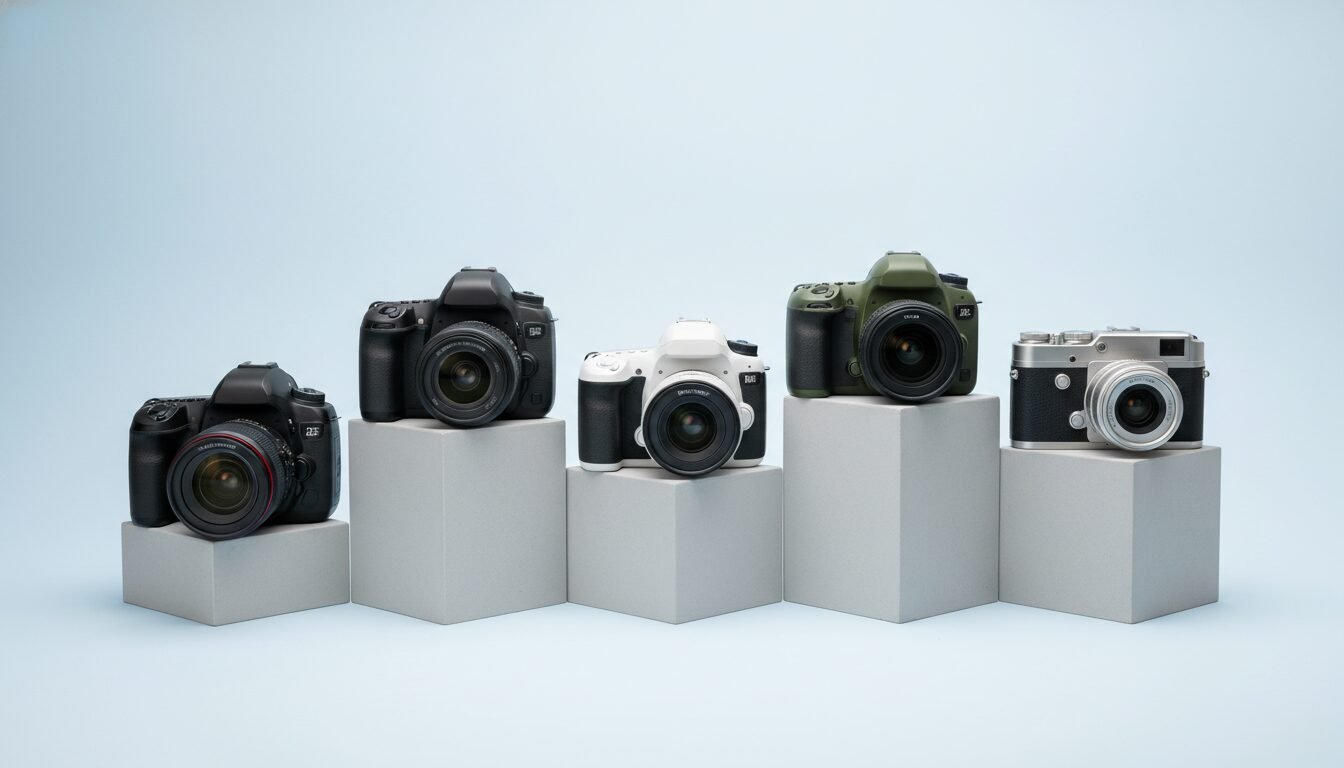
The following table compares five excellent DSLRs that remain highly relevant in 2026. Prices are approximate street prices for new or like‑new condition, based on current retailer listings.
| Model | Sensor | Megapixels | Burst Rate | Video | Key Feature | Approx. Price (USD) |
|---|---|---|---|---|---|---|
| Nikon D850 | Full‑frame | 45.7 | 7 fps (9 w/ grip) | 4K 30p | Top‑tier resolution & dynamic range | $2,500 new / $1,600 used |
| Pentax K1 II | Full‑frame | 36.4 | 4.4 fps | 1080p | 5‑axis IBIS, Pixel Shift, Astrotracer | Under $2,000 |
| Canon EOS 90D | APS‑C | 32.5 | 10 fps | 4K 30p | Fast burst & high‑res crop sensor | $1,199 (body) |
| Nikon D7500 | APS‑C | 20.9 | 8 fps | 4K 30p | All‑around enthusiast camera | $999.95 (w/ 18‑140mm lens) |
| Canon EOS Rebel SL3 | APS‑C | 24.1 | 5 fps | 4K 24p | Compact, beginner‑friendly | $649 (w/ 18‑55mm lens) |
Best Professional DSLR
The Nikon D850 is widely regarded as the most refined DSLR ever built. Its 45.7‑megapixel full‑frame sensor delivers exceptional detail and a dynamic range that rivals the best mirrorless cameras. With 7 frames per second – extendable to 9 fps using the MB‑D18 grip – it handles landscapes, studio work, and action equally well. As noted by Photography Life, the D850 “still rivals or beats most new mirrorless cameras” even nine years after its debut. Used copies are now available for as little as $1,600, making it a compelling alternative to $4,000 mirrorless flagships.
“The Nikon D850 is arguably the most refined and technologically advanced DSLR that any camera company has ever made.” — Nasim Mansurov, Photography Life
Best Enthusiast DSLR
For keen amateurs, the Canon EOS 90D and Pentax K1 II represent two very different paths. The 90D uses a 32.5‑megapixel APS‑C sensor to deliver a 10 fps burst and 4K video, making it a versatile all‑rounder. The K1 II, with its full‑frame sensor and built‑in 5‑axis stabilization, is a dream for landscape and astrophotography. Pentax’s Pixel Shift mode captures four separate exposures to create ultra‑high‑resolution files, while Astrotracer compensates for the Earth’s rotation during long exposures of the night sky.
Best Entry‑Level DSLR
The Canon EOS Rebel SL3 (also sold as the 250D) is the most accessible way into a good digital SLR camera ecosystem. Its 24.1‑megapixel sensor and DIGIC 8 processor produce clean images up to ISO 25600, and it even records 4K video. The lightweight body is easy to carry all day, and the vast Canon EF‑S lens lineup lets beginners grow without replacing their camera.
How to Evaluate a Good Digital SLR for Your Needs
Selecting a good digital SLR camera involves more than racing for the highest megapixel count. You need to weigh resolution, autofocus performance, video features, and ergonomics against the kind of photography you actually do.
Resolution and Sensor Quality
For large prints or heavy cropping, a higher‑resolution sensor like the 45.7 MP in the Nikon D850 is ideal. However, a 24 MP APS‑C sensor still produces excellent prints up to 20×30 inches. Dynamic range and low‑light noise are often more perceptible than pure resolution. Full‑frame sensors generally hold a half‑stop to one‑stop advantage over APS‑C in high‑ISO performance.
Autofocus Performance
DSLRs use dedicated phase‑detection autofocus (AF) modules that are separate from the imaging sensor. This system is extremely fast and accurate in good light. Look for cameras with a high number of cross‑type AF points – for example, the Nikon D7500 offers 51 points, 15 of which are cross‑type, ensuring reliable focus even with off‑centre subjects.
Video Capabilities
While mirrorless cameras lead in video, modern DSLRs can still capture superb footage. The Nikon D850 and Canon 90D both record 4K at 30p with full sensor readout. If videography is a priority, check for a headphone jack, microphone input, and clean HDMI output – features found on many mid‑range and pro DSLR bodies.
Pros and Cons
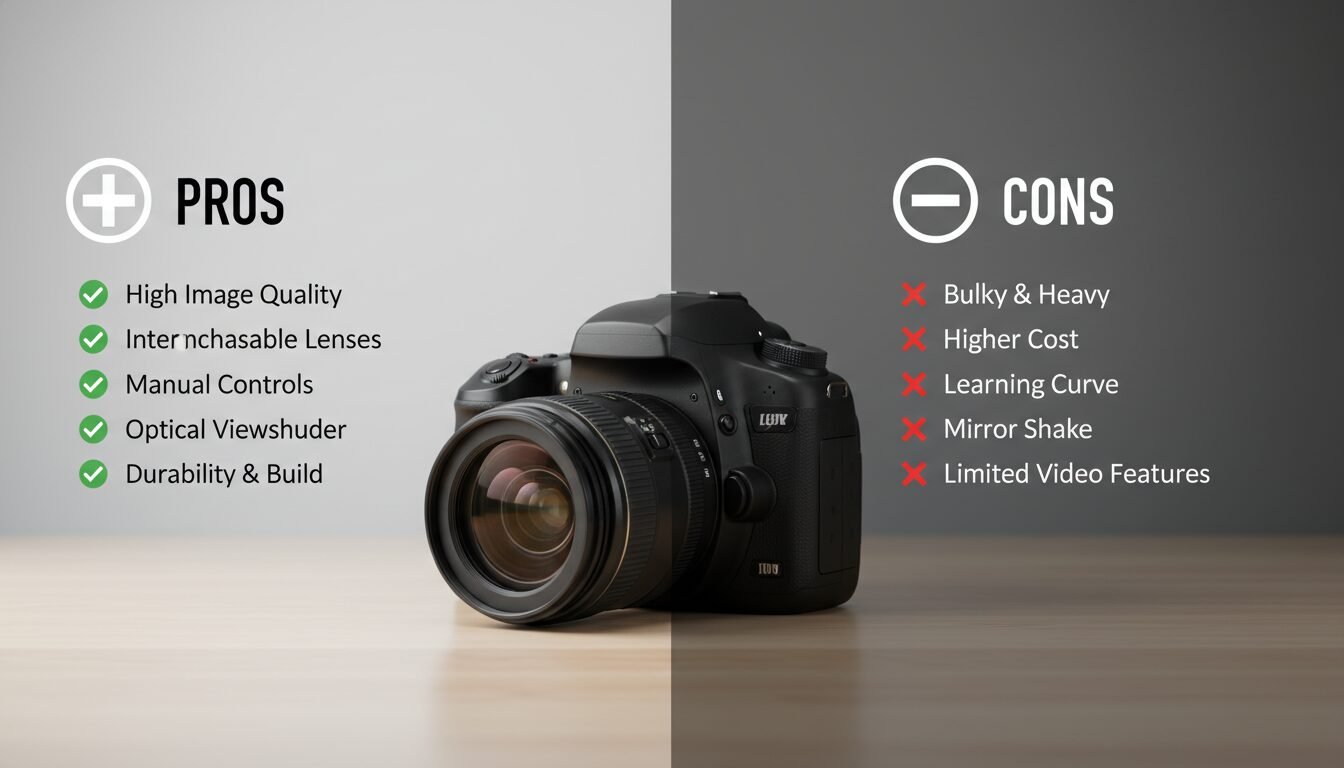
Pros
- Exceptional battery life – often exceeding 1,000 shots per charge compared to 300-500 for mirrorless
- Optical viewfinder provides zero-lag, true-to-life composition without electronic processing
- Vast selection of affordable used lenses from decades of production
- Proven reliability and durability in challenging weather conditions
- Physical controls and dedicated buttons for faster setting adjustments
- Lower prices on the used market as photographers migrate to mirrorless
Cons
- Larger and heavier than equivalent mirrorless cameras
- Limited development of new models – only Pentax actively releases new DSLRs
- Slower live view autofocus compared to mirrorless systems
- No in-body image stabilization on most models (except Pentax)
- Video features lag behind mirrorless capabilities
DSLR vs. Mirrorless: Why a Good Digital SLR Still Makes Sense
The rise of mirrorless has not erased the inherent strengths of the DSLR design. For several common use cases, a good digital SLR camera is still the smarter tool.
Battery Life Advantage
The optical viewfinder uses no power, so a DSLR can routinely deliver over 800 shots per charge – often much more on models rated at 1,200–1,800 frames. Equivalent mirrorless cameras typically manage 300–500 shots. For travel, weddings, or extended wildlife sessions, this difference means carrying fewer spare batteries.
Lens Ecosystem Value
Decades of production have flooded the market with used Canon EF and Nikon F lenses. A professional‑grade 70‑200mm f/2.8 that once sold for $2,000 can now be found for under $800 in excellent condition. This depth of availability simply does not exist yet for mirrorless mounts.
Optical Viewfinder Purity
Some photographers simply prefer the immediacy of an optical view. It shows exactly what the lens sees without any electronic processing, and it never suffers from pixelation or lag. This is especially valuable when panning with fast subjects or working in studio strobe conditions where an EVF can struggle.
The Used Market: Finding a Good Digital SLR Camera at a Bargain
The shift to mirrorless has driven down prices of excellent DSLR gear. With a cautious approach, you can build a professional‑grade kit for a fraction of the original price.
Where to Buy Used DSLRs
Trusted retailers such as B&H Photo, KEH Camera, and MPB specialise in used camera gear and offer warranties and return policies. Online marketplaces like eBay and Facebook Marketplace require more scrutiny but can yield even lower prices. When buying privately, always request shutter count and sample images to verify condition.
What to Check Before Purchase
Follow this checklist when inspecting a used DSLR:
- Shutter count: Consumer DSLRs are typically rated for 100,000–150,000 actuations; pro bodies can exceed 300,000.
- Sensor condition: Check for dust spots or scratches by taking a photo of a plain white wall at f/22.
- AF accuracy: Test with a sharp lens at wide aperture to ensure focus hits exactly where intended.
- Physical wear: Examine the lens mount, battery contacts, and control dials for excessive play.
- Firmware: Update to the latest version to unlock any later‑added features.
Popular Used Models Today
The Nikon D850 and Canon 5D Mark IV are common in the used aisles because professionals have migrated to mirrorless systems. Both deliver full‑frame image quality that still meets commercial standards. Among crop‑sensor bodies, the Nikon D7500 and Canon 80D (predecessor to the 90D) offer fantastic value at under $600 used.
Lenses Matter: Building a Kit Around Your Good Digital SLR
Even the best DSLR body is limited by the glass in front of it. A well‑chosen set of lenses will outlive several camera generations and transform your good digital SLR camera into a complete creative system.
Staple Zoom Lenses
A standard zoom such as a 24‑70mm f/2.8 (full‑frame) or 17‑55mm f/2.8 (APS‑C) covers everything from wide landscapes to portraits. Adding a 70‑200mm f/2.8 telephoto zoom gives you reach for sports and wildlife. Both lenses are widely available used and retain excellent sharpness.
Prime Lenses for Sharpness
Prime lenses offer superior image quality and larger apertures for shallow depth‑of‑field effects. A 50mm f/1.8 is the classic starter prime – tiny, sharp, and typically under $150 used. A 35mm f/1.4 wide‑angle prime and an 85mm f/1.8 portrait lens round out a versatile three‑lens kit.
Adapting Older Glass
One advantage of DSLR mounts is their ability to use decades of manual‑focus lenses. Pentax K‑mount bodies can natively mount M42 screw‑mount glass via a simple adapter, while Nikon F‑mount accepts many classic Ai‑S lenses without any adapter. This opens up creative options at minimal cost.
Real‑World Performance: What Photographers Say About Good Digital SLRs
Data from workshop leaders and long‑term users confirms that DSLRs remain trusted tools in the field.
Field Feedback from Workshops
Kevin Pepper, who leads photography workshops on topics from aurora to wildlife, tracks the equipment his 154 yearly clients bring. His findings show a three‑way split among the most popular camera brands, many of which are DSLRs:
“Sony – 35% of my attendees are now using a Sony Mirrorless camera system. Nikon – 30% of my attendees are now using a Nikon system. Canon – 25%… The rest comprise the remaining 10%.” — Kevin Pepper Photography
While mirrorless adoption is growing, about one‑quarter of workshop participants still rely on DSLRs, especially in Nikon and Canon camps. Their feedback consistently praises the reliability and familiar handling of these cameras in remote locations.
Long‑Term Reliability
DSLRs are built without the complex electronic viewfinder and in‑body stabilization (except Pentax) that add potential failure points. Many working photographers keep a DSLR as a backup body because it “just works.” The mechanical robustness of a Nikon D750 or Canon 7D Mark II is legendary, with shutters that routinely exceed their rated life.
Ergonomics and Handling
The larger grip of a traditional DSLR provides a secure hold with heavy telephoto lenses. Physical buttons and top‑deck LCD panels let you change settings without diving into menus, a feature that speeds up work in fast‑changing light. For anyone who values tactile control, a good digital SLR camera remains a joy to operate.
Common Mistakes When Buying a Good Digital SLR Camera
Avoid these pitfalls to ensure you end up with a camera that genuinely fits your needs.
Overlooking Lens Compatibility
Each brand uses a proprietary lens mount. Although adapters exist, they often limit autofocus or aperture control. If you already own a collection of lenses from a specific system, stick with that brand’s DSLR body. Switching mounts later is expensive and rarely necessary when image quality differences are minimal.
Ignoring Battery Life
Budget DSLRs often use smaller batteries that drain faster during Live View or video recording. Check the CIPA rating of any model you are considering. For all‑day shooting, the Nikon D850 and Canon 5D Mark IV excel with their high‑capacity EN‑EL15a and LP‑E6N batteries, respectively.
Chasing Megapixels Over Handling
High megapixel counts generate large files that demand fast memory cards and powerful computers. Unless you regularly print larger than 20×30 inches or crop heavily, a 20‑24 MP sensor will serve you perfectly. Spend the extra budget on better lenses or a tripod – those upgrades have a greater impact on image quality than choosing a good digital SLR camera solely based on resolution.
Frequently Asked Questions
What is a good digital SLR camera for beginners?
The Canon EOS Rebel SL3 (250D) is an excellent entry point. It offers a 24.1 MP sensor, point‑and‑shoot simplicity, and full compatibility with Canon’s extensive EF and EF‑S lens lineup, making it easy to grow your skills without swapping systems.
How many megapixels do I need in a good digital SLR camera?
For most photographers, 20 to 24 megapixels are more than sufficient for online sharing, album prints, and moderate cropping. You only need 36 MP or above if you plan to make very large prints or routinely crop into small portions of the frame.
Can I use my old lenses on a digital SLR?
Yes, within the same brand mount. Nikon DSLRs can mount most F‑mount lenses made since 1977, while Canon EF‑mount bodies accept all EF lenses made since 1987. Pentax K‑mount is backward compatible with K‑series and M42 screw‑mount lenses via adapters.
Are DSLRs still worth buying in 2026?
Absolutely. DSLRs offer unmatched battery life, huge used‑lens markets, and optical viewfinders that many photographers prefer. Models like the Nikon D850 and Pentax K1 II deliver professional‑grade image quality at a fraction of the cost of comparable mirrorless cameras.
What’s the difference between a DSLR and a mirrorless camera?
A DSLR uses a mirror to reflect light into an optical viewfinder, while a mirrorless camera sends a live feed from the sensor to an electronic viewfinder (or rear screen). DSLRs typically have better battery stamina and a wider selection of used lenses, while mirrorless bodies are often smaller and offer advanced video features.
Which good digital SLR camera has the best battery life?
The Nikon D850 and Canon 5D Mark IV are known for exceptional battery endurance, often exceeding 1,200 shots per charge under normal use. The Pentax K1 II also offers strong performance, especially when using its optical viewfinder rather than Live View.
Ready to find your perfect camera? Contact Emin Media for a free brand consultation and let us help you build a visual strategy that matches your creative vision.
Enjoyed this article?
Contact Emin Media for a free brand consultation and let's create something amazing together.
Get in TouchRelated Articles
Digital TLR Camera Guide: Chuzhao Review & Buying Tips 2026
Digital TLR camera buying guide featuring Chuzhao specs, pricing, and alternatives. Get vintage vibes with…
Digital Photo Camera Guide 2026: Expert Reviews & Buying
Find the perfect digital photo camera in 2026. Expert reviews, price comparisons, and buying tips…
Best Video Recording Camera 2026: 15 Top Picks by Budget
Find the best video recording camera for your needs and budget. From $500 action cams…