Freelance Digital Marketing: A Real-World 2026 Guide
Key Takeaways
- Freelance digital marketing is the practice of offering digital marketing services on a self-employed, contract basis, covering areas like SEO, social media, content creation, and paid advertising.
- It’s a legitimate and growing field. Demand comes from businesses that need flexible, specialized expertise without the overhead of full-time hires.
- Success requires a mix of technical skills (SEO, analytics, social media), soft skills (communication, time management), and a strategic approach to client acquisition through platforms like Upwork, networking, and cold outreach.
- The path to consistent income runs through a strong portfolio, a defined niche, and rates set from market research and the actual value you deliver.
- As of 2026, AI has automated a lot of routine execution, which means the freelancers who thrive are the ones who pair technical skill with real strategic thinking.
Introduction
Freelance digital marketing is the self-employed practice of helping businesses promote their products or services online through channels like search engines, social media, email, and websites. It’s a flexible, scalable career path for anyone with the right skills and enough business sense to back them up.
Companies of every size want agile marketing support right now, without the commitment of full-time salaries. That’s created a real market for freelance digital marketers who can deliver results clients can actually measure. According to a Coursera article, digital marketing gives professionals “greater flexibility to set your schedule, determine which clients to work with, and more.” But building a sustainable this type of marketing business takes more than tactical know-how. It demands strategic client management, financial discipline, and a habit of learning constantly. We built this guide from experienced freelancers’ insights, platform data, and industry analysis, so you get a complete roadmap instead of scattered tips.
What Is Freelance Digital Marketing?
Definition and Scope
this kind of marketing is a career model where an independent professional offers marketing services on a project or retainer basis instead of as a permanent employee. These services span the entire digital ecosystem: search engine optimization (SEO), pay-per-click (PPC) advertising, social media management, content marketing, email marketing, analytics, and conversion rate optimization. Some freelancers specialize in one lane, like Google Ads management. Others act as generalists, running a full-stack operation for small businesses that can’t afford an agency retainer.
Unlike an agency, a freelancer works alone, handling client relationships, project execution, and business development personally. Clients get direct access to expertise, often at a lower cost than an agency would charge, while freelancers get the freedom to pick their projects and work from wherever they want.
The Freelancer vs. In-House Marketer
In-house digital marketers work as salaried employees inside a single company, focused entirely on that brand’s goals. A freelance digital professional juggles multiple clients at once, adapting strategy across industries that might have nothing in common. This exposure accelerates skill growth. You see more tools, more problems, more market quirks than someone locked into one brand ever will. The tradeoff is that it demands sharp time management and the ability to switch mental gears fast, sometimes multiple times before lunch.
Common Misconceptions
A lot of people assume digital marketing is a quick path to easy money. It isn’t. Building a real client base takes consistent effort, and early income is often unpredictable. Another myth: freelancers work in isolation. In reality, the successful ones network constantly, online and off. And some treat it like a side hustle they’ll abandon at the first slow month, but the ones who make it work treat it as an actual business, investing in their own development and their own brand the same way they’d advise a client to.
The Legitimacy and Demand for Freelance Digital Marketers
Is Freelance Digital Marketing Legit?
Yes, freelance digital marketing is a legitimate career and business model. The question “is digital marketing legit” gets around 170 monthly searches according to Better Marketing, which tells you this is a common, honest concern rather than a fringe worry. Millions of businesses, from scrappy startups to major enterprise brands, hire freelancers to fill gaps in their marketing efforts. Platforms like Upwork and Fiverr move enormous volumes of work every year, and digital marketing sits among their most requested categories.
“Freelance digital marketing is how I got my start in the marketing industry,” writes Justin McLaughlin in his Better Marketing article. “My experience as a freelance digital marketer [shows] it is in fact legit. The pros outweigh the cons if you treat it as a business.”
Market Demand in 2026
Demand for freelance digital marketers keeps climbing this year. Companies are more data-driven and digital-first than ever, and that means they need specialized skills that aren’t always sitting in-house. The gig economy’s expansion, pushed along by remote work becoming normal rather than novel, has made flexible workforces standard practice. Freelance digital marketing roles are especially attractive because businesses can scale campaigns up or down fast, matching spend to whatever the budget allows that quarter.
The Pros of Freelance Digital Marketing
The advantages are real: flexible scheduling, location independence, uncapped earning potential, and exposure to a variety of clients and industries. Freelancers build a broad skill set by solving different problems for different businesses. From the client’s side, they get specialized talent without the overhead of benefits, office space, or training time. That win-win dynamic is exactly what keeps this field growing.
Core Skills Every Freelance Digital Marketer Needs
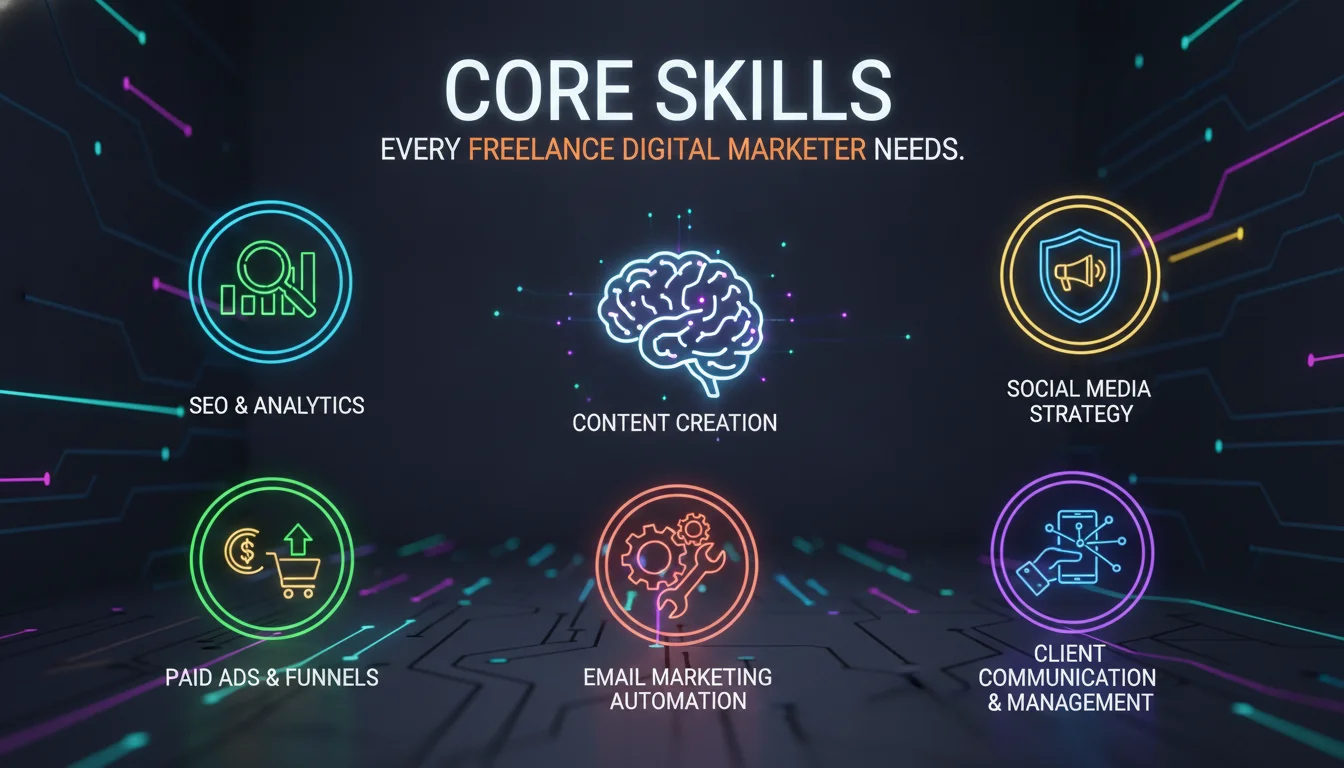
Technical Skills: SEO, PPC, Social Media, and Analytics
Delivering real results means mastering at least one technical discipline deeply, not skimming five of them. The most common specializations include:
- SEO: Keyword research, on-page optimization, link building, and technical audits. Certifications like Semrush Academy can strengthen your credibility with prospects.
- PPC Advertising: Managing campaigns on Google Ads and social platforms. Understanding bidding strategies, audience targeting, and conversion tracking is non-negotiable here.
- Social Media Marketing: Creating content, engaging followers, and running paid campaigns on networks like Instagram, LinkedIn, and TikTok.
- Analytics: Using tools like Google Analytics and Looker Studio to measure what’s working and inform the next move.
Per Coursera, following a structured learning path, like the Adobe Marketing Specialist Professional Certificate, can help build job-ready skills in content development, branding, and AI-powered marketing.
Soft Skills: Communication, Time Management, and Client Relations
Technical chops only get you halfway. Freelancers need to translate complex data into client-friendly reports, set clear expectations upfront, and negotiate contracts without flinching. Time management matters just as much. Juggling multiple clients without missing deadlines is the line between freelancers who last and ones who burn out in a year. Long-term client relationships come from being proactive, transparent, and consistently better than expected, not from being the cheapest option in the inbox.
Continuous Learning and Certification
The digital marketing world moves fast: algorithm updates, new platforms, shifting consumer habits. Top freelancers block out time weekly just to keep learning. Coursera, HubSpot Academy, and Google Skillshop all offer free or low-cost courses worth your time. Certifications in specialized areas, Google Ads, Meta Blueprint, and similar programs, act as trust signals when you’re pitching a client who’s never worked with you before.
How to Start Freelance Digital Marketing: A Step-by-Step Guide
Step 1: Choose Your Niche
Choosing a niche means picking a specific industry or service focus instead of trying to be everything to everyone. Generalists can find work, but niching down dramatically increases your odds of standing out in a crowded market. Consider specializing in an industry, e-commerce or real estate, say, or a service like Facebook Ads for coaches. Niching lets you become the obvious expert, charge higher rates, and land clients faster because you’re not competing with every generalist on the platform.
Step 2: Build a Portfolio That Demonstrates Results
Building a portfolio means documenting measurable outcomes from real work, even work you did for free or for yourself. You don’t need a long client roster to make this happen. Run campaigns for a friend’s small business, work on your own side project, or offer pro-bono help to a local non-profit. The key is documenting outcomes clearly: “increased organic traffic in three months” or “reduced cost-per-lead noticeably” tells a better story than a vague list of skills. A sharp portfolio is your best sales tool in freelance digital marketing, full stop.
Step 3: Set Up Your Online Presence
Build a professional website or a clean one-page site that shows your services, case studies, and testimonials. Optimize your LinkedIn profile with the right keywords and a headline that says exactly what you do, not a vague title nobody searches for. Join Upwork and Fiverr, and fill out your profiles completely instead of leaving them half-finished. A polished presence establishes legitimacy fast and helps clients find you when they’re searching for help.
Finding Clients as a Freelance Digital Marketer
Freelance Platforms: Upwork, Fiverr, Freelancer, and More
Freelance platforms remain one of the fastest paths to paid work for beginners without an existing network. Here’s a comparison of the most popular options:
| Platform | Fees | Pros | Cons | Best For |
|---|---|---|---|---|
| Upwork | Up to 20% on first $500 per client | Large job selection, built-in collaboration tools, escrow payment protection | High competition, platform fees can eat into earnings | Long-term projects and professional networking |
| Fiverr | 20% of total earnings | Easy setup, gig-based, global reach | Often low-budget projects, race to the bottom on price | Quick tasks and standardized service packages |
| Freelancer | 10% or $5, whichever is greater | Free members get 6 bids/month, contest features | Subscription required for more bids, lower job quality | Competitions and small projects |
| LinkedIn Services | Free to list, no platform transaction fee | Leverages existing professional network, high trust | Requires robust network, less structured process | Established professionals seeking high-value clients |
Data sourced from Quora discussions (Shivam Bhatnagar and others) and platform websites. Fees change, so always confirm current terms before committing.
“Building a portfolio, leveraging social media, and using freelance platforms with niche-specific services” are the moves that actually work, according to Shivam Bhatnagar, a freelancer writing on Quora about landing early clients.
Networking and Referrals
Word-of-mouth is still one of the strongest client sources in freelance digital marketing. Show up at industry meetups, virtual or in-person, and join professional groups on LinkedIn and Facebook where real conversations happen. Once you’ve delivered great work, ask satisfied clients directly for referrals, most won’t offer unprompted. A referral network reduces your dependence on crowded platforms and tends to bring higher-quality, repeat business over time.
Cold Outreach and Social Media Prospecting
Cold emailing and direct messages can work well when they’re done thoughtfully instead of copy-pasted. Look for businesses with clear gaps: outdated websites, weak SEO, inactive social accounts. Personalize every pitch by naming the specific problem you noticed and proposing a real fix, not a generic “I can help you grow.” LinkedIn in particular is a strong channel for connecting directly with founders and marketing managers who need help right now.
Setting Your Rates and Managing Finances
Researching Market Rates
Rates in freelance digital marketing vary widely depending on specialization, experience, and location. Entry-level social media managers often start in the $15 to $30 per hour range, while experienced PPC consultants can charge well over $100 per hour once they’ve built a track record. Use tools like Upwork’s rate explorer alongside general industry benchmarks to sanity-check your number. Then work backward from your target annual income to figure out the minimum hourly rate you actually need.
Project-Based vs. Hourly Pricing
Two pricing models dominate: hourly and project-based. Hourly suits open-ended or ongoing work well, but project-based pricing aligns everyone’s incentives with the outcome, clients know the total cost upfront, and you benefit when you work efficiently. Many freelance digital marketing veterans eventually move to value-based pricing, where the price reflects the client’s expected return rather than your hours worked.
Invoicing and Tax Considerations
Freelancers are business owners, which means taxes are entirely on you. Use invoicing software like FreshBooks or Wave to track payments and expenses without losing your mind come tax season. Set aside roughly a quarter to a third of your income for taxes, depending on your jurisdiction. Consider forming an LLC to keep personal and business finances separate. Solid financial habits keep your freelance business profitable and out of legal trouble.
Tools and Platforms to Boost Your Freelance Digital Marketing Business
Essential Digital Marketing Tools
A well-equipped freelancer’s toolkit usually includes:
- SEO: Ahrefs, Semrush, or Moz for keyword research and site audits.
- PPC: Google Ads Editor, Facebook Ads Manager.
- Social Media: Buffer, Hootsuite, or Later for scheduling; Canva for design.
- Analytics: Google Analytics, Google Search Console, Hotjar for behavior analytics.
Most of these offer free tiers for beginners. Invest in paid versions only once client volume actually justifies the cost.
Project Management and Communication Tools
Staying organized across multiple clients is non-negotiable. Trello, Asana, or Notion help you track tasks and deadlines without losing anything in a messy inbox. Slack or Microsoft Teams keep communication moving in real time. A central dashboard for your operations means fewer dropped balls and fewer awkward “sorry, I forgot” emails.
Learning Platforms and Communities
Upskilling constantly is what separates top freelancers from the pack. Coursera offers structured certificates, while Skillshare and LinkedIn Learning provide on-demand courses you can fit around client work. Communities on Reddit (r/digital_marketing, r/freelance) and niche Facebook groups are worth joining too, both for staying current and for solving real problems with people who’ve hit the same walls.
Challenges of Freelance Digital Marketing and How to Overcome Them
Inconsistent Income Stream
Feast-or-famine cycles are one of the most common frustrations in freelance digital marketing. Diversify your client base so no single account controls your income, a good rule of thumb is keeping any one client under roughly a third of total revenue. Build retainer relationships wherever possible for recurring income, and keep a financial buffer covering at least a few months of living expenses. Some freelancers also build small passive income streams, digital products or affiliate work, to smooth out the rough months.
Client Acquisition and Retention
Landing your first few clients is almost always the hardest part of this whole business. Once you’re past that, focus shifts to delivering work strong enough to generate testimonials and referrals on its own. Set up a clean onboarding process that sets expectations and a regular reporting rhythm from day one. Happy clients don’t just stick around, they become the unofficial sales team you never had to hire.
Staying Updated with Industry Changes
Google algorithm updates and platform policy shifts can quietly wreck a strategy overnight if you’re not paying attention. Set aside weekly time for reading industry blogs like Search Engine Journal and Social Media Examiner, attending webinars, and testing new features before your competitors do. Proactively flagging changes to clients and adjusting campaigns accordingly builds trust that’s hard to buy any other way.
Pros and Cons
Pros
- Flexible schedule and location independence, work from wherever you actually want to be
- Uncapped earning potential tied to skill and client value, not a fixed salary band
- Exposure to varied industries and challenges that accelerate skill growth faster than a single in-house role would
- Direct client relationships with no agency layer diluting the work or the credit
Cons
- Inconsistent income, especially in the first year before retainers stabilize things
- No built-in benefits like health insurance or paid time off
- All the business tasks, invoicing, taxes, contracts, land on you alone
- Constant need to self-market and prospect, even when client work is already full
Brand Spotlight: What Separates a Freelancer From an Agency Mindset
The freelancers who eventually build agency-level businesses are the ones who think in brand systems, not just deliverables. Picture a mood board of a client’s brand: color palette, tone of voice, campaign visuals, all working toward one recognizable identity across every channel. A freelancer who understands that visual and verbal consistency drives recall, not just individual campaign performance, becomes the person clients call before they call anyone else. Creative industry data shows that brands with consistent visual identity across platforms tend to build stronger recognition over time, which is exactly why freelance digital marketers who think beyond the next ad set are the ones who get retained, not just hired.
Conclusion: The Future of Freelance Digital Marketing
Freelance digital marketing isn’t a passing trend, it’s a structural shift in how marketing work actually gets done. As AI automates more of the routine tasks, the human elements, strategy, creativity, client relationships, become more valuable, not less. The freelancers who win going forward will be the ones combining real technical skill with business instincts, building personal brands strong enough to attract clients who pay for outcomes, not hours.
If you’re exploring this as a side hustle or making a full leap from an in-house role, the path is the same: master one craft, build proof, and make genuine connections instead of chasing every platform at once. The opportunities here are real for anyone willing to run it like a business instead of a gig. Pick one skill from this guide, practice it this week, and go land your first client. Let’s build something bold: contact Emin Media for a free brand consultation if you want a creative partner as you grow.
Frequently Asked Questions
What does a digital marketing freelancer do?
A digital marketing freelancer plans, executes, and analyzes online marketing campaigns for clients on a contract basis. This can include SEO, paid ads, social media, content creation, and email marketing, often across several clients at once.
Is digital marketing a legit side hustle?
Yes, digital marketing is a legitimate side hustle that can scale into a full-time income. Many businesses pay freelancers specifically for skills that deliver measurable returns, which makes it a viable, and often profitable, path rather than a gimmick.
How to start freelance digital marketing for beginners?
Beginners should start by learning one high-demand skill, like SEO or Facebook Ads, then build a portfolio using practice projects, create profiles on freelance platforms, and network within the industry to land their first few clients.
How do beginners start digital marketing?
Beginners can start by taking accessible courses like Google Digital Garage or HubSpot Academy, practicing on their own projects or a small business’s accounts, and offering freelance services once they have real, demonstrable results to show.
What are the best platforms to find freelance digital marketing clients?
Popular platforms include Upwork, Fiverr, Freelancer, and LinkedIn. Upwork suits longer professional relationships, Fiverr works well for quick gigs, and LinkedIn tends to shine for networking-based client acquisition instead of cold platform bidding.
Enjoyed this article?
Contact Emin Media for a free brand consultation and let's create something amazing together.
Get in TouchRelated Articles
Digital Marketing for Creatives: A Bold Guide
Digital marketing for creatives builds real visibility and sales. Learn strategies for social media, SEO,…
Video SEO for Creative Agencies: The 2026 Playbook
Video SEO for creative agencies is how you turn portfolio reels into search traffic. Get…
Creative Brand Photography: The Complete Guide
Creative brand photography is your visual voice. Learn how to plan shoots, find the right…