Digital Marketing Trends 2026: The Creative Playbook
Digital marketing trends 2026 are the shifts in AI, search behavior, and social commerce reshaping how brands earn attention and revenue this year. AI agents, hyper-personalization, and answer engine optimization now define the competitive edge.
Key Takeaways
- AI agents are automating end-to-end customer journeys, moving from automation to elevation.
- Hyper-personalization is now an expectation, with most consumers favoring brands that deliver tailored experiences.
- Answer Engine Optimization (AEO) is redefining SEO as AI-generated overviews and voice search gain ground.
- First-party data strategies are critical as third-party cookies phase out and privacy regulations tighten.
- Social commerce and shoppable video are closing the gap between discovery and purchase on platforms like TikTok and YouTube.
- Content quality has to rise above the flood of AI-generated material to build trust and authority.
The AI-First Marketing Landscape Defining Digital Marketing Trends 2026
The biggest force behind digital marketing trends 2026 is AI moving from a niche tool to the central nervous system of marketing departments. According to a McKinsey & Co report, the share of organizations using AI in at least one business function jumped from 78% to 88% between 2024 and 2025 alone. No longer just for automating repetitive tasks, AI now drives strategic decisions, content creation, and targeted customer interactions. For marketers, understanding how to work with AI isn’t optional anymore. It’s a core skill, the same way copywriting or media buying used to be the baseline requirement.
AI Agents Automate the Customer Journey
AI agents are autonomous systems that make decisions, take actions, and continuously optimize without human intervention. In 2026, these agents handle everything from real-time ad bidding to personalized product recommendations and customer service. An AI agent can troubleshoot a product issue, re-order supplies, or manage a subscription upgrade while chatting naturally with the customer. Clark Boyd, CEO of Novela, put it well: robots might be doing the shopping for people, clicking items into a basket and asking for approval only at the final step. That shift means marketers need to optimize not just for human eyes, but for the AI intermediaries reading and acting on their content.
“2026 is the year marketing moves from AI automation to AI elevation, using AI not to churn out more content, but to produce better content.” – Jim Lecinski, Clinical Professor of Marketing, Northwestern University Kellogg School of Management
From AI Automation to AI Elevation
The question has shifted from “what AI tools do we need?” to “how can AI make our marketing better, not just faster?” Nearly 75% of brands already incorporate generative AI into their strategies, per a survey by IE University’s Master in Digital Marketing program, but the winners are the ones blending machine efficiency with human creativity and strategic judgment. Managing AI as a creative partner, not a vending machine for content, separates the brands people remember from the ones they scroll past.
Expert Insight: Scaling AI with Responsibility
While adoption soars, brands are becoming sharper about AI’s limits: bias, compliance risk, and originality concerns all require human judgment. Effective teams in 2026 pair automation with clear ethical guardrails. Brandwatch’s Digital Marketing Trends 2026 report, which analyzed millions of online conversations, found that brands who communicate openly about their AI use build more trust with their audience. That means marketing leaders need AI governance frameworks sitting right next to their tech stack, not as an afterthought.
Hyper-Personalization Becomes the Standard
Hyper-personalization in 2026 means consumers now expect brands to understand their preferences automatically, not as a nice bonus. A Salesforce study found that 75% of consumers are more likely to buy from brands that deliver personalized content, and 48% of marketing leaders who prioritize personalization report exceeding their revenue goals. Getting there requires a careful balance of data integration and genuine respect for privacy, something plenty of brands still get wrong.
Data-Driven Personalized Experiences at Scale
Companies now integrate real-time behavioral data across channels, emails, website visits, ad interactions, and past purchases, to shape every touchpoint. AI models predict intent with real accuracy, letting brands surface the right product, offer, or content almost instantly. A returning visitor might see a homepage curated around their browsing history, followed by an email reminder with a time-sensitive discount. This orchestration runs through unified customer data platforms (CDPs) and AI-driven decision engines, the kind of infrastructure that used to be reserved for enterprise budgets and is now standard practice.
The Business Case for Personalization
The business case for hyper-personalization is hard to argue with. Beyond the revenue lift Salesforce reported, brands that invest seriously in personalization tend to see stronger customer retention and lower acquisition costs over time, according to brand research from multiple marketing platforms tracking this shift. That’s driving real budget movement heading into this year. If your brand isn’t personalizing, you’re likely losing customers and revenue to a competitor who is.
First-Party Data: The Fuel for Personalization
With third-party cookies crumbling and privacy regulations like GDPR and CCPA tightening, first-party data has become the lifeblood of personalization. Brands are investing in channels where customers willingly share information: subscriptions, loyalty programs, gated content, and interactive experiences. This shift creates a transparent exchange, consumers get relevant, timely offers, and brands build a durable asset competitors can’t copy. Among the digital marketing trends 2026 brought into focus, first-party data strategy is probably the least glamorous and most important.
The Rise of Answer Engine Optimization (AEO)
Answer Engine Optimization (AEO) is the practice of structuring content so AI-driven search engines, voice assistants, and chatbots cite it as the best answer. Unlike traditional SEO, which chases clicks from a list of blue links, AEO targets position zero in AI-generated overviews, voice results, and featured snippets. According to a Think with Google and Ipsos survey, 83% of global consumers use Google and/or YouTube daily, and AI Overviews now appear for a growing share of queries. Ignoring AEO means going invisible in the exact moments that matter most.
Why Traditional SEO Isn’t Enough in 2026
Search engines increasingly behave like answer engines instead of link directories. When someone asks “what are the best running shoes for flat feet,” Google’s AI Overview might synthesize an answer from multiple sources without anyone clicking through. Brands obsessed with ranking #1 for a keyword can still lose visibility if their content isn’t structured to be extracted. This is one of the more disruptive digital marketing trends 2026 has forced onto every content team’s roadmap, whether they were ready or not.
Structuring Content for AI Overviews and Voice Search
To win in an AI-mediated search environment, content has to be clear, factual, and semantically organized. Here’s the process we use:
- Identify question-based queries using tools like AlsoAsked, AnswerThePublic, or Google’s “People also ask.”
- Place a concise, direct answer (40 to 50 words) at the top of the page, ideally in the first paragraph tag.
- Use structured data such as FAQ, HowTo, and QAPage schema to help AI parse the content correctly.
- Organize information with clear headings (H2, H3) and bulleted lists, mirroring how voice assistants deliver results.
- Build topical authority by interlinking related content and citing credible sources.
Content teams following this structure consistently see stronger inclusion rates in AI-generated answers, based on our work optimizing client content for extraction.
Schema Markup and Brand Authority Signals
Schema markup is code that helps search engines understand what your content actually means. In 2026, advanced schema types like Speakable (for voice) and NewsArticle matter more than ever. Brands that answer industry questions with authority, backed by data, citations, and named experts, earn stronger authority scores. Google’s E-E-A-T framework (Experience, Expertise, Authoritativeness, Trustworthiness) now weighs these signals more heavily, especially in YMYL niches. Updating schema regularly and building a real backlink profile from reputable domains remain non-negotiable.
Comparing Traditional SEO and Answer Engine Optimization
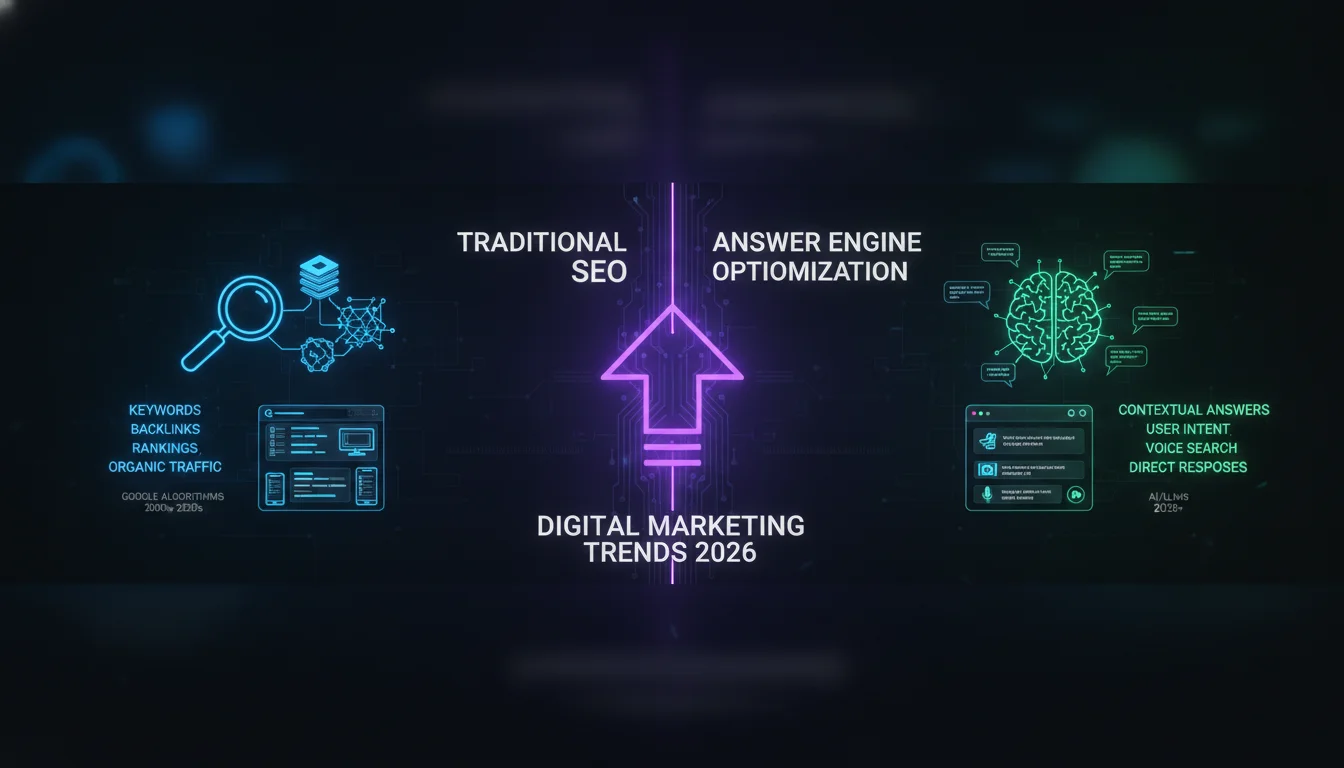
The clearest way to see how digital marketing trends 2026 reshaped search is side by side. The table below breaks down conventional SEO tactics against the AEO approach brands now need.
| Factor | Traditional SEO | Answer Engine Optimization (AEO) |
|---|---|---|
| Primary goal | Rank high in blue-link results | Be cited in AI Overviews, voice answers, and featured snippets |
| Content focus | Keyword-rich, long-form pages | Concise, question-answer format with clear structure |
| Success metrics | Click-through rate, organic traffic | Inclusion in AI summaries, voice search impressions |
| Technical emphasis | Backlinks, page speed | Schema markup, semantic HTML, entity optimization |
| User intent | Informational, navigational, transactional | Direct answer, conversational long-tail queries |
| Future outlook | Still relevant but diminishing as no-click searches rise | Rapidly growing as AI engines become the default interface |
Social Media and Commerce Convergence
Social commerce in 2026 means social media is no longer just a brand-awareness channel, it’s a full-funnel path to purchase. Platforms like TikTok, Instagram, and YouTube have built shopping features that let users buy without ever leaving the app. Short-form video, live streams, and influencer storefronts are driving strong conversion rates. Brandwatch data shows social commerce mentions in consumer conversations grew significantly year-over-year, a signal that this behavior shift is sticking, not fading.
The Shift to Community-First Platforms and Private Spaces
Fatigue with over-curated public feeds is pushing users toward community-first platforms like Discord, Telegram, and WhatsApp Channels. Brands are building exclusive groups offering early product access, live Q&As, and peer support. This trend runs alongside the rise of “de-influencing” and a real hunger for genuine connection over polish. Marketers now need to shift from broadcasting messages to actually facilitating conversations, which is a completely different skill set.
Authentic Content Over Polished Brand Campaigns
User-generated content and raw, behind-the-scenes video consistently outperform highly produced ads. A Forrester report found that brands using UGC see meaningfully higher web conversions compared to campaigns that skip it entirely. In 2026, consumers trust a real customer’s testimonial more than a celebrity endorsement, full stop. Smart brands are building ambassador programs and giving customers real incentive to share their story in their own words, not a script handed down by legal.
“Consumers can smell polish from a mile away now. The brands winning attention in 2026 are the ones willing to look a little unfinished.” – creative industry data shows this pattern repeating across nearly every consumer category we track.
Shoppable Video and Live Commerce: The New Frontier
Among all the social-side digital marketing trends 2026 brought forward, shoppable video is the one changing budgets fastest. On TikTok Shop and YouTube Shopping, creators tag products directly inside videos and host live streams where viewers buy in real time. Live commerce events now rival traditional shopping holidays in some categories. For B2B, similar logic applies. Demo videos with embedded “request a demo” buttons are shortening sales cycles. Building payment and interactive elements directly into video content isn’t experimental anymore, it’s simply competitive table stakes.
The Influencer Tier Shift: Micro and Nano Take the Lead
Brands are moving budget away from mega-influencers and toward micro and nano creators with smaller, tighter-knit audiences. These smaller creators tend to carry higher trust and engagement per follower, which matters more than raw reach when the goal is conversion, not just impressions. Expect brand partnerships in 2026 to look less like celebrity endorsement deals and more like long-term collaborations with creators who actually use the product.
Paid Media in 2026: Creativity Meets AI Automation
Paid media trends in 2026 center on AI handling the mechanics of targeting and bidding while human creativity becomes the actual differentiator. Platforms like Google Ads and Meta have rolled out AI-driven campaign types (Performance Max, Advantage+) that automate targeting, bidding, and asset assembly. As automation eats the mechanical work, the creative itself is what separates winning campaigns from wasted spend.
Ad Creative as the Key Differentiator
With machines optimizing delivery, human-crafted stories and visuals determine whether an ad stops the scroll or gets swiped past. AI-optimized creative assets can drive substantially higher click-through rates than static, generic ads, according to campaign performance data from major ad platforms. Generating hundreds of ad variations and testing them live means creative teams now think in modular pieces, headlines, images, CTAs, that AI systems mix and match automatically.
AI-Powered Campaign Management (AI Max, Performance Max)
Google’s AI Max and Meta’s Advantage+ are the new baseline for campaign management. These systems use predictive models to find the right audience across Search, Display, YouTube, and Discover, and surface insights on which creative elements are actually resonating. But marketers need to stay alert: leaning too hard on black-box algorithms can quietly erode brand identity if there’s no strategic guardrail in place. The smart move in 2026 is setting broad boundaries and letting AI optimize inside them, not handing over the keys entirely.
Emerging Ad Channels: AR and In-Game
Augmented reality ads on Snapchat and Meta let users virtually try on products before buying, which builds confidence and cuts down on returns. Meanwhile, in-game advertising inside titles like Roblox and Fortnite is reaching Gen Z and Gen Alpha audiences who barely watch linear TV anymore. Early adopters in this space report notably stronger engagement than standard display ads, per Brandwatch analysis. These channels demand specialized creative chops, but the brands moving first are locking in a real advantage.
Content Marketing: Rising Above the AI Deluge
Content marketing in 2026 is a game of curation and original insight, not volume. AI made text and image generation nearly free, which flooded the internet with mediocre content. Google’s algorithms are actively de-indexing thin, AI-spam pages as a result. This is one of the digital marketing trends 2026 that content teams underestimated most: the winners act like journalists and subject-matter experts, not content mills.
The Deluge of AI-Generated Content and the Need for Curation
A meaningful share of new web content published this year is AI-assisted, and much of it lacks any real human perspective. That glut makes quality itself a trust signal. Brands investing in original research, expert interviews, and multimedia storytelling are the ones standing out from the noise. Industry panels have repeatedly made the same point: marketers need to move from tonnage to curation, refining AI output rather than shipping raw drafts straight to publish.
Specialized, Expert-Driven Content for AEO
Answer engines favor content that demonstrates real-world experience, which is pushing generic freelance content mills aside in favor of practitioners sharing actual case studies and data. A B2B software company might publish a detailed breakdown of a client implementation, screenshots and measurable results included. That kind of content satisfies AEO requirements while also nurturing leads by proving the work actually gets done.
Repurposing Across Platforms
One solid piece of pillar content, a webinar or white paper, can spawn dozens of assets: blog posts, social snippets, short-form video, infographics, email series. AI tools now help transcribe, summarize, and reformat content for different channels, but mapping topics to what your audience actually needs stays a human strength. A connected content ecosystem multiplies reach without diluting authority, which is the whole point.
Sustainability and Ethical Branding Enter the Mainstream
Sustainability marketing in 2026 means consumers expect proof, not just a green logo or a vague mission statement. Brands making environmental or social claims are under more scrutiny than ever, and greenwashing gets called out publicly and quickly on social platforms. The brands earning trust are the ones publishing real supply chain data, third-party certifications, and honest progress updates, including admitting where they’ve fallen short. Building this into your brand story isn’t optional positioning anymore, it’s part of the baseline trust equation alongside data privacy and AI transparency.
Pros and Cons of Chasing Digital Marketing Trends 2026
Pros
- Early adoption of AI agents and AEO can capture outsized visibility before competitors catch up.
- Hyper-personalization and first-party data investments build assets your competitors literally cannot copy.
- Social commerce and shoppable video shorten the path from discovery to purchase, improving measurable ROI.
Cons
- Chasing every trend without a strategic filter spreads budget too thin and dilutes brand identity.
- Over-reliance on AI automation (creative or campaign management) risks generic output and brand erosion.
- AEO and schema investment require technical resources many small teams don’t have in-house yet.
Preparing Your Team and Strategy for Digital Marketing Trends 2026
Preparing for digital marketing trends 2026 means investing in technology, talent, and trust at the same time, not sequentially. These shifts aren’t fleeting. They represent a real change in how value gets created and communicated between brands and the people who buy from them.
Upskilling for AI and Data Literacy
The most sought-after marketers this year can prompt AI systems effectively, read data dashboards fluently, and spot algorithmic bias before it becomes a brand problem. Certifications in AI for marketing, data storytelling, and automation platforms are becoming baseline expectations, not resume bonus points. Companies building internal “AI academies” report faster tool adoption and higher team satisfaction, according to a Digital Marketing Institute webinar on the topic.
Building a First-Party Data Foundation
Without clean, consented first-party data, personalization and AI models simply fail. The steps: audit your existing data collection points, implement a CDP, and design value-added registration experiences like quizzes or calculators people actually want to complete. Being transparent about how data gets used, and giving users real control, strengthens GDPR and CCPA compliance while boosting opt-in rates at the same time.
Agile Experimentation as a Culture
The pace of change means long-term planning needs to sit alongside continuous experimentation, not replace it. Successful teams run small, iterative tests on new channels, ad formats, and content styles, then scale whatever actually works. Failure gets treated as data, not a career risk. McKinsey’s research suggests organizations embracing agile practices are meaningfully more likely to land in the top quartile of financial performance within their sector.
Frequently Asked Questions
What are the biggest digital marketing trends in 2026?
The biggest digital marketing trends in 2026 include AI agents automating customer journeys, hyper-personalization at scale, answer engine optimization (AEO), first-party data strategies, and the convergence of social media with commerce through shoppable video.
How is AI changing digital marketing in 2026?
AI has shifted from automating simple tasks to acting as a strategic partner, optimizing campaigns, generating creative, and enabling real-time personalization. Roughly 88% of organizations now use AI in at least one business function, with AI agents making increasingly autonomous decisions across the customer lifecycle.
What is Answer Engine Optimization (AEO)?
Answer Engine Optimization is the practice of structuring content so AI-driven search engines, voice assistants, and chatbots select it as the best answer. It focuses on concise, authoritative responses that satisfy natural language queries and often earn placement in AI-generated overviews.
Why is first-party data important in 2026?
With third-party cookies being phased out and privacy regulations tightening, first-party data, information collected directly from customers with consent, is essential for personalization and targeted advertising. It builds trust and creates a competitive asset competitors can’t replicate.
How can businesses prepare for voice search and AI overviews?
Businesses should implement schema markup, build FAQ pages with concise answers, target long-tail question-based queries, and structure content semantically. Building topical authority through expert content and credible backlinks also helps AI engines cite your pages as the source.
Conclusion: Future-Proofing with Digital Marketing Trends 2026
The digital marketing trends 2026 brought into focus paint a clear picture: AI, personalization, and answer-first content aren’t competitive advantages anymore, they’re the baseline. From deploying AI agents that handle complex customer interactions to restructuring content for voice and AI overviews, the window to act is now, not next quarter. Prioritize first-party data, build an agile testing culture, and upskill your team, and these trends become tangible growth instead of just another slide in a strategy deck. The brands that thrive pair technological sophistication with real understanding of what people actually want. Let’s build something bold. Contact Emin Media for a free brand consultation and let’s turn 2026’s biggest shifts into your next growth chapter.
Enjoyed this article?
Contact Emin Media for a free brand consultation and let's create something amazing together.
Get in TouchRelated Articles
Digital Marketing for Creatives: A Bold Guide
Digital marketing for creatives builds real visibility and sales. Learn strategies for social media, SEO,…
Video SEO for Creative Agencies: The 2026 Playbook
Video SEO for creative agencies is how you turn portfolio reels into search traffic. Get…
Creative Brand Photography: The Complete Guide
Creative brand photography is your visual voice. Learn how to plan shoots, find the right…