Digital Marketing Training: Best Courses for 2026
-
Key Takeaways
- Digital marketing training equips you with skills in SEO, social media, content, and analytics.
- Programs range from free certifications (HubSpot, Google) to university certificates (UT Austin, UMD) and professional credentials (DMI).
- AI and data analytics are now core components of modern marketing curricula.
- Hands-on projects and recognized certifications boost career prospects and earning potential.
- The 3-3-3 rule is a content distribution framework often taught in social media training.
Digital marketing training is a structured set of courses and certifications that teach SEO, social media, email marketing, and analytics. These programs prepare professionals for careers in a data-driven, always-on marketing world.
As of 2026, the demand for skilled digital marketers keeps climbing as businesses shift budgets heavily toward online channels. According to the Digital Marketing Institute, over 300,000 members have joined their programs, with more than 75,000 professionals certified worldwide. That signals a real appetite for marketing training among career seekers and business owners alike.
What Is Digital Marketing Training?
this type of training is a structured educational process that teaches individuals how to promote products or brands through online channels. It covers a wide array of disciplines: search engine optimization (SEO), pay-per-click (PPC) advertising, social media management, content marketing, and email automation. Unlike traditional marketing education, it emphasizes practical, hands-on learning with tools like Google Analytics, HubSpot, and ChatGPT.
The Scope of Modern Training
Today’s programs go well beyond basic concepts. Curricula often include modules on AI-powered marketing, data analytics, customer relationship management (CRM), and omnichannel strategy. The University of Maryland’s Professional Certificate includes AI approaches to customer value analysis, while UT Austin’s program is explicitly labeled “AI-Powered Certified Digital Marketer.” These additions reflect how the field has matured into a data-rich, technology-driven profession.
Why Traditional Marketing Skills Aren’t Enough
Classic marketing theory still holds value. But the digital environment demands real-time metrics, agility, and technical proficiency. A marketing manager who cannot interpret Google Analytics data or manage a Google Ads campaign is at a serious disadvantage. this kind of training bridges the gap between creative strategy and execution on the platforms that dominate modern consumer attention.
Why Digital Marketing Training Is Essential in 2026
digital marketing is essential in 2026 because the marketing field evolves faster than most professionals can self-teach. With the rise of AI tools, voice search, and new social platforms, continuous learning is no longer optional. The right program gives you a foundation to adapt to these shifts and capitalize on emerging opportunities before your competitors do.
Growing Demand for Certified Professionals
Employers actively seek candidates with verified skills. HubSpot Academy reports that over 200,000 professionals have advanced their careers through its free certification. The Google Digital Marketing & E-commerce Professional Certificate on Coursera carries a 4.8-star rating with more than 51,000 ratings, indicating massive enrollment interest. These numbers confirm that marketing training is not just a personal development tool. It’s a career accelerator.
Higher Earning Potential and Career Mobility
Certified digital marketers consistently command premium compensation, according to industry consensus. this type of training opens doors to roles like SEO specialist, content strategist, social media manager, and growth marketer. Many of these positions reach six-figure salaries at senior levels. The skills are also transferable across industries, from tech startups to healthcare and finance.
Types of Digital Marketing Training Programs
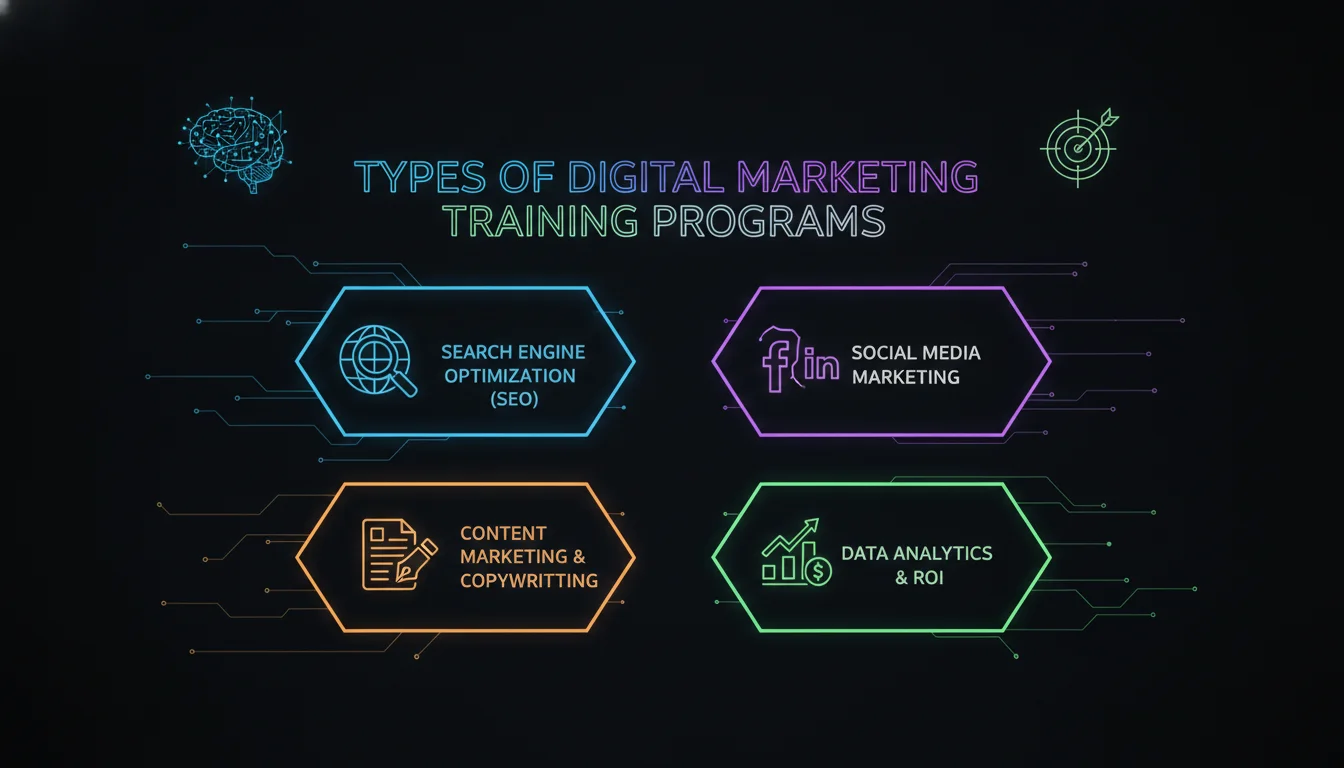
this kind of training comes in many forms, from free online courses to intensive university certificates. Choosing the right path depends on your goals, budget, and learning style. Here’s how the main categories break down.
Free Digital Marketing Training Options
Several reputable organizations offer free digital marketing with optional certifications. HubSpot Academy’s Digital Marketing Certification Course includes 10 lessons, 30 videos, and 8 quizzes across approximately 3.5 hours of content. Upon completion, you earn a certificate to share on LinkedIn. Google Skillshop provides free courses on Google Ads, Analytics, and more, with credentials like the Google Analytics Individual Qualification. These free options are excellent for beginners who want to test the waters without financial commitment.
Professional Certification Programs
For those seeking globally recognized credentials, professional bodies like the Digital Marketing Institute offer structured programs. DMI’s certifications are respected worldwide and come with membership in a community of over 300,000 marketers. The Google Digital Marketing & E-commerce Certificate on Coursera provides hands-on learning with real tools and is recognized by thousands of employers. These programs typically blend theory with practical assignments and are designed to be completed within 3 to 6 months.
University and Executive Education Certificates
Top universities have entered the marketing training space with professional certificates that carry academic weight. The Digital Marketing Professional Certificate from the University of Maryland’s Robert H. Smith School of Business comprises four self-paced courses at $199 each, covering digital marketing analytics, online advertising, and customer relationship management. The University of Texas at Austin’s McCombs School of Business offers a 10-week AI-Powered Certified Digital Marketer program at $2,250 (discounted from $2,950), which includes three technology certifications: Google Analytics, Google Ads Search, and HubSpot Email Marketing, plus a UT Austin certificate of completion. These university programs often include career support, instructor mentoring, and networking opportunities.
Key Skills Covered in Digital Marketing Training
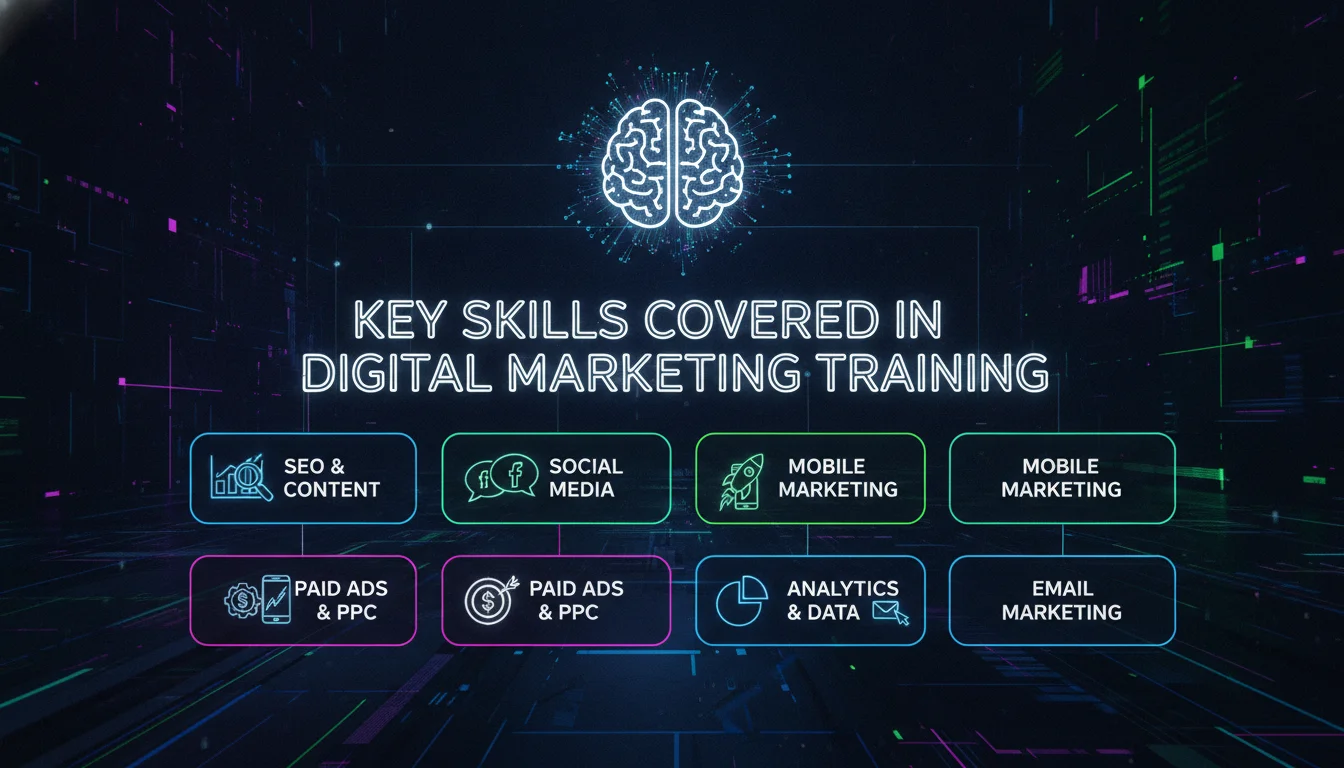
Comprehensive this type of training touches on a broad spectrum of skills. While the exact syllabus varies by provider, most reputable programs cover the following core areas.
Technical Skills: SEO, PPC, and Web Analytics
Search engine optimization and pay-per-click advertising form the backbone of digital visibility. Training teaches you how to conduct keyword research, optimize on-page content, build backlinks, and manage Google Ads campaigns. Web analytics using tools like Google Analytics 4 is another critical component. Trainees learn to track user behavior, measure campaign performance, and derive actionable insights. The UMD program dedicates an entire course to digital marketing analytics, emphasizing machine learning and AI/big data applications.
Strategic Skills: Content Marketing and Social Media
Great content fuels every other digital effort. Courses show you how to create blog posts, videos, and infographics that attract and engage audiences. Social media strategy is equally important. You’ll learn to craft platform-specific content, analyze social analytics, and run paid social campaigns. The 3-3-3 rule, a popular framework taught in many social media modules, recommends distributing content in a pattern of three value-driven posts, three personally engaging posts, and three promotional posts. HubSpot Academy’s certification includes dedicated instructors for social media and content marketing.
AI and Data-Driven Decision Making
Artificial intelligence has become a central theme in modern this kind of training. Programs now cover AI tools for content generation, predictive analytics, customer segmentation, and campaign optimization. UT Austin’s curriculum integrates AI across all modules, teaching students to use ChatGPT, HubSpot’s AI features, and Google’s machine learning capabilities. The Digital Marketing Institute’s short course on Advanced AI covers the fundamentals of AI in marketing as well.
“The best digital marketing goes beyond theory. It requires real-world application and constant upskilling in AI tools, because the platforms marketers use today may look completely different in 18 months.” – Senior marketing educator, Digital Marketing Institute
This shift mirrors the broader industry trend where AI proficiency is becoming a baseline expectation, not a bonus skill.
How to Choose the Right Digital Marketing Training
Selecting the right marketing training program starts with an honest assessment of your goals, timeline, and budget. With so many options available, a structured approach saves you from expensive detours.
Factors to Consider
- Cost: Free courses like HubSpot minimize risk. Paid programs like DMI and UT Austin often include deeper content and career support.
- Duration: Quick 3.5-hour trainings suit busy professionals. Multi-month certificates accommodate career changers.
- Certification: Employer-recognized credentials from Google and DMI carry more weight than basic completion certificates.
- Hands-on Projects: Courses that include real-world exercises build a portfolio and reinforce learning far better than passive video watching.
- Career Support: Some university programs offer resume reviews, LinkedIn optimization, and one-on-one coaching.
Comparison of Top Digital Marketing Training Programs
| Program | Provider | Cost | Duration | Certification | Key Features |
|---|---|---|---|---|---|
| Digital Marketing Certification | HubSpot Academy | Free | 3.5 hours | Certificate | Inbound focus, 10 lessons, 30 videos |
| Digital Marketing Pro | Digital Marketing Institute | ~$535 | 9 hours self-paced | International certification | Global standard, 75,000+ certified |
| Digital Marketing Professional Certificate | University of Maryland | $796 (4 courses at $199 each) | 4 months, 3-5 hrs/week | Professional Certificate | University-backed, analytics focus |
| AI-Powered Certified Digital Marketer | UT Austin McCombs | $2,250 (discounted from $2,950) | 10 weeks | Certificate + 3 tech certs | AI-focused, career support |
| Google Digital Marketing & E-commerce | Google (via Coursera) | ~$300 (subscription) | 3-6 months at 10 hrs/week | Professional Certificate | Hands-on, job-ready skills, 51K+ ratings |
Expert Insight
When evaluating programs, industry professionals consistently stress the value of community and continuous learning. “Don’t just chase the certificate,” advises a senior marketing manager familiar with HubSpot Academy’s model. “Look for programs that offer access to alumni networks and updated content, because digital marketing changes every quarter.” This viewpoint aligns with the Digital Marketing Institute’s philosophy of providing ongoing resources to members even after certification.
“A certificate gets you in the room. What keeps you there is the habit of learning you build during the program.” – Marketing director, executive education sector
Step-by-Step: Launching a Digital Marketing Career After Training
Completing a digital marketing training program is just the beginning. To turn knowledge into a job, follow this proven sequence.
Step 1: Select a Specialization
Most programs give a broad overview, but employers hire for specific roles. Choose a focus area: SEO, paid media, content, or marketing analytics. Base that choice on your strengths and market demand. If you enjoy data and spreadsheets, SEO or analytics is a natural fit. If you’re more creative, content or social media might be your lane.
Step 2: Build a Portfolio with Real Projects
The best way to demonstrate new skills is through tangible outcomes. During your digital marketing training, work on a mock campaign, a blog, or a volunteer project for a local business. Document the process and results. UT Austin’s program encourages this directly by integrating HubSpot and Google tools throughout the curriculum, allowing students to produce portfolio-ready assets before they graduate.
Step 3: Gain Practical Experience and Network
Practical experience solidifies learning and impresses recruiters. Consider internships, freelance gigs, or short-term contracts. LinkedIn is crucial for networking. Join discussions in digital marketing groups, share insights from your training, and connect with alumni from your program. Many university and professional certification bodies maintain active job boards and alumni networks specifically for this purpose.
Corporate Training and Team Enrollment Options
Individual learners aren’t the only ones investing in digital marketing training. Businesses increasingly enroll entire marketing teams to standardize skills and close capability gaps. The Digital Marketing Institute, for example, offers university partnership and training provider partnership models that allow organizations to bring globally recognized certification programs in-house. This approach is particularly valuable for agencies, in-house marketing departments, and companies undergoing a digital transformation. Team training also creates a shared vocabulary across departments, which tends to improve campaign coordination and reduce costly miscommunication.
The Future of Digital Marketing Training: AI and Beyond
The future of digital marketing training is being written by AI right now. Staying ahead means embracing continuous education and the growing suite of AI-driven tools that are reshaping every marketing discipline.
AI-Powered Marketing Tools
Generative AI tools like ChatGPT and Google’s AI products are becoming everyday instruments for marketers. Training programs are rapidly updating their syllabi to include prompt engineering, AI content review, and automated campaign optimization. The IBM Generative AI Engineering certificate on Coursera is now marked as a top AI program, signaling the convergence of marketing and AI skill sets that every serious marketer needs to understand.
Upskilling for a Lifelong Learning Path
The era of a one-time degree or certificate is fading fast. Digital marketing training is increasingly viewed as a continuous journey rather than a destination. Platforms like Coursera and LinkedIn Learning offer subscription models that allow marketers to update skills on demand. The Digital Marketing Institute’s membership model provides ongoing resources, ensuring certified professionals stay current long after their initial certification. This trend underscores the need for a mindset of perpetual growth.
At Emin Media, we see this play out with every client we work with. The brands that grow fastest aren’t the ones with the biggest budgets. They’re the ones with teams that learn faster than the market changes. If you want to build that kind of team, or sharpen your own edge, explore what Emin Media’s creative and digital services can do for your brand.
Pros and Cons
Pros
- Accessible entry points: Free programs from HubSpot and Google mean anyone can start building skills without financial risk.
- Employer-recognized credentials: Certifications from Google, DMI, and top universities carry real weight in hiring decisions.
- AI-integrated curricula: Modern programs teach the tools marketers actually use today, not outdated theory.
- Career flexibility: Skills transfer across industries, from e-commerce to healthcare to finance.
- Community access: Many programs connect you with alumni networks, job boards, and ongoing learning resources.
Cons
- Quality varies widely: Not all certifications carry equal weight. A certificate from an unknown provider may add little to your resume.
- Rapid obsolescence: Digital marketing evolves quickly. A course completed two years ago may already be partially outdated.
- Cost of premium programs: University-backed options like UT Austin ($2,250) represent a significant investment that not every learner can absorb.
- No substitute for experience: Training builds knowledge, but employers still prioritize candidates with real campaign results in their portfolios.
Frequently Asked Questions
How do I start learning digital marketing?
Start with free, recognized certifications like HubSpot Academy’s Digital Marketing Certification Course or Google Skillshop. These give you a broad foundation across SEO, social media, and email marketing. Once you have the basics, specialize in one area based on your interests and where you see the strongest job demand.
Is digital marketing still in demand in 2026?
Yes, demand remains strong. The Digital Marketing Institute reports over 300,000 members and growing, and Google’s Digital Marketing & E-commerce Certificate on Coursera has accumulated more than 51,000 ratings, reflecting massive ongoing enrollment. Businesses across every sector are increasing their digital spend, which keeps the talent market competitive.
What is the 3-3-3 rule in marketing?
The 3-3-3 rule is a content distribution framework taught in many social media training modules. It recommends distributing content in a pattern of three value-driven posts, three personally engaging posts, and three promotional posts to balance audience value with business goals. Variations of the framework exist across different programs and instructors.
Does digital marketing really pay?
Yes. Certified digital marketers consistently earn above-average compensation, with senior roles in SEO, analytics, and paid media frequently reaching six-figure salaries. Specializations that combine technical skill with strategic thinking tend to command the highest rates, according to industry consensus.
How long does it take to complete digital marketing training?
It depends on the program. Short courses take as little as a few hours (HubSpot’s certification runs about 3.5 hours), while comprehensive programs like Google’s Certificate on Coursera are designed for 3 to 6 months at a part-time pace. University programs like UT Austin’s run 10 weeks with a structured schedule.
Which digital marketing certification is best for beginners?
The free HubSpot Digital Marketing Certification or Google’s Digital Marketing & E-commerce Certificate on Coursera are the strongest starting points for beginners. Both are widely recognized by employers, built around practical skills, and accessible without prior marketing experience.
Enjoyed this article?
Contact Emin Media for a free brand consultation and let's create something amazing together.
Get in Touch