Digital CCD Camera: Buyer’s Guide 2026
Key Takeaways
- A digital CCD camera uses a charge-coupled device sensor known for rich colors and low base-ISO noise.
- CCD-based digicams from 2005 to 2014 are fueling a vintage photography trend, with used prices ranging from $30 to $500.
- Power consumption can be up to 100 times higher than CMOS sensors, but image quality in daylight remains distinctive.
- Many Amazon listings labeled “CCD camera” actually contain CMOS sensors. Verify specs before buying.
- The Olympus XZ-1, Canon PowerShot S95, and Panasonic Lumix LX5 are among the most sought-after digital CCD camera models.
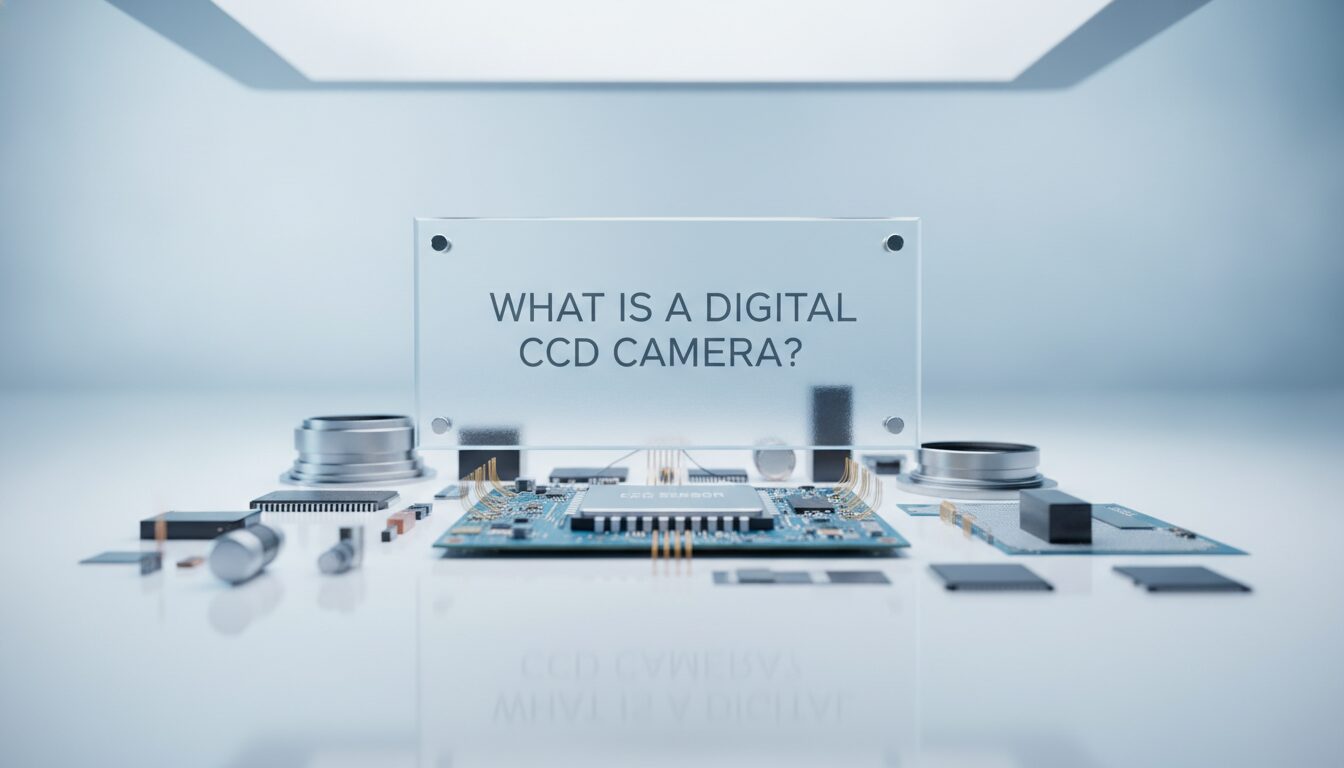
A digital CCD camera is any camera that uses a charge-coupled device sensor to capture images with characteristic color rendering and low noise at base ISO. Popular for vintage aesthetics, photographers hunt for old digicams with CCD sensors on eBay, thrift stores, and specialty resellers.
What Is a Digital CCD Camera?
Media” class=”wp-image-10227″ loading=”lazy” width=”1792″ height=”1024″ />The CCD Sensor Defined
A charge-coupled device (CCD) is a solid-state image sensor that converts incoming light into electrical charge. Each pixel’s photodiode accumulates charge proportional to photons, then shifts and reads out the voltage to form an image. This process delivers high fill-factor and sensitivity. In a ccd camera, the sensor is the heart of the imaging pipeline, generating raw data that is later converted into a JPEG or RAW file.
How CCD Differs from CMOS
CCD and CMOS (complementary metal-oxide-semiconductor) are the two dominant image sensor architectures. CMOS sensors integrate amplification and analog-to-digital conversion at each pixel. CCD sensors move charge across the chip before readout. This difference creates real trade-offs. CCD sensors historically produced cleaner images with lower read noise and better dynamic range at low ISOs, but they are more expensive to manufacture and can consume up to 100 times more power than an equivalent CMOS sensor, according to industry experts who have benchmarked both architectures.
The Resurgence of Vintage Digicams
Since the early 2020s, a growing subculture of photographers has driven a surge in demand for old point-and-shoot this type of cameras, often called “digicams.” Wikipedia’s list of digital cameras with CCD sensors notes that these cameras offer a nostalgic look without the recurring cost of analog film. The trend coincides with a broader revival of 1990s and Y2K aesthetics, where the CCD “color science” – warmer tones, subtle highlight roll-off, and a slight grain-like texture – is prized for social media and personal projects.
Pros and Cons of a Digital CCD Camera
Pros
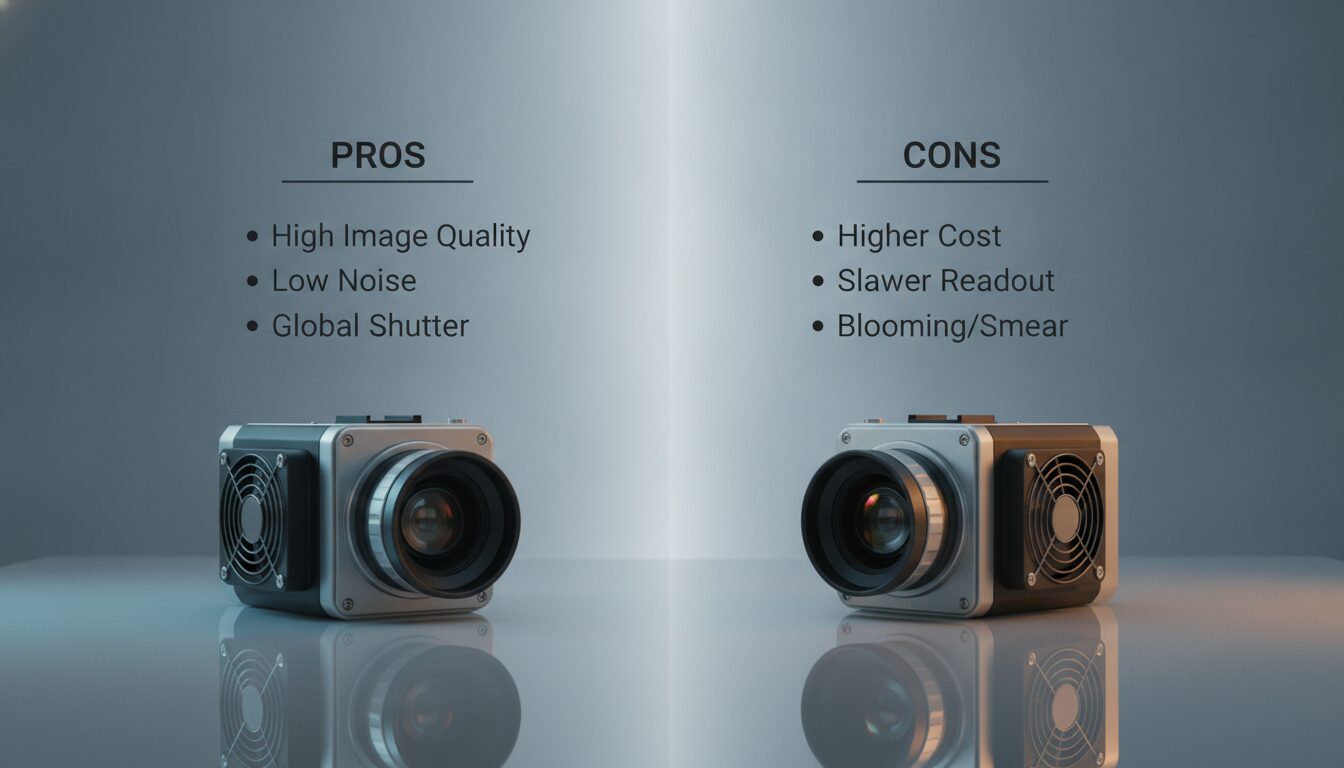
- Distinctive color science: CCD sensors render reds, skin tones, and midtones with a warmth that modern CMOS cameras require heavy post-processing to replicate.
- Low base-ISO noise: At ISO 80 to 200, CCD output is exceptionally clean with pleasing, film-like grain rather than harsh digital noise.
- Affordable entry point: Working models start at roughly $30 to $50 on the used market, making experimentation nearly risk-free.
- Compact and pocketable: Most CCD digicams from 2005 to 2014 fit in a shirt pocket, making them ideal everyday carry cameras.
- RAW support on premium models: Cameras like the Olympus XZ-1, Canon G12, and Nikon Coolpix P7100 offer RAW files for post-processing flexibility.
Cons
- High power consumption: CCD sensors can drain batteries up to 100 times faster than CMOS equivalents, limiting a typical shoot to 200 to 300 frames per charge.
- Limited high-ISO performance: Above ISO 400, noise becomes intrusive and detail loss is significant by modern standards.
- No new production: The last notable consumer CCD digicam shipped in 2014. You are always buying aging, second-hand hardware.
- Sensor degradation: After 15 to 20 years, hot pixels, stuck pixels, and sensor banding become real risks.
- Video limitations: Most vintage CCD digicams cap out at 720p or 480p, with rolling shutter artifacts common in motion footage.
Why Choose a Digital CCD Camera in 2026?
Unique Color Rendition and Aesthetics
Photographers who shoot with a this kind of camera often cite the sensor’s ability to produce rich, film-like colors straight out of the camera. Kristoffer Trolle’s big CCD sensor test observes that “the CCD-sensor is said to have richer colors, and to give a more retro look than modern CMOS-sensors.” While modern post-processing can mimic the effect, the immediacy of a genuine CCD color profile, especially in midday light where many modern cameras render flat results, makes these older bodies feel creatively distinct.
Low-Light Performance and Noise Characteristics
CCD sensors are not low-light champions by today’s standards, but at base ISO (usually 80 to 200) they exhibit exceptionally clean output with pleasing noise grain. According to camera community discussions, a CCD sensor can produce higher-resolution images with less noise and is also more sensitive to light compared to early CMOS designs. This means that in well-lit scenes, a good digital ccd can still hold its own against contemporary entry-level models.
Affordability and the Thrift Factor
A key driver of the trend is cost. eBay listings show that working ccd camera models can be had for as little as $30. A Casio EX-Z29 lists for around $39.99 and a Fujifilm Finepix S700 for roughly $37.90. Even the most coveted models, like a Canon PowerShot G12 or Nikon Coolpix P7100, typically sell between $150 and $300. This accessibility allows experimentation without a large financial commitment.
Digital CCD Camera Buying Guide
Key Specs to Check: Sensor Size and Resolution
Not all CCD sensors are equal. The Wikipedia list of CCD cameras highlights models with a 1/1.7-inch CCD sensor or larger as the sweet spot for image quality. Such sensors gather more light and yield better dynamic range. Resolution typically falls between 8 and 16 megapixels, which is more than sufficient for sharing online or printing up to 8×10 inches. Look for models that support SDHC memory cards (up to 32 GB) for easy file transfer to modern computers.
Where to Find Digital CCD Cameras
The second-hand market is the primary source. eBay offers the widest selection, but caution is needed. Experienced buyers report that a significant share of used CCD cameras arrive with hidden defects, based on Kristoffer Trolle’s hands-on testing experience. Thrift stores, garage sales, and local classifieds can yield better-tested units. Avoid new listings on Amazon that claim “CCD camera” but describe a CMOS sensor in the details. Always cross-reference the exact model number with the manufacturer’s specifications.
How to Inspect a Used CCD Camera (Step-by-Step)
Step 1: Request clear photos of the lens, sensor (if the shutter is open), and battery compartment. Look for corrosion or moisture damage.
Step 2: Ask the seller to take a test shot at full resolution and share the unedited JPEG. Zoom in on all four corners to check for dead pixels or SD card errors.
Step 3: Verify that the autofocus motor operates silently and locks on a subject at different focal lengths.
Step 4: Ensure the camera powers on with either AA batteries (if required) or the original proprietary battery. Factor in the cost of a new battery, since old lithium-ion packs often fail after a decade.
Step 5: Confirm that the USB port (if present) or SD card reader can transfer files to your computer. Many older this type of camera units require a specific driver that may not work on current operating systems, so an external card reader is safest.
Following these steps significantly reduces the risk of receiving a non-functional unit, particularly when buying from individual sellers rather than vetted resellers.
Top Digital CCD Camera Models (2026 Comparison)
| Model | Sensor Size | Megapixels | Key Feature | Typical eBay Price (2026) |
|---|---|---|---|---|
| Olympus XZ-1 | 1/1.63″ CCD | 10 MP | f/1.8 Zuiko lens, RAW support | ~$200 |
| Panasonic Lumix LX5 | 1/1.63″ CCD | 10 MP | 24–90mm, f/2.0–3.3, SDXC | ~$150 |
| Canon PowerShot S95 | 1/1.7″ CCD | 10 MP | 28–105mm, f/2.0–4.9, RAW | ~$120 |
| Nikon Coolpix P7100 | 1/1.7″ CCD | 10 MP | 28–200mm f/2.8–5.6, RAW, SDXC | ~$180 |
| Canon PowerShot G12 | 1/1.7″ CCD | 10 MP | Swivel LCD, hot shoe, RAW | ~$200 |
| Canon PowerShot S200 | 1/1.7″ CCD | 10 MP | 24–120mm, f/2.0–5.9, SDXC (2014) | ~$250 |
Prices are approximate and based on auction and “Buy It Now” listings observed on eBay in 2026. The Canon S200, released in 2014, is the last notable consumer this kind of camera to hit the market.
Digital CCD Camera vs. CMOS: A Head-to-Head Comparison
Image Quality and Color Science
Side-by-side, a digital ccd often renders reds and skin tones with a warmth that early CMOS sensors struggled to replicate. Modern CMOS sensors have largely closed the color gap through advanced in-camera processing, but many enthusiasts still prefer the unprocessed look of a CCD’s analog signal chain. At base ISO, a well-exposed CCD file can match or exceed the perceived sharpness of a 20-megapixel CMOS sensor due to the absence of aggressive noise reduction.
Power Consumption and Battery Life
CCD sensors require high-voltage clocks and charge-coupled shift registers, leading to power drain up to 100 times that of CMOS. In practice, a typical ccd camera might take 200 to 300 shots on a single charge, whereas a modern CMOS compact can exceed 500. Always carry spare batteries, especially with older units whose cells may have degraded over a decade of use.
Video Capabilities
Most vintage CCD digicams record video at 720p or 480p resolutions. The slow readout speed of CCD sensors often produces rolling shutter distortion familiar in early digital video. If video matters to you, consider a CCD camcorder or a later model like the Canon PowerShot S200, which supports 720p HD.
CCD Cameras in Surveillance and Scientific Use
CCD technology didn’t disappear when consumer cameras moved on. It migrated into sectors where its strengths matter most. According to Security Camera King, “Most video security cameras today are digital color CCD cameras or digital color CMOS cameras,” confirming that CCD remains active in dedicated, low-volume sectors. Surveillance deployments favor CCD for its global shutter (which eliminates rolling shutter distortion in fast-moving scenes) and its sensitivity in low-light environments where consistent image quality is non-negotiable.
Beyond security, CCD sensors remain the standard in scientific imaging, astrophotography, and medical diagnostics. Telescopes, spectrometers, and microscopy rigs still rely on large-format CCD arrays because the technology delivers extremely low read noise and predictable, linear response to light. These professional-grade sensors bear little resemblance to a pocket digicam, but they share the same core physics. For photographers interested in the high end of CCD imaging, medium format digital backs from manufacturers like Phase One and Leaf used large CCD sensors before transitioning to CMOS, and used backs from that era (roughly 2005 to 2015) can still be found on the professional second-hand market for anywhere from $500 to several thousand dollars.
“CCD sensors offer a predictable, linear response to light that makes them ideal for scientific and forensic imaging applications where calibration and repeatability matter more than speed.” – Camera sensor engineering overview, imaging industry literature
“The vintage digicam market is one of the few areas in photography where a $50 camera can genuinely outperform a $500 smartphone in terms of aesthetic output – not because of resolution, but because of character.” – Kristoffer Trolle, photographer and CCD camera tester
How to Get the Best Results from Your Digital CCD Camera
Step 1: Nail Exposure with Base ISO
Set your this type of camera to its lowest ISO (usually 80 or 100) and use exposure compensation to protect highlights. CCD sensors lack the dynamic range of modern CMOS, so blown highlights cannot be recovered in post.
Step 2: Embrace the “SOOC” Workflow
Many shooters value the straight-out-of-camera JPEG. Adjust picture settings in-camera (contrast, saturation, sharpness) to get the desired look without post-processing. This is where the CCD aesthetic shines brightest.
Step 3: Use a Fast SD Card (Class 10 U1 or Better)
Even small CCD cameras benefit from a fast write speed. This reduces shot-to-shot lag, which can exceed 2 seconds on older cameras with slow interfaces. A Class 10 card costs under $10 and makes a noticeable difference in shooting rhythm.
Common Pitfalls When Buying a Digital CCD Camera
Counterfeit “CCD” Listings on Amazon
A quick search for “this kind of camera” on Amazon returns thousands of results, but most are current-generation CMOS compacts. Sellers often tag products with “CCD” to catch the trend. Always read the specifications. If the sensor type is not explicitly stated as CCD, it is almost certainly CMOS.
Dead Pixels and Sensor Aging
After 15 to 20 years, CCD sensors can develop hot or stuck pixels. While software can map them out, a cluster of dead pixels in the frame center ruins the image. Inspect test shots at 100% before committing to a purchase.
Memory Card Compatibility
Many vintage digital ccd models were built for standard SD cards (2 GB max) or the now-obsolete xD-Picture Card. Wikipedia notes that Fujifilm Super CCD cameras used xD cards, making them less convenient today. Look for cameras that explicitly support SDHC (up to 32 GB) or, ideally, SDXC.
The Future of Digital CCD Cameras
Are New CCD Cameras Still Made?
No major manufacturer produces a new consumer ccd camera. The last notable release was the Canon PowerShot S200 in 2014. Industrial, scientific, and astrophotography applications still use CCD sensors for their high sensitivity and low noise in specialized conditions, but the consumer market has fully transitioned to CMOS.
Long-Term Value of Vintage Digicams
As supply of working this type of camera units dwindles, prices for the best models are likely to rise. Early adopters who bought a Canon G12 for under $50 in 2020 have already seen values roughly double. The market is speculative, though. Buy a camera because you want to shoot with it, not solely as an investment. The real value is in the images you make, not the resale price.
As of 2026, the vintage digicam community continues to grow on platforms like Reddit, Instagram, and dedicated forums, keeping demand for quality CCD bodies strong. If you’re considering picking one up, now is a good time before the best examples disappear into collections.
Frequently Asked Questions
What is a digital CCD camera?
A this kind of camera uses a charge-coupled device sensor to capture images. CCD sensors were the standard in early digital cameras and are known for rich color reproduction and low noise at base ISO. They were widely used in consumer cameras from roughly 2000 to 2014.
Do they still make CCD cameras?
No, CCD sensors are no longer used in new consumer cameras. The last notable CCD digicam was the Canon PowerShot S200 in 2014. You can still buy used models on platforms like eBay, with prices ranging from $30 to $500 depending on condition and model.
Why are CCD cameras popular again?
The vintage digicam trend values the unique, film-like colors and nostalgic aesthetic of CCD sensors. They’re also extremely affordable, often under $50 for entry-level models, making them accessible to photographers of any budget.
How can I tell if a camera has a CCD sensor?
Check the manufacturer’s specifications or look up the model on Wikipedia’s list of CCD cameras. Most consumer cameras released before 2010 use CCD sensors, while cameras from 2012 onward are almost exclusively CMOS.
Are CCD cameras better than CMOS?
Not across the board. CCD sensors excel in color rendition at base ISO and produce a distinctive aesthetic that many photographers prefer. CMOS sensors offer better high-ISO performance, lower power consumption, faster readout speeds, and video capabilities that CCD simply cannot match.
Can I use modern SD cards with a digital CCD camera?
Most digital CCD cameras support SDHC cards up to 32 GB. Some newer models also support SDXC, but many vintage cameras are limited to 2 GB standard SD cards. Always verify compatibility with the specific model before buying a card.
The digital CCD camera sits at a fascinating crossroads of retro aesthetics and practical affordability. Whether you’re chasing the Y2K look, building a creative toolkit on a tight budget, or simply curious about what made early digital photography feel so different, the CCD market has something real to offer. Shop carefully, know your models, and you’ll find a camera with genuine character.
Ready to build a brand with that same kind of character? Contact Emin Media for a free brand consultation and let’s create something that stands out.
Enjoyed this article?
Contact Emin Media for a free brand consultation and let's create something amazing together.
Get in TouchRelated Articles
Best Cheap Digital Canon Camera Picks for 2026
Find the best cheap digital canon camera in 2026. Compare PowerShot, Rebel T7, EOS R100,…
Best Digital SLR Camera Used: 2026 Buying Guide
Find the best digital slr camera used in 2026. Compare prices, top models, and trusted…
Best Canon Digital SLR Camera: Top Picks for 2026
Find the best Canon digital SLR camera for your style. We rank top DSLRs from…