Best Canon Digital SLR Camera: Top Picks for 2026
Key Takeaways
- The Canon EOS-1D X Mark III is the top professional DSLR for speed and durability, while the EOS 5D Mark IV offers superb all-around image quality.
- The EOS 7D Mark II remains a solid choice for action photographers thanks to its 10 fps burst rate and rugged magnesium alloy build.
- Entry-level shooters can confidently start with the Canon Rebel T8i (EOS 850D) for its guided interface and price point under $800 with a kit lens.
- Canon DSLRs deliver exceptional battery life, with the EOS 90D stretching past 1,300 frames per charge, and an optical viewfinder experience that many professionals still prefer.
- All models accept Canon’s EF lens lineup, ensuring future compatibility with RF-mount mirrorless bodies via the EF-EOS R adapter.
- Canon’s EF mount has been in production since 1987, with over 150 million EF lenses sold, making the used glass market one of the richest in photography.
The best Canon digital SLR camera is the EOS 5D Mark IV for most photographers, balancing full-frame resolution, speed, and build quality, while the EOS-1D X Mark III leads for sports professionals and the Rebel T8i is the top pick for beginners.
Even as of 2026, Canon’s DSLR lineup stays compelling for photographers who value an optical viewfinder, all-day battery life, and access to decades of EF glass. This guide ranks the slr camera options across every skill level, from professional workhorses to entry-level gems, and explains exactly why a DSLR might still be your smartest move. Whether you’re upgrading or buying your first interchangeable-lens camera, there’s a Canon DSLR built for you.
Why Consider a Canon DSLR Today?
Canon DSLRs remain worth buying in 2026 because they combine a lag-free optical viewfinder, industry-leading battery endurance, and access to one of the largest used lens markets in photography history.
The Optical Viewfinder Advantage
An optical viewfinder (OVF) delivers a lag-free, real-time view of your scene directly through the lens. Unlike electronic viewfinders found in mirrorless cameras, an OVF uses zero battery power and stays crystal clear even in direct sunlight. For sports, wildlife, and concert photography, that instant, flicker-free preview is invaluable. Many working pros say composing through glass helps them connect with their subject more intuitively than any screen ever could.
Unmatched Battery Life
Canon DSLRs consistently outperform mirrorless cameras in battery endurance. A single charge on an EOS 5D Mark IV delivers over 900 shots, while the APS-C EOS 90D stretches past 1,300 frames. For long wedding days, remote travel, or multi-day field work, that reliability means fewer battery swaps and more keepers in the bag.
Affordable Lens Ecosystem
Canon’s EF mount has been around since 1987, and the used market is stacked with high-quality glass at every price point. From the beloved EF 50mm f/1.8 STM to fast L-series telephotos, you can build a professional kit on a modest budget. Canon’s EF-EOS R adapter means every EF lens works on mirrorless RF-mount bodies too, protecting your investment if you ever switch systems.
Top Canon DSLR Models at a Glance
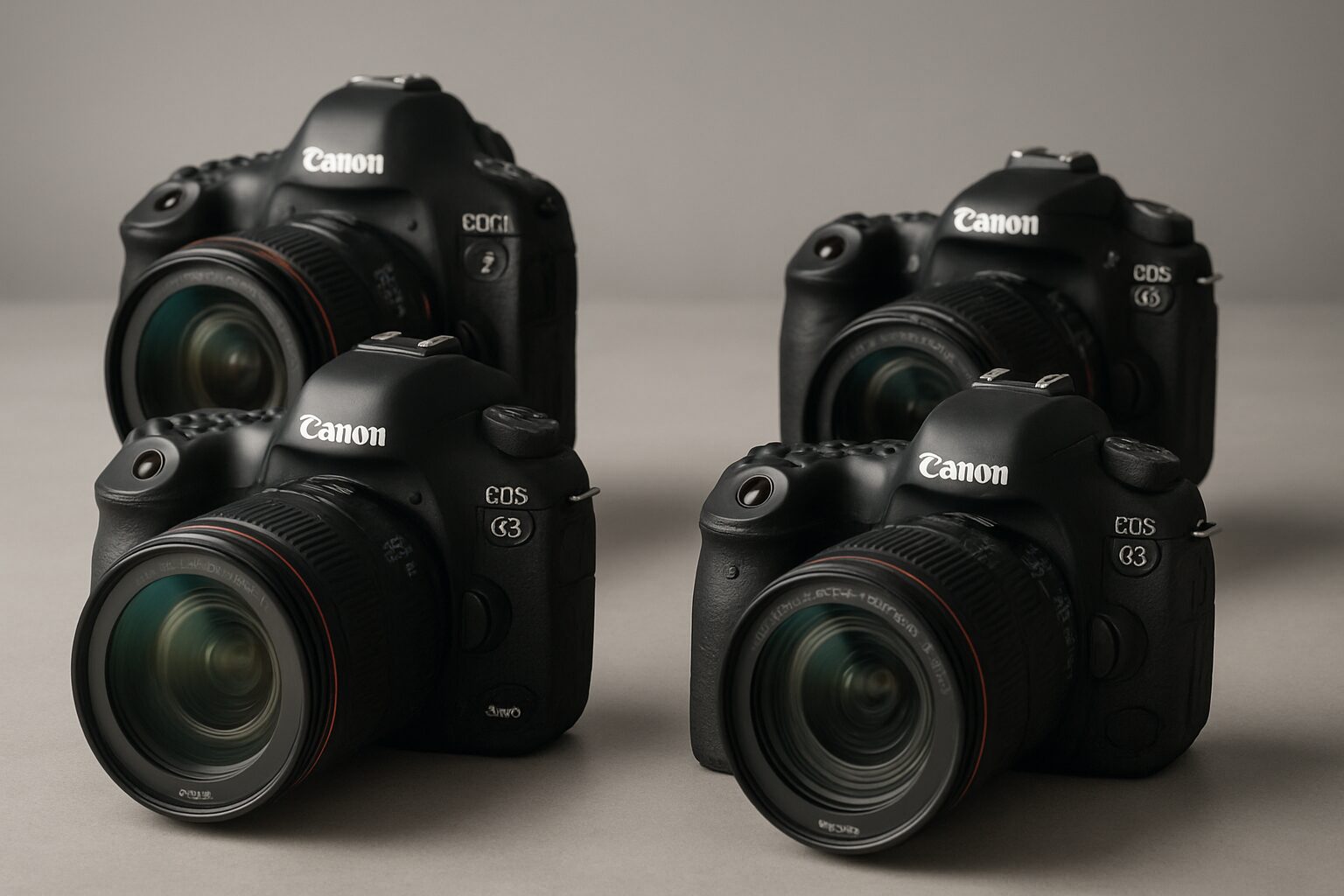
| Model | Sensor | Best For | Key Feature | Target User |
|---|---|---|---|---|
| EOS-1D X Mark III | Full-frame | Professional sports, journalism | Industry-leading speed, rugged build | High-end professional |
| EOS 5D Mark IV | Full-frame | Enthusiast, portrait, landscape | All-around excellence, refined UI | Serious enthusiast / working pro |
| EOS 7D Mark II | APS-C | Action, wildlife | 10 fps burst, 65-point AF | Sports/wildlife specialist |
| EOS 90D | APS-C | Advanced hobbyist | High resolution, 1,300+ shot battery | Advanced amateur |
| Rebel T8i (850D) | APS-C | Beginners, family | Guided UI, vari-angle touchscreen | Entry-level / student |
Use this table to quickly gauge where each this type of camera option fits your needs. The sections below go deeper into why each model earns its spot in 2026.
A Brief History Worth Knowing
Canon’s DSLR story is one of the most influential in modern photography. In August 2003, the Canon EOS 300D became the first DSLR priced under $1,000 USD, launching at $999 and opening interchangeable-lens photography to an entirely new audience. Then in 2008, the EOS 5D Mark II introduced 1080p full-HD video recording to DSLRs, a move that reshaped filmmaking. According to Canon Rumors, the 5D Mark II was used to shoot an entire episode of the TV show “House,” cementing the line’s cultural impact on visual storytelling. That legacy of bold engineering decisions is exactly why the this kind of slr camera options today still carry so much credibility.
“The Canon EOS 5D Mark II didn’t just change how photographers worked. It changed how television was made. Cinematographers who had never touched a DSLR suddenly had a tool that could compete with cinema cameras costing 20 times as much.” – Canon Rumors, reflecting on the EOS legacy
Pros and Cons of Canon DSLRs
Canon DSLRs offer a proven combination of optical performance and ecosystem depth, but they do come with real trade-offs worth understanding before you buy.
Pros
- Lag-free optical viewfinder that works in any lighting condition without draining the battery
- Outstanding battery life, with flagship and mid-range models delivering 900 to 1,300+ shots per charge
- Massive EF lens ecosystem built over nearly 4 decades, with rich used-market availability at every price point
- Proven autofocus systems, especially the 65-point all cross-type AF in the 7D Mark II and the advanced tracking in the 1D X Mark III
- Forward compatibility via the EF-EOS R adapter, so your glass works on future RF-mount mirrorless bodies
- Lower entry cost compared to equivalent mirrorless systems, particularly on the used market
Cons
- Canon’s R&D focus has shifted to RF mirrorless, meaning new DSLR releases are increasingly unlikely after 2026
- Larger and heavier bodies compared to modern mirrorless alternatives at similar price points
- Live view autofocus is slower than mirrorless on most DSLR models, limiting video usability on older bodies
- No in-body image stabilization (IBIS) on any Canon DSLR, unlike many current mirrorless competitors
- Electronic viewfinder features absent, including exposure preview, focus peaking, and real-time histogram overlay
Best Canon Digital SLR Camera for Professionals: EOS-1D X Mark III
The EOS-1D X Mark III is the the canon digital slr camera for professional use, built specifically for photographers who cannot afford to miss a single frame.
Purpose-Built for Speed and Toughness
The 1D X Mark III’s integrated vertical grip and weather-sealed magnesium alloy body shrug off rain, dust, and hard knocks without hesitation. While mirrorless cameras have closed the gap in many areas, the 1D X III’s optical viewfinder gives a zero-lag view of fast action that many sideline sports shooters still prefer above all else. According to Canon Rumors, the pro-level EOS-1 series has consistently set benchmarks for autofocus and durability, and this third iteration carries that legacy forward with confidence.
Intelligent Autofocus and Real-World Reliability
The 1D X III employs a sophisticated AF system informed by Canon’s mirrorless research, delivered through a dedicated DSLR AF sensor. The result is confident subject tracking in chaotic environments like motorsports, field sports, and breaking news. Dual CFexpress card slots ensure you’ll never run out of buffer or storage mid-assignment. Battery life stays strong across thousands of frames, essential for all-day editorial work.
Capturing the Decisive Moment
The 1D X III delivers industry-leading burst speed for a DSLR, and paired with the optical viewfinder’s real-time clarity, it becomes a trusted tool for capturing the absolute peak of action. For pros who demand responsiveness without any electronic lag, this camera remains the definitive answer to what the camera looks like at the professional tier.
Best Canon Digital SLR Camera for Enthusiasts: EOS 5D Mark IV
The EOS 5D Mark IV is the best canon for enthusiasts and working pros who need full-frame image quality across a wide range of shooting conditions.
The All-Rounder That Still Delivers
The 5D Mark IV has been the go-to for wedding, portrait, and landscape photographers since its release, and that reputation hasn’t faded. It pairs a high-resolution full-frame sensor with a refined interface that gets out of your way when it matters most. The 5D series carries serious cultural weight: the earlier 5D Mark II introduced 1080p HD video to DSLRs and was used to shoot an entire episode of “House,” a milestone that redefined what a still camera could do on a professional set.
Image Quality That Holds Up
The 5D Mark IV’s sensor yields rich colors and exceptional dynamic range, performing beautifully in natural light and studio settings alike. Its Dual Pixel CMOS AF enables smooth focus transitions during live view and video work, making it a capable hybrid stills and video machine. For anyone printing large or cropping heavily, the detail captured is more than sufficient for professional output.
Why It Remains a Smart Buy
In a market full of mirrorless options, the 5D Mark IV holds its ground for photographers who prefer an OVF and want direct access to Canon’s EF lens library without adapters. Its user experience is polished and familiar to millions of shooters worldwide. For the enthusiast seeking a best Canon digital SLR camera that balances cost and capability, the 5D Mark IV is the benchmark everything else gets measured against.
Best Action DSLR: Canon EOS 7D Mark II
The Canon EOS 7D Mark II is the best Canon digital SLR camera for action and wildlife photography, combining 10 fps burst shooting with a 65-point all cross-type autofocus system in a weather-sealed body.
10 fps and a Pro-Grade Autofocus System
As documented in a detailed field review, the 7D Mark II shoots at 10 frames per second and locks onto fast, erratically moving subjects with impressive accuracy thanks to its 65-point all cross-type AF system. When paired with a telephoto lens, the APS-C sensor’s 1.6x crop factor turns a 300mm lens into an effective 480mm reach. For wildlife photographers working on a budget, that extra reach is a genuine advantage over full-frame alternatives at the same price.
Rugged and Ready for the Field
The 7D II’s magnesium alloy body and weather sealing match the demands of outdoor shooting in harsh conditions. Dual card slots (CF and SD) add peace of mind on long shoots, while built-in flicker compensation eliminates banding under artificial stadium lights. That last feature alone makes it a favorite for indoor sports photographers.
A Legacy Performer
Newer mirrorless bodies have surpassed its resolution, but the 7D Mark II’s optical viewfinder and robust construction keep it relevant for action specialists who prioritize speed and reach above all else. Its ergonomics, featuring a deep grip and intuitive direct controls, are consistently cited as among the best of any DSLR ever made.
Best Beginner-Friendly Canon DSLR: Rebel T8i / EOS 850D
The Canon Rebel T8i is the best Canon digital SLR camera for beginners, offering a guided learning interface, a 24.1-megapixel APS-C sensor, and a price point typically under $800 with a kit lens.
Guided Learning Without Sacrificing Quality
The T8i’s feature assistant mode explains settings in plain language as you compose, helping newcomers understand aperture, shutter speed, and ISO on the fly rather than buried in a manual. The 24.1-megapixel sensor delivers images sharp enough for large prints, and the vari-angle touchscreen opens up creative angles that a fixed screen simply can’t match.
Versatile Video and Stills
With 4K video recording and Dual Pixel CMOS AF for smooth focus pulls, the T8i doubles as a capable vlogging camera. The optical viewfinder, combined with a clean button layout, makes it far less intimidating than most mirrorless alternatives for someone just starting out. Beginners can grow with the camera by adding EF or EF-S lenses as their skills and ambitions expand.
Affordability and a Path to Upgrade
The T8i offers modern connectivity including Wi-Fi and Bluetooth, and stays fully supported within Canon’s ecosystem. Its sub-$800 price with a kit lens makes it the most accessible entry point to genuine interchangeable-lens photography. If you’re just starting and want a real DSLR experience without a painful learning curve, the Rebel T8i is the right first step.
Best Value for Advanced Amateurs: Canon EOS 90D
The Canon EOS 90D is the best Canon digital SLR camera for advanced amateurs who want high resolution, 10 fps burst shooting, and over 1,300 frames of battery life in a single body.
High-Resolution APS-C Powerhouse
The 90D out-resolves many entry-level full-frame cameras, making it ideal for cropping in on distant subjects or producing detailed landscape prints. The optical viewfinder stays bright and responsive, and the direct-access controls let you change settings without diving through menus. That alone puts it ahead of several mirrorless designs in pure shooting efficiency.
Speed Meets Versatility
Capable of 10 fps continuous shooting, the 90D handles sports and action competently alongside the 7D Mark II, but in a lighter body with an updated sensor. Its 4K video capabilities and external microphone input appeal to content creators who prefer the DSLR form factor. The 1,300+ shot battery life per charge is a standout advantage for event photographers and travelers who can’t afford downtime.
The Last of a Breed
With Canon’s clear shift to RF-mount mirrorless, the 90D represents one of the final advanced APS-C DSLRs the company will produce. That makes it a special pick for photographers who want a modern sensor in a traditional DSLR body with native compatibility across decades of EF and EF-S lenses.
“According to The-Digital-Picture, mirrorless models now top Canon’s overall camera recommendations for 2026, but the site emphasizes that existing DSLR lenses adapt to RF-mount bodies without compromise, making a DSLR purchase today a genuinely future-proof investment in glass.”
How to Select Your Ideal Canon DSLR
Selecting the right best Canon digital SLR camera comes down to four decisions: sensor size, autofocus needs, build requirements, and lens investment strategy.
Step 1: Identify Your Sensor Size
Full-frame sensors (5D and 1D series) deliver the best low-light performance and shallowest depth of field. APS-C sensors (Rebel, 90D, 7D series) provide extra reach and lower cost. Match your sensor to your primary subjects: full-frame for portraits and landscapes, APS-C for wildlife and budget-conscious builds.
Step 2: Prioritize Autofocus and Speed
If you shoot moving subjects, look for a high frame rate and a dense AF point array. The 7D Mark II’s 65-point system and 10 fps burst are ideal for fast action. For moderate movement, the 90D’s AF system is more than capable. Stationary subjects let you prioritize resolution and dynamic range instead of raw speed.
Step 3: Consider Build and Weather Sealing
Outdoor photographers should lean toward the 1D X III, 5D Mark IV, or 7D Mark II for their magnesium alloy bodies and environmental seals. Casual shooters will find the Rebel series perfectly durable for everyday use without the added weight.
Step 4: Plan Your Lens Investment
One of the strongest arguments for choosing a best Canon digital SLR camera remains the lens library. Decide whether you’ll mostly use kit zooms or fast primes, then check compatibility. All current Canon DSLRs accept EF and EF-S lenses, and every one of those lenses carries forward to mirrorless via the EF-EOS R adapter.
Lens Compatibility and Long-Term Value
One of the most overlooked advantages of buying a best Canon digital SLR camera today is that your glass stays fully functional on the modern RF mirrorless system, protecting your investment for years.
EF Lenses on Mirrorless: A Smooth Transition
Canon’s EF-EOS R adapter, available in multiple configurations including a version with a built-in control ring, enables EF lenses to autofocus accurately on RF-mount bodies. According to The-Digital-Picture, mirrorless models now top Canon’s overall recommendations, but the site confirms that existing DSLR lenses adapt without compromise. You can enjoy the full DSLR experience today and carry every lens you own into a mirrorless future.
Building a Cohesive Kit
Start with a versatile zoom like the EF 24-70mm f/2.8L or the affordable EF 50mm f/1.8 STM. As you expand, the used EF market offers exceptional value at every focal length. Canon has sold over 150 million EF lenses since 1987, so the selection is staggering. Even if you eventually add an RF-mount body to your kit, your lens collection retains full utility.
Firmware and Longevity
Canon continues to support its DSLRs with firmware updates. While major innovations now target mirrorless, bodies like the 5D Mark IV and 1D X Mark III receive maintenance updates ensuring compatibility with current accessories. For a purchase intended to last 5 or more years, a high-end DSLR remains a secure and well-supported investment.
Canon DSLRs vs. Mirrorless: The Honest Comparison
Canon DSLRs and mirrorless cameras serve different photographers, and understanding where each excels helps you avoid an expensive mistake.
Mirrorless bodies like the Canon EOS R5, which features a 45-megapixel sensor, and the EOS R5 Mark II, capable of up to 30 frames per second continuous shooting, represent where Canon’s engineering energy is focused in 2026. These are genuinely impressive tools. But they cost significantly more, drain batteries faster, and require adapters to use the EF glass that millions of photographers already own.
DSLRs win on battery life, optical viewfinder clarity, used-market value, and native EF lens compatibility. Mirrorless wins on autofocus sophistication, video features, and future development roadmap. If you shoot primarily stills, value all-day battery endurance, and already own EF lenses, a best Canon digital SLR camera is still the smarter financial decision in 2026. If video and cutting-edge AF are your priorities, the RF mirrorless lineup deserves serious consideration.
Conclusion: Finding Your Best Canon Digital SLR Camera
Choosing the best Canon digital SLR camera depends entirely on what you’re shooting and how you work. Professionals who need ultimate speed and build quality will gravitate to the EOS-1D X Mark III. Enthusiasts after a classic full-frame experience will find everything they need in the EOS 5D Mark IV. Action specialists will appreciate the EOS 7D Mark II’s 10 fps burst and rugged field performance, while beginners can learn confidently on the Rebel T8i. The EOS 90D splits the difference with a high-resolution sensor, 10 fps shooting, and 1,300+ frame battery life in a versatile body.
Each of these cameras represents decades of refined engineering. In a world moving rapidly toward mirrorless, these DSLRs still produce breathtaking images and deliver the tactile, battery-efficient experience that many photographers genuinely prefer. Whichever you pick, Canon’s EF lens ecosystem ensures your kit can grow and adapt for years to come.
Ready to build something bold with your brand’s visual identity? Contact Emin Media for a free brand consultation and let’s create imagery and content that actually moves people.
Frequently Asked Questions
Does Canon still make SLR cameras in 2026?
Yes, Canon continues to sell and support several DSLR models including the EOS Rebel T8i, EOS 90D, and the professional EOS-1D X Mark III. However, Canon’s R&D focus has clearly shifted to RF-mount mirrorless systems, making new DSLR releases increasingly unlikely going forward.
What is the best Canon DSLR for video?
The EOS 5D Mark IV and EOS 90D both offer 4K recording and Dual Pixel CMOS AF for smooth, accurate focus. The 5D Mark IV’s full-frame sensor and headphone and microphone jacks make it the preferred choice for filmmakers still working in the DSLR format.
Are Canon DSLRs good for beginners?
Absolutely. The Rebel T8i (EOS 850D) includes a guided interface that explains settings as you shoot, making it an excellent learning tool. Its sub-$800 price point and access to the vast EF lens ecosystem allow beginners to explore photography without a steep initial investment.
Can I use Canon EF lenses on mirrorless cameras later?
Yes. Canon’s EF-EOS R adapters let you mount any EF or EF-S lens on an RF-mount mirrorless body with full autofocus and image stabilization support. Your DSLR lens collection retains its full value if you ever decide to switch systems.
Why would I choose a DSLR over a mirrorless camera?
Canon DSLRs offer a lag-free optical viewfinder, superior battery life ranging from 900 to 1,300+ shots per charge, and a vast used lens market built over nearly 4 decades. For photographers who shoot action in bright light or need all-day endurance without carrying spare batteries, a DSLR is often the more practical and cost-effective choice.
Which Canon DSLR has the best autofocus?
The EOS-1D X Mark III leads with its advanced AF system optimized for professional sports and journalism, while the EOS 7D Mark II’s 65-point all cross-type AF system is a proven performer for wildlife and action photography. Both deliver fast, accurate tracking in genuinely challenging conditions.
Enjoyed this article?
Contact Emin Media for a free brand consultation and let's create something amazing together.
Get in TouchRelated Articles
Sony Cyber-shot Camera: 2026 Buyer’s Guide
Explore the camera sony digital cyber shot lineup: RX100 VII, ZV-1, ZV-1F, and budget picks.…
Canon 350D Digital SLR Camera: 2026 Buyer’s Guide
The Canon 350D digital SLR camera delivers film-like 8MP images for under $120 used. Is…
Canon Digital Single Lens Reflex Camera Guide 2026
Shop the best canon digital single lens reflex camera in 2026. Compare EOS Rebel T7,…