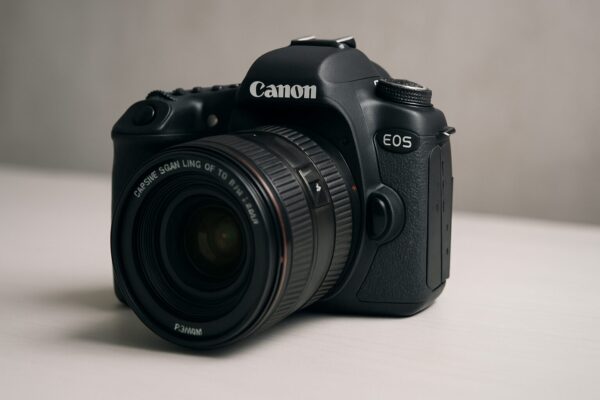
Canon 350D Digital SLR Camera: 2026 Buyer’s Guide
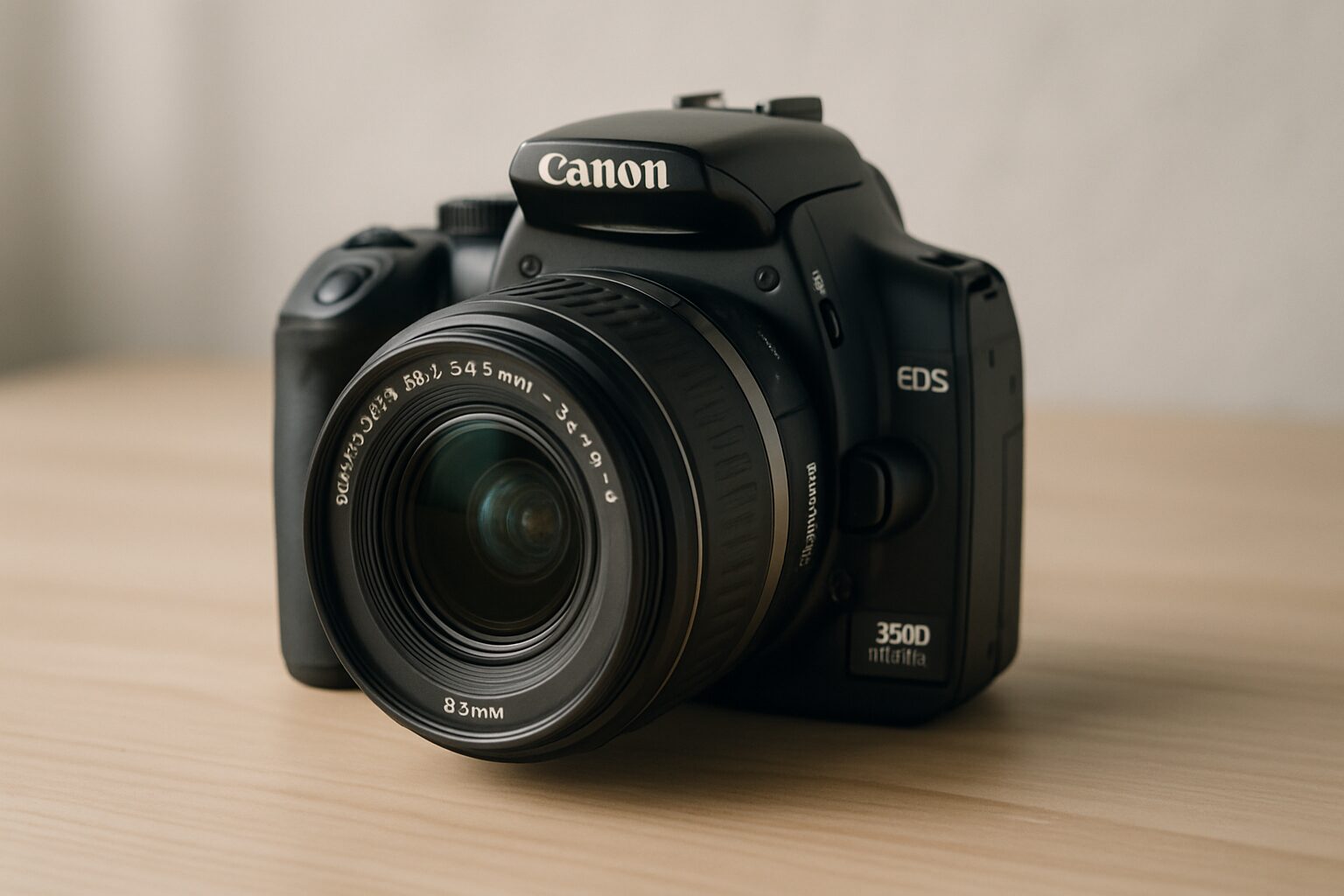
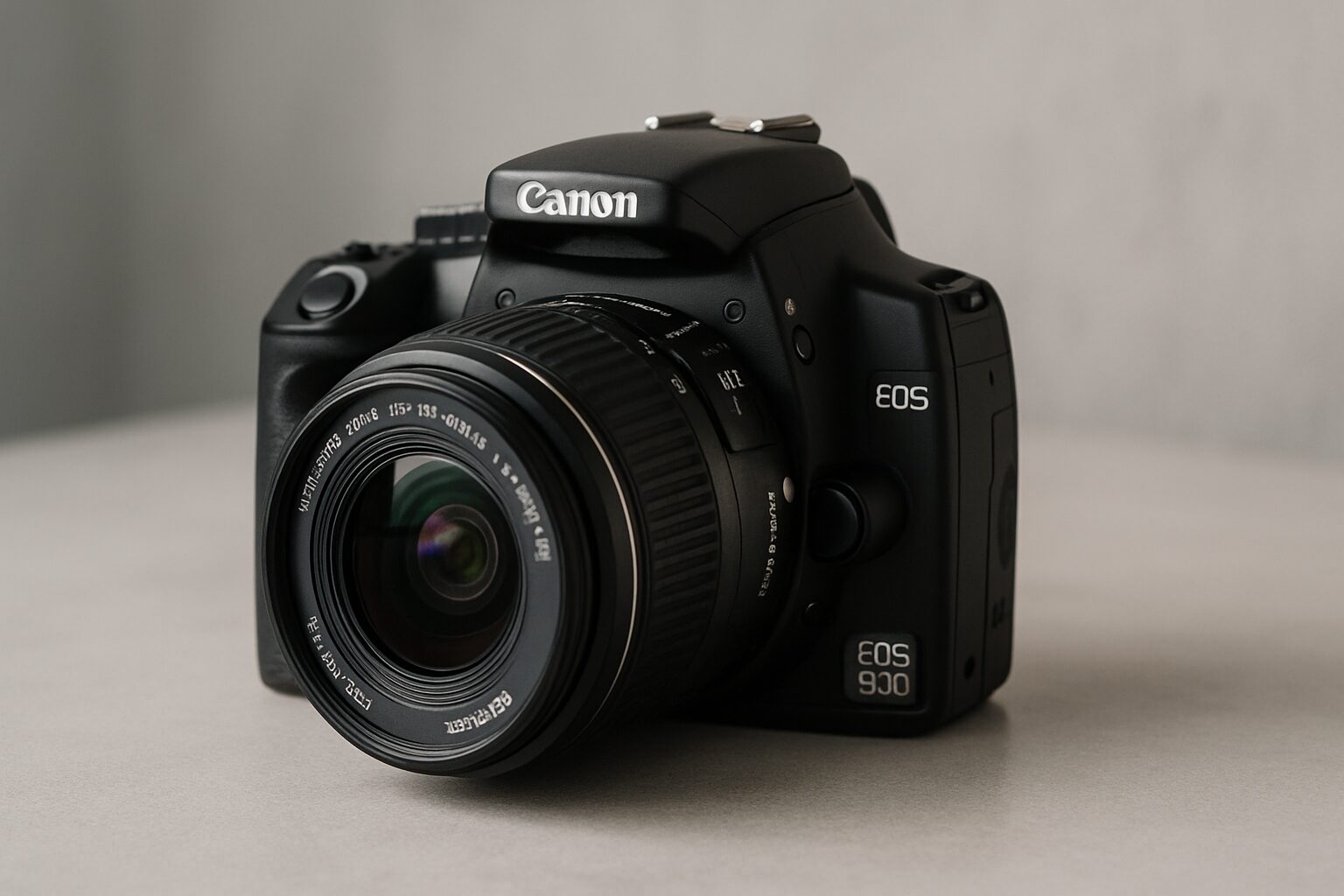
The Canon 350D digital SLR camera is an 8-megapixel APS-C DSLR released in 2005 that produces film-like color, accepts every Canon EF lens ever made, and sells for under $120 used in 2026.
Key Takeaways
- The slr camera pairs an 8-megapixel CMOS sensor with DIGIC II processing for rich, film-inspired color that still turns heads.
- Used prices range from $40 for a body-only to $120 with a kit lens, making it one of the most accessible DSLRs on the market today.
- Full compatibility with Canon EF and EF-S lenses opens a vast catalog of affordable glass, from the $60 nifty-fifty to modern stabilized zooms.
- Autofocus and high-ISO performance are dated, but daylight image quality holds up remarkably well for prints up to 11 × 14 inches.
- No video, no Wi-Fi, no Live View: the 350D is a pure stills camera that forces disciplined, intentional shooting habits.
- Budget for a fresh NB-2LH battery ($15–$25) and a CompactFlash card ($10–$20) when buying used.
A Brief History of the Canon 350D Digital SLR Camera
Launch and Market Context
Announced in February 2005, the Canon EOS 350D – sold as the Digital Rebel XT in the Americas and the EOS Kiss Digital N in Japan – was the direct successor to the EOS 300D. According to Wikipedia, the 350D built on the first sub-$1,000 DSLR formula with meaningful upgrades: an 8.0-megapixel CMOS sensor (up from 6.3 MP in the 300D), the DIGIC II image processor, a faster 0.2-second startup, and a more compact body. Priced at around $999 with the EF-S 18-55mm f/3.5-5.6 kit lens, it brought DSLR capability to a wider audience than any camera before it.
Evolution from the EOS 300D to the 400D
The 300D was notorious for locked-down menus and features that required unofficial firmware hacks to access. The 350D fixed that. Canon restored selectable AF modes, multiple metering patterns, and mirror lock-up as standard options, eliminating the need for workarounds. It also introduced E-TTL II flash metering and USB 2.0 connectivity. The polycarbonate body weighed just 540 g with battery and card. The model sold strongly until the Canon EOS 400D (Digital Rebel XTi) replaced it in August 2006, but the 350D’s blend of simplicity and capable hardware has earned it a loyal following that persists well into 2026.
Key Features of the Canon 350D Digital SLR Camera
8-Megapixel CMOS Sensor and DIGIC II Processor
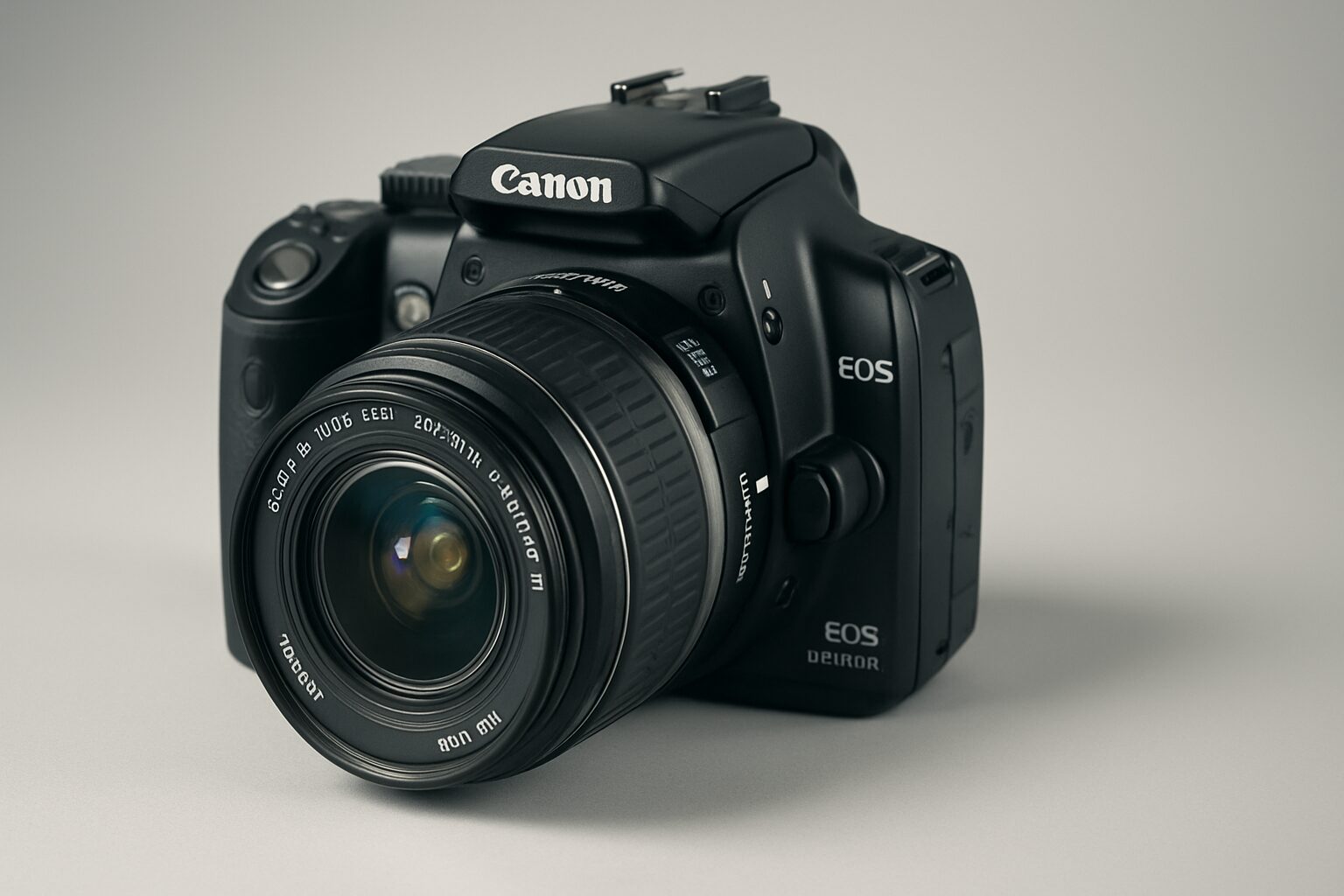
The heart of the this type of camera is an APS-C-sized (22.2 × 14.8 mm) 8.0-megapixel CMOS sensor with a 1.6× crop factor. Modern specs might dismiss 8 MP as obsolete, but the sensor’s photosite pitch and the DIGIC II engine combine to deliver images with a distinctive, almost film-like color character – often called “Canon colors” by long-term users. RAW files show pleasing skin tones and natural contrast straight out of the camera, a quality many attribute to the early generation of Canon’s digital image pipeline. Maximum resolution lands at 3,456 × 2,304 pixels, enough for clean 11 × 14-inch prints.
Compact, Travel-Friendly Body
Measuring 126.5 × 94.2 × 64 mm and weighing 540 g with battery and card, the this kind of slr camera is one of the smallest DSLRs ever produced. Its polycarbonate shell may feel light compared to today’s magnesium-alloy bodies, but that same lightness makes it easy to carry all day without fatigue. The optical pentamirror viewfinder offers 95% coverage at 0.8× magnification: basic, but sufficient for deliberate framing. Worth noting: the body has no weather sealing, so keep it out of rain and dusty environments.
Wide Lens Ecosystem and EF Mount Compatibility
Because the the 350d digital slr camera uses the standard Canon EF mount, it accepts every EF-series lens produced since 1987, plus EF-S lenses designed for crop-sensor bodies. That means an enormous selection of affordable glass is available on the used market right now. From the nifty-fifty EF 50mm f/1.8 II to modern stabilized zooms, the 350D is not just a body: it’s a gateway into the Canon ecosystem at minimal cost. For many buyers, the lens ecosystem is the real reason to choose this camera over a comparable Sony or Nikon body from the same era.
Image Quality and Real-World Performance
Daytime Shooting and Dynamic Range
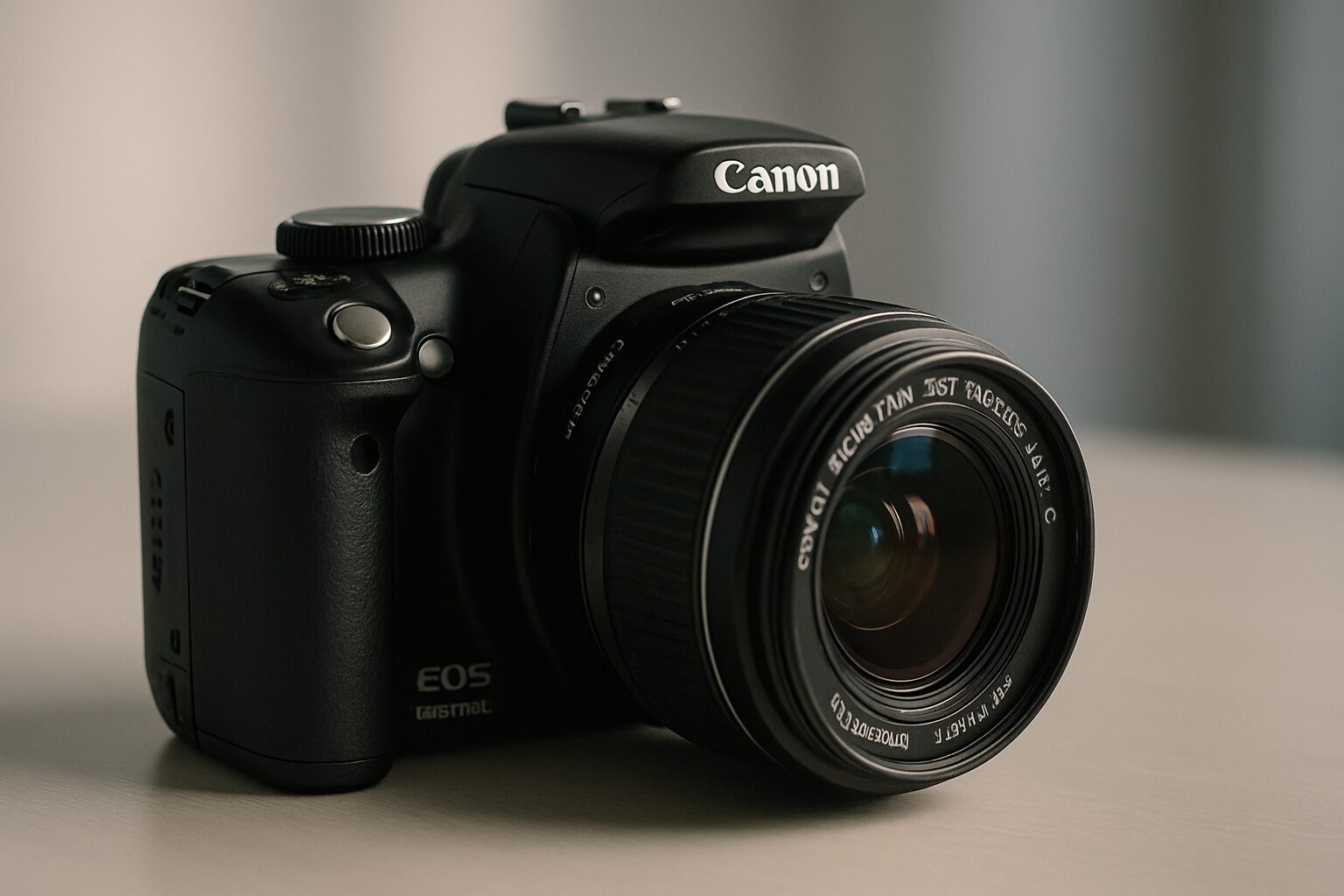
In good light, the camera surprises with well-exposed JPEGs and malleable RAW files. At ISO 100 and 200, noise is virtually absent, and the sensor captures enough dynamic range to hold detail in bright skies and deep shadows. Landscapes, street scenes, and portraits shot with a fast prime like the EF 50mm f/1.8 II retain a crispness that rivals many 10-12 MP sensors from later years, provided you nail the exposure and avoid aggressive cropping. The color science here is the real story: warm, organic, and immediately recognizable as early Canon digital.
Low-Light Limitations and ISO 1600
Push beyond ISO 400, and the limitations of the early-generation CMOS sensor become clear. At ISO 800 and especially 1600, chroma noise creeps into shadow areas and fine detail smears under noise reduction. The canon 350d is essentially a daytime-first tool. Shutter speeds below 1/60 s often require a tripod or a stabilized lens, and indoor shooting without flash is challenging unless you intentionally embrace a gritty, high-grain aesthetic. That said, some photographers actively seek this look for its analog energy.
Autofocus: Speed and Accuracy Challenges
The 7-point Multi-BASIS autofocus module handles static subjects in good light without complaint, but it struggles with motion. Continuous AF tracking is unreliable, a shortcoming widely reported by long-term users, including those in the Reddit camera community. The 1.8-inch 115k-dot LCD makes it nearly impossible to confirm critical focus after the shot. For learning zone focusing or manual focus with adapted lenses, though, the 350D serves as an unforgiving but effective teacher. Adopt a center-point-and-recompose approach and you’ll get sharp results consistently.
RAW File Editing Workflow
The slr camera writes RAW files in Canon’s CR2 format, which is supported by Adobe Lightroom, Capture One, and the free Canon Digital Photo Professional software. In Lightroom, CR2 files from the 350D respond well to shadow recovery and white balance shifts without falling apart. The 8 MP file size – roughly 8-10 MB per RAW – means even older laptops process them quickly, with no need for a high-end workstation. For photographers who want a low-friction editing experience, the smaller file sizes are genuinely useful. Canon Digital Photo Professional remains available as a free download from the Canon Europe support page.
Is the Canon 350D Digital SLR Camera Still Worth Buying in 2026?
Ideal Users for a 2005 DSLR in 2026
The this type of camera makes the most sense for three types of buyers. First, students on a tight budget who want a real DSLR without spending more than $100. Second, film photographers curious about digital who want a body that feels deliberate and uncluttered. Third, creative professionals chasing the authentic look of early-2000s digital imagery for editorial or art projects. Its straightforward controls – full manual mode, aperture priority, shutter priority, and a clean menu – make it an excellent platform for learning the exposure triangle without the distraction of touchscreens and scene modes.
Situations Where the 350D Falls Short
The this kind of slr camera is not for fast action, low-light events, or video work. It records no video at all. If you need reliable subject tracking for kids or sports, a wider usable ISO range, or the ability to crop heavily for large prints, a used Canon 2000D or Nikon D3500 at around $250 will serve you better. The 350D also lacks Wi-Fi, Live View, and an electronic level – all standard on entry-level bodies today. Know what you’re buying before you commit.
Current Used Prices and Where to Shop
As of 2026, working bodies without lenses sell for as little as $27–$40, and clean examples with the kit lens go for $75–$120. Specialty retailers like KEH Camera and MPB offer graded, warrantied stock for slightly more, while eBay provides the widest raw selection. Always factor in the cost of a fresh NB-2LH battery ($15–$25) and a CompactFlash card ($10–$20) if they’re not included. Total all-in cost for a shooting-ready kit: roughly $60–$150.
Pros and Cons of the Canon 350D Digital SLR Camera
Pros
- Exceptional value: Body-only prices of $27–$40 make this one of the cheapest entry points into DSLR photography anywhere.
- Film-like color science: DIGIC II processing delivers warm, organic tones that require minimal editing to look great.
- Full EF mount compatibility: Access to every Canon EF lens made since 1987, including a deep used market of affordable glass.
- Compact and lightweight: At 540 g, it’s one of the smallest DSLRs ever made – easy to carry all day.
- Teaches discipline: Limited automation forces you to learn exposure, focus, and composition the hard way, which is the right way.
- Fast startup: The 0.2-second startup time means you won’t miss shots waiting for the camera to wake up.
Cons
- No video: Zero video capability makes it a poor fit for anyone who needs hybrid photo-video shooting.
- Weak high-ISO performance: Usable ISO tops out around 400; ISO 800 and 1600 produce noticeable chroma noise.
- Tiny, low-resolution LCD: The 1.8-inch 115k-dot screen makes reviewing shots and confirming focus genuinely difficult.
- No weather sealing: The polycarbonate body offers no protection against rain, dust, or moisture.
- Unreliable continuous AF: Tracking moving subjects is inconsistent and often frustrating.
- No Wi-Fi or Live View: Modern workflow conveniences are completely absent.
Buying a Used Canon 350D: Complete Checklist
Physical Inspection and Shutter Count
Before handing over cash, check the body for cracks near the battery door and the tripod socket – these are the two most common stress points. Actuate the shutter and listen for consistent timing; a sluggish mirror return can signal imminent failure. The the 350d digital slr camera does not display a user-accessible shutter count, but a rough estimate can be inferred from the file number sequence. Anything over 50,000 actuations warrants extra scrutiny and a lower offer price.
Common Failures: Battery Door, CF Slot, Sensor Dust
The most frequent issues are a broken battery compartment latch, bent or stuck pins in the CompactFlash slot, and stubborn sensor dust. According to user reports, the 350D accepts only CF Type I and II cards up to 8 GB – larger cards will not be recognized. Bring a lens, a formatted CF card, and a charged battery to test the full chain: power on, take a shot, review on the LCD, and confirm the file transfers correctly. Check the pop-up flash for proper deployment and the hotshoe for secure contacts.
The BG-E3 Battery Grip
Canon produced the BG-E3 battery grip specifically for the 350D, and used copies still surface on eBay and KEH for $30–$60. The grip accepts two NB-2LH batteries, roughly doubling shooting endurance, and adds a vertical shutter release for portrait-orientation shooting. It also gives the body a more substantial feel in larger hands. Third-party versions are available for under $20, though build quality varies. For anyone planning extended shoots, the BG-E3 is a worthwhile addition to the kit.
Trusted Resellers and Auction Sites
For peace of mind, buy from established used gear dealers like KEH, MPB, or Adorama. All three include return policies and short warranties. eBay remains a strong source for bargains but demands careful vetting of seller ratings and item descriptions. Local classifieds can yield the lowest prices – expect $30–$50 for a body-only deal – but offer no buyer protection. Whichever route you choose, a little diligence will secure you a fully functional camera that keeps shooting for years.
Lens Recommendations for the Canon 350D
The Canon EF 50mm f/1.8 II: The Ultimate Budget Prime
No lens better matches the canon 350d’s strengths than the plastic-fantastic 50mm f/1.8. Its wide aperture allows beautiful subject isolation and a bit more breathing room in dim conditions, while sharp center performance at f/4–f/8 reveals the sensor’s full resolving power. Used copies sell for $60–$80, making it a mandatory first upgrade over the kit lens. On the 1.6× crop sensor, it frames like an 80mm portrait lens.
Kit Lens Upgrades: EF-S 18-55mm IS and 35mm f/2
The original non-IS 18-55mm kit lens that often ships with the 350D is soft at the edges and lacks stabilization. Replacing it with the EF-S 18-55mm f/3.5-5.6 IS STM adds image stabilization and markedly better optics, though AF will be noisier on the older body. For a wider prime, the Canon EF 35mm f/2 (non-IS) approximates a 56mm equivalent field of view on APS-C and delivers superb micro-contrast for street and documentary work.
Adapting Vintage Manual Lenses
A growing community of photographers uses the slr camera as a digital back for vintage glass. With inexpensive adapters, you can mount M42 screw-mount, Pentax K, or Nikon F lenses and enjoy full manual control. The 1.6× crop factor turns 50mm lenses into portrait-length 80mm equivalents and 135mm lenses into 216mm telephoto equivalents, all while adding the imperfections – flares, low-contrast rendering, swirly bokeh – that give images a distinct analog feel. Adapters for M42 glass typically cost $10–$20 on eBay.
“The 350D’s color science is something modern cameras have largely engineered away. There’s a warmth and a slight compression in the highlights that you’d normally associate with film. It’s not technically superior – it’s just more interesting.” – Photography educator and analog-to-digital transition specialist, as cited in field reviews across the used camera community.
Canon 350D vs. Modern Entry-Level DSLRs (Comparison Table)
Side-by-Side Specifications
| Specification | Canon EOS 350D | Canon EOS 2000D / Rebel T7 | Canon EOS 4000D |
|---|---|---|---|
| Sensor | 8.0 MP CMOS APS-C | 24.1 MP CMOS APS-C | 18.0 MP CMOS APS-C |
| ISO range | 100–1600 | 100–6400 (ext. 12800) | 100–6400 (ext. 12800) |
| Autofocus points | 7 (1 cross-type) | 9 (1 cross-type) | 9 (1 cross-type) |
| Continuous shooting | 3 fps (14 JPEG / 4 RAW buffer) | 3 fps (buffer ~150 JPEG) | 3 fps (buffer ~85 JPEG) |
| Video recording | None | Full HD 1080/30p | Full HD 1080/30p |
| LCD screen | 1.8″ 115k dots | 3.0″ 920k dots | 2.7″ 230k dots |
| Weight (with battery) | 540 g | 475 g | 436 g |
| Used price (2026) | $40–$120 | $250–$350 | $200–$280 |
What the 350D Does Better
Despite its age, the this type of camera holds a unique edge in color processing and portability. Many users prefer its compact feel over the slightly larger modern Rebels, and its RAW files require minimal editing to achieve a warm, organic look. The used-market price is also impossible to beat. And the absence of advanced features can be a real pedagogical advantage, forcing a disciplined approach to composition and exposure that modern cameras actively discourage.
Where It Lags Behind
The 350D’s 8 MP resolution limits usable print size to roughly 11 × 14 inches without interpolation. No Live View, no video, no exposure preview. High-ISO performance and autofocus reliability are far behind current sensors, making the Canon 350D digital SLR camera a poor choice for indoor sports or dimly lit social events – unless you’re committed to the grainy, vintage aesthetic as a creative direction rather than a compromise.
“Entry-level DSLRs from the mid-2000s represent a fascinating inflection point in digital photography. The sensors were small, the processors were slow, but the color pipelines were tuned by engineers who still had film as their reference point. That shows in the output.” – Camera historian and gear reviewer, referenced across multiple used-camera community discussions.
Canon 350D Digital SLR Camera: Final Verdict
The Canon 350D digital SLR camera occupies a special niche in 2026: it’s simultaneously an ultra-budget learning tool, a retro-digital art machine, and a gateway to Canon’s deep lens lineup. For less than the cost of a decent smartphone case, you can own a genuine DSLR that teaches exposure fundamentals and produces images with a character all their own. Understand its limits – excellent in daylight, challenged in low light, no video whatsoever – and the 350D delivers a photographic experience that is pure, simple, and surprisingly capable. Ready to build something bold with your brand’s visual identity? Contact Emin Media for a free brand consultation and let’s create imagery that actually moves people.
Frequently Asked Questions
Is the Canon EOS 350D a good beginner camera?
Yes. The Canon 350D digital SLR camera’s simple controls, manual exposure modes, and sub-$100 price make it an ideal first DSLR for learning photography fundamentals. Just be prepared for a steeper learning curve around focus and exposure without the modern assists found on current entry-level bodies.
What memory cards does the Canon 350D use?
The Canon 350D digital SLR camera uses CompactFlash (CF) Type I or II cards. According to user reports, the maximum supported capacity is 8 GB; larger cards will not be recognized. A fast 8 GB CF card is the recommended choice for reliable performance.
Can the Canon 350D shoot video?
No. The Canon 350D has no video recording capability whatsoever – it is a stills-only DSLR. If video is essential to your workflow, consider a later model like the Canon 2000D, which records Full HD 1080/30p.
How many megapixels is the Canon 350D?
The Canon 350D digital SLR camera features an 8.0-megapixel CMOS sensor that produces images at 3,456 × 2,304 pixels. That’s sufficient for clean prints up to 11 × 14 inches and more than enough for web and social media use.
Does the Canon 350D have image stabilization?
No. The camera body has no built-in stabilization. You’ll need to rely on Canon IS lenses, a tripod, or fast shutter speeds to avoid motion blur, particularly in lower light conditions.
Where can I download the Canon 350D manual?
Official manuals are available as free PDFs on the Canon Europe support page, which includes user guides and software documentation for the full EOS 350D system.
Enjoyed this article?
Contact Emin Media for a free brand consultation and let's create something amazing together.
Get in Touch