14 Brand Repositioning Examples That Redefined Growth
Key Takeaways
- Brand repositioning is a strategic change in perception, not a cosmetic logo refresh.
- The best brand repositioning examples follow two patterns: perception-first reframing or business-model migration.
- Standout cases include Old Spice, Netflix, Starbucks, Slack, Domino’s, Dove, BlackBerry, and Amazon.
- Common triggers behind these shifts: declining relevance, demographic shift, technology disruption, and damaged brand image.
- Execution requires brand health assessment, customer research, value proposition rewrite, integrated launch, and measurement.
Brand repositioning examples are real-world cases where companies changed how people perceive a product without abandoning its core identity. Old Spice, Netflix, and Domino’s each reframed relevance to reignite growth.
Repositioning isn’t a surface-level fix. It’s a deliberate attempt to rewire the mental associations customers carry, often while the product underneath barely changes at all. Below, we’ve synthesized evidence from across the industry to show what separates a repositioning win from an expensive miss.
Expert Insight: “Repositioning involves refining and rewriting the brand’s customer value proposition, and its associated brand storytelling, to refocus them on either a new consumer target, a new promise of value, a new competitive frame of reference, or new reasons to believe in the brand.” Professor Jill Avery, Harvard Business School Online
What Brand Repositioning Actually Means
Defining Repositioning and Its Strategic Role
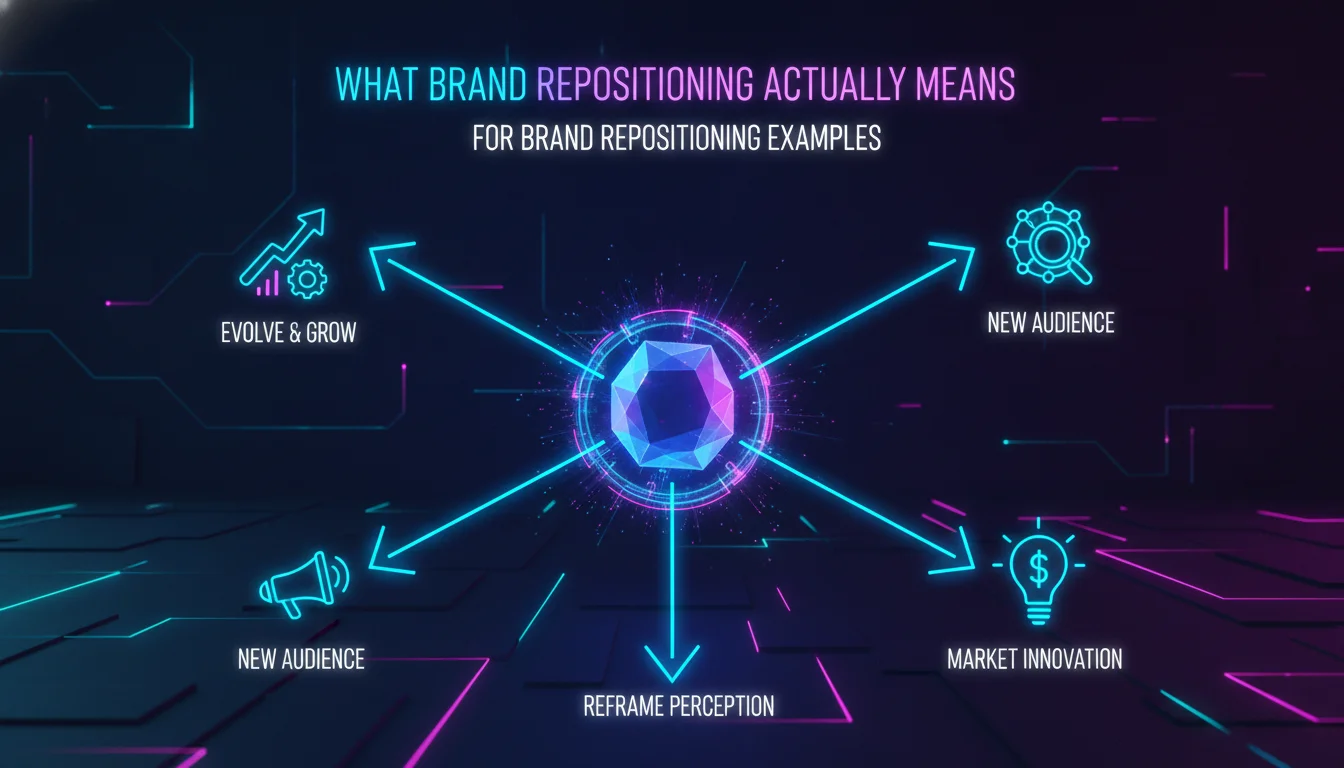
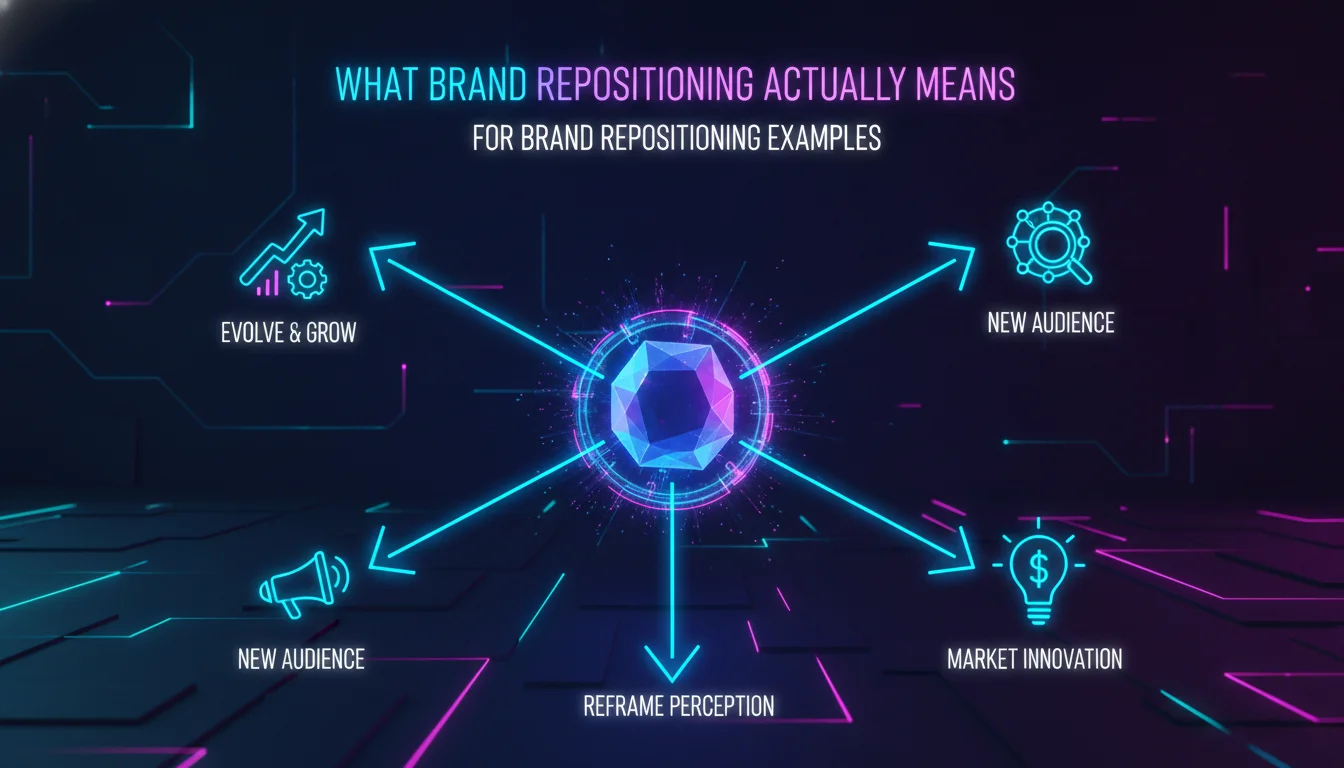
Brand repositioning is the process of changing how a target market perceives a product or company. According to Harvard Business School Online, it involves rewriting the customer value proposition and brand storytelling to refocus on a new consumer target, a new promise of value, a new competitive frame of reference, or new reasons to believe.
This definition matters because it locates the work in consumer perception, not production. A product can stay identical while its meaning shifts entirely. Many brand repositioning examples succeed precisely because they alter meaning without rebuilding the factory.
Repositioning vs. Rebranding vs. Revitalization
People often confuse brand repositioning with rebranding, but they’re not the same animal. Rebranding focuses on visual identity: names, logos, packaging. Repositioning is about strategic messaging. Qmarkets describes repositioning as changing who a product is for, what problem it solves, and why it matters, often without touching the product itself.
It’s a calculated adjustment, not a full identity remake. According to MarketVeep, the goal is updating status, associations, personality, or core message while keeping a continuous, recognizable identity intact. Revitalization is a broader term for restoring energy to a declining or mature brand.
Why Brands Reposition: Core Triggers
Brands reposition for several reasons. Perceptual Maps identifies a range of triggers: the brand has reached its potential, the positioning is poor, customer needs have changed, the image has been damaged, new competition has emerged, the firm wants to enter new markets, or the product is in decline.
- Limited growth in the current position
- Changing customer needs and lifestyles
- Damaged brand image after a public setback
- Competitive pressure eroding differentiation
- New market or segment entry requiring a different promise
- Premium pricing goals or product life cycle decline
The Strategic Triggers Behind the Most Successful Brand Repositioning Examples
Revenue, Relevance, and Competitive Pressure
Declining sales and a shrinking audience push most companies toward repositioning. When current strategies stop working, a brand has two options: fade quietly or redefine its place. In many brand repositioning examples, this decision wasn’t optional. It was a direct response to unflattering performance numbers.
Ideascale notes that repositioning is often a last-ditch effort when the alternative is closing the doors. The key is transitioning while there’s still enough capital coming in to make a major shift. That urgency is exactly why repositioning tends to be treated as a strategic priority rather than a nice-to-have.
Audience and Demographic Shifts
Audience change is one of the most powerful triggers we see. Old Spice was seen as a traditional older brand, purchased largely by women for male partners. Its repositioning explicitly targeted the female grocery buyer with a modern, humorous message designed to make the brand feel fresh to younger men. Perceptual Maps highlights that the campaign targeted the female buyer, not the male user, meaning target audience differed sharply from target market.
Buick and Cadillac took a similar route, working to seem more current, stylish, and hipper to appeal to younger consumers. According to Nova Southeastern University, both brands added built-in Wi-Fi with 4G LTE to many new cars as part of this effort.
Technology and Category Evolution
Technology shifts can make products obsolete overnight or unlock entirely new business models. Netflix moved from mail-order DVD rentals to streaming because both technology and customer expectations changed underneath it. Perceptual Maps notes that repositioning is often a must-do as technology and lifestyles shift. Amazon similarly expanded from books to a full e-commerce ecosystem as online shopping matured.
Classic Consumer Brand Repositioning Examples
Old Spice: From Outdated to Irresistibly Modern
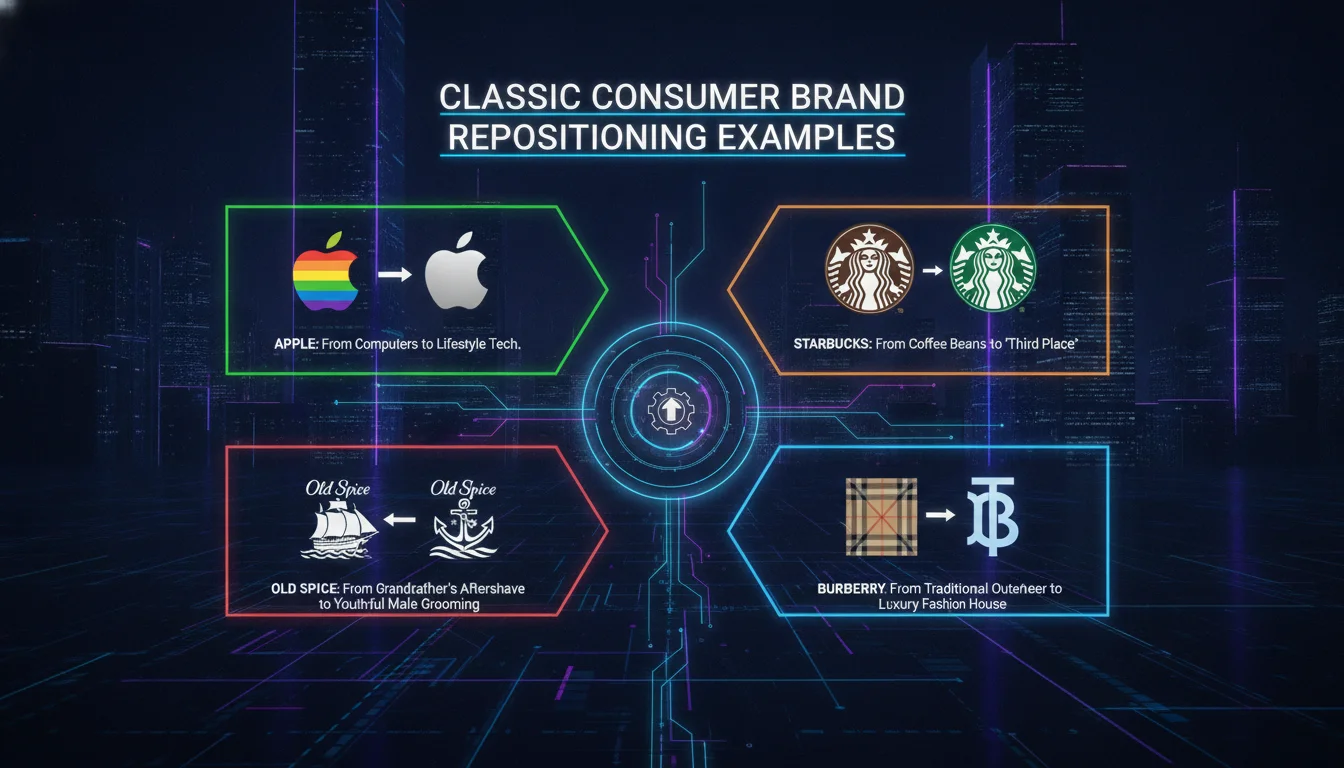
Old Spice was a traditional men’s cologne or aftershave associated with an older target market. Its repositioning began in 2010 with the campaign built around “The Man Your Man Could Smell Like.” According to Perceptual Maps, the campaign used fun, modern videos that went viral to refresh the brand with a youthful, athletic, humorous image.
The key lesson from Old Spice: integrated marketing communications can be highly effective on their own. You don’t always need to change the entire marketing mix. A single viral creative platform shifted perception from old-fashioned to modern in a matter of months.
Dove: From Product Beauty to Real Beauty
Dove moved away from traditional beauty messaging toward “Real Beauty.” Perceptual Maps explains that repositioning often means rethinking the traditional view of what customers want and thinking differently than in the past. Dove’s shift didn’t change the soap; it changed the story about whose beauty counts.
The campaign reframed the brand around authenticity and inclusion, tapping into shifting cultural values about body image and self-acceptance. This is a textbook perception-first repositioning: the product stayed largely the same while the emotional promise transformed completely.
Domino’s: From Cardboard Jokes to Quality Commitment
Domino’s faced a lagging image tied to poor product quality. The company overhauled its pizza recipe from dough to sauce to toppings and launched the “Pizza Turnaround” documentary-style commercial to spread the word. According to Nova Southeastern University, these initiatives helped reposition the brand’s image around quality and honesty.
Domino’s also embraced technology in ordering and delivery, introducing features like the Pizza Tracker, “Dom” the voice ordering assistant, and ordering by text message, smart watches, smart TVs, and Twitter. This combined honesty about past shortcomings with visible proof of change, which is exactly why it worked.
Technology and Business Model Brand Repositioning Examples
Netflix: From Mail-Order DVDs to Streaming Powerhouse
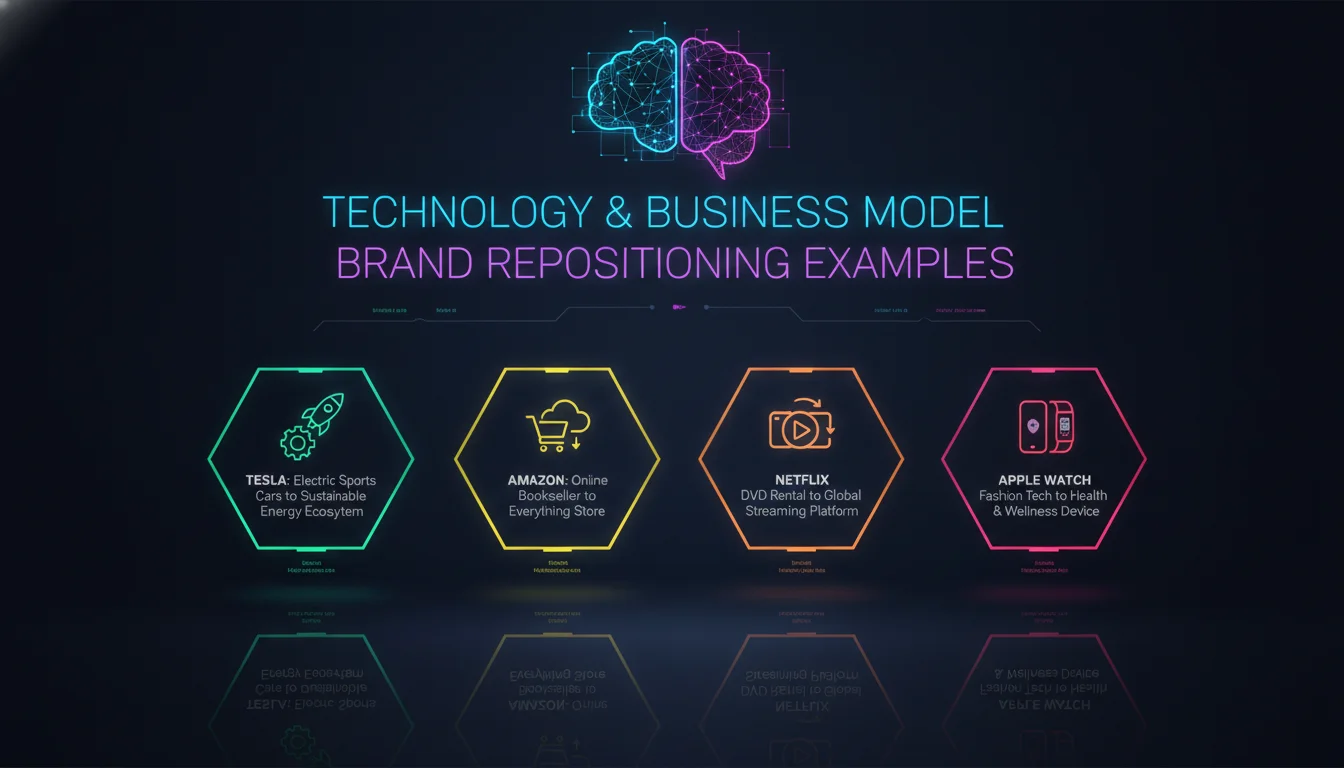
Netflix is one of the most cited brand repositioning examples because it changed its underlying business model entirely, not just its messaging. MarketVeep highlights Netflix’s shift from a mail-order DVD rental service to a streaming powerhouse. Perceptual Maps adds that this repositioning was a must-do as technology and customer lifestyles changed.
The lesson here isn’t just about streaming. Netflix repositioned by moving from a convenience-focused rental service to an entertainment platform built around original content, eventually becoming a category-defining brand in its own right.
Amazon: From Bookstore to Everything Store
Amazon launched in 1995 as the “Earth’s Biggest Bookstore,” selling new and used physical books. According to Ideascale, Amazon then began selling goods from other vendors, with eBay as its primary competitor at the time. Today, Amazon sells groceries, prescriptions, electronics, and its own branded devices like the Kindle and Fire.
This is business-model repositioning rooted in incremental expansion rather than one dramatic pivot. Amazon didn’t abandon books; it absorbed them into a much broader promise of selection and convenience.
Slack and BlackBerry: Pivots Born from Failure or Obsolescence
Slack emerged from the failure of Glitch, an online game created by Tiny Speck. The game had a popular instant chat feature buried inside it. According to Ideascale, the team shut down the game and built Slack as a multifunctional collaboration tool, later acquired by Salesforce.
BlackBerry launched in the 1980s as a simple two-way pager and introduced keyboard mobile phones in 1999. After touchscreen competitors from Apple, Samsung, and LG disrupted the market, BlackBerry repositioned as an industry-leading mobile cybersecurity specialist. Ideascale notes this shift kept BlackBerry within the technology industry while serving consumers in a new way entirely.
Play-Doh: From Wallpaper Cleaner to Kids’ Craft Staple
Play-Doh offers one of the more surprising origin stories in this list. It launched in the 1930s as a household cleaner meant to remove coal residue from wallpaper, according to Ideascale. When oil and gas heat replaced coal in the 1950s, that entire use case disappeared almost overnight.
The company pivoted after learning that a Cincinnati teacher was using the compound for arts and crafts with her students. Hasbro acquired the brand in 1991, and it grew into a household name in children’s play. It’s proof that repositioning doesn’t always start in a boardroom. Sometimes it starts with a teacher noticing something the original company missed.
Food, Beverage, and Retail Repositioning Examples That Worked
Starbucks: Selling Coffee as a Third Place, Not Just Beans
Starbucks launched in the 1970s selling coffee beans and coffee equipment, but no coffee or food products. Howard Schultz bought the Seattle chain of stores and turned them into coffeehouses. According to Ideascale, the brand marketed itself as a “home away from home,” romanticizing the idea of reading, meeting, or relaxing over coffee.
This repositioning didn’t require a new product. It required a new use case and a new social context. Starbucks shifted from a commodity retailer to a full experience brand, and that’s a distinction worth sitting with if you’re rethinking your own customer journey.
McDonald’s: From Burgers and Fries to Evolved Menu and Experience
McDonald’s is an example of continuous, gradual repositioning rather than a one-off campaign. Perceptual Maps notes that repositioning doesn’t need to be a single event; it can be constant and evolving to fit the changing marketing environment. Vivaldi lists McDonald’s among the brands it has worked with on repositioning, alongside IBM, PwC, Philips, and Dun and Bradstreet, according to Vivaldi.
The company expanded its menu, updated its design language, and embraced digital ordering. It stayed a fast-food leader by changing the conversation from cheap burgers to broader convenience, quality, and experience.
Vinegar: From Pantry Staple to Wellness Ingredient
Vinegar offers a smaller but instructive product repositioning example. Perceptual Maps describes vinegar’s move into a new product category by tapping into an emerging consumer trend, ideal for a product sitting in the decline stage of its life cycle. Rather than compete as a basic condiment, it became associated with health, cleaning, or wellness.
This example proves that even commodity products can find a new value story when consumer interests shift. You don’t need a Silicon Valley budget to reposition something. You need insight into where culture is heading next.
Retail and consumer brand repositioning examples also include Apple, Nike, Burberry, Lego, GoPro, Microsoft, Heinz, and Reebok, according to MarketVeep. Nike, in particular, evolved from a straightforward sports brand into a full lifestyle apparel company, a shift that broadened its audience well beyond athletes. These cases show that repositioning is a strategic response used across nearly every category, not a tactic reserved for struggling brands.
How Different Brand Repositioning Examples Compare
Comparison Table: Brand Repositioning Examples at a Glance
| Brand | Original Position | Repositioned Position | Primary Tactic | Trigger |
|---|---|---|---|---|
| Old Spice | Traditional men’s aftershave for older buyers | Youthful, humorous, athletic grooming brand | Integrated viral video campaign | Aging demographic and female purchase role |
| Netflix | Mail-order DVD rental | Streaming media and content platform | New delivery model and content strategy | Technology and lifestyle change |
| Starbucks | Seller of coffee beans and equipment | Coffeehouse experience as a ‘home away from home’ | Retail experience redesign | Unmet social demand around coffee |
| Slack | Failed game Glitch’s internal chat tool | Multifunctional workplace collaboration platform | Product repivot around existing feature | Failure of original product with valuable asset |
| BlackBerry | Two-way pager and keyboard smartphones | Mobile cybersecurity specialist | Business model shift within technology | Touchscreen competition |
| Domino’s | Low-quality pizza with damaged image | Honest, quality-focused, tech-enabled pizza brand | Recipe overhaul and advertising transparency | Declining sales and poor product perception |
Pattern 1: Perception-First Repositioning
Comparing these brand repositioning examples side by side reveals a clear pattern. Old Spice, Dove, Domino’s, and Vinegar changed perception without abandoning their core product. The product stayed broadly the same; the story changed. This approach works best when a brand suffers from outdated associations or damaged credibility rather than genuine product irrelevance.
Pattern 2: Capability and Business Model Repositioning
Netflix, Amazon, Slack, and BlackBerry changed what the company actually does. The repositioning involved a new delivery system, a new product portfolio, or a new target buyer entirely. This path is riskier but can unlock much larger market spaces. It works best when technology or competition has made the old model structurally unviable.
Step 1: Assess Your Brand Health Before You Reposition
You assess brand health by tracking awareness, associations, preference, relational engagement, and purchase behaviors before making any strategic changes. Harvard Business School Online’s Creating Brand Value course outlines this disciplined path, and we’ve paired it below with practical launch and measurement steps.
- Step 1: Assess brand health. Track awareness, associations, preference, relational engagement, and purchase behaviors. A healthy brand is one customers recognize, feel positively about, prefer over competitors, and purchase differentially.
- Step 2: Conduct customer research. Uncover motivations, needs, and barriers. Repositioning requires convincing consumers to rewire existing associations, so research must reveal what to keep and what to change.
- Step 3: Reframe the value proposition and story. Decide whether to target a new consumer, promise a new value, change the competitive frame, or give new reasons to believe.
- Step 4: Align the marketing mix and touchpoints. Update messaging, channels, product experience, and proof points so every signal supports the new position.
- Step 5: Launch with honest, integrated communications. Domino’s succeeded because it admitted past quality problems. Old Spice succeeded because the campaign was memorable and sharable. Authenticity and consistency matter more than polish.
- Step 6: Measure perception and iterate. Repositioning isn’t one-and-done. McDonald’s shows that gradual, continuous repositioning can keep a brand relevant over many years.
Using Brand Health Checks to Avoid Guesswork
Annual brand health checks help track progress and monitor key performance indicators. If brand health is slipping, repositioning can reset strategy before the problem compounds. Diagnosis should always come before creative execution, not after.
Avoiding Common Execution Pitfalls
The most common mistake we see is treating repositioning as a logo change. Perceptual Maps warns that more established brands find repositioning harder to pull off. A second mistake is telling a new story without product truth. Domino’s paired its message with an actual recipe change, which is why it landed. A third pitfall is ignoring existing customers; Netflix didn’t abandon its DVD users overnight but transitioned gradually as streaming demand grew.
Measuring the Impact of Repositioning and Reading the Signals
Brand Health Metrics That Matter
Brand repositioning should be judged on perception shifts, loyalty, equity, and market performance, not just a fresh coat of visual paint. Harvard Business School Online describes brand health as encompassing customer thoughts, feelings, attitudes, relational engagement, and purchase behaviors. These are leading indicators that show up well before financial results do.
Industry Perspective: “A healthy brand is one that customers recognize, have positive associations with, prefer over competitors, and purchase and use differentially in ways that are beneficial to the firm.” Professor Jill Avery, in Harvard Business School Online’s Creating Brand Value course
When Repositioning Signals Danger vs Opportunity
Repositioning is not always the right answer, and that’s worth saying plainly. If a product is structurally obsolete, a message change won’t save it. Netflix and BlackBerry changed their business models, not just their taglines. If the brand is healthy but creatively tired, a lighter refresh may be all it needs.
Lessons from Companies That Waited Too Long
Brands that wait until capital is exhausted have far fewer options on the table. Ideascale notes that repositioning should happen while enough capital remains to make a major shift. Every case in this article shares one trait: the company acted before irrelevance became terminal.
Pros and Cons of Brand Repositioning
Pros
- Reaches new audiences and demographics without building a new company from scratch
- Extends the life of an existing product or business model that still has value
- Can be executed through messaging alone, keeping costs lower than a full rebuild
- Strengthens brand equity and emotional connection when done with authenticity
Cons
- Risks alienating loyal customers if the shift feels dishonest or abrupt
- Established, older brands find repositioning structurally harder to pull off
- Requires real product or service change behind the message, or the campaign rings hollow
- Results take time to show up in sales, which makes leadership patience essential
Conclusion: What the Best Brand Repositioning Examples Teach Us
The Repositioning Mindset
The most instructive brand repositioning examples share one mindset: repositioning isn’t about looking different, it’s about meaning different. Old Spice, Netflix, Starbucks, and Domino’s each changed the promise, the target, or the delivery model, not just the visual identity.
Applying Lessons to Your Brand
Start with a brand health assessment and real customer research. Decide whether your problem is perception or capability. Then choose the right pattern: perception-first reframing or business-model migration. As of 2026, the brands winning attention are the ones treating repositioning as an ongoing discipline, not a one-time campaign. Successful repositioning is a strategic choice, never a cosmetic exercise.
If your brand feels stuck between who it used to be and who it needs to become, that tension is usually the first sign repositioning is overdue. We’ve helped brands find that new story and build the visual and strategic system to carry it. Contact Emin Media for a free brand consultation, and let’s build something bold together.
Frequently Asked Questions
What is brand repositioning?
Brand repositioning is the process of changing how a target market perceives a product or company. It usually involves rewriting the value proposition, target, or story rather than changing the product itself.
What is the difference between repositioning and rebranding?
Rebranding focuses on visual identity such as names, logos, and packaging. Repositioning focuses on strategic messaging and perception. A company can reposition without ever touching its logo.
What are the three C’s of brand positioning?
Depending on the framework, the three C’s can refer to company, customer, and competition, or clarity, consistency, and constancy. They describe the alignment a brand must maintain to hold a clear position in the market.
Can you give me an example of brand revitalization?
Old Spice is a strong example. The brand revitalized itself through a 2010 viral campaign that shifted its image from old-fashioned to youthful and humorous while retaining its grooming focus.
Why do brands reposition?
Brands reposition because of declining sales, changing customer needs, damaged image, new competition, or a desire to enter new markets. The goal is almost always to restore relevance and growth.
How long does brand repositioning take?
There’s no fixed timeline. Some campaigns, like Old Spice, change perception quickly; others, like McDonald’s, reposition gradually over years. Continuous measurement guides the pace.
Enjoyed this article?
Contact Emin Media for a free brand consultation and let's create something amazing together.
Get in TouchRelated Articles
Brand Design Trends 2026: Motion, AI & Imperfection
Explore brand design trends 2026: motion-first identities, AI collaboration, tactile imperfection, and expressive type shaping…
Digital Marketing Agency Services: The Full 2026 Guide
Explore what digital marketing agency services actually include, what they cost, and how to pick…
Digital Marketing Occupation: Roles, Skills & Career Paths
The digital marketing occupation spans SEO, social media, content, and paid ads. Explore every role,…