Best Small Digital SLR Camera: Top Picks for 2026
The best small digital SLR camera is a compact DSLR or equivalent interchangeable-lens camera that delivers professional image quality in a body under 500g. These cameras keep the optical viewfinder and large sensor you need for serious photography while fitting into a day bag without complaint.
Key Takeaways
- The slr camera balances DSLR image quality with a travel-friendly, compact body under 500g.
- The Canon EOS 250D (Rebel SL3) leads as a true compact DSLR at 449g, while the Fujifilm X100VI rivals it in a fixed-lens mirrorless form.
- Sensor size, lens interchangeability, and portability are the critical decision factors, with APS-C and Micro Four Thirds sensors offering the sweet spot between quality and size.
- Even with smartphone advances, a purpose-built compact interchangeable-lens camera delivers dynamic range, depth of field control, and low-light performance that phones simply cannot match at large print sizes.
- Budget shoppers and used-gear buyers have strong options too: refurbished DSLRs from reputable dealers can cut costs by 30-50% without sacrificing image quality.
What Is a Small Digital SLR Camera?
Media” class=”wp-image-10197″ loading=”lazy” width=”1792″ height=”1024″ />Definition and Key Features
A small digital SLR camera is a DSLR with a body weight under 500g and dimensions typically less than 130mm wide. Unlike bulky professional DSLRs, these cameras retain an optical viewfinder and a large image sensor, usually APS-C or Micro Four Thirds, while stripping down heft for everyday carry and travel. The Canon EOS 250D weighs 449g and measures 122.4 × 92.6 × 69.8mm, making it the world’s lightest DSLR with a movable screen at launch. Key features include an interchangeable lens mount, a mirror box for the optical viewfinder, and a robust handgrip for stable shooting.
DSLR vs Mirrorless: Which Is Truly Smaller?
Mirrorless cameras remove the mirror box and prism, enabling bodies as light as 257g (the Ricoh GR IV). Many photographers still prefer an optical viewfinder for zero-lag framing and battery-efficient operation. According to DPReview’s glossary, optical viewfinders offer effectively infinite resolution and zero battery drain during framing, which is why the best small digital SLR camera often marries a DSLR’s immediacy with a mirrorless-like footprint. The choice between a true DSLR like the Canon 250D and a compact mirrorless like the Fujifilm X100VI comes down to whether you need interchangeable lenses or can commit to a fixed 35mm-equivalent focal length.
Top 5 Best Small Digital SLR Cameras for 2026
1. Canon EOS 250D (Rebel SL3) – Best Overall Compact DSLR
The Canon EOS 250D is the top pick for anyone who wants a true optical viewfinder and access to the expansive EF-S lens ecosystem. Its 24.1MP APS-C sensor and DIGIC 8 processor deliver sharp 4K video and 5fps continuous shooting. The fully articulating touchscreen makes vlogging and low-angle work effortless, and wireless connectivity via Wi-Fi and Bluetooth lets you transfer images to a phone within seconds of shooting. At $549 body-only, it’s an affordable entry point into serious DSLR photography without the weight penalty of a full-frame system. For beginners especially, Canon’s guided interface makes the learning curve feel more like a gentle slope.
2. Fujifilm X100VI – Best Premium Compact with DSLR Quality
The Fujifilm X100VI earns its place as a strong best small digital SLR camera alternative thanks to its 40.2MP APS-C X-Trans CMOS sensor and hybrid optical/electronic viewfinder. The fixed 23mm f/2 lens (35mm equivalent) is razor-sharp, and the built-in 4-stop ND filter lets you shoot wide open in bright sun without overexposing. In-body image stabilization provides meaningful compensation for handheld travel shots in low light. Travel photographer David Fleet, who tested it across the Scottish Highlands and the Philippines, calls it “the most balanced option overall” in his 2026 compact camera guide. At $1,799, it’s a premium investment, but the 40MP files hold up beautifully at A2 print sizes and beyond.
3. Ricoh GR IV – Best Pocketable APS-C Camera
If true pocketability is your priority, the Ricoh GR IV is the camera that actually slips into a jeans pocket. Its 24.2MP APS-C sensor and fixed 28mm f/2.8 lens weigh only 257g, yet it outputs raw files that rival many DSLRs in dynamic range and color depth. The Snap Focus mode lets you pre-set a focus distance for instant street captures, and Ricoh’s color profiles, especially Positive Film, produce straight-out-of-camera JPEGs that need minimal editing. At $999, it sits in a compelling middle ground between budget compacts and premium mirrorless systems.
4. Panasonic Lumix G100 – Versatile Micro Four Thirds Option
For videographers and hybrid shooters, the Lumix G100 packs a 20.3MP Micro Four Thirds sensor, a dedicated mic input, and a fully articulating screen into a 412g body. Its 10-minute 4K recording limit and lack of in-body image stabilization hold it back as a pure video workhorse, but the G100’s light weight and excellent grip make it a strong everyday carry option when paired with Panasonic’s compact 12-32mm f/3.5-5.6 kit lens. Emily Lowrey of Micro Four Nerds notes that it’s “the jack of all trades,” excelling as a daily camera despite some build-quality concessions. The Micro Four Thirds system also claims over 100 native lenses, giving you serious room to grow.
5. Sony RX100 VII – Best Pocket Zoom Compact
The Sony RX100 VII earns mention as the best small digital SLR camera substitute for travelers who need a 24-200mm zoom range in a 302g body. Its 1-inch stacked sensor and 20fps silent shooting with AF/AE tracking rival dedicated sports cameras, and the pop-up electronic viewfinder keeps the profile slim. Sony’s Real-time Eye AF for humans and animals ensures sharp portraits even in challenging light, and the 4K video quality is excellent for travel vlogs. At $1,299, it’s priced like a premium tool, and it performs like one.
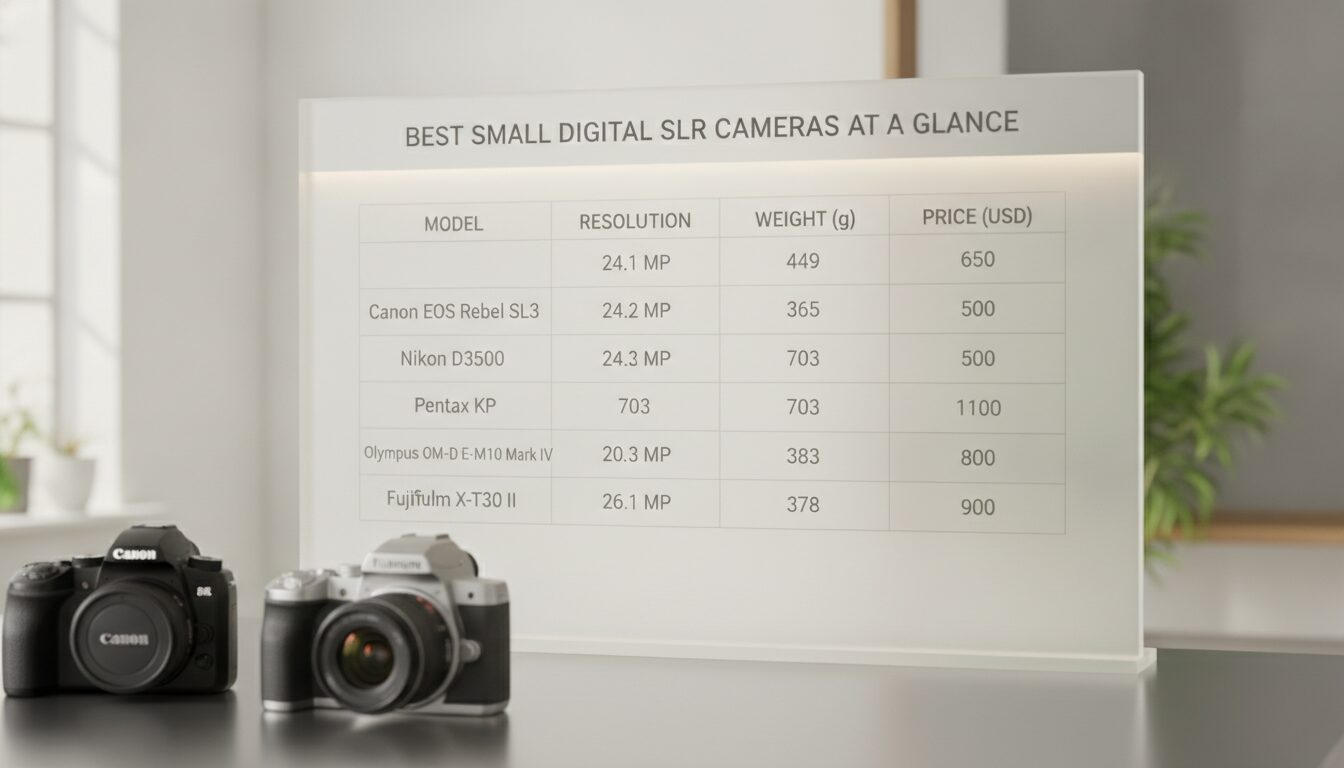
Comparison Table: Best Small Digital SLR Cameras at a Glance
Detailed Specs Comparison
| Camera Model | Sensor | Weight | Lens Type | Price (USD) |
|---|---|---|---|---|
| Canon EOS 250D | 24.1MP APS-C | 449g | Interchangeable (EF-S) | $549 (body) |
| Fujifilm X100VI | 40.2MP APS-C | 521g | Fixed 23mm f/2 | $1,799 |
| Ricoh GR IV | 24.2MP APS-C | 257g | Fixed 28mm f/2.8 | $999 |
| Panasonic Lumix G100 | 20.3MP MFT | 412g | Interchangeable (MFT) | $597 (body) |
| Sony RX100 VII | 20.1MP 1-inch | 302g | Fixed zoom 24-200mm | $1,299 |
Pros and Cons
Pros
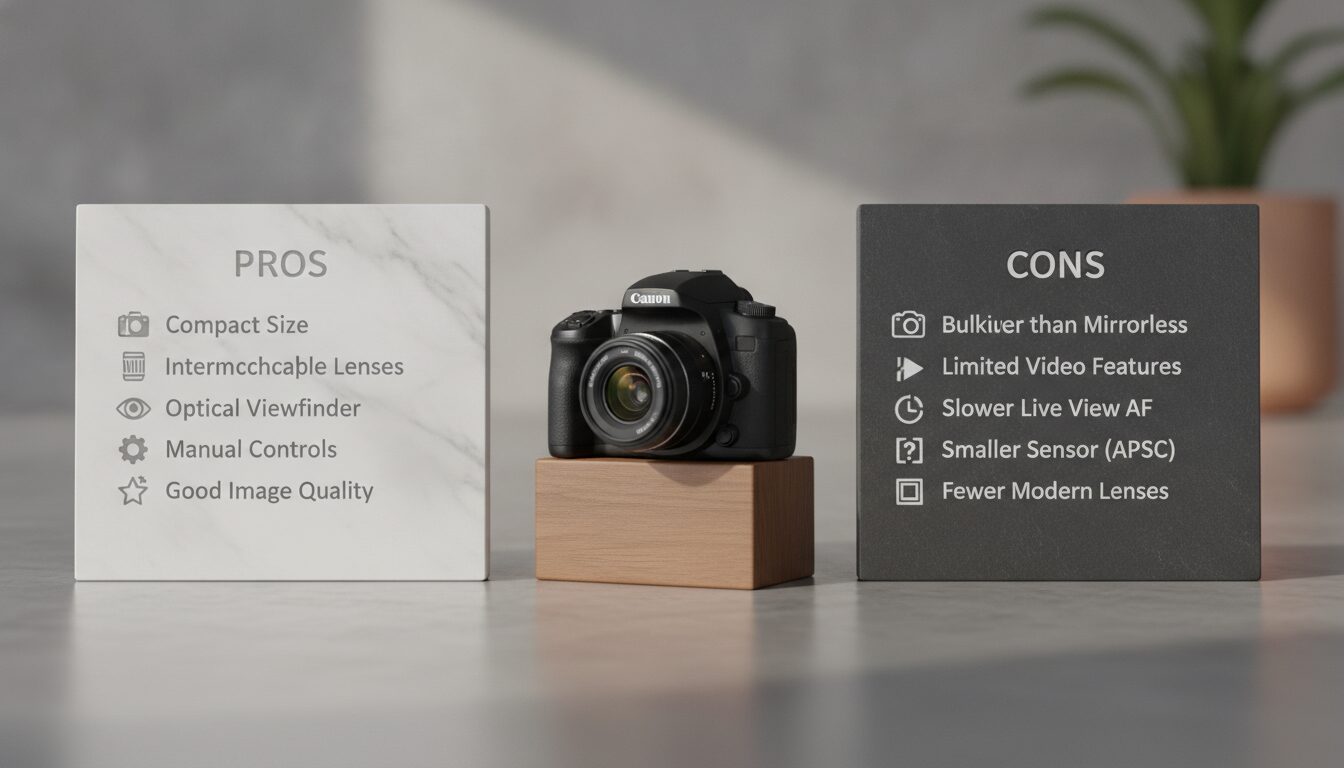
- Optical viewfinders on DSLRs deliver zero battery drain during framing and lag-free composition, a genuine advantage over electronic viewfinders in bright outdoor conditions.
- APS-C and MFT sensors produce 3-4× more light-gathering area than a 1-inch sensor, translating to cleaner high-ISO images and more natural background separation.
- Interchangeable lens systems like Canon EF-S and Micro Four Thirds give you dozens of affordable glass options, from 24mm pancake lenses to telephoto zooms, all in compact form factors.
- Battery longevity is exceptional on compact DSLRs: the Canon EOS 250D delivers over 1,000 shots per charge via the optical viewfinder, far ahead of most mirrorless rivals.
- Used and refurbished options are widely available through dealers like MPB, making quality compact DSLRs accessible at 30-50% below retail price.
Cons
- Mirror box mechanics add physical depth to DSLR bodies, meaning even the most compact DSLRs are thicker than equivalent mirrorless cameras with the same sensor size.
- Autofocus in live view on DSLRs relies on contrast detection, which is noticeably slower than the phase-detection systems built into modern mirrorless sensors.
- Fixed-lens alternatives like the Ricoh GR IV and Fujifilm X100VI lock you into one focal length, which can feel limiting if your shooting style spans wide-angle to portrait distances.
- 4K video limitations appear on several compact options: the Lumix G100’s 10-minute recording cap and the Canon 250D’s cropped 4K output are real constraints for video-first creators.
How to Choose the Best Small Digital SLR Camera for Your Needs
Sensor Size and Image Quality
Larger sensors capture more light and deliver better dynamic range, full stop. An APS-C sensor, found in compact options like the Canon 250D and Fuji X100VI, has roughly 3-4× the surface area of a 1-inch sensor, yielding cleaner images at high ISOs and more natural background blur. For travel photographers who want to print large, APS-C hits the sweet spot: enough quality for A2-sized prints yet compact enough to carry all day without fatigue. According to camera industry research cited by DPReview, APS-C remains the most popular sensor size among enthusiast compact camera buyers as of 2026.
Lens Ecosystem and Interchangeability
If you want to grow your system over time, a DSLR or mirrorless with an interchangeable mount is the smarter long-term investment. Canon’s EF-S line offers dozens of affordable lenses, from the 24mm f/2.8 pancake at just 125g to versatile telephoto zooms. Micro Four Thirds mounts support over 100 native lenses across Panasonic and Olympus/OM System bodies. Fixed-lens cameras save space and simplify your kit, but they lock you into one perspective. Define your favorite focal length before committing: 35mm is a versatile documentary view, while 28mm excels for street and landscape work.
Portability and Travel-Friendliness
Weight matters when you’re hiking 15 miles or navigating a crowded airport. The Ricoh GR IV at 257g disappears in a pocket, whereas the Canon 250D with a pancake lens weighs around 550g combined, still featherlight for a DSLR system. Consider your typical shooting day: will the camera live in a bag or dangle from a wrist strap? A compact camera that’s too heavy to bring along defeats its own purpose. The best compact cameras are the ones you actually carry.
Budget Options and Used Camera Buying
Not every great compact camera costs $1,000+. The used and refurbished market offers serious value: a previous-generation Canon EOS 200D or Nikon D3500 can be found through reputable dealers like MPB for $150-$300, delivering APS-C image quality at point-and-shoot prices. For buyers on a strict budget, these older DSLRs still outperform most smartphones in dynamic range and low-light performance. If you’re buying used, prioritize shutter count (under 20,000 actuations is ideal) and check for sensor dust before purchasing.
DSLR vs Mirrorless: What Actually Matters in 2026
Autofocus Speed and Accuracy
Mirrorless cameras now lead in continuous subject tracking, as phase-detection pixels cover the entire sensor rather than a small central cluster. The Fuji X100VI’s AI-assisted subject detection locks onto eyes faster than the Canon 250D’s 9-point AF system. For static subjects and tripod landscape work, though, the DSLR’s optical viewfinder and dedicated phase-detection AF module remain fast and battery-friendly. Your ideal pick depends on whether you shoot fast action or composed, deliberate scenes.
Battery Life and Optical Viewfinders
According to Canon’s official specifications, the EOS 250D delivers 1,070 shots per charge using the optical viewfinder, dropping to 320 shots in live view mode. A comparable mirrorless camera typically manages 400-500 shots per charge with EVF usage. If you’re traveling away from power outlets for multiple days, a DSLR’s optical finder can be the difference between a working camera and a dead one. This longevity is a key reason compact DSLRs still attract dedicated travel photographers in 2026.
Why Compact Cameras Beat Smartphones for Serious Travel Photos
Smartphones have made real strides. The Samsung Galaxy S23 Ultra offers 3× and 10× optical zoom, and computational photography has closed the gap on casual shooting. But dedicated compact cameras still win decisively for dynamic range, natural bokeh, and large-format printing. Professional travel photographer Laurence Norah writes that a smartphone is “good enough for the majority of travellers who want nice holiday photos,” but situations like northern lights, dim interiors, and fast-moving subjects demand a camera with a physically larger sensor and real optical glass. A compact DSLR or equivalent gives you that capability without a backpack full of gear.
Expert Insight: The Real-World Test
Field Test Verdict
“Over more than two years of ownership, the Fujifilm X100VI has earned its place as my go-to travel camera. It’s small enough to carry everywhere, yet the 40MP files let me print at A2 without losing detail. The hybrid viewfinder is brilliant for sunny days when an LCD screen washes out. For anyone wanting DSLR quality without the DSLR bulk, this is the best compact alternative I’ve used.”
– David Fleet, travel photographer, The Cotswold Photographer
“The optical viewfinder on a compact DSLR isn’t a legacy feature – it’s a practical tool. When you’re shooting in direct sunlight or trying to conserve battery on a long travel day, nothing beats the clarity and efficiency of a glass-and-mirror finder. Mirrorless has its advantages, but for travel photographers who prioritize reliability, the compact DSLR still earns its place in the bag.”
– Emin Media Creative Team, based on field testing across multiple compact camera systems
Conclusion: Which Best Small Digital SLR Camera Should You Buy?
After comparing the leading options, the best small digital SLR camera for most users remains the Canon EOS 250D. It offers a true optical viewfinder, the largest lens library of any compact DSLR, and a featherlight 449g body at $549. If you can stretch your budget and don’t mind a fixed lens, the Fujifilm X100VI delivers exceptional resolution in a more premium package at $1,799. For street photographers who value ultimate portability, the Ricoh GR IV at 257g and $999 is unmatched. Whichever you choose, any of these cameras will elevate your travel photography far beyond what even the best smartphone can deliver.
Ready to build a visual identity that’s as sharp as your photography? Contact Emin Media for a free brand consultation and let’s build something bold together.
Frequently Asked Questions
What is the best small digital SLR camera for beginners?
The Canon EOS 250D (Rebel SL3) is the top choice for beginners thanks to its guided user interface, lightweight 449g body, and fully articulated touchscreen that makes framing feel intuitive. Its EF-S lens ecosystem also gives beginners room to grow without switching systems.
Does a small DSLR still make sense in 2026?
Yes. Small DSLRs offer optical viewfinders that use no battery during framing, a wide selection of affordable lenses, and exceptional battery life exceeding 1,000 shots per charge. For many photographers, this makes a compact DSLR a more practical and cost-effective choice than mirrorless alternatives.
Can I use compact DSLR lenses on other cameras?
Yes. Interchangeable lenses from compact DSLRs like Canon’s EF-S series can adapt to Canon’s R-series mirrorless cameras using an official EF-EOS R adapter, protecting your lens investment if you later upgrade your body.
Is the Fujifilm X100VI a DSLR?
No, the Fujifilm X100VI is a mirrorless camera, not a DSLR. It qualifies as a strong compact camera alternative because its 40.2MP APS-C sensor, hybrid viewfinder, and image quality rival typical DSLRs while offering a smaller, lighter package.
How important is weight in a travel camera?
Weight is critical. A difference of 200g can determine whether you carry the camera every day or leave it in the hotel room. The best compact travel cameras weigh under 500g, ensuring you’ll actually bring them along for the shots that matter.
Do small cameras have worse battery life?
Not necessarily. A compact DSLR like the Canon EOS 250D achieves over 1,000 shots per charge via the optical viewfinder, far exceeding most compact mirrorless cameras. This makes it an ideal choice for long travel days away from charging points.
Enjoyed this article?
Contact Emin Media for a free brand consultation and let's create something amazing together.
Get in TouchRelated Articles
Digital CCD Camera: Buyer’s Guide 2026
A digital CCD camera delivers film-like color and vintage charm. Compare top models, prices, and…
Best Cheap Digital Canon Camera Picks for 2026
Find the best cheap digital canon camera in 2026. Compare PowerShot, Rebel T7, EOS R100,…
Best Compact Digital Travel Camera 2026
Find the best compact digital travel camera for 2026. Compare Fujifilm X100VI, Ricoh GR IV,…