LinkedIn Content Strategy 2026: The AI Search Playbook
Key Takeaways
- A winning linkedin content strategy 2026 optimizes for AI-powered search and problem-solution visibility, not feed virality.
- Define a clear niche and 3-4 content pillars to signal expertise to both algorithms and audiences.
- Video and document-based formats like carousels and PDFs drive disproportionate engagement and get indexed by AI search.
- Structural techniques, clear headings, question-based hooks, and entity-rich text, improve your odds of AI citation.
- Engagement now rewards depth: thoughtful comments and LinkedIn groups beat surface-level likes.
- Your profile is now a landing page for both humans and AI chatbots scraping it for citations.
A linkedin content strategy 2026 is a system for making your posts discoverable in AI-powered search, not just visible in the feed. This guide breaks down the exact moves to make that happen.
LinkedIn has gone through a real shake-up. Traditional traffic from Google to the platform dropped 60% in 2026, while AI-powered search and zero-click queries now exceed 60% of all discovery, according to Anas Hidaoui’s 2026 playbook. The old “post daily, get likes, grow followers” model is finished. Your strategy 2026 now has one job: make sure you show up when prospects search for solutions, not just when they happen to scroll past you. We built this piece from the latest data, algorithm shifts, creator burnout numbers, engagement frameworks, to give you a repeatable system built for the AI search era.
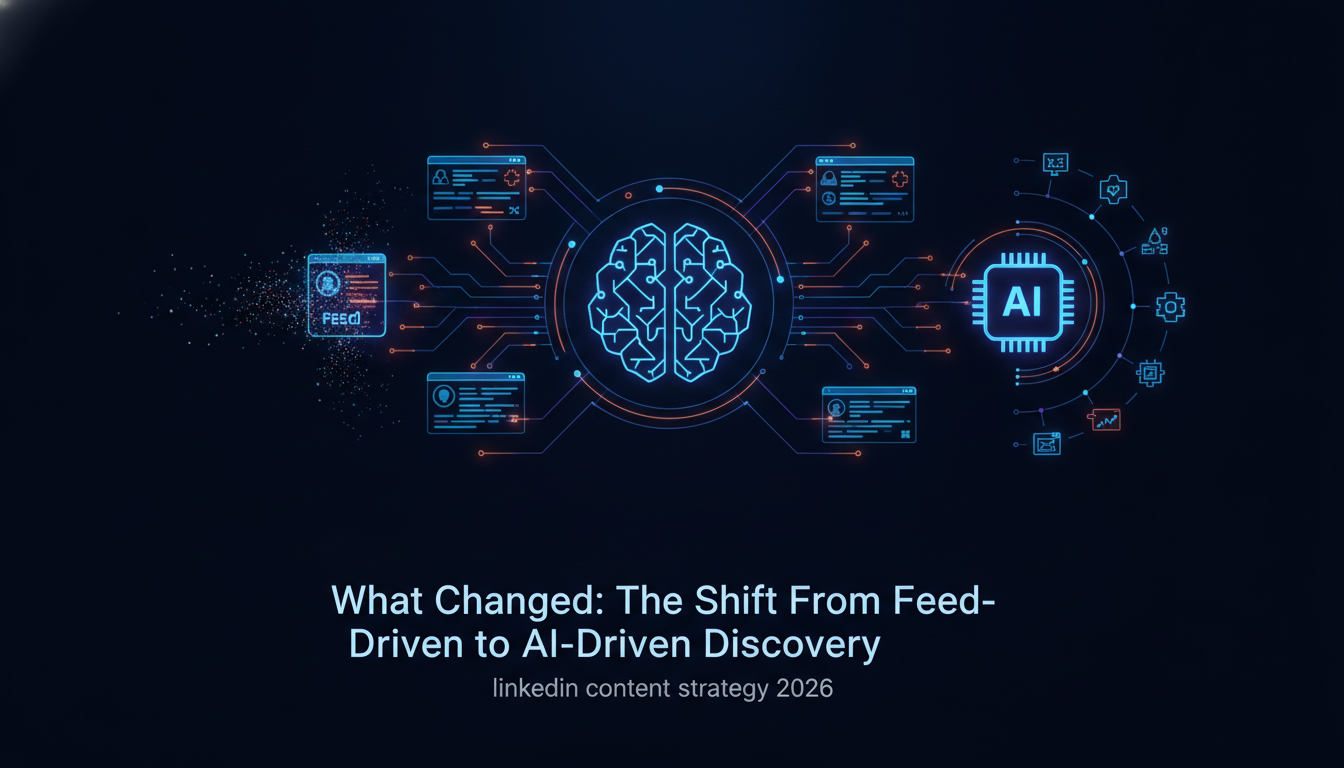
What Changed: The Shift From Feed-Driven to AI-Driven Discovery
How Search Behavior Rewrote the Rules
LinkedIn’s transformation mirrors what happened to search engines years ago: users stopped scrolling and started searching. People no longer wait for the homepage feed to surface good content; they actively type in “[problem]” or “[solution]” and see what LinkedIn hands back. In response, LinkedIn formed a cross-functional AI Search Taskforce and rolled out a new framework, “be seen, be mentioned, be considered, be chosen”, replacing the old “rank, click, visit, convert” journey. That means your this type of 2026 has to center on answer-oriented content instead of vague thought-leadership posts.
Research from Supergrow.ai found that 94% of marketers believe trust is the decisive factor in the AI era. When your content shows up in a moment of need, you build that trust instantly, before a single sales call happens. Just as telling: LinkedIn has stated outright that it’s “not designed for virality.” Its systems now weigh relevance and credibility over engagement bait, which is exactly the kind of shift that rewards a documented approach over random posting.
Industry Insight: “LinkedIn is not designed for virality.” The platform now classifies content quality by relevance and credibility rather than raw engagement, according to reporting cited in Supergrow.ai’s 2026 creator research.
Why Your Follower Count Is Now a Vanity Metric
The implication is stark: 99% of your potential customers don’t follow you yet, and most never will unless search becomes your primary discovery lever, per Hidaoui’s analysis. Picture a viral post about leadership lessons from a morning run. It might rack up 200 likes and zero business impact, because no decision-maker searching “customer retention strategies” will ever cross paths with it. In 2026, you optimize for problem-solution visibility: when a prospect types a specific challenge into LinkedIn, does your content answer it? That question is the whole point of a modern linkedin content strategy 2026.
Why a Documented Content Strategy Matters More Than Ever
The Burnout Epidemic Among Creators
Without a plan, posting turns unsustainable fast. A Harvard survey cited by Supergrow.ai found that 62% of digital creators experience high or extreme burnout. A scattershot approach produces reactive, inconsistent content that confuses the algorithm and your audience in equal measure. A documented linkedin content strategy 2026, by contrast, gives you clarity, cuts down decision fatigue, and makes sure every post reinforces the same expertise story.
Standing Out in a Red Ocean of AI-Generated Noise
Content creation barriers have basically disappeared. Anyone can generate 30 days of posts with an AI tool in an afternoon. But that output is mostly noise, and Supergrow.ai’s guide calls this a “red ocean” where only creators with a genuine thought-leadership strategy get remembered. A real strategy turns lived experience into a lesson people actually retain. Justin Welsh, a well-known LinkedIn growth expert, put it plainly when describing his own approach to picking topics.
Expert Insight: “Solve one expensive problem repeatedly. With every post, I try to answer: ‘How do I build attention or revenue on my own?’ That’s a $100K+ problem.” – Justin Welsh, LinkedIn growth expert, via Supergrow.ai
Step 1: Define Your Core Message and Audience
You define your core message by picking one primary mode, storyteller, educator, or entertainer, and building content pillars around it instead of trying to be everything to everyone. Fatima Khan’s 2026 growth guide starts here: purpose, positioning, and audience, before a single post gets written.
Pick a Lane: Storyteller, Educator, or Entertainer
Top creators don’t chase every content trend. They choose one primary lane and build recognizable pillars around it. Inside a linkedin content strategy 2026, this cuts audience confusion and sends the algorithm a consistent topic signal instead of a scattered one.
Audience Definition: Who Are You Really Talking To?
Define your ideal customer profile (ICP) with real precision. What problems do they type into the search bar at 11 p.m.? What words do they actually use? La Growth Machine’s 2026 B2B guide makes the case that audience definition drives everything downstream, from content topics to posting windows. Skip it, and you’re shouting into a void that doesn’t echo back.
Content Pillars That Signal Expertise
Choose 3-4 thematic pillars mapped to your ICP’s actual pain points, think personal branding, LinkedIn growth, mindset for creators, or whatever fits your work. These pillars need enough range to fuel recurring content but enough focus to build unmistakable authority. Plenty of creators sabotage themselves by hopping between unrelated topics, which quietly dilutes their search relevance over time.
Step 2: Optimize Your Profile for Maximum Impact
You optimize your LinkedIn profile by treating it like a landing page built for both human visitors and AI systems scraping it for citations. That means a sharp photo, a punchy headline, and an About section written in plain, searchable language.
The Anatomy of a 2026 Profile
Fatima Khan’s checklist is close to a gold standard here: a profile photo at 1000x1000px, a headline running 40-45 characters (short and punchy beats clever), and a banner carrying a mission statement, social proof, or a direct call-to-action. La Growth Machine adds that the About section should tell a story, the Featured section should showcase your strongest content, and recommendations bring third-party credibility to the table. Every one of these elements feeds into how LinkedIn judges your authority for search.
New AI-Friendly Profile Considerations
Because AI systems now pull profiles for citations, use a real headshot (not a logo, not a cropped group photo), write a headline that includes your primary keyword, and fill the About section with natural language describing the specific problems you solve. This is what lets tools like ChatGPT and Perplexity cite you accurately when someone asks for a recommendation. Hidaoui’s research points out that LinkedIn is now one of the most cited sources by AI systems, so your profile needs to work for machine readers and human ones at the same time.
Step 3: Choose the Right Content Formats and Cadence
The formats that win in 2026 are video, carousels, and newsletters because they hold attention longer and get indexed more thoroughly by AI search systems. Text posts still work, but they need sharper structure to compete.
The Formats That Win in 2026
Hootsuite’s 2026 strategy guide notes that the algorithm now prioritizes video content and meaningful conversation over surface engagement. Other strong performers include carousels (document posts), polls, LinkedIn Live, and LinkedIn Newsletters. The real key is variety: mixing text, images, video, and interactive formats keeps your audience from tuning out any single content type.
| Format | Engagement Level | Best Use Case | AI Indexing Potential |
|---|---|---|---|
| Short Text Posts | Moderate | Quick insights, questions | High if structured with clear headings |
| Carousels/Documents | Very High | Step-by-step guides, lists | Very High (text inside documents is scanned) |
| Native Video | Extremely High | Thought leadership, demos, interviews | Moderate (captions and titles help) |
| Polls | High (but short-lived) | Engagement boosts, market research | Low |
| Newsletters | High (committed audience) | Long-form thought leadership | Very High (full text is indexable) |
Posting Frequency and Timing
La Growth Machine recommends posting 3-5 times per week, with strong windows on Tuesday through Thursday, both mornings and late afternoons. That said, consistency beats volume every time. Your linkedin content strategy 2026 should build in a scheduling routine that prevents burnout rather than causing it. Tools like LinkedIn’s native scheduler, Canva for graphics, and ChatGPT for ideation, all recommended by Khan, keep the workflow moving without eating your whole week.
Step 4: Create Content That Solves Real Problems
You create content that solves real problems by answering the exact question your ICP types into LinkedIn’s search bar, not by posting generic career reflections. This is the core mechanic behind problem-solution visibility.
The Problem-Solution Visibility Framework
Hidaoui’s framework breaks down simply: identify the exact problems, create content that answers them, structure it for AI parsability, and optimize for citation. This isn’t about posting more; it’s about posting the right content. A consultant is better off writing “How to Reduce Churn in SaaS: A 4-Step Framework” than another generic leadership anecdote nobody was searching for.
Hook Formulas That Stop the Scroll
La Growth Machine’s tested hooks include curiosity gaps (“You’re Doing LinkedIn Wrong, Here’s Why”), empathy plays (“Struggling to Get Clients? Read This”), bold claims (“Why Case Studies Are Dead in 2026”), and how-to promises (“The Exact Process I Use to Land 5 Clients a Month”). Every hook has to lead straight into real value; otherwise engagement collapses and the algorithm quietly deprioritizes you.
Step 5: Master AI and Search Optimization for LinkedIn
You master AI search optimization by structuring posts with clear subheadings, bullet points, and upfront definitions so both LinkedIn’s search engine and outside AI tools can parse and cite them.
How to Structure Content for AI Extraction
To get cited by AI chatbots, your posts need clean, logical structure. Use descriptive subheadings, bullet points, and numbered lists, and put definitions and key takeaways near the top instead of burying them. A linkedin content strategy 2026 that skips this step stays invisible to the majority of buyers now relying on AI-powered search. Hidaoui’s guide notes that LinkedIn now detects “citable” content, meaning it’s formatted for easy extraction and summarization by outside systems.
Keywords in a Semantic, Not Spammy Way
Don’t stuff keywords. Instead, naturally vary the language around your core topics and lean on entities (company names, tool names, standards) to build topical authority. Mentioning tools like HubSpot or Salesforce in relevant contexts signals to LinkedIn’s AI that your content belongs to a specific professional domain. 310 Creative’s guide notes that successful brands blend authentic, exclusive content with regular posting, but as of 2026, that content also has to be findable to matter.
Zero-Click Content Is Not Zero-Value
With zero-click searches now exceeding 60% of queries, your content often delivers its full value right inside the search results or chatbot answer. That’s still a win. Design posts that stand alone as complete answers while enticing readers to click through to your profile for the deeper version. This is exactly what powers the “be seen” and “be considered” stages of the new discovery framework.
Step 6: Boost Engagement Through Strategic Networking
You boost engagement by prioritizing depth over speed, meaning fewer generic “great post” comments and more genuine back-and-forth with a tight circle of peers in your niche.
The 15-Minute Rule and Engagement Pods
Fatima Khan recommends engaging 15 minutes before and after you post. This primes the algorithm by signaling that you’re actively present, not just dropping content and disappearing. Build an engagement list of 30-50 peers in your niche and interact with their posts daily. The 2026 algorithm rewards meaningful conversation: long-form comments, real debate, shared insight, over the reflexive “great post!” reply.
LinkedIn Groups and Employee Advocacy
Don’t sleep on LinkedIn Groups. They’re still an underused channel for reaching tightly targeted professional audiences. Participate for real, share genuine insight, and skip the blatant self-promotion. For companies, employee advocacy programs amplify organic reach well beyond what a single company page can manage, according to La Growth Machine. When employees share company content in their own voice, it signals trust and widens the network effect naturally.
Pros and Cons of a Search-First LinkedIn Content Strategy
The biggest advantage of this approach is durable visibility; the biggest tradeoff is that it takes longer to show results than a viral-post strategy does.
Pros
- Content compounds over time instead of expiring after 48 hours in the feed
- You attract prospects actively searching for solutions, not passive scrollers
- Profile and post structure improvements benefit both human readers and AI citation
- Reduces creator burnout by replacing guesswork with a repeatable system
Cons
- Slower initial results compared to chasing viral, engagement-bait posts
- Requires more upfront research into your ICP’s actual search language
- Formats like carousels and video demand more production time than a quick text post
- Requires consistent measurement discipline; guessing won’t cut it
Measuring Success and Iterating on Your LinkedIn Content Strategy 2026
You measure success by tracking profile views, search appearances, and inbound messages from potential clients, not by watching impression counts climb.
Metrics That Actually Matter
Vanity metrics like impressions and like counts mislead more than they inform. Focus instead on profile views, search appearances, follower growth within your actual target demographic, and direct messages from potential clients. Use native LinkedIn Analytics to track these, then export the data to tools like ChatGPT or Claude for pattern analysis, a workflow Khan recommends. A/B test hooks, formats, and posting times to find what genuinely moves the needle for your specific audience.
Continuous Improvement Through Data
Third-party tools like Hootsuite’s Perch or Sales Navigator offer deeper analytics than the native dashboard. The trick is avoiding analysis paralysis. Pick 2-3 core metrics, set a monthly review cadence, and adjust your content pillars or posting schedule based on evidence instead of gut feeling. A solid linkedin content strategy 2026 stays iterative. It never sits still.
Your LinkedIn Content Strategy 2026 Starts Today
The shift is clear: LinkedIn success this year hinges on AI-ready, problem-focused content that makes you the obvious answer when your ideal client goes looking for help. By defining a sharp niche, optimizing your profile for machine and human readers alike, building structural content, and engaging with real depth, you build a presence that compounds instead of resetting every week. Stop chasing virality and start chasing discoverability. The old playbook already expired, so the only real move is building your linkedin content strategy 2026 around search, not scroll.
Ready to put this into action? Contact Emin Media for a free brand consultation, and let’s build a content system that gets you found, not just liked. Let’s build something bold.
Frequently Asked Questions
What is the most important shift in LinkedIn content for 2026?
The shift from feed-driven vanity metrics to AI-powered problem-solution visibility. When prospects search for specific business challenges, your content needs to be the answer, structured in a way AI systems can cite and summarize.
How often should I post on LinkedIn in 2026?
Most data points to 3-5 times per week, with Tuesday through Thursday mornings and late afternoons performing best. Consistency and value density matter more than sheer posting volume.
Which content formats work best for a LinkedIn content strategy 2026?
Video, carousels and documents, and LinkedIn Newsletters lead in both engagement and AI indexing. Text-only posts still work but need strong hook structures and explicit formatting to get picked up by AI extraction.
How do I make my LinkedIn profile AI-friendly?
Use a clear headshot, a keyword-rich headline, and an About section that plainly describes the problems you solve. Mention credible tools and entities, and keep the profile fully filled out, since AI chatbots frequently scrape profiles for citations.
Are LinkedIn groups still effective in 2026?
Yes, when used for genuine networking and value sharing. LinkedIn groups remain an underused channel for reaching niche professional audiences, especially when paired with an employee advocacy program.
What tools help streamline a LinkedIn content strategy 2026?
Essential tools include Canva for design, ChatGPT for content briefs, LinkedIn’s native scheduler, and analytics platforms like Hootsuite’s Perch. Together they cut production time and help you stay consistent without burning out.
Enjoyed this article?
Contact Emin Media for a free brand consultation and let's create something amazing together.
Get in Touch