Digital Super 8mm Camera: CS8 vs Kodak vs Vintage
A digital super 8mm camera is a video device that replicates the grain, color drift, and soft focus of Super 8 film through digital processing, or combines real Super 8 film with modern digital features. The $199 Camp Snap CS8 and the $5,495 Kodak Super 8 represent opposite ends of this spectrum.
Key Takeaways
- The Camp Snap CS8 ($199) delivers a convincing Super 8 aesthetic digitally, with zero recurring costs and a screen-free shooting experience.
- The Kodak Super 8 ($5,495) shoots actual Super 8 film with a 3.5-inch LCD monitor, USB-C connectivity, and a 6mm f/1.2 C-mount lens.
- Film costs $49.95–$64.95 per roll, and lab processing plus scanning adds $80–$150 per roll on top of that.
- Pro8mm in Burbank, California, rebuilds vintage Super 8 cameras from $695 to $2,995 with modern battery upgrades and Max8 gate modifications.
- Camp Snap has sold over 500,000 cameras across its product line, signaling strong mainstream demand for the retro aesthetic.
- For most creators, the CS8 wins on value. For filmmakers who need authentic film grain, the Kodak hybrid justifies its price.
What Is a Digital Super 8mm Camera?
Media” class=”wp-image-9840″ loading=”lazy” width=”1792″ height=”1024″ />A 8mm camera is a modern video device that either digitally replicates the soft focus, grain, and color shifts of Super 8 film, or combines actual Super 8 film recording with digital conveniences like an LCD viewfinder, audio recording, and easier data transfer. These cameras appeal to content creators seeking instant, ready-to-share vintage footage without the delays and expense of film processing.
The Super 8 Film Legacy
Kodak introduced Super 8 in 1965 as an easy-to-use home movie format. Its compact cartridges made filming accessible to families, and its distinctive look became synonymous with 1970s nostalgia. According to Kodak, the format remains beloved for its warm, organic texture that digital filters often struggle to match. Sixty years later, that texture still commands a premium in commercial and artistic filmmaking.
The Digital Emulation Approach
The digital emulation path, best represented by the Camp Snap CS8, skips film entirely. These devices use digital sensors and built-in filters to imitate the grainy, color-drifted aesthetic of Super 8. Pre-loaded film stock emulations, such as vtg2 or analog, apply grain, flicker, and color shifts in real time, eliminating recurring film and processing costs. For creators who shoot frequently, this approach can save hundreds of dollars per month.
Hybrid Analog-Digital Cameras
At the other end of the spectrum, the Kodak Super 8 camera records onto genuine Super 8 film cartridges but incorporates a digital flip-out screen for framing and playback, a microphone for sound, and a C-mount lens system for interchangeable optics. This hybrid design serves filmmakers who want the authenticity of physical film alongside the ease of modern production. It’s the choice for purists who refuse to compromise on real film grain.
“The Super 8 format has a warmth and organic quality that digital emulation can approximate but never fully replicate. For serious film work, there’s still no substitute for actual photochemical grain.” – Kodak Motion Picture Division
Pros and Cons of a Digital Super 8mm Camera
Pros
- Zero recurring costs: Digital options like the CS8 record to microSD with no film, processing, or scanning fees.
- Instant results: Footage is available immediately after shooting, enabling fast turnaround for clients and social media.
- Authentic aesthetic on demand: Built-in film stock emulations deliver convincing grain, color drift, and flicker without post-production work.
- Accessible price points: Entry starts at $199, making the Super 8 look available to creators at every budget level.
- Modern features: Updated models include cold shoe mounts, external mic jacks, and USB-C connectivity.
Cons
- Digital emulation isn’t identical to film: No filter perfectly replicates true photochemical grain and optical color rendition.
- High cost for authentic film: The Kodak Super 8 costs $5,495 upfront, plus $130–$215 per roll in film and lab fees.
- No screen on the CS8: The screen-free design is intentional but can frustrate creators who need precise framing.
- Film workflow complexity: Analog and hybrid cameras require mailing cartridges to labs and waiting days or weeks for scans.
- Limited audio on vintage models: Many classic Super 8 cameras record low-quality magnetic audio or none at all.
The Camp Snap CS8: A True Digital Super 8mm Camera
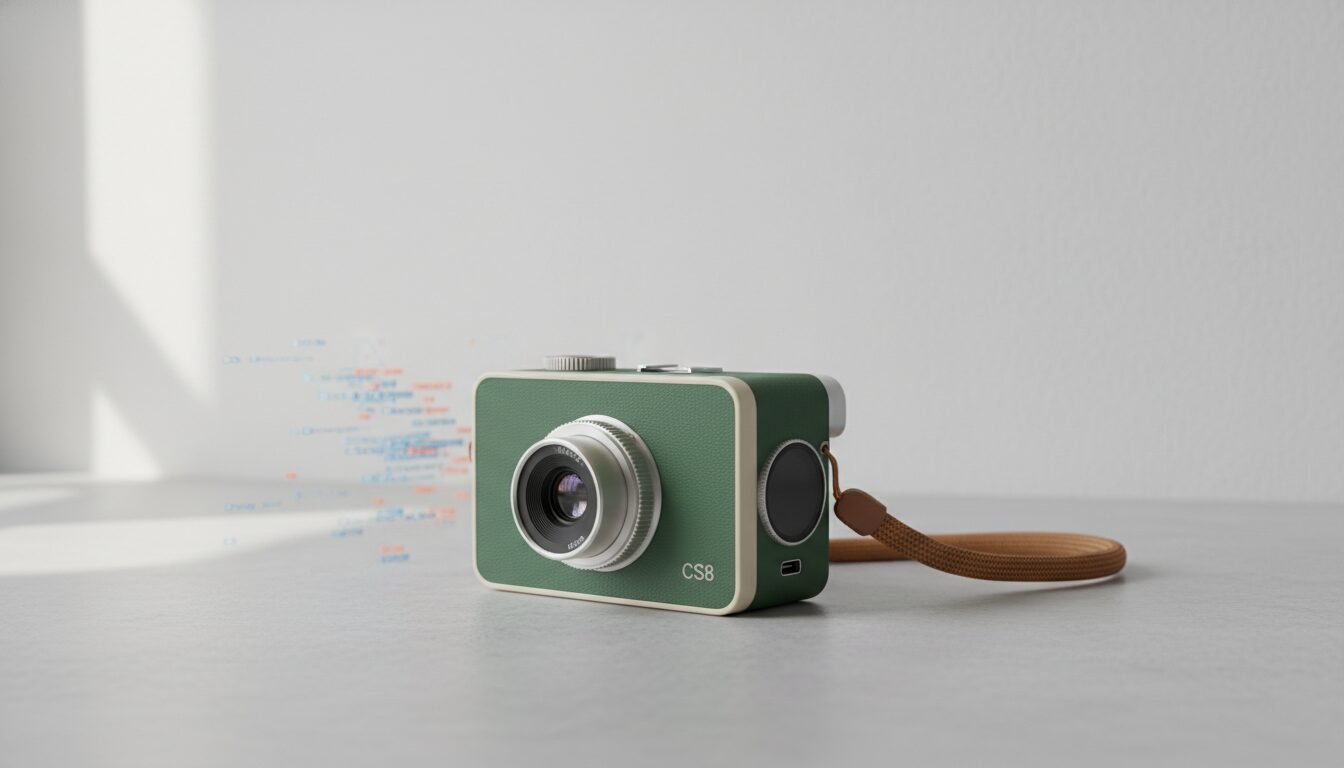
The Camp Snap CS8 is a pocket-sized digital video camera that deliberately mimics the Super 8 shooting experience. It embodies a screen-free philosophy: no playback display, pushing users to enjoy the moment and anticipate the final result much like shooting film. At $199, it’s the most affordable entry point into the Super 8 aesthetic, and Camp Snap has sold over 500,000 cameras across its product line, proving the retro format has real mainstream appeal.
Key Features and Specs
- Screen-free design: No display means you don’t watch your footage until you upload it to a computer.
- Rechargeable battery: Record for extended sessions without disposable batteries.
- Simple controls: Point, hold the trigger, and capture. No complex menus or settings.
- Custom filters: Choose from multiple film stock emulations (vtg2, analog, and others) to get different Super 8 looks.
- Aspect ratio selection: Switch between standard 4:3 and 16:9 formats.
- microSD storage: Footage transfers directly to your computer by dragging files from the card.
Using the CS8 for Creative Projects
The lack of a screen forces a spontaneous shooting style that produces happy accidents and authentic-feeling clips. Filmmakers have used it for wedding highlight reels, fashion show coverage, and travel diaries, appreciating its unpolished charm. Because it records directly to a microSD card, transferring footage is as simple as dragging files onto your computer. That simplicity is the whole point.
2026 Updates and Accessories
According to a CS8 review by Eddie Studios, the newest batch as of 2026 includes a cold shoe mount for attaching lights or microphones, and a dedicated mic jack for external audio. These updates make this this type of camera more versatile for semi-professional use while retaining its charming simplicity. The cold shoe addition alone opens up a new category of run-and-gun documentary work.
“The CS8 isn’t trying to replace your cinema camera. It’s trying to make you fall in love with filmmaking again – the same way a disposable camera makes you fall in love with photography.” – Eddie Studios, YouTube review, 2026
The Kodak Super 8 Camera: Analog Film Meets Digital Tech
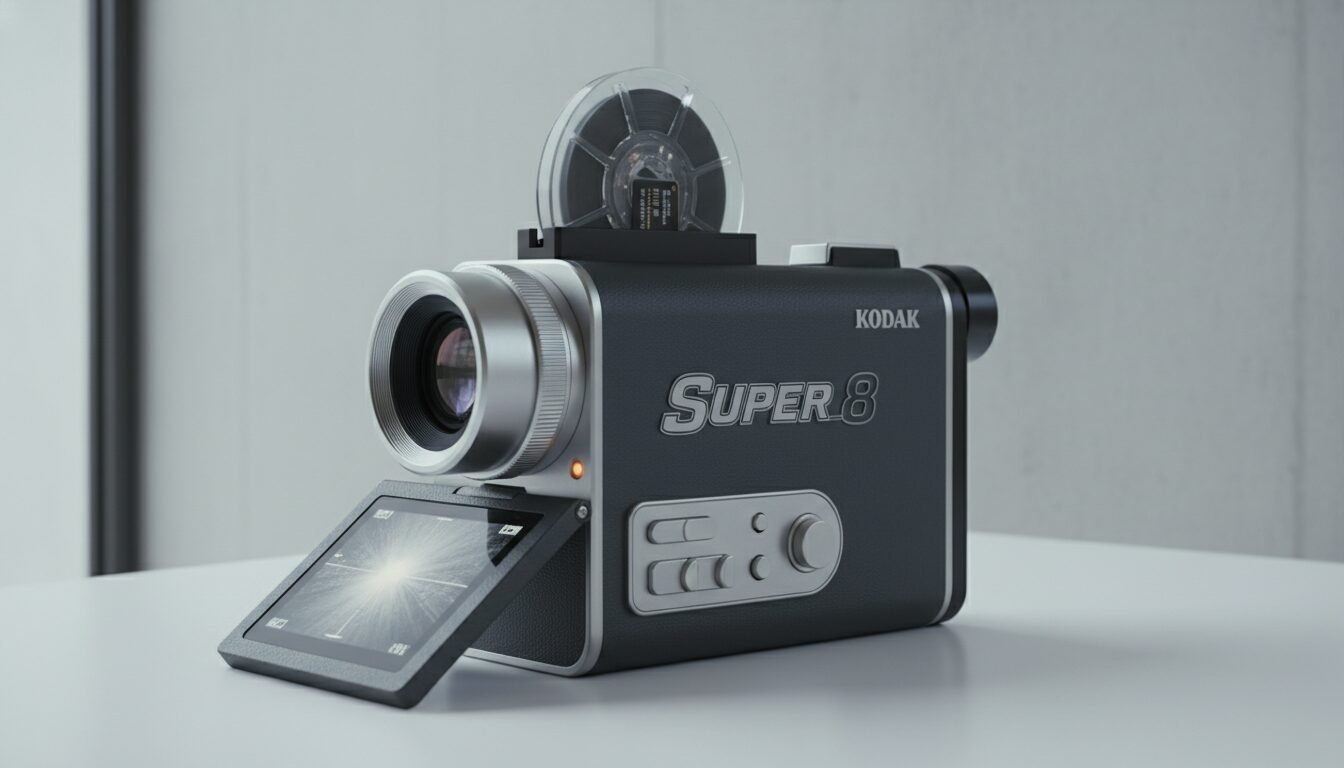
The Kodak Super 8 is not a digital camera in the strict sense. It’s an analog film camera with digital intelligence, priced at $5,495. As B&H Photo Video demonstrated in a hands-on review, the camera blends classic film mechanics with a 3.5-inch LCD screen, USB-C connectivity, and audio recording. It’s the most ambitious attempt to bridge two eras of filmmaking.
Hybrid Design and Build
The camera uses standard Super 8 film cartridges, including Tri-X black-and-white and Ektachrome color, but its digital side lets you see exactly what the lens sees, adjust exposure with precision, and play back scanned clips via an SD card slot. It records sound to an SD card, which then needs to be synced with the developed film if you’re using the analog footage for visuals. The workflow is more involved than a purely digital solution, but the results justify it for the right project.
Lens and Image Quality
The Kodak Super 8 ships with a detachable wide-angle 6mm f/1.2 C-mount lens, making it compatible with a wide range of C-mount optics for creative flexibility. The film itself delivers true optical grain and color rendition that no digital emulation can perfectly replicate. Shooting at 18 fps on a 50-foot cartridge yields roughly 3 to 5 minutes of footage per roll, so every frame counts.
Who Should Buy the Kodak Super 8?
This camera targets professional filmmakers, artists, and dedicated enthusiasts who have the budget for film stock at $49.95–$64.95 per roll plus processing. The upfront cost is high, but the results are unmistakably authentic. If your project demands real photochemical grain, no this kind of 8mm camera alternative delivers the same result.
Vintage Super 8 Cameras: A Film Purist’s Choice
Fully mechanical or early electronic Super 8 cameras from the 1960s through the 1980s remain viable shooting tools. While they aren’t digital, they represent the foundation that today’s the super 8mm camera seeks to recreate. Companies like Pro8mm in Burbank, California, specialize in rebuilding and modifying classic cameras to surpass original factory standards.
The Pro8mm Rebuilt Cameras
Pro8mm offers a range of serviced Super 8 cameras starting at $695 for a basic model and reaching $2,995 for a Classic Professional Super 8. Each unit is disassembled, cleaned, and updated with modern battery modifications and ergonomic improvements. They also perform “Max8” gate modifications to widen the frame for a widescreen aspect ratio, giving classic bodies a genuinely modern output.
Frame Rates, Lens Mounts, and Technical Specs
Classic Super 8 cameras typically shoot at 18 fps (standard) or 24 fps (cinema speed), with some models offering variable frame rates from 9 fps up to 54 fps for slow-motion effects. Most vintage bodies use a fixed or bayonet-mount lens, though higher-end models like the Canon 1014 XL-S and Beaulieu 4008 ZM II accept interchangeable C-mount or proprietary lenses. The Canon 814 series and Nikon R10 are among the most sought-after rebuilt models for their reliable metering and sharp optics. Pro8mm’s Max8 modification expands the film gate to capture roughly 40% more frame area than standard Super 8, enabling true 16:9 widescreen output from analog cartridges.
Considerations for Shooting Analog Film
Using a vintage Super 8 camera means committing to a workflow that involves purchasing film, shooting sparingly due to cost, mailing cartridges to a lab, and waiting days or weeks for processing and scanning. There’s no instant playback. You won’t know what you captured until the scans come back, which many find thrilling and nerve-racking in equal measure.
Cost of Ownership
Beyond the camera body, a single roll of Super 8 film costs $49.95 (Tri-X) to $64.95 (Ektachrome) according to B&H Photo Video listings. Processing and high-quality scanning through a lab like Pro8mm can add $80–$150 per roll, depending on resolution and turnaround. Over a few projects, these recurring costs quickly surpass the price of a digital alternative.
Lab Scanning Resolution Options
Most professional labs offer Super 8 scanning at 2K or 4K resolution. Pro8mm’s 4K scan option captures the full detail of the film frame, including grain structure, at a higher per-roll cost than standard HD scanning. For social media and web delivery, HD scanning is typically sufficient. For commercial or festival work, 4K scanning preserves the most latitude for color grading and archival use. Turnaround times range from 3 business days for rush processing to 2–4 weeks for standard orders, depending on lab volume.
How to Choose the Right Digital Super 8mm Camera (Step-by-Step)
Choosing the right camera comes down to four decisions: budget, authenticity, workflow, and long-term cost. Work through each step before committing.
Step 1: Set Your Budget
A digital super can cost anywhere from $199 (Camp Snap CS8) to over $5,000 (Kodak Super 8). Vintage analog cameras fall in between, from $695 to $2,995, but carry ongoing film and lab costs. Determine how much you’re willing to spend upfront and over a full year of shooting before you decide.
Step 2: Decide Between Analog and Digital
Ask yourself: do you need the authentic, physical film look, or is a convincing digital version sufficient? If authenticity is non-negotiable, a hybrid or vintage analog camera is the right path. If you prioritize convenience, speed, and low cost, the CS8 is the clear choice.
Step 3: Evaluate Features and Workflow
Think about your shooting style. Do you need a screen for framing? The CS8 intentionally lacks one, forcing a more spontaneous approach. The Kodak provides a 3.5-inch screen for precise composition. Also consider audio: for sound-forward projects, the Kodak or the updated CS8 with a mic jack are both strong options.
Step 4: Consider Long-Term Costs
If you plan to shoot frequently, a film-based camera will cost far more over time. A 8mm camera has near-zero marginal cost per shoot. Calculate how many minutes of footage you expect to capture each month, then compare the total cost of film, processing, and scanning against the one-time price of a digital body. For most creators shooting more than 2–3 rolls per month, digital pays for itself within a year.
Price and Value Comparison
Below is a head-to-head comparison of the three main approaches to owning a digital super 8mm camera as of 2026.
Camera Comparison Table
| Camera | Type | Price | Media | Screen? | Audio Recording | Recurring Costs |
|---|---|---|---|---|---|---|
| Camp Snap CS8 | Digital Emulation | $199 | microSD card | No | Internal mic + mic jack (2026 model) | None (rechargeable) |
| Kodak Super 8 | Hybrid Analog-Digital | $5,495 | Super 8 film cartridges | Yes (3.5″ LCD) | Yes (SD card sync) | High: $130–$215 per roll all-in |
| Pro8mm Rebuilt (e.g., Pro814) | Analog | $695–$2,995 | Super 8 film cartridges | No (optical viewfinder) | Some models only | High: $130–$215 per roll all-in |
Hidden Costs of Analog vs. Digital
While a vintage Super 8 camera might seem cheaper initially, a single weekend of shooting can easily consume 5–10 rolls of film. At $130–$215 per roll including processing and scanning, a weekend of heavy use could cost $650–$2,150. That figure surpasses the price of a digital super 8mm camera in just a few days of shooting.
Best Value for Creators
For social media content creators, wedding filmmakers, and casual users, the Camp Snap CS8 offers exceptional value. It delivers the Super 8 aesthetic at a fraction of the cost with no waiting. The Kodak Super 8, on the other hand, justifies its price for commercial and artistic projects where the tactile qualities of real film are a creative imperative.
Creative Uses for a Digital Super 8mm Camera
A digital super 8mm camera isn’t just a novelty. It’s a versatile tool that can elevate several genres of video content and give your brand a visual identity that stock footage simply can’t replicate.
Wedding and Event Filmmaking
Super 8’s romantic, timeless look makes it a beloved choice for wedding films. Digital cameras like the CS8 let shooters capture candid moments throughout the day without the anxiety of burning through expensive film. The immediate availability of files also means faster turnaround for clients, which matters when couples are eager to share their day.
Social Media Content
On platforms like Instagram Reels and TikTok, vintage aesthetics consistently stand out in algorithmically flattened feeds. A digital super 8mm camera lets you create scroll-stopping clips with authentic personality. The screen-free experience can even become part of your brand story, showing followers the surprise and delight of seeing the footage later. According to HubSpot’s video marketing research, short-form video with a distinct visual style generates significantly higher engagement than generic smartphone footage.
Music Videos and Short Films
Indie music video directors often turn to Super 8 for its expressive grain and color. A digital alternative makes it feasible to shoot hours of B-roll and experimental footage without worrying about budget. Combined with post-production effects in tools like DaVinci Resolve or Adobe Premiere Pro, you can push the look even further into something genuinely cinematic.
Want to see how a distinct visual identity translates into brand recognition? Explore our thoughts on visual branding strategy and Emin Media’s creative production services to understand how the right aesthetic choice becomes a competitive advantage.
Frequently Asked Questions
What exactly is a digital super 8mm camera?
A digital super 8mm camera is a video camera that replicates the look and feel of Super 8 film through digital processing, or a hybrid device that records onto Super 8 film while offering modern digital features. It aims to provide the aesthetic without the full analog workflow. The Camp Snap CS8 and Kodak Super 8 are the two most prominent examples available as of 2026.
How does the Camp Snap CS8 create the Super 8 look?
The CS8 uses on-board filters that apply grain, color shifts, and flicker effects in real time. Users select preset film stock emulations to mimic classic Super 8 stocks. The absence of a screen adds to the unpredictable, analog-like experience that makes the footage feel genuinely spontaneous.
Can I record audio with a digital super 8mm camera?
Yes. The Camp Snap CS8 has a built-in microphone, and the 2026 model adds an external mic jack for better audio quality. The Kodak Super 8 records audio separately to an SD card for later syncing with the developed film. Vintage cameras vary: some record low-quality magnetic audio, but many rely on silent cartridges.
Is the Kodak Super 8 worth the $5,495 price tag?
For professional filmmakers and artists who demand genuine film grain and have the budget for consumables, it can be worth the investment. For casual creators, the cost-per-minute of footage is difficult to justify compared to digital alternatives. Renting before buying is a smart way to test whether the film workflow suits your production style.
Which digital super 8mm camera is best for beginners?
The Camp Snap CS8 is the most beginner-friendly option available. At $199, it requires no knowledge of film types, exposure settings, or processing workflows. Point, shoot, and upload, with results that look intentionally cinematic rather than accidentally amateur.
Do I need to process film if I buy a digital super 8mm camera?
Only if you choose a film-based hybrid like the Kodak Super 8 or a vintage analog camera. Fully digital cameras like the CS8 record directly to a memory card and require no processing whatsoever. The digital path is the faster, cheaper, and more forgiving option for most creators.
Ready to Build Something Bold?
The grainy, dreamlike quality of Super 8 footage remains one of the most emotionally resonant visual languages in modern media. Whether you choose the affordable immediacy of the Camp Snap CS8, the authentic hybrid experience of the Kodak Super 8, or a lovingly rebuilt vintage model from Pro8mm, there’s a path into this aesthetic that fits your creative vision and budget.
We recommend starting with the CS8 if you’re curious but budget-conscious. If you fall in love with the look and want to explore true film, renting a Kodak Super 8 or buying a serviced Canon 814 or Beaulieu body from Pro8mm is a logical next step.
Ready to bring a distinct visual identity to your brand’s video content? Contact Emin Media for a free brand consultation and let’s build something that actually looks like it was made with intention.
Enjoyed this article?
Contact Emin Media for a free brand consultation and let's create something amazing together.
Get in Touch