Digital Single Lens Reflex Camera Definition: Complete Guide
Key Takeaways
- Digital single lens reflex camera definition refers to a digital camera that combines a reflex mirror and pentaprism with a solid-state image sensor.
- DSLRs evolved from film SLRs and dominated photography from the 2000s before declining in favor of mirrorless models from the 2010s.
- The optical viewfinder provides a direct through-the-lens view, eliminating parallax errors common in rangefinder and twin-lens cameras.
- Interchangeable lenses, large sensors (full‑frame or APS‑C), and advanced autofocus remain core advantages for both professionals and enthusiasts.
- Understanding this terminology helps buyers differentiate DSLRs from mirrorless, point‑and‑shoot, and vintage film cameras.
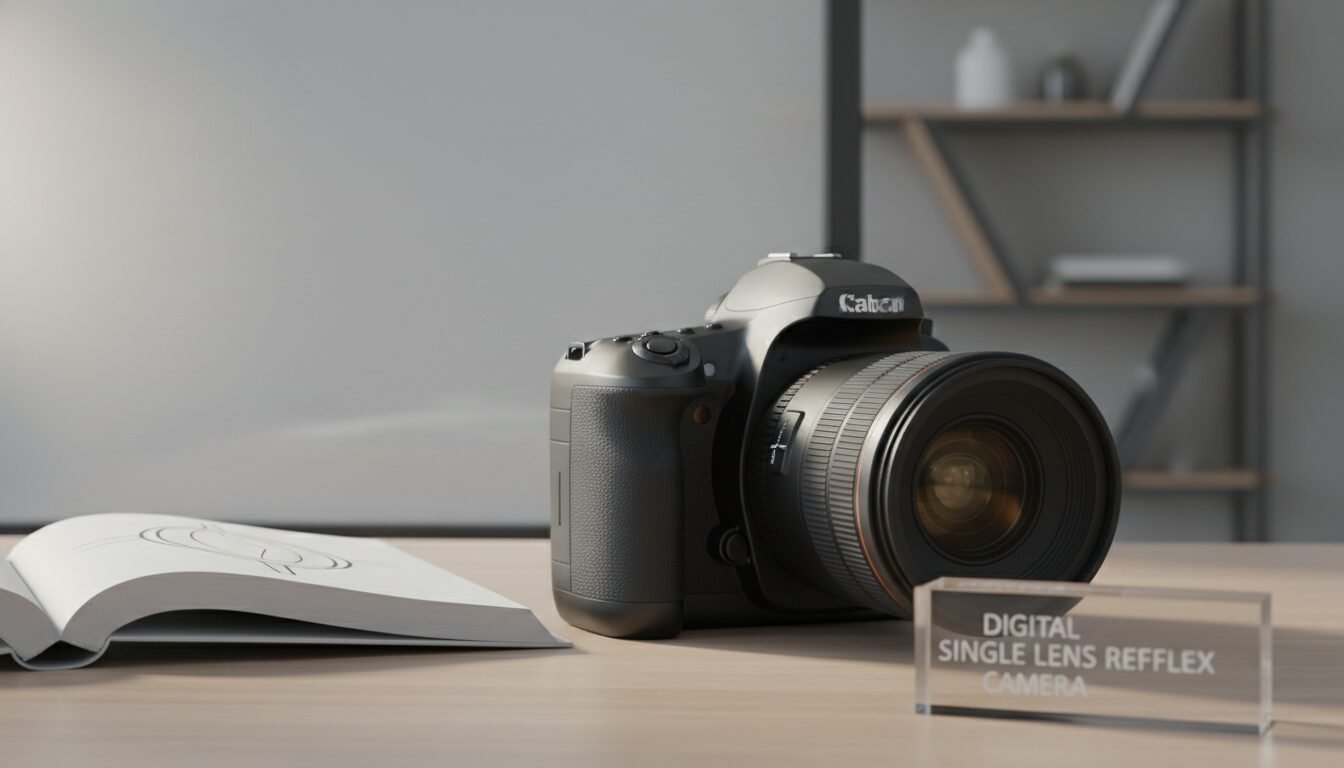
Digital single lens reflex camera definition is a digital camera that uses a reflex mirror and prism system to give photographers a real‑time optical view through the taking lens.
What Does Digital Single Lens Reflex Camera Mean?
Media” class=”wp-image-9687″ loading=”lazy” width=”1792″ height=”1024″ />A camera definition breaks down into three core technical concepts. “Digital” indicates the camera records images on an electronic sensor instead of photographic film. “Single lens” means the same lens handles both viewing and capturing, unlike twin‑lens reflex cameras with separate viewing and taking lenses. “Reflex” points to the mirror mechanism that reflects light upward into the viewfinder.
Breaking Down the Term
The phrase “digital single lens reflex” packs distinct technical ideas into one label. This design ensures the image seen in the viewfinder matches the captured photo exactly. Together, every these definition centers on this mirror‑and‑prism optical path combined with a digital imaging sensor.
The Role of the Reflex Mirror
Inside every DSLR, a hinged mirror sits at a 45‑degree angle behind the lens. Light entering the lens hits this mirror and bounces up to a focusing screen and pentaprism before reaching the viewfinder. According to Canon’s EOS magazine, “a reflex mirror reflects light from the lens to a focusing screen. The image formed on the screen passes through a pentaprism and is viewed through the optical eyepiece.” When the shutter button is pressed, the mirror flips up, the shutter opens, and light hits the image sensor to record the photograph.
How DSLRs Differ from Other Digital Cameras
Unlike mirrorless cameras that display a live electronic feed on an LCD or EVF, DSLRs offer an optical viewfinder with zero lag and no battery drain for viewing. Compared to compact point‑and‑shoot cameras, DSLRs accept a wide range of interchangeable lenses. And unlike vintage film SLRs, DSLRs store images digitally on memory cards rather than on rolls of film. These distinctions are essential to a complete such camera definition and help photographers select the right tool for their needs.
History of the Single‑Lens Reflex Design
From Film SLRs to Digital
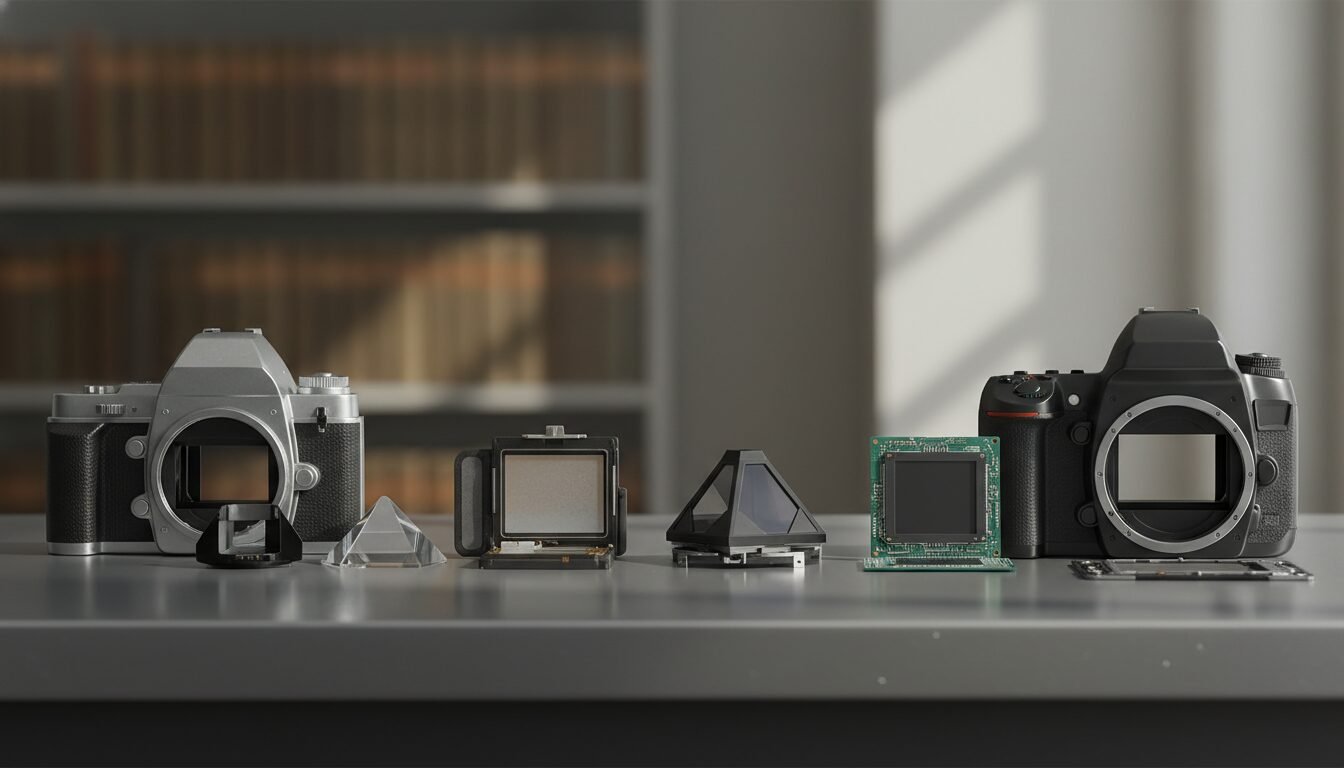
The single‑lens reflex concept dates back to the 1930s, but it gained mainstream popularity in the 1960s and 1970s as camera makers refined the roof pentaprism for eye‑level viewing. According to Wikipedia, SLRs “became the dominant design for professional and consumer‑level cameras throughout the late 20th century, offering interchangeable lenses, through‑the‑lens (TTL) metering, and precise framing.” Film SLRs from brands like Canon, Nikon, and Pentax defined photography for decades.
The First DSLRs and Market Evolution
The shift to digital began in earnest during the 1990s. Photography Life reports that “the first commercial digital SLR with an image sensor appeared in 1991.” Through the 2000s, DSLRs rapidly replaced film‑based SLRs as sensor technology improved and prices fell. By 2005, the the single lens reflex camera definition had become the standard for working professionals and serious hobbyists, a position they held for nearly 15 years.
The Shift to Mirrorless Technology
Starting in the 2010s, major manufacturers began transitioning away from DSLR lines. Fujifilm stated that “many DSLR product lines have now been discontinued” and that mirrorless cameras are “the current industry standard in digital photography.” As of 2026, while DSLRs remain in use, new model releases have trickled to a stop, cementing the mirrorless design as the future of interchangeable‑lens cameras.
How a DSLR Camera Works
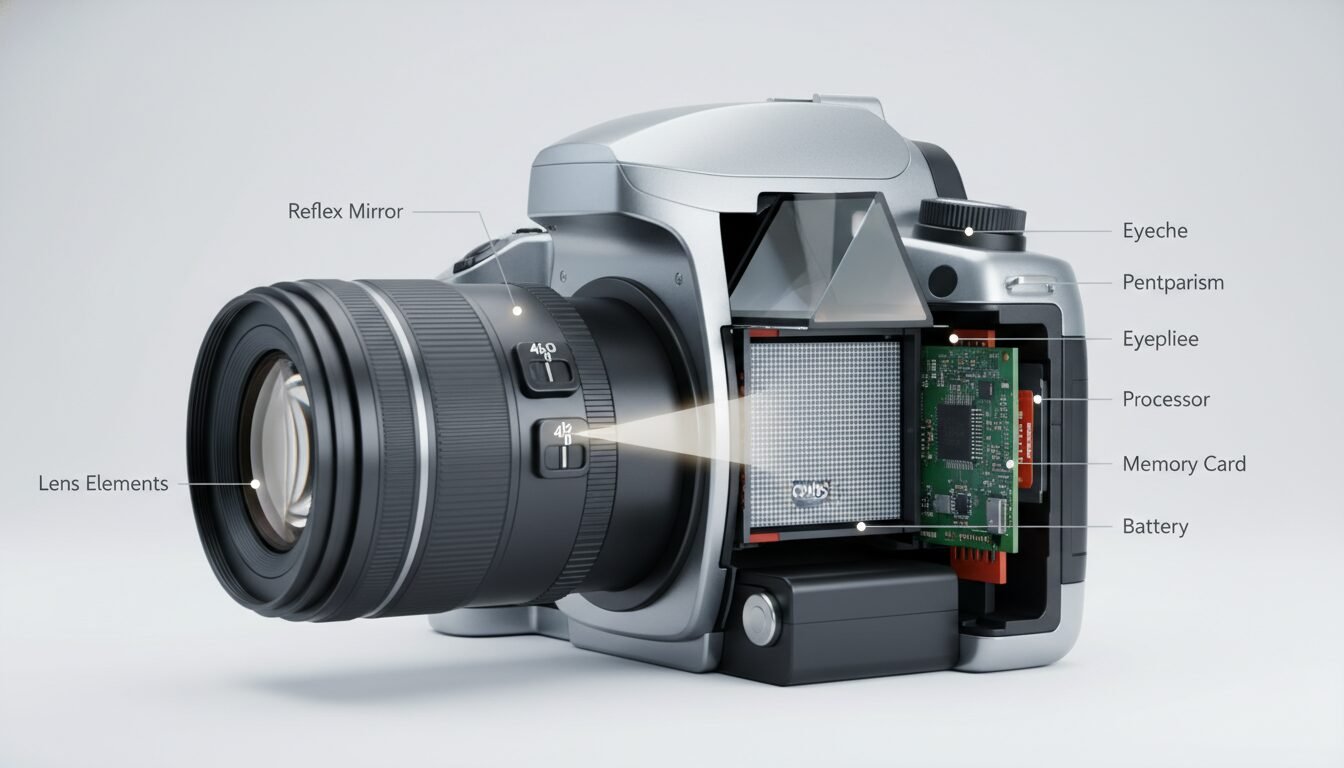
A DSLR operates through a precise sequence of mirror movements and light paths. When you look through a DSLR viewfinder, you see light that has traveled through the attached lens, struck a 45‑degree reflex mirror, and been redirected upward. As noted by Adobe, “a photographer sees their subject in the optical viewfinder via a reflection of that light from a mirror inside the camera body.” The mirror stays down during composition and focusing, then flips up in a fraction of a second to expose the sensor.
Pentaprism and Optical Viewfinder
Above the mirror, a pentaprism (or pentamirror in entry‑level models) corrects the lateral and vertical orientation of the image so that it appears upright and correctly oriented to the eye. This optical chain delivers a bright, clear, and immediate view of the scene — one of the key reasons many photographers still prefer understanding the definition for action, wildlife, and studio work.
Sensor and Image Capture
Once the mirror lifts, the shutter opens, and light reaches the digital sensor. Depending on the model, this sensor may be a full‑frame chip (measuring 36×24 mm, equivalent to 35mm film) or an APS‑C sensor (around 22×15 mm, with a crop factor). The sensor converts light into electronic signals, which are then processed and saved as image files onto an SD or CFexpress card. This digital workflow is what distinguishes a DSLR from its film‑era predecessors.
Key Components of a DSLR System
Interchangeable Lenses
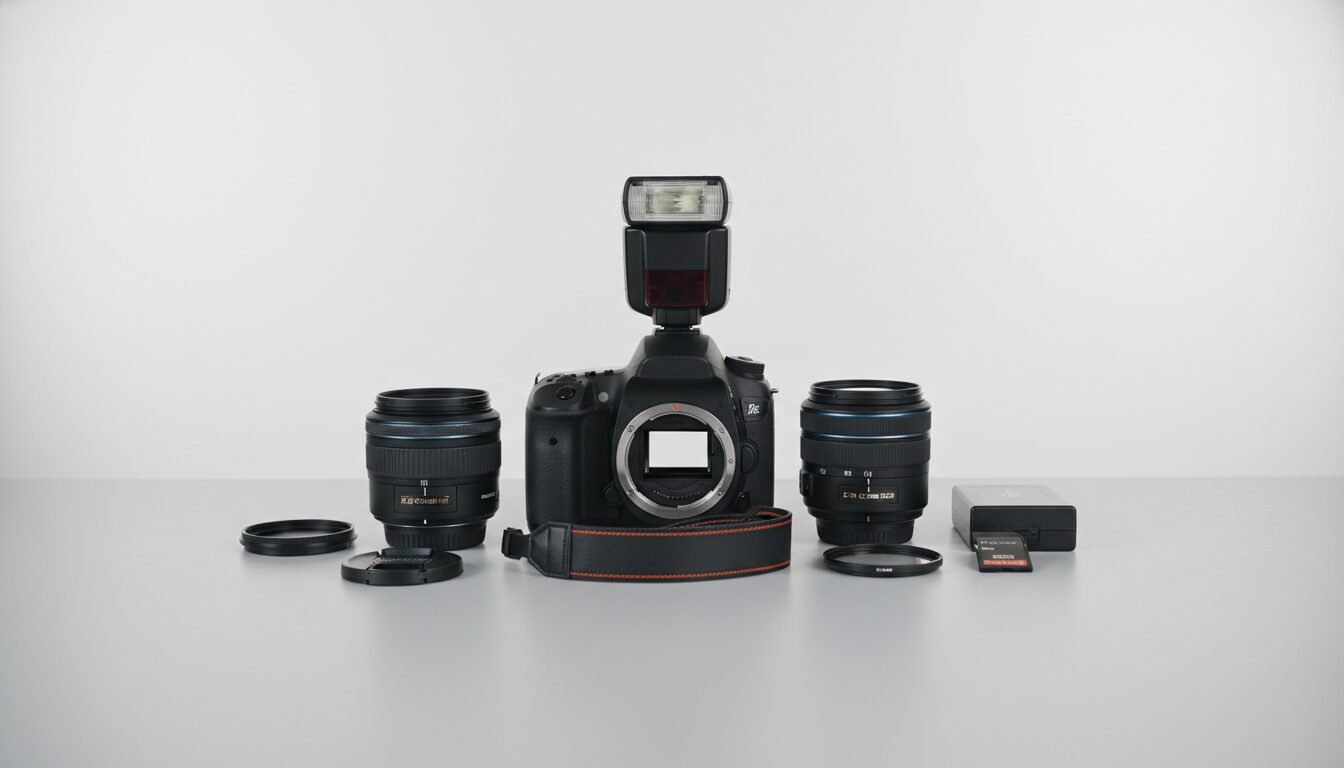
One of the defining features of any DSLR is the ability to swap lenses. From ultra‑wide‑angle zooms to super‑telephoto primes, photographers can choose optics tailored to portraits, landscapes, sports, or macro work. As professional photographer Ivy Chen explained to Adobe, “You’re able to get different types of lenses that serve different purposes and give you different looks. DSLRs are way more versatile in that respect.”
“You’re able to get different types of lenses that serve different purposes and give you different looks. DSLRs are way more versatile in that respect.” — Ivy Chen, photographer (via Adobe)
Image Sensors: Full‑Frame vs APS‑C
DSLRs come with two primary sensor formats. Full‑frame sensors match the dimensions of traditional 35mm film and deliver superior low‑light performance, shallower depth of field, and a wider field of view. APS‑C sensors are smaller, typically offering a 1.5× or 1.6× crop factor that effectively extends the reach of telephoto lenses. Adobe’s guide notes that “full‑frame camera sensors … are the standard,” while APS‑C models often appeal to budget‑conscious buyers and wildlife photographers who value the extra apparent magnification.
Autofocus and Metering
Modern DSLRs employ phase‑detection autofocus (AF) modules housed in the bottom of the mirror box. Light passing through the lens is split and directed to dedicated AF sensors, enabling fast and accurate focus tracking. Through‑the‑lens (TTL) metering, introduced in film SLRs, is further refined in digital bodies, allowing evaluative, center‑weighted, and spot metering modes to work seamlessly with the optical viewfinder.
| Feature | DSLR (Digital Single Lens Reflex) | Mirrorless | SLR (Film Single Lens Reflex) |
|---|---|---|---|
| Recording Medium | Digital sensor, memory card | Digital sensor, memory card | Photographic film |
| Viewfinder Type | Optical (mirror and pentaprism) | Electronic (EVF) or rear LCD | Optical (mirror and pentaprism) |
| Mirror Box | Yes, reflex mirror | No | Yes, reflex mirror |
| Size and Weight | Typically larger and heavier | Generally smaller and lighter | Compact to medium formats |
| Live View Shooting | Available on later models | Standard | Not available |
| In‑body Stabilization | Rare (mostly lens‑based) | Common | Not applicable |
Pros and Cons
Pros
- Optical viewfinder provides zero lag and works without battery power
- Excellent battery life compared to mirrorless cameras
- Wide selection of lenses from decades of development
- Superior autofocus tracking for fast-moving subjects
- Familiar ergonomics and controls for experienced photographers
Cons
- Larger and heavier than mirrorless alternatives
- Mirror mechanism creates vibration and noise
- Limited video features compared to modern mirrorless cameras
- No silent shooting modes due to mechanical shutter
- Declining support from manufacturers as they focus on mirrorless
DSLR Definition in Context: SLR, Mirrorless, and More
DSLR vs SLR: What’s the Difference?
While “SLR” stands for single‑lens reflex, adding the “D” specifies a digital sensor instead of film. The optical viewfinder and mirror mechanism are identical in principle, but understanding the digital single means recognizing that DSLRs record images electronically, offer instant preview, and store files on removable media. Wikipedia’s entry on digital SLRs clarifies that it “combines the optics and mechanisms of a single‑lens reflex camera with a solid‑state image sensor and digitally records the images from the sensor.”
Mirrorless Cameras: A New Definition
Mirrorless interchangeable‑lens cameras (MILCs) remove the reflex mirror and optical viewfinder entirely. Light passes directly to the sensor, which feeds a live electronic image to an EVF or rear screen. This eliminates mirror‑induced vibration, reduces body size, and enables silent electronic shutters. However, it also means the viewfinder consumes battery power whenever active. Understanding this contrast is key to grasping why the camera definition remains a distinct category despite the market’s pivot toward mirrorless.
Common Misconceptions
Beginners often confuse “DSLR” with “any camera with interchangeable lenses.” In reality, many mirrorless cameras also support lens swapping, and some fixed‑lens cameras include DSLR‑like styling. A true these definition must contain a reflex mirror and optical viewfinder — no matter how advanced its sensor or processing. This strict technical definition helps avoid miscommunication in reviews, buying guides, and photography forums.
Why the “Single” in DSLR Still Matters
The Twin‑Lens Reflex Alternative
Twin‑lens reflex (TLR) cameras, popular in the mid‑20th century, use two separate lenses: one for the taking lens and one for the viewfinder. Because the viewing lens sits above the taking lens, close‑up framing suffered from parallax errors. The “single” in the such camera definition eliminates this problem — the photographer looks through the actual taking lens, so what you see is precisely what you get. This design advantage was revolutionary in the 1960s and remains a core part of modern DSLR technology today.
Single Lens Advantage for Photographers
Having one lens for both viewing and capturing simplifies filter use (no need for two filters), ensures accurate depth‑of‑field preview, and supports through‑the‑lens metering. Macro photographers, in particular, rely on the DSLR’s single‑lens design to avoid parallax when shooting tiny subjects at high magnification. Even as mirrorless cameras become more popular, the principle of a single optical path endures as a benchmark of framing accuracy.
Modern Interpretations
Some modern digital cameras incorporate “DSLR‑like” ergonomics — large grips, top LCD panels, and weather‑sealed bodies — without containing a mirror. These are not DSLRs by definition. Understanding the “single lens reflex” language helps consumers parse marketing claims and recognize that only cameras with an optical reflex mirror fit the digital single lens reflex camera definition.
Digital Single Lens Reflex Camera Definition in the Market
Industry Standards and Terminology
Camera manufacturers, retailers, and publishers adhere to a consistent definition: a DSLR is a digital camera with an optical reflex viewfinder based on a moving mirror and pentaprism. This standard appears in educational materials from Adobe, EOS magazine, and Photography Life. The uniformity helps buyers compare products and ensures that tutorials and reviews remain accurate.
How Brands Define Their DSLRs
Canon’s EOS‑1D X Mark III, Nikon’s D6, and Pentax’s K‑3 III are all explicitly marketed as DSLRs, each sharing the same mirror‑box architecture. While specifications differ — resolution ranges from 20 to 30+ megapixels, burst rates from 5 to 16 fps — the fundamental optical design is unchanged. Even as these companies scale back DSLR production, the digital single lens reflex camera definition continues to underpin every official datasheet and manual.
Future of the Term
With mirrorless now dominating new product launches, the phrase “DSLR” is slowly transitioning from a current technology to a historical category. Nonetheless, the digital single lens reflex camera definition will remain essential in photography education, used‑camera listings, and archival documentation. Future generations of photographers will learn the term as part of the evolution from film to digital to mirrorless.
“Preparing a raw file before retouching or color editing took some adjustment when I moved to digital. All the light and color reacted differently from what I learned — you get a lot of pronounced reds and that was very new for me.” — Stephen Klise, DSLR photographer (via Adobe)
Frequently Asked Questions
What is the basic digital single lens reflex camera definition?
A digital single lens reflex camera is a digital camera that uses a mirror and pentaprism to show the photographer an optical view through the lens, then flips the mirror up to expose a digital sensor and capture the image.
How does a DSLR differ from a mirrorless camera?
A DSLR has a reflex mirror and optical viewfinder; a mirrorless camera sends light directly to the sensor and displays an electronic image on an EVF or LCD.
Why is “single” used in the term DSLR?
“Single” distinguishes it from twin‑lens reflex cameras that used separate viewing and taking lenses, eliminating framing errors and parallax.
Can a DSLR shoot video?
Yes. Most DSLRs introduced after 2008 offer HD video recording, though mirrorless models now typically provide superior video autofocus and features.
Are DSLRs still worth buying in 2026?
For photographers who prefer an optical viewfinder, long battery life, and a wide used‑lens market, DSLRs remain a solid choice, especially at second‑hand prices.
What does “reflex” refer to in a DSLR?
“Reflex” refers to the mirror that reflects light from the lens up to the viewfinder. When the shutter is pressed, the mirror swings up and out of the way.
Digital Single Lens Reflex Camera Definition: Final Thoughts
From its origins in mid‑century film cameras to its peak as the go‑to digital tool of the 2000s, the digital single lens reflex camera definition has remained constant: an optical viewfinder built around a reflex mirror and a lens that serves both seeing and capturing. While mirrorless technology now leads the industry, understanding this concept is critical for evaluating gear, deciphering photography history, and making informed buying decisions. Whether you encounter the term in a vintage manual or a modern online listing, you can now recognize exactly what it describes — and why it mattered so much for so long.
Contact Emin Media for a free brand consultation to explore how visual storytelling can transform your creative projects.
Enjoyed this article?
Contact Emin Media for a free brand consultation and let's create something amazing together.
Get in Touch