What is a Digital SLR Camera? Complete Guide for 2026
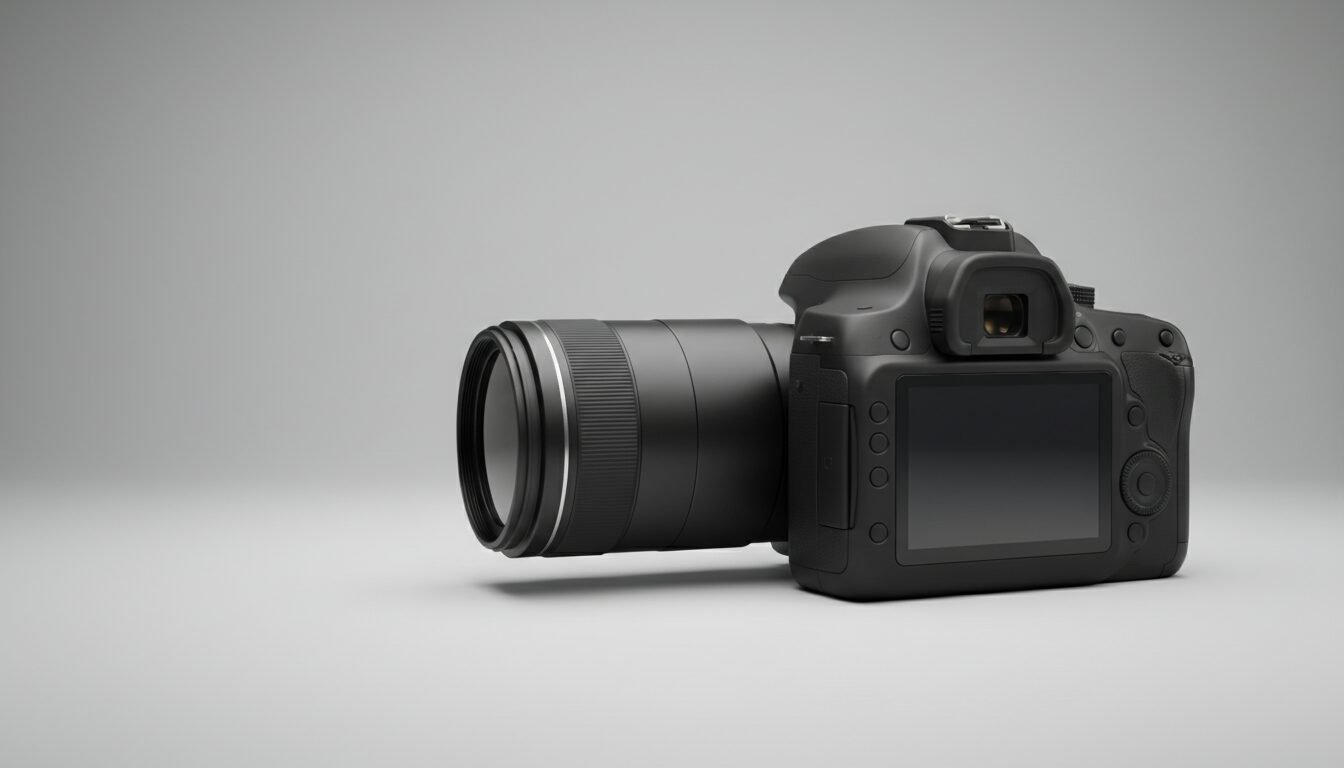
What is a digital SLR camera? A digital SLR camera is a camera that uses a mirror mechanism and optical viewfinder to show exactly what the lens sees, then captures images with a digital sensor instead of film.
Key Takeaways
- DSLR stands for Digital Single-Lens Reflex, using a mirror system to reflect light through the lens to an optical viewfinder
- Interchangeable lenses, long battery life, and zero-lag optical viewing make DSLRs a favorite for many photographers
- As of 2026, mirrorless cameras dominate new releases, but DSLRs remain valuable for their vast lens ecosystems and affordability
- Learning on a DSLR builds fundamental photography skills thanks to direct manual controls and optical feedback
- Professional DSLRs can shoot over 11 frames per second with exceptional autofocus performance
- The used DSLR market offers incredible value with decades of compatible lenses available
What is a Digital SLR Camera?
A digital SLR camera combines traditional optical mechanics with modern digital sensors to create images. The “SLR” stands for Single-Lens Reflex, referring to the mirror mechanism that defines how these cameras work.
The Reflex Mirror Mechanism
The core of slr camera lies in its reflex mirror. When light enters the lens, it hits a mirror angled at 45 degrees inside the camera body. This mirror reflects the light upward into a focusing screen and pentaprism, which flips the image and directs it to the optical viewfinder. What you see is an unprocessed, real-time optical image of your scene—no digital lag, no battery-draining screen. According to Wikipedia, this design means the viewfinder image “will not differ substantially from what is captured by the camera’s sensor,” giving a true preview. When you press the shutter, the mirror swings up, the shutter opens, and light reaches the digital sensor to record the photo.
Optical Viewfinder vs. Digital Displays
Unlike compact cameras or mirrorless models that use electronic viewfinders (EVFs) or rear LCDs, a DSLR’s optical viewfinder (OVF) consumes no power and shows the scene in ambient light. This makes it ideal for fast-action photography where even milliseconds of EVF lag can miss the moment. In bright sunlight, an OVF remains clear and free of glare. As PENTAX explains, the optical viewfinder “provides a real-time, through-the-lens view of your subject, which helps in making precise compositions.”
Digital Sensor and Image Processing
Behind the mirror sits the image sensor—typically a CMOS or CCD chip. DSLRs use sensors much larger than those in smartphones or point-and-shoot cameras, capturing more light and detail. The camera’s processor converts sensor data into an image file, writes it to a memory card, and allows instant playback on the LCD. The first commercial CCD sensor appeared in 1973, and Adobe notes that today’s DSLR sensors can hold thousands of photos on an internal memory card.
How a DSLR Camera Works (Step-by-Step)
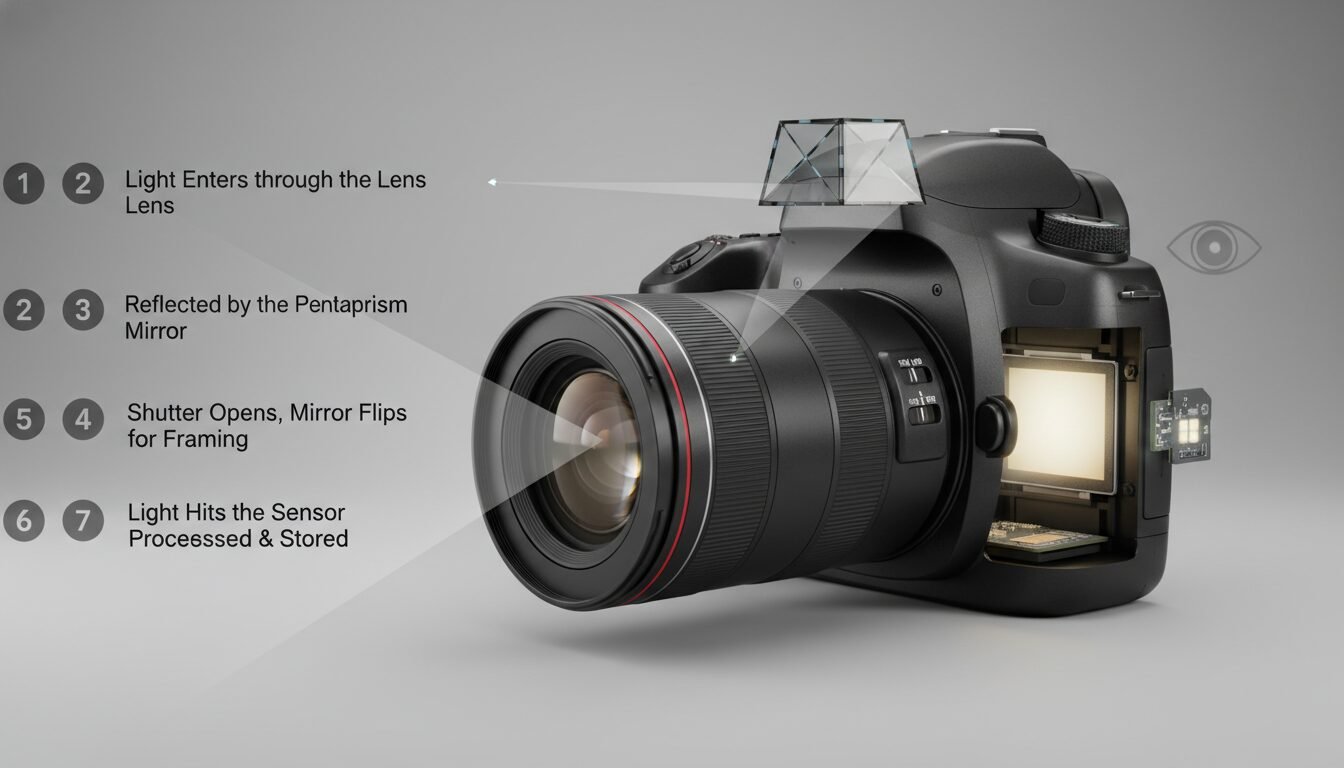
Understanding what is a digital SLR camera means grasping its mechanical process. Every photograph follows a precise sequence of optical and mechanical events.
Light Path Through the Lens
Every photograph begins with light entering through the lens. The lens focuses the scene onto the reflex mirror, which sits in front of the shutter and sensor. The mirror reflects the light upward at a 90-degree angle.
Mirror, Prism, and Viewfinder
After the mirror, the light hits a focusing screen and enters a glass pentaprism (or a less expensive pentamirror in entry-level models). The prism corrects the image orientation and directs it to the optical viewfinder eyepiece. This mechanical chain gives you a direct, live view of what the lens captures.
The Shutter and Sensor Activation
Pressing the shutter button triggers a sequence:
- The reflex mirror swings upward, clearing the path to the sensor
- The focal-plane shutter opens for the designated exposure time
- Light hits the digital sensor, which records the image as an electronic signal
- The shutter closes, the mirror returns to its 45-degree position, and the camera processes the image
This entire cycle can happen in a fraction of a second—professional DSLRs like the Nikon D850 can repeat it more than 11 times per second, according to Photography Life.
Key Components of a DSLR Camera
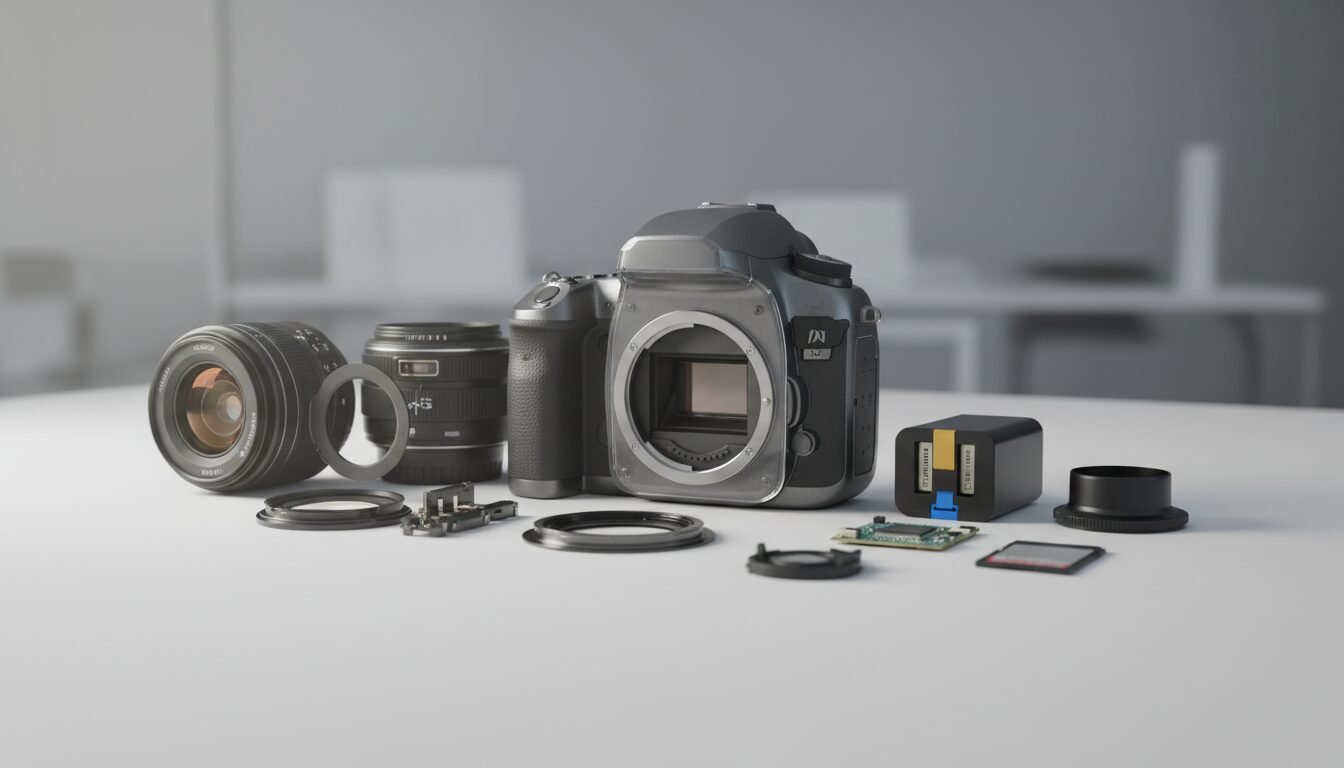
When photographers ask what is a digital SLR camera, they’re really asking about a system of interconnected components that work together.
Interchangeable Lens System
One of the biggest advantages of a DSLR is the ability to swap lenses. From ultra-wide-angle to super-telephoto, macro to fisheye, the lens choice defines perspective and creative control.
“DSLRs are way more versatile in that respect,” says photographer Ivy Chen, referring to the limitless lens options. [Source: Adobe]
Canon’s EF mount and Nikon’s F-mount have decades of compatible glass, including many affordable second-hand options.
Image Sensor Sizes: Full-Frame vs. APS-C
DSLR sensors come mainly in two sizes: full-frame (36×24mm, matching 35mm film) and APS-C (approximately 23.6×15.7mm). Full-frame sensors excel in low light and shallow depth-of-field, while APS-C sensors offer a crop factor that extends telephoto reach. Adobe notes that even APS-C sensors are large enough to “blow your smartphone camera image quality out of the water.”
Autofocus Systems
Traditional DSLR autofocus uses a dedicated phase-detection sensor located below the mirror. This system splits incoming light to quickly measure focus distance, making it very fast for still photography. While mirrorless cameras now lead in subject-tracking and video autofocus, a high-end DSLR still offers rapid, accurate focus in good light.
Live View and LCD Preview
Modern DSLRs include a live view mode that flips up the mirror and displays the sensor feed on the rear LCD. This transforms the camera into something closer to a mirrorless experience, complete with exposure preview and focus magnification. However, autofocus becomes slower in live view since the camera must use contrast-detection instead of its dedicated phase-detection system.
DSLR vs. Mirrorless Cameras: A Detailed Comparison
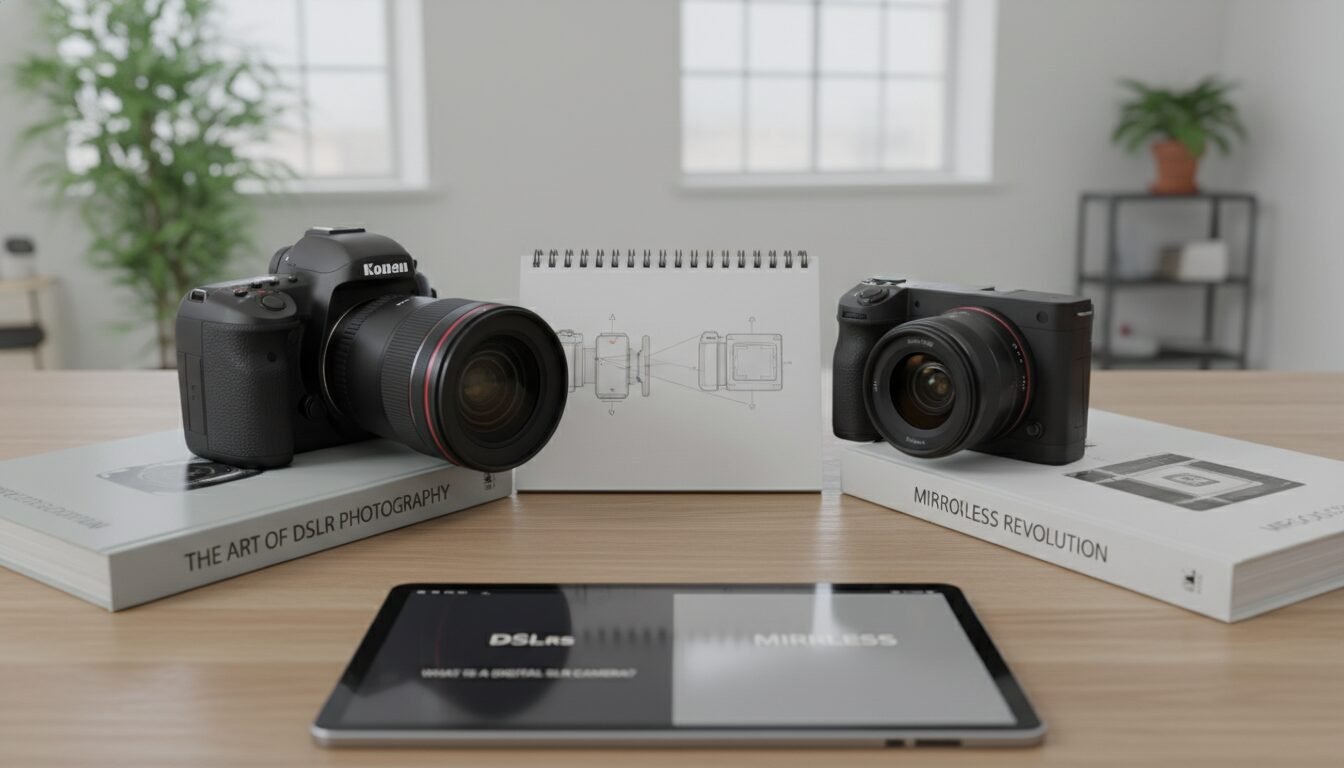
The question “what is a digital SLR camera” often leads to comparisons with mirrorless alternatives. Each system has distinct advantages.
Optical vs. Electronic Viewfinder
The defining division is the viewfinder: an optical through-the-lens system in a DSLR versus an electronic screen in a mirrorless camera. OVFs show the scene as your eye sees it, with zero lag and no battery drain. EVFs display exposure simulation and digital overlays but can suffer from noise in dim light. For many photographers, the optical viewfinder remains the reason to choose a DSLR.
Autofocus Performance and Battery Life
Because a DSLR’s AF sensor is independent of the image sensor, it requires precise calibration but can be extremely fast. Mirrorless cameras read focus straight from the sensor, which benefits video and eye-tracking. However, a DSLR’s optical viewfinder means the camera isn’t constantly powering a screen, leading to much longer battery life. Where a typical mirrorless body might need a battery change after a few hundred shots, a DSLR can often last for a full day of shooting.
Comparison Table
| Feature | DSLR Camera | Mirrorless Camera |
|---|---|---|
| Viewfinder | Optical (real-time, through-the-lens) | Electronic (digital preview with exposure simulation) |
| Autofocus | Phase-detection via dedicated AF sensor; fast for stills | On-sensor phase or contrast-detect; often superior for video |
| Battery Life | Extended (optical finder uses no power) | Shorter (EVF and LCD drain battery continuously) |
| Size & Weight | Bulkier due to mirror box and prism | Generally more compact and lighter |
| Lens Compatibility | Decades of native lenses; large second-hand market | Newer mounts; adapters needed for legacy glass |
| Silent Shooting | Audible mirror slap; some models offer quiet modes | Completely silent electronic shutter available |
Size, Weight, and Lens Ecosystems
DSLR bodies are inherently larger due to the mirror mechanism, but this extra size can provide better grip and balance with heavy lenses. The used lens market for Canon EF and Nikon F-mounts is enormous, offering professional optics at a fraction of the cost of new mirrorless lenses. As of 2026, PENTAX is one of the only manufacturers still fully committed to DSLR development, continuing to refine the optical viewfinder experience.
Pros and Cons
Pros
- Superior battery life – Optical viewfinder uses no power, enabling all-day shooting
- Zero viewfinder lag – Real-time optical view with no digital delay
- Vast lens selection – Decades of compatible lenses, including affordable used options
- Excellent ergonomics – Larger bodies provide better grip and control layout
- Fast autofocus for stills – Dedicated phase-detection sensors excel at tracking subjects
- Lower cost of entry – Used DSLR market offers professional features at budget prices
Cons
- Mirror slap and noise – Mechanical operation creates vibration and sound
- Exposure preview limitations – Optical viewfinder doesn’t show final exposure settings
- Larger size and weight – Mirror mechanism adds bulk compared to mirrorless
- Limited new model development – Most manufacturers have shifted focus to mirrorless
- Slower live view autofocus – Must use contrast-detection when mirror is up
What is a Digital SLR Camera Used For?
Understanding what is a digital SLR camera means recognizing its strengths across different photography disciplines.
Learning Photography Fundamentals
Many photography teachers still recommend a DSLR for learning because it forces the user to understand the exposure triangle—aperture, shutter speed, and ISO—through direct dials and an optical viewfinder. The immediate optical feedback helps students internalize the relationship between settings and lighting without digital aids.
Sports and Action Photography
With their fast phase-detection AF and zero-viewfinder-lag, DSLRs excel at sports. The Canon EOS 40D, released over 15 years ago, could still track a running child with precision, as noted by TakeBetterPhotos. Modern DSLRs continue this legacy, shooting bursts at 7–14 fps to freeze the decisive moment.
Studio and Portrait Work
In a controlled studio, DSLRs remain a workhorse. Their high-resolution sensors, compatibility with strobes, and vast lens options make them ideal for commercial photography. The optical viewfinder provides a clear, lag-free view even when studio lights overpower an LCD screen.
Video Capabilities and HD Recording
Many modern DSLRs offer HD video recording, with some flagship models supporting 4K capture. While mirrorless cameras generally provide superior video features, DSLRs can still produce professional results for interviews, documentaries, and creative projects where the larger body provides better stabilization.
DSLR Cameras for Beginners and Professionals
When considering what is a digital SLR camera for different skill levels, the market offers options from entry-level to professional.
Entry-Level Models
For a new photographer, an entry-level DSLR like the Nikon D3500 is an affordable way to start. It offers guided modes, a comfortable grip, and access to thousands of lenses. Other beginner-friendly models include the Canon EOS Rebel series. These cameras often include scene modes that automate settings while leaving room to grow into manual control.
Enthusiast and Semi-Professional Options
Stepping up, the Canon EOS 80D or the PENTAX K-3 Mark III offer advanced features. The K-3 Mark III boasts a glass pentaprism with 100% field coverage and a five-axis in-body stabilization system, as detailed by PENTAX. These cameras are built for durability and serious hobbyists.
Professional Workhorses
Flagship models like the Nikon D850 and Canon EOS 5D series deliver high-resolution, fast burst rates, and exceptional low-light performance. The D850’s ability to capture over 11 frames per second at 45.7 megapixels makes it a favorite among wildlife and sports pros. Such cameras represent the peak of DSLR technology.
Advanced DSLR Features
Modern DSLRs include sophisticated features that enhance the traditional optical experience.
Dust Reduction Systems
Most DSLRs include sensor-shake dust reduction that vibrates the sensor at startup to remove particles. Some models also feature sensor cleaning modes and dust-resistant weather sealing to protect internal components during lens changes.
Articulating Screens and GPS
Many current DSLRs offer tilting or fully articulating rear LCD screens for easier composition at unusual angles. GPS functionality automatically tags photos with location data, valuable for travel and landscape photography.
Depth-of-Field Control
The larger sensors in DSLRs provide superior depth-of-field control compared to smaller cameras. Combined with fast aperture lenses, this allows photographers to isolate subjects with beautiful background blur that smartphones cannot match.
The Future of DSLRs in a Mirrorless World
As the industry evolves, the question of what is a digital SLR camera becomes more about understanding a mature, refined technology.
Manufacturer Shifts and Market Trends
Since the 2010s, according to Wikipedia, major manufacturers have been transitioning away from DSLRs to mirrorless interchangeable-lens cameras (MILCs). By 2026, most R&D investment flows into mirrorless, and few new DSLR models are released. Despite this, millions of DSLR bodies remain in active use, and the used market is stronger than ever.
PENTAX’s Unique Commitment
PENTAX stands alone among major brands in publicly committing to DSLR development. Their recent models emphasize the optical viewfinder experience, and they continue to release firmware updates. For photographers who prioritize the OVF, PENTAX is the future-proof choice.
The Enduring Value of DSLRs
Even as mirrorless technology matures, the DSLR’s fundamental advantages—optical purity, battery endurance, and lens legacy—ensure its relevance.
“Preparing a raw file before retouching or color editing took some adjustment when I moved to digital,” says DSLR photographer Stephen Klise. “All the light and color reacted differently from what I learned — you get a lot of pronounced reds.” [Source: Adobe]
Understanding what is a digital SLR camera today means appreciating a timeless tool for learning, creating, and mastering the craft of photography.
Ready to explore the world of DSLR photography? Contact Emin Media for a free brand consultation and discover how professional photography can transform your visual storytelling.
Frequently Asked Questions
What exactly does DSLR stand for?
DSLR stands for Digital Single-Lens Reflex. “Digital” refers to the sensor and storage; “single-lens” means the same lens is used for viewing and taking the photo; “reflex” indicates the moving mirror that reflects light to the viewfinder.
Can I use old film SLR lenses on a digital SLR?
Many film-era lenses are compatible with current DSLR bodies, especially within the same mount system. Canon EF and Nikon F-mount lenses from the 1980s and later often work, though some may lose autofocus or metering features. Always check manufacturer compatibility charts.
Which is better for beginners: DSLR or mirrorless?
A DSLR is excellent for beginners because its optical viewfinder and manual controls build foundational skills without digital interpretation. They are also more affordable on the used market. Mirrorless cameras offer easier video and lighter weight, but their electronic viewfinders can introduce a learning curve.
Are DSLRs still made in 2026?
Yes, though the selection is smaller. PENTAX continues to develop new DSLR models, and existing stocks of Canon and Nikon DSLRs can still be purchased new. The second-hand market is robust, with many professional-grade bodies available at steep discounts.
What is the biggest advantage of a DSLR over a smartphone?
Image sensor size. A DSLR’s sensor—even a crop-sensor—is many times larger than a smartphone’s, capturing far more light and detail. Combined with interchangeable lenses, this yields superior depth-of-field control, low-light performance, and sharpness that no phone can match.
Why do DSLR batteries last so long?
Because the optical viewfinder does not consume electricity. The camera only draws power for autofocus, shutter actuation, and processing. By turning off the rear LCD, a DSLR can take over 1,000 photos on a single charge.
Enjoyed this article?
Contact Emin Media for a free brand consultation and let's create something amazing together.
Get in Touch