Video Marketing ROI Metrics That Actually Matter
Video marketing ROI metrics are the measurements brands use to connect video spend to real business outcomes, from leads and sales to customer lifetime value. Without them, you’re producing content on faith. With them, you’re running a growth engine.
Key Takeaways
- roi metrics go far beyond view counts: watch-through rate, conversion rate, and cost per acquisition tell the real story.
- According to Forbes, 91% of businesses used video as a marketing tool in 2024, with 90% reporting a good ROI.
- Vanity metrics (views, likes, impressions) measure attention. Business metrics measure action. You need both, but weight them differently.
- Funnel stage determines which this type of metrics matter: awareness, consideration, and conversion each demand different KPIs.
- Tools like Google Analytics, YouTube Analytics, Wistia, and Vidyard give you the data infrastructure to track performance end-to-end.
- Setting clear objectives before production is the single most important step in measuring ROI effectively.
Understanding Video Marketing ROI
Video marketing ROI is the return businesses receive from video content relative to what they spent producing and distributing it. Calculating it means comparing revenue or pipeline generated against total costs, including production, distribution, and paid promotion. Understanding this relationship is what separates brands that scale video confidently from those that treat every campaign as a creative gamble.
What is ROI?
ROI (Return on Investment) is a financial metric used to evaluate the efficiency of an investment. It’s calculated by dividing net profit from the investment by its initial cost. In video marketing, ROI helps brands determine whether their campaigns generate enough revenue to justify the spend and where to double down next.
Why Video Marketing ROI Matters
Video has become a foundation of digital marketing because it connects, informs, and converts like no other medium. According to Forbes, 91% of businesses used video as a marketing tool in 2024, with 90% claiming it provided a good ROI. Those numbers are compelling, but they only hold if you’re measuring the right things. Tracking this kind of roi metrics is what turns a creative investment into a defensible budget line.
“Views tell you how many people started watching. They don’t tell you if anyone finished, cared, or did anything after.” – Airvue Media, 2026
The Problem With Vanity Metrics

Vanity metrics are the numbers platforms hand you by default, and they’re designed to make you feel good, not make you smarter. Views, likes, and impressions measure attention. They don’t measure intent, and they definitely don’t measure revenue.
A video can rack up over 100,000 views and generate zero leads. Another can get 2,000 views and close five deals. The second video worked. The first one just looked good in a deck.
Likes and shares signal resonance, which matters for brand work. But resonance isn’t the same as purchase intent. Someone can love your video and never become a customer. Impressions are even fuzzier: an impression means your video appeared on a screen, not that anyone actually watched it.
This doesn’t mean you ignore these metrics entirely. At the awareness stage, reach and impressions are legitimate signals. The mistake is treating them as proof of ROI when they’re really just proof of distribution.
Key Video Marketing ROI Metrics to Track
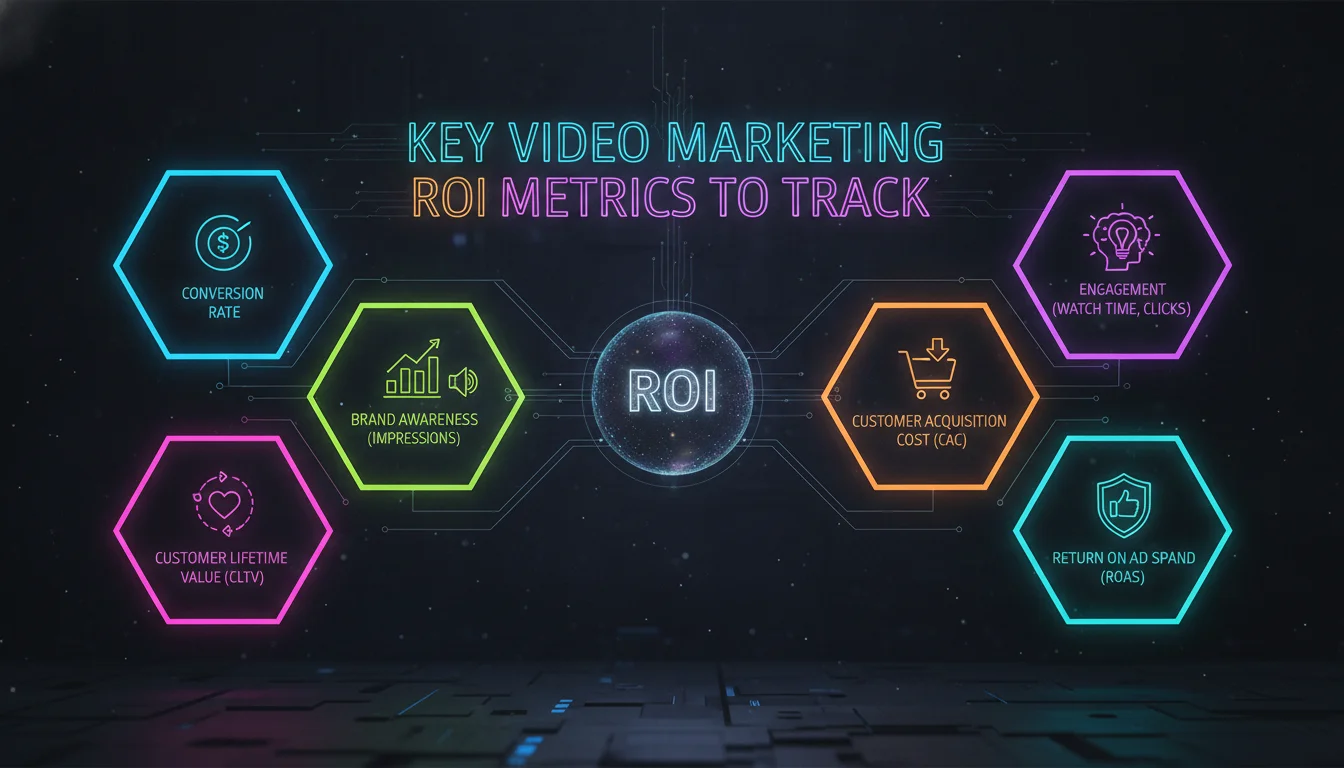
The right the marketing roi metrics depend on where your video sits in the funnel. Here’s how to think about each stage and which numbers actually matter.
1. View Count
View count is the baseline metric showing how many times a video was watched. It’s a starting point for gauging reach, especially when comparing performance across YouTube, Facebook, Instagram, or TikTok. Don’t rely on it alone. A high view count without engagement or conversions means your content isn’t resonating with the right audience.
2. Watch-Through Rate
Watch-through rate is the percentage of viewers who watched to the end, or to a meaningful point in the video. This is one of the most honest signals in your metrics toolkit. If people drop off in the first ten seconds, your hook failed. If they watch to the end, your content delivered. Most platforms show you a retention curve so you can see exactly where attention breaks.
3. Engagement Rate
Engagement rate measures how viewers interact through likes, comments, shares, and saves as a percentage of views. High engagement signals that the content resonates enough to spark conversation or advocacy. Practically speaking, videos with stronger engagement are also prioritized by platform algorithms, which compounds your organic reach without extra spend.
4. Watch Time and Average View Duration
These metrics show how long viewers are actually watching. A higher average view duration suggests the content holds attention. If viewers drop off early, the video may need a stronger opening or a tighter runtime. According to ThinkSpark’s published insights, watch time data is one of the most actionable inputs for refining future scripts and edit structures.
5. Audience Retention
Audience retention tells you exactly where viewers stop watching. If a significant portion of your audience drops off at the same timestamp, that section needs reworking. More importantly, move your key message or CTA earlier if retention data shows you’re losing people before they reach it.
Conversion Metrics
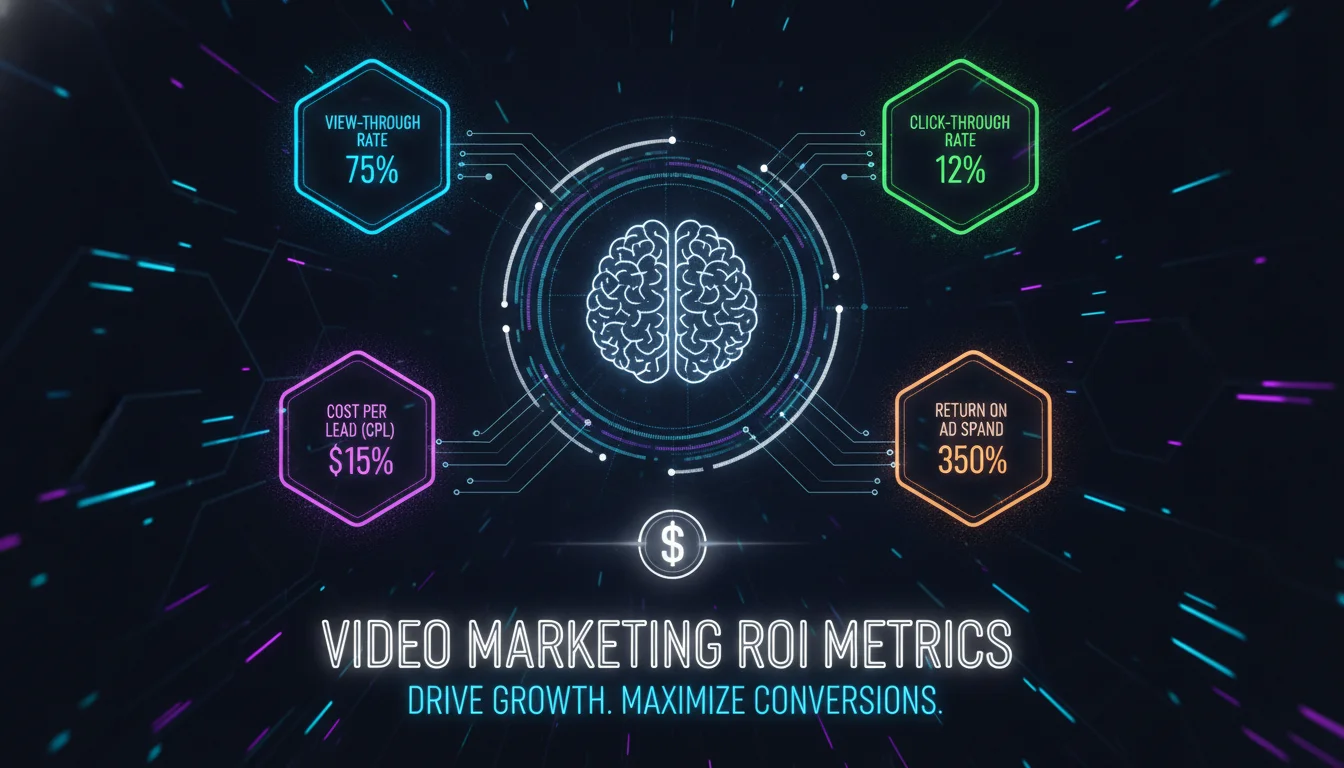
Conversion metrics are where video marketing get serious. These are the numbers that connect creative output to business outcomes.
1. Conversion Rate
Conversion rate measures the percentage of viewers who take a desired action after watching, whether that’s signing up, booking a demo, or making a purchase. This is the clearest signal of whether a video is doing its job. Pair it with a strong landing page experience to improve performance across the board.
2. Click-Through Rate (CTR)
CTR shows how many viewers clicked on a call-to-action within or after the video. A low CTR usually means the CTA was unclear, poorly placed, or irrelevant to the audience. A high CTR means the video successfully bridged watching and acting. Test CTA placement, wording, and timing to find what works for your audience.
3. Cost Per Acquisition (CPA)
Cost per acquisition divides total video spend (production plus distribution) by the number of customers acquired. This is your efficiency metric. If your CPA sits below your customer lifetime value, the video is profitable. If it doesn’t, you need to either reduce production costs, improve targeting, or strengthen the conversion path.
4. Return on Ad Spend (ROAS)
For paid video campaigns, ROAS calculates revenue generated per dollar spent on ads. It’s a direct measure of financial effectiveness and one of the clearest inputs for budget decisions. If a campaign generates $4 in revenue for every $1 in ad spend, you have a clear case for scaling it.
5. Revenue Attributed to Video
This is the ultimate video marketing ROI metric: total revenue generated by customers who engaged with your video content. Attribution gets messy here because the video rarely works alone. It plays alongside emails, ads, and sales calls. Use multi-touch attribution models to give video appropriate credit without over-crediting or ignoring it entirely.
How Video Marketing ROI Metrics Actually Work: The Mechanics
Understanding roi metrics means understanding how data flows from viewer behavior to business outcome. Here’s the underlying mechanics, because most teams track numbers without understanding what generates them.
When a viewer watches your video, every platform captures behavioral data: how long they watched, whether they clicked, whether they rewatched a section, and whether they shared it. This raw behavioral data feeds into platform analytics (YouTube Analytics, Meta Business Suite) and, when connected via UTM parameters or pixel tracking, into your broader analytics stack (Google Analytics, your CRM).
The connection between video engagement and business outcome requires deliberate architecture. A viewer watches a product video on YouTube, clicks a CTA link tagged with UTM parameters, lands on a conversion page, and completes a purchase. Google Analytics captures that journey. Without the UTM tag, the conversion shows up as direct traffic and video gets no credit.
For gated content or lead generation videos, tools like Wistia and Vidyard go further. They track individual viewer behavior, show you heatmaps of engagement, and can trigger CRM actions when a viewer hits a certain watch threshold. This is where this type of metrics become genuinely powerful: you’re not just counting views, you’re identifying which prospects are most engaged and routing them to sales at the right moment.
“If you want video to be a repeatable growth lever, not a one-off experiment, you need to measure what actually matters, not what’s easy to screenshot.” – Airvue Media, 2026
How to Track Video Marketing ROI Metrics: A Step-by-Step Approach
Tracking this kind of roi metrics effectively requires a structured process, not just access to a dashboard. Here’s how to build that process from the ground up.
Step 1: Define Your Objectives Before Production Starts
Every video needs a single primary goal: awareness, consideration, or conversion. That goal determines which metrics you track. A brand film optimized for reach shouldn’t be judged on conversion rate. A product demo shouldn’t be judged on view count alone. Lock in the goal before you write the brief.
Step 2: Map Metrics to Funnel Stage
Awareness videos: track reach, impressions, and view count. Consideration videos: track watch-through rate, engagement rate, and average view duration. Conversion videos: track CTR, conversion rate, CPA, and ROAS. Using the wrong metrics for the wrong stage is one of the most common measurement errors we see.
Step 3: Set Up Tracking Infrastructure
Tag every video link with UTM parameters. Install platform pixels (Meta Pixel, LinkedIn Insight Tag) on your landing pages. Connect your video platform to Google Analytics. If you’re using Wistia or Vidyard, integrate them with your CRM so engagement data flows into your sales pipeline automatically.
Step 4: Establish Baseline Benchmarks
Before you can optimize, you need a baseline. Run your first few videos, collect data, and establish what normal looks like for your audience and industry. Your benchmarks will be more relevant than any industry average because they reflect your specific audience, content style, and distribution channels.
Step 5: Analyze and Act on the Data
Review analytics on a regular cadence, monthly at minimum, quarterly for strategic reviews. Look for patterns: which video types drive the most conversions? Which platforms deliver the lowest CPA? Where does audience retention consistently drop? These patterns are your optimization roadmap.
Step 6: Run A/B Tests on Key Variables
Test one variable at a time: CTA placement, video length, thumbnail, opening hook. A/B testing removes guesswork and gives you data-backed answers. Even small improvements in CTR or watch-through rate compound significantly across a campaign’s lifetime.
Step 7: Report and Iterate
Create reports that connect video performance to business outcomes, not just platform metrics. Show stakeholders the relationship between video engagement and pipeline generated, or between watch-through rate and conversion rate. This is how video marketing earns its budget and grows it.
Tools for Measuring Video Marketing ROI Metrics
The right tools make tracking video marketing ROI metrics practical rather than painful. Here’s what we recommend at different levels of sophistication.
1. Google Analytics
Google Analytics is the backbone for tracking website traffic and conversions from video content. By tagging video links with UTM parameters and monitoring user behavior on landing pages, you can trace the path from video view to conversion. It’s free, widely supported, and integrates with virtually every other tool in your stack.
2. YouTube Analytics
YouTube Analytics provides detailed performance data including watch time, audience retention curves, CTR, and demographic breakdowns. This data helps you understand not just how many people watched, but who they were and how they behaved. Use it to refine content strategy for your YouTube channel specifically.
3. Meta Business Suite
For Facebook and Instagram video, Meta Business Suite offers insights on views, engagement, reach, and paid campaign performance. It’s particularly strong for understanding how video performs in feed versus Stories versus Reels, which matters for format decisions.
4. Wistia and Vidyard
These platforms are built for business video with advanced features like viewer heatmaps, individual contact tracking, and CRM integrations. If you’re using video for B2B lead generation or sales enablement, Wistia and Vidyard give you a level of granularity that native platform analytics simply can’t match.
5. LinkedIn Analytics
For B2B video, LinkedIn’s native analytics are worth monitoring closely. According to published LinkedIn data, LinkedIn Live videos receive an average of 7x more reactions and 24x more comments than native video, making engagement benchmarks on the platform meaningfully different from other channels.
Video Marketing ROI Metrics: Tool Comparison
| Tool | Best For | Key Metrics Tracked | Cost | CRM Integration |
|---|---|---|---|---|
| Google Analytics | Website conversion tracking | Traffic, conversions, goal completions | Free | Via GTM |
| YouTube Analytics | YouTube channel performance | Watch time, retention, CTR, demographics | Free | Limited |
| Meta Business Suite | Facebook and Instagram video | Reach, engagement, paid ROAS | Free | Via Meta Pixel |
| Wistia | B2B lead gen, sales enablement | Heatmaps, individual viewer tracking, CTR | Paid | Native (HubSpot, Salesforce) |
| Vidyard | B2B sales and marketing video | Viewer engagement, pipeline influence | Paid | Native (Salesforce, HubSpot) |
| LinkedIn Analytics | B2B brand and thought leadership | Views, reactions, comments, follower growth | Free | Limited |
Funnel-Stage Metric Framework
| Funnel Stage | Video Goal | Primary Metrics | Secondary Metrics |
|---|---|---|---|
| Awareness | Reach new audiences | Views, reach, impressions | Watch-through rate, brand lift |
| Consideration | Build trust and educate | Watch time, engagement rate, avg view duration | Social shares, return viewers |
| Conversion | Drive action | CTR, conversion rate, CPA, ROAS | Revenue attributed, pipeline influenced |
| Retention | Deepen customer relationships | Repeat views, NPS correlation, support ticket reduction | Upsell rate, customer lifetime value |
Pros and Cons of Tracking Video Marketing ROI Metrics
Pros
- Budget justification: Clear metrics give you the data to defend and grow your video budget with stakeholders.
- Optimization clarity: Knowing which videos convert best tells you exactly where to invest production resources next.
- Audience insight: Retention curves and engagement data reveal what your audience actually cares about, not what you assume they care about.
- Cross-channel intelligence: Comparing video marketing ROI metrics across platforms shows you where your audience is most responsive.
- Predictable growth: When you understand what drives ROI, video becomes a repeatable growth lever rather than a creative experiment.
Cons
- Attribution complexity: Video rarely converts in isolation. Multi-touch attribution is genuinely hard to implement correctly.
- Platform data silos: Each platform measures metrics differently, making cross-platform comparison tricky without a unified analytics layer.
- Lagging indicators: Some video ROI signals (brand lift, customer lifetime value) take months to materialize, making short-term reporting difficult.
- Tool costs: Advanced platforms like Wistia and Vidyard add meaningful cost to your analytics stack.
- Data overload: Access to too many metrics without a clear framework leads to analysis paralysis rather than action.
Common Mistakes to Watch Out For
Most video marketing measurement failures come down to a handful of recurring errors. Knowing them in advance saves you months of wasted budget.
Measuring the Wrong Metrics for the Goal
Judging a brand awareness video by its conversion rate is like judging a billboard by how many people called the number on it. Each video type needs metrics matched to its purpose. Awareness videos live or die by reach and watch-through rate. Conversion videos live or die by CTR and CPA. Mixing these up produces misleading conclusions and bad decisions.
No Tracking Infrastructure Before Launch
Publishing a video without UTM parameters, pixel tracking, or goal setup in analytics is like running a race without a finish line. You’ll have no way to attribute conversions accurately. Set up tracking before the video goes live, not after you notice the data is missing.
Treating Views as Proof of Success
As Airvue Media noted in their 2026 analysis, a video can rack up over 100,000 views and generate zero leads. Views measure distribution, not impact. Use them as a reach indicator, not a success metric.
Ignoring Audience Retention Data
Most teams look at total views and average view duration. Few look at the retention curve. That curve tells you exactly where you’re losing people and why. If your drop-off happens at the 15-second mark consistently, your opening isn’t earning attention. Fix the hook before you spend more on distribution.
Skipping A/B Testing
Producing one version of a video and calling it done leaves significant performance gains on the table. Testing different CTAs, thumbnails, video lengths, and opening hooks is how you move from average results to strong ones. Even modest improvements in CTR compound across a campaign’s full run.
Not Connecting Video Data to CRM
If your video engagement data lives in YouTube Analytics and your lead data lives in your CRM with no connection between them, you’ll never be able to prove video’s contribution to pipeline. Integrate your video platform with your CRM so that high-engagement viewers can be identified, scored, and routed to sales appropriately.
A Realistic Scenario: What Good Measurement Looks Like
Here’s a realistic example of how a brand might apply video marketing ROI metrics in practice. This is a composite scenario based on common patterns we see, not a specific client case.
A B2B software company produces a three-minute explainer video targeting mid-market buyers. Total production cost: $8,000. They publish it on YouTube, embed it on their pricing page, and run it as a LinkedIn paid campaign with a $5,000 ad budget. Total investment: $13,000.
They tag every link with UTM parameters and set up a goal in Google Analytics for demo requests. They also integrate Vidyard with their HubSpot CRM so that any contact who watches more than 60% of the video gets flagged as a warm lead.
After 60 days, the data shows: the YouTube version drives strong watch-through rates but low CTR on the CTA. The LinkedIn paid campaign drives lower view counts but significantly higher CTR and conversion rates, because the audience targeting is tighter. The pricing page embed shows the highest conversion rate of all three placements, because viewers are already in buying mode when they encounter it.
Total demo requests attributed to the video across all placements: 34. Average deal value for the company: $12,000. Close rate on demos: roughly 25%. Revenue influenced: approximately $102,000. Against a $13,000 investment, that’s a return of roughly 7x, before accounting for customers who watched but converted through other touchpoints later.
The team uses this data to make three decisions: increase LinkedIn ad spend on the video, add a stronger CTA to the YouTube version, and create a follow-up video specifically for the pricing page audience. Each decision is grounded in the video marketing ROI metrics, not gut feel.
Setting Clear Objectives for Video Marketing
Clear objectives are the foundation of any meaningful video marketing ROI metrics analysis. Without them, you’re collecting data with no frame of reference.
1. Define Your Goals
Establish specific goals for your video marketing efforts: increasing brand awareness, generating leads, or driving sales. Clear goals guide which metrics you track and how you interpret the results.
2. Align Objectives with Business Goals
Your video marketing objectives need to connect to broader business goals. This alignment is what lets you demonstrate video’s value to stakeholders and justify the investment in concrete terms.
3. Set Measurable Outcomes
Define measurable outcomes for each objective: a target conversion rate, a CPA ceiling, a watch-through rate benchmark. Measurable outcomes give you a clear standard for evaluating success and a trigger for optimization when performance falls short.
Analyzing and Optimizing Video Marketing Performance
Tracking video marketing ROI metrics is only valuable if you act on what the data tells you. Analysis without action is just reporting.
1. Regularly Review Analytics
Review analytics monthly at minimum. Look for trends over time rather than reacting to individual data points. A single video underperforming is noise. A pattern of underperformance across a content type or platform is a signal worth acting on.
2. Implement A/B Testing
A/B testing means creating multiple versions of a video or its surrounding elements (thumbnail, CTA, landing page) to determine which performs better. Test one variable at a time so you know what actually caused the difference. This discipline is what separates teams that improve steadily from those that plateau.
3. Gather Audience Feedback
Quantitative data tells you what happened. Qualitative feedback tells you why. Solicit feedback from viewers through surveys, comments, and sales team input. This context makes your video marketing ROI metrics analysis sharper and your next video smarter.
Video Marketing ROI Metrics in 2026: What’s Changed
As of 2026, the video marketing landscape has shifted in ways that directly affect how you should approach measurement. Short-form video has matured from a trend into a standard content format, with Reels and TikTok-style content now expected across B2C and increasingly B2B audiences. This means watch-through rate benchmarks have shifted: shorter videos are held to a higher completion standard.
AI-generated video is entering the production pipeline for many brands, which changes the cost side of the CPA equation significantly. When production costs drop, the ROI math improves, but only if distribution and conversion remain strong. This makes tracking the full video marketing ROI metrics picture more important, not less.
According to Adverity’s 2026 analysis, the percentage of marketers who consider video a crucial marketing tool has grown substantially over the past decade, reflecting how central video has become to brand strategy across industries. The pressure to prove ROI has grown alongside that investment, making a disciplined metrics approach essential rather than optional.
Attribution technology has also improved. More CRM platforms now offer native video integration, and multi-touch attribution models are more accessible to mid-market teams than they were even two years ago. If you haven’t revisited your attribution setup recently, 2026 is the year to do it.
Frequently Asked Questions
What are video marketing ROI metrics?
Video marketing ROI metrics are measurements used to evaluate the effectiveness and financial return of video marketing campaigns. They include both engagement signals (watch-through rate, engagement rate) and business outcome metrics (conversion rate, cost per acquisition, revenue attributed). Together, they tell you whether your video investment is generating real business results.
Why is measuring video marketing ROI important?
Measuring video marketing ROI is essential for justifying spend, optimizing content strategy, and scaling what works. Without measurement, video budgets are based on opinion rather than evidence. With it, you can identify which videos, platforms, and formats drive the best returns and allocate resources accordingly.
What metrics should I track for video marketing?
The metrics you track should match your funnel stage. For awareness, track reach, impressions, and view count. For consideration, track watch-through rate, engagement rate, and average view duration. For conversion, track CTR, conversion rate, CPA, and ROAS. Revenue attributed to video is the ultimate metric across all stages.
What are the best practices for video marketing ROI in 2026?
As of 2026, best practices include setting clear objectives before production, tagging all video links with UTM parameters, integrating video platforms with your CRM, using multi-touch attribution models, and reviewing performance data on a regular monthly cadence. Short-form video now requires higher completion rate benchmarks, and AI-assisted production is changing the cost side of the ROI equation for many teams.
How can I improve my video marketing ROI?
Focus on three levers: improve the video itself (stronger hook, clearer CTA, tighter runtime), improve the distribution (better targeting, right platform for the audience), and improve the conversion path (landing page quality, follow-up sequence). A/B testing each element systematically is the most reliable way to move the needle on your video marketing ROI metrics over time.
What tools can I use to measure video marketing performance?
Google Analytics and YouTube Analytics are the free-tier foundation for most teams. Meta Business Suite covers Facebook and Instagram. For B2B video with deeper tracking needs, Wistia and Vidyard offer individual viewer tracking, heatmaps, and CRM integrations that native platform analytics can’t match. LinkedIn Analytics is worth monitoring closely for B2B brand and thought leadership content.
How often should I review my video marketing metrics?
Review video marketing ROI metrics monthly for operational decisions (which videos to boost, which CTAs to test) and quarterly for strategic decisions (which content types to prioritize, which platforms to scale). Avoid making major strategic changes based on less than 30 days of data, as short windows can produce misleading signals.
Ready to build a video strategy that actually proves its worth? Contact Emin Media for a free brand consultation and let’s build something bold together. You can also explore our thinking on brand storytelling and digital strategy across our full resource library.
Enjoyed this article?
Contact Emin Media for a free brand consultation and let's create something amazing together.
Get in Touch