Digital Rebel XTi Camera: Complete 2026 Buying Guide
Key Takeaways
- The Canon EOS Digital Rebel XTi (EOS 400D) is a 10.1-megapixel entry-level DSLR from 2006.
- It offers solid image quality and durable build, making it a popular budget choice for learning photography.
- Used bodies can be found for as little as $55, with full kits often under $150.
- The 10.1MP CMOS sensor and DIGIC II processor produce printable images up to 18×24 inches.
- Its 9-point autofocus and 3 fps continuous shooting are adequate for many beginners.
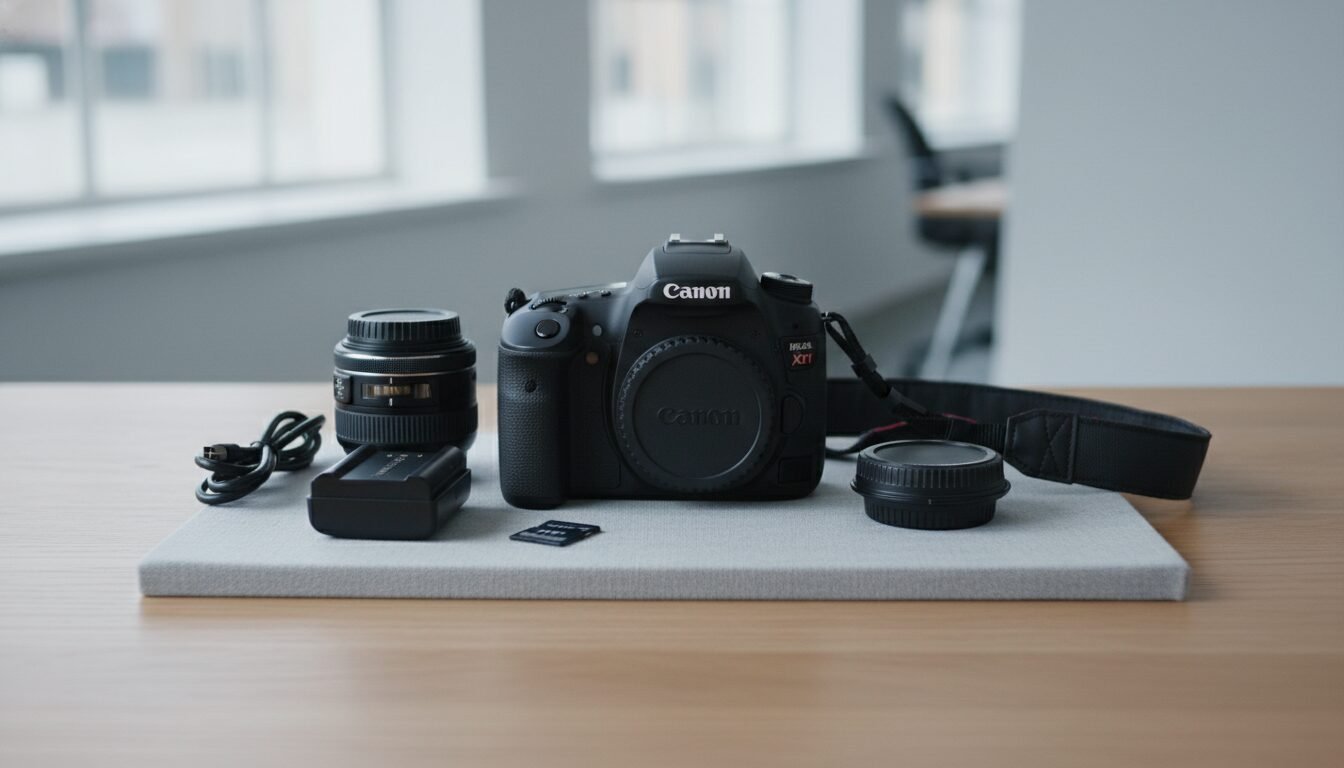
The digital rebel xti camera is a 10.1-megapixel DSLR launched by Canon in September 2006. It remains a capable tool for new photographers who want an inexpensive, durable body to learn manual controls and interchangeable lenses.
Overview of the Digital Rebel XTi Camera
The Canon EOS Digital Rebel XTi (called the EOS 400D in Europe and EOS Kiss Digital X in Japan) is an entry-level digital single-lens reflex camera that launched the careers of countless photographers. It features a 10.1-megapixel APS-C CMOS sensor, Canon’s DIGIC II image processor, and compatibility with the entire EF and EF-S lens lineup. This camera was designed for users upgrading from compact digital cameras as well as first-time DSLR buyers who needed something reliable yet affordable.
A Brief History and Release Context
Introduced in September 2006, the digital rebel xti camera replaced the Rebel XT (350D) and significantly upgraded the resolution from 8 to 10.1 megapixels. It also added a larger 2.5-inch LCD, a self-cleaning sensor, and a more refined autofocus system. In its era, it was among the best-selling DSLRs, helping Canon dominate the entry-level market and establish the Rebel line as the go-to choice for beginners.
Key Features at a Glance
- 10.1-megapixel APS-C CMOS sensor (22.2 × 14.8 mm) delivering prints up to 18 × 24 inches.
- DIGIC II processor ensuring fast operation and accurate colors.
- 2.5-inch LCD with 230,000 dots and a 170° viewing angle.
- 9-point wide-area autofocus with a center cross-type point sensitive to f/2.8.
- Continuous shooting at 3.0 fps for up to 27 JPEG frames in a burst.
- ISO 100–1600 plus HI (ISO 3200 equivalent) option.
- Startup time of just 0.2 seconds.
- EOS Integrated Cleaning System with a self-cleaning sensor and Dust Delete Data software.
Technical Specifications and Performance
Sensor, Processor, and Resolution
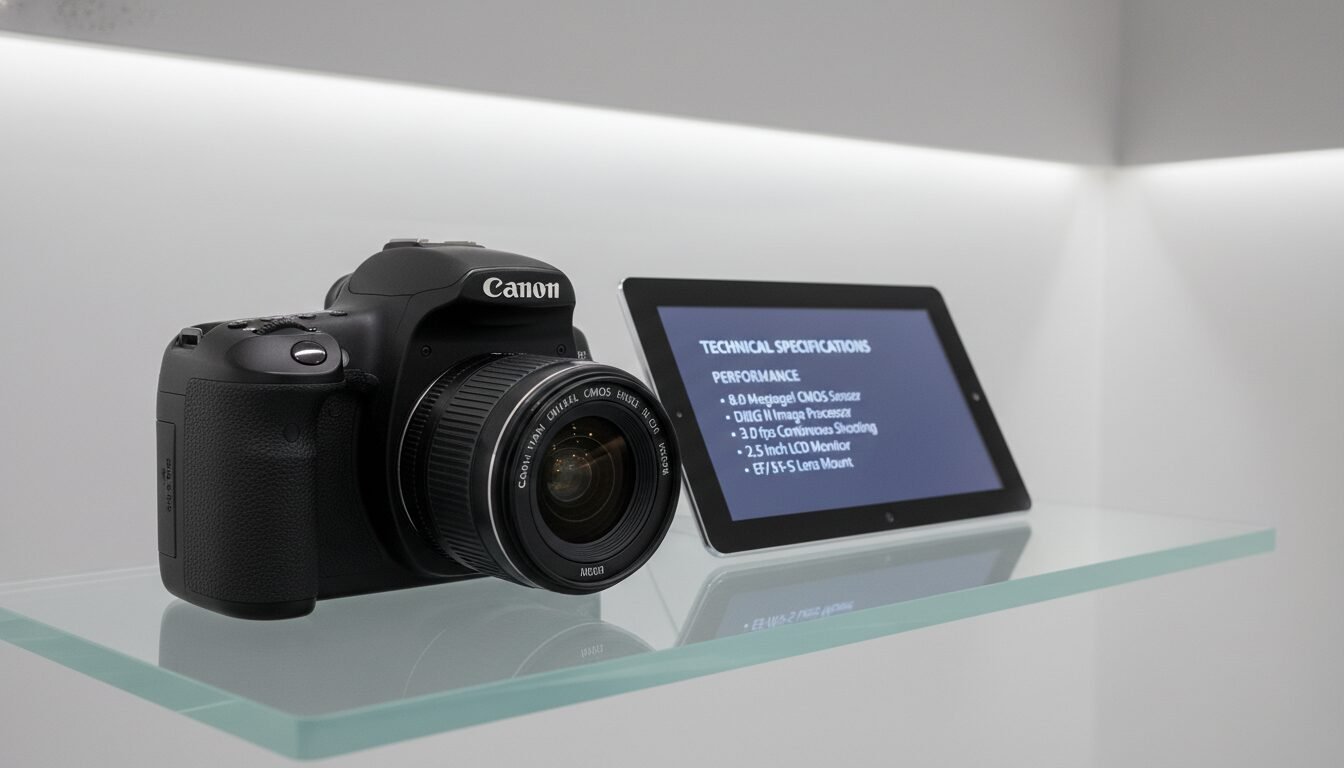
At the heart of the digital rebel xti camera is a 10.1-megapixel CMOS sensor measuring 22.2 × 14.8 mm — the standard APS-C format. Paired with DIGIC II, this sensor processes images quickly and reduces noise even at higher sensitivities. The 10.1MP resolution yields files of 3888 × 2592 pixels, sufficient for sharp A3+ prints. According to Canon’s official archive, the sensor was engineered for low noise and natural color reproduction, enabling clean results at ISO 800 and usable images at ISO 1600.
Autofocus and Continuous Shooting
The camera uses a 9-point phase-detection autofocus system with a center point that is extra sensitive when using lenses with a maximum aperture of f/2.8 or wider. This helps lock focus in dim conditions. It can shoot continuously at approximately 3 frames per second for up to 27 JPEG (Fine) frames or up to 10 RAW frames before the buffer fills. Startup is rated at 0.2 seconds, ensuring you rarely miss a spontaneous moment.
ISO Range and Low-Light Performance
The standard ISO range spans 100 to 1600, with a push-processing HI option giving an ISO 3200 equivalent. Photographers have long praised the digital rebel xti camera for its low noise at high ISO. Jim Zimmerlin, a long-time user, notes:
“One of the best things about the Rebel XTi is the ability to shoot in natural light at high ISO settings without getting horribly grainy pictures.”
His sample photos at ISO 1600 (see Jim Zimmerlin’s gallery) show minimal noise without additional software processing.
Image Quality and Sensor Technology
10.1-Megapixel CMOS Sensor Capabilities
The sensor’s large photodiodes and finely tuned microlenses allow it to capture detail with low noise. Users can produce high-quality 18 × 24-inch prints, making it suitable for family portraits, landscapes, and even some stock photography. The 3:2 aspect ratio matches standard 4×6 and 8×12 print formats without cropping.
Color Reproduction and Picture Styles
Canon equipped the digital rebel xti camera with Picture Style presets — Standard, Portrait, Landscape, Neutral, Faithful, and Monochrome — that adjust sharpness, contrast, and saturation. The DIGIC II engine renders skin tones naturally, a quality often cited in user forums like the Canon Community. Photographers can also create custom settings to match their preferences.
High ISO Noise Handling
Despite an older sensor design, the XTi performs admirably up to ISO 800. At ISO 1600, noise becomes visible but is generally luminance-based and film-like rather than color blotches. As seen in sample photos from Jim Zimmerlin, indoor shots without flash show good detail retention. This makes the camera usable in dimly lit churches or evening events where flash is prohibited.
Design, Build, and Handling
Physical Layout and LCD Display
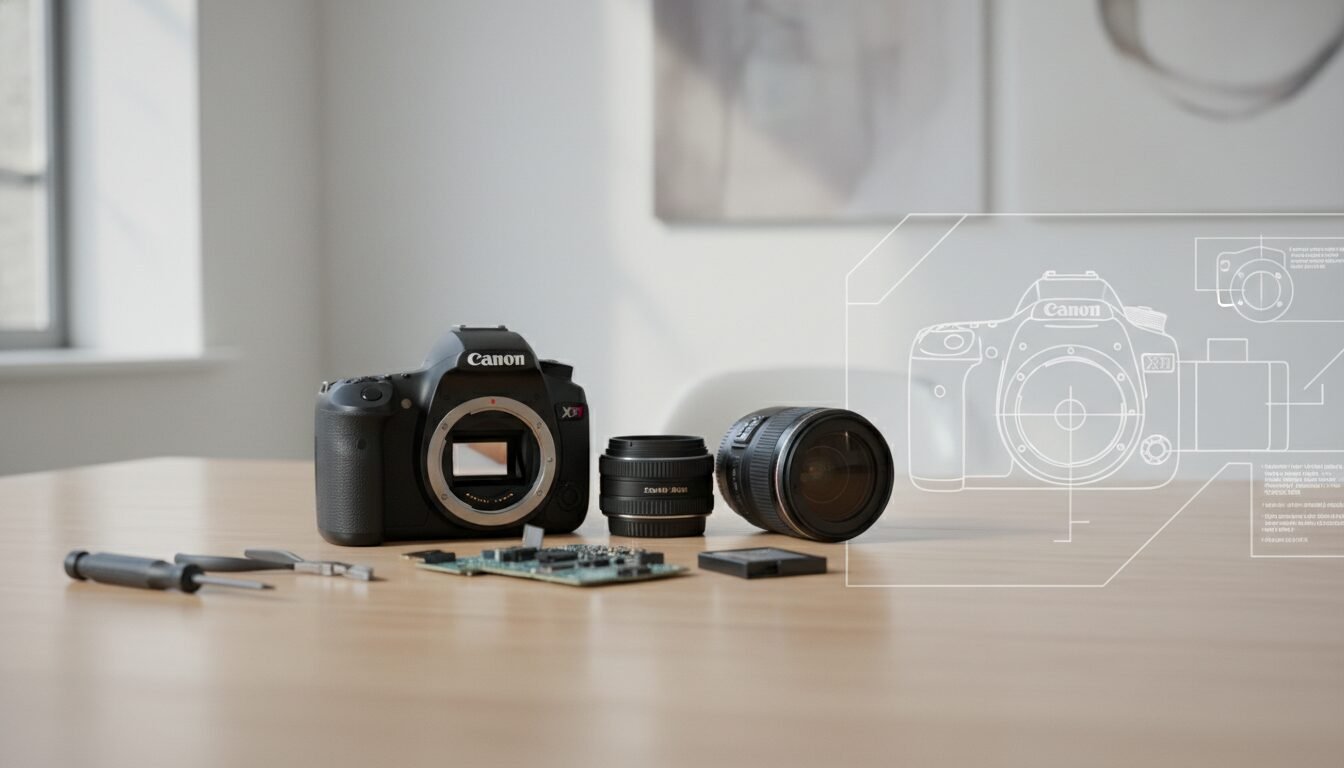
The digital rebel xti camera body is relatively compact and lightweight, making it easy to carry for extended periods. The top deck is cleanly laid out with a mode dial, main dial, shutter button, and a few direct‑control buttons. The 2.5‑inch LCD is much larger than its predecessor’s 1.8‑inch screen and offers a 170‑degree viewing angle, though it lacks live view capability — a feature that would come later.
Durability and Build Quality
Constructed mainly of polycarbonate over a stainless steel chassis, the XTi feels solid for its class. Real‑world anecdotes prove its resilience: one photographer reports dropping his XTi three feet onto concrete and having it survive with only a cracked case, continuing to work perfectly for years. Such durability makes it a reliable companion for beginners who might be less careful.
User Interface and Ease of Use
The menu system is straightforward, with controls for white balance, Picture Style, flash exposure compensation, and custom functions accessible through the LCD screen. The digital rebel xti camera lacks an eye sensor for automatic LCD shutoff, so users manually toggle the display. The large, bright optical viewfinder covers most of the frame, making composition easy even in full sunlight.
Lens Compatibility and Kit Options
EF and EF-S Lens Mount
The Canon EF-S lens mount with EF compatibility gives the XTi access to hundreds of lenses from Canon and third-party makers like Sigma, Tamron, and Tokina. EF-S lenses are designed for APS-C sensors and are often lighter and less expensive. The camera can also use full-frame EF lenses, making it easy to build a lens collection that carries forward to future Canon bodies.
Popular Lens Pairings for the XTi
Many users enhance the kit lens with a telephoto zoom like the 75–300mm f/4–5.6 for wildlife or a fast prime like the 50mm f/1.8 for sharp portraits with blurred backgrounds. A video review by Leigh & Raymond Photography demonstrates how the digital rebel xti camera handles with a 28–80mm and 75–300mm combo, showing that even budget lenses produce satisfying results.
Kit Lens Performance: EF-S 18–55mm f/3.5–5.6
The bundled EF-S 18–55mm lens, while not optically stellar, covers a useful wide to short-telephoto range (29–88mm full-frame equivalent). Stopped down to f/8–f/11, it delivers sharp center resolution. For beginners, it’s a versatile starter lens for landscapes, group shots, and everyday photography. Canon later improved the design with image stabilization (IS) versions, which are recommended for sharper handheld shots.
Real-World User Experiences and Sample Photos
Photographer Testimonials and Long-Term Use
Many digital rebel xti camera owners report using the camera for over a decade without issues. On the Facebook group Beginners Photography Group, member Tonya Prairie LaDue asked if this model is good for learning, receiving a resounding “yes.” Experts there noted that simpler gear forces you to concentrate on technique rather than relying on automated features. On the Canon Community forum, longtime users confirm the camera’s reliability and image quality.
Sample Images and High ISO Examples
Jim Zimmerlin’s sample gallery showcases the XTi’s strengths: a pelican at Pismo Beach (ISO 100, sharp detail), butterflies at ISO 800 with minimal noise, and a border collie at ISO 1600 in a dim arena. These examples demonstrate that even in challenging light, the digital rebel xti camera captures usable, emotive images. Natural-light portraits at ISO 1600 show a film-like grain that many photographers find pleasing.
Known Limitations and Common Complaints
- No video recording. This is purely a stills camera.
- CompactFlash (CF) memory cards — less common than SD, but CF cards are still available and affordable.
- Battery life is moderate: around 300 shots per charge with the NB-2LH battery. Spare batteries are inexpensive.
- Slow low‑light autofocus without an AF‑assist beam; the pop‑up flash can serve as an AF assist, but it is intrusive.
- No live view or touch screen — you must use the viewfinder for composing.
Pros and Cons
Pros
- Affordable (< $100 body‑only)
- 10.1 MP allows large prints (18×24 in.)
- Excellent high‑ISO performance for its age
- Large EF/EF‑S lens ecosystem
- Durable construction — real‑world drops survived
- Simple controls teach photography fundamentals
Cons
- No video recording
- Uses CompactFlash (less common)
- Battery life ~300 shots
- No live view or touch screen
- Slow buffer for RAW (10 shots)
- Autofocus hunts in poor light
Buying a Used Digital Rebel XTi Camera in 2026
Where to Find Deals and What to Pay
Used digital rebel xti camera bodies are widely available on eBay, MPB, KEH, and local classifieds. According to recent eBay listings, body‑only prices start around $55, while kits with the 18–55mm lens often range from $80 to $150 depending on condition. An Amazon renewed listing shows a full kit at $99 for body‑only and $164–$190 with lens (Amazon). These low prices make the XTi one of the most affordable DSLRs for beginners.
What to Check Before Purchasing
- Shutter count: The shutter is rated for approximately 50,000–100,000 actuations; ask for the count. Lower is better.
- Sensor condition: Check for dust spots or scratches. The self‑cleaning feature helps, but inspect if possible.
- CF card slot pins: Bent pins are a common issue; test with a known‑good card.
- Battery and charger: The NB-2LH battery may be old; budget for a replacement ($10–$15).
- Lens functionality: If buying a kit, verify the zoom and autofocus operate smoothly without noise.
The Digital Rebel XTi Camera as a Learning Tool for Beginners
Why Old DSLRs Still Make Great Starter Cameras
New learners often benefit from a manual‑focused camera that demands an understanding of aperture, shutter speed, and ISO. The digital rebel xti camera offers full creative modes (P, Tv, Av, M) and a clear menu, encouraging real skill development. As noted by several responders in the Beginners Photography Group, using older gear can reduce distraction and force you to get the basics right.
Recommended Accessories and Learning Resources
- Memory cards: SanDisk or Lexar CompactFlash cards up to 32 GB (the camera may not support larger cards without firmware updates).
- Lenses: The Canon EF-S 24mm f/2.8 STM “pancake” is a tiny, sharp prime that balances well on the XTi.
- Books: Canon EOS Digital Rebel XTi/400D Guide to Digital SLR Photography by David Busch is often recommended.
- Online courses: Free YouTube channels like Photography Life and paid platforms like LinkedIn Learning offer structured curricula.
Step‑by‑Step Setup for First‑Time Users
- Charge the NB‑2LH battery fully.
- Insert a formatted CompactFlash card.
- Set the mode dial to P (Program AE) to start.
- Press Menu, set the date and time, and choose JPEG Large/Fine quality.
- Explore Tv (shutter priority) to freeze motion or Av (aperture priority) to control depth of field.
- Use center‑point AF and focus‑recompose for accurate focusing.
Ready to start your photography journey? Contact Emin Media for a free brand consultation and discover how visual storytelling can transform your creative projects.
Frequently Asked Questions
Is the Canon Rebel XTi a good camera for beginners?
Yes. It provides manual controls, strong image quality, and a wide lens system at a very low price, making it an ideal learning platform. Many photography instructors recommend older DSLRs for their simplicity and durability.
What lenses are compatible with the Canon Rebel XTi?
It accepts all Canon EF and EF-S lenses, as well as third‑party lenses with EF mount from Sigma, Tamron, and Tokina. The crop factor applies a 1.6× multiplier to focal lengths.
Does the Canon Rebel XTi shoot video?
No. The XTi is a still‑photography DSLR without any movie recording function. Video was introduced in later Rebel models.
What memory card does the Canon Rebel XTi use?
It uses CompactFlash (CF) cards, not SD cards. Most capacities up to 32 GB work reliably; larger cards may require a firmware update or might not be compatible.
How old is the Canon Rebel XTi, and is it still usable today?
It was released in September 2006, making it roughly 20 years old in 2026. Despite its age, it is fully functional for still photography and produces quality images that suit web use and moderate‑sized prints.
Is the Canon Rebel XTi worth buying for its price?
If you find a well‑maintained body for $50–$100, it is an excellent value. The money saved can go toward better lenses that you can keep when you later upgrade to a newer Canon body.
Enjoyed this article?
Contact Emin Media for a free brand consultation and let's create something amazing together.
Get in Touch