Digital Media Production: What It Is and How to Break In
Key Takeaways
- Digital media production covers the creation and distribution of content across digital platforms, from video to podcasts to motion graphics.
- The workflow breaks into three phases: pre-production, production, and post-production, each with its own deliverables and pitfalls.
- Career growth in this field is outpacing the national average, with roles like producers, art directors, and editors all in demand.
- Degree and certificate programs exist at community colleges and universities alike, but portfolios often matter more than diplomas.
- Hands-on experience through internships, student media, and freelance gigs is what actually separates hireable candidates from the rest.
- As of 2026, brands expect production teams to think in platforms first, format second.
What Is Digital Media Production?
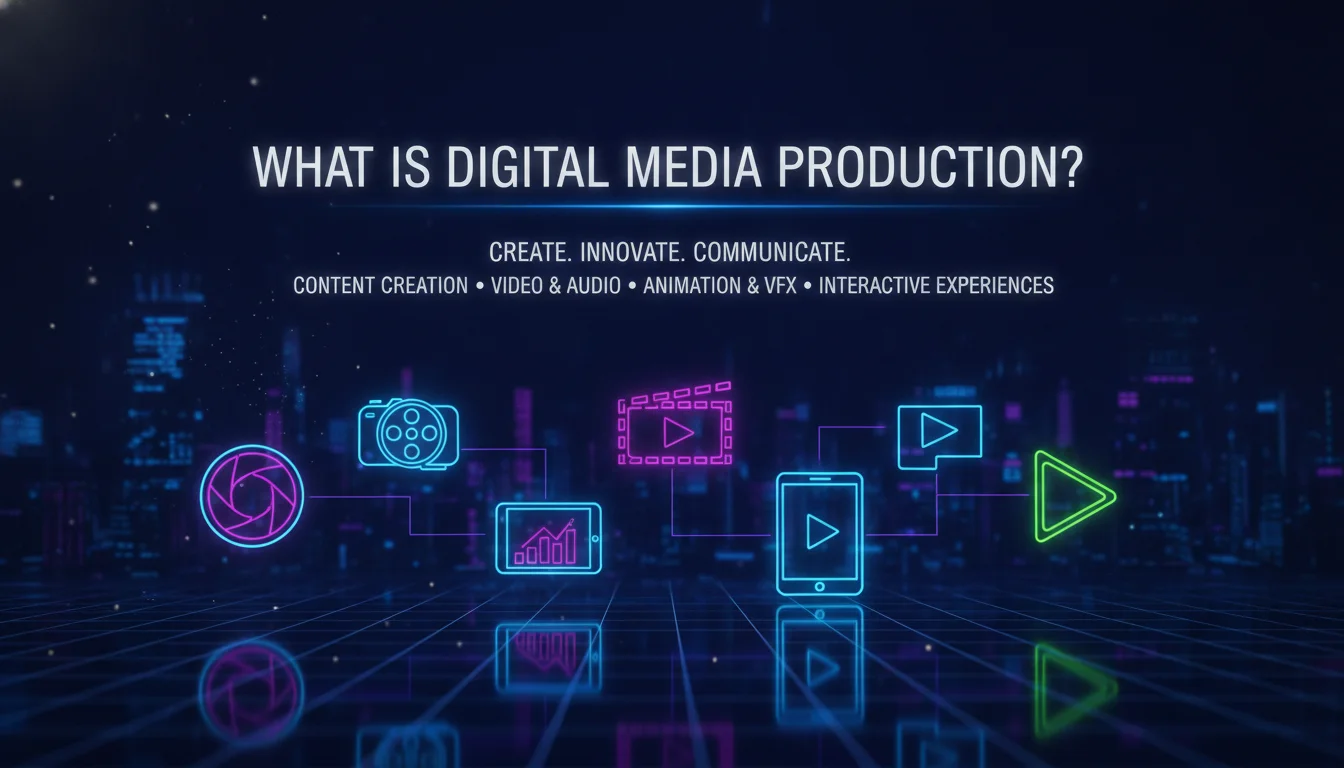
Digital media production is the process of planning, creating, and distributing content across digital platforms like video, audio, animation, and web. It covers everything from a 15-second Reel to a full brand documentary. This work sits at the center of how brands tell stories, sell products, and build audiences online.
Businesses and creators lean on strong production because attention is the scarcest resource on the internet. A beautifully shot video means nothing if it’s built for a platform that’s already moved on to a new format. That’s why we treat production less like a checklist and less like a filmmaking exercise, and more like a strategic discipline that happens to involve cameras, code, and sound design.
“Careers in digital media production are expected to grow faster than the national average through 2031,” according to data cited by Kent State University’s School of Media and Journalism, drawing on U.S. Bureau of Labor Statistics projections.
The Phases of Digital Media Production
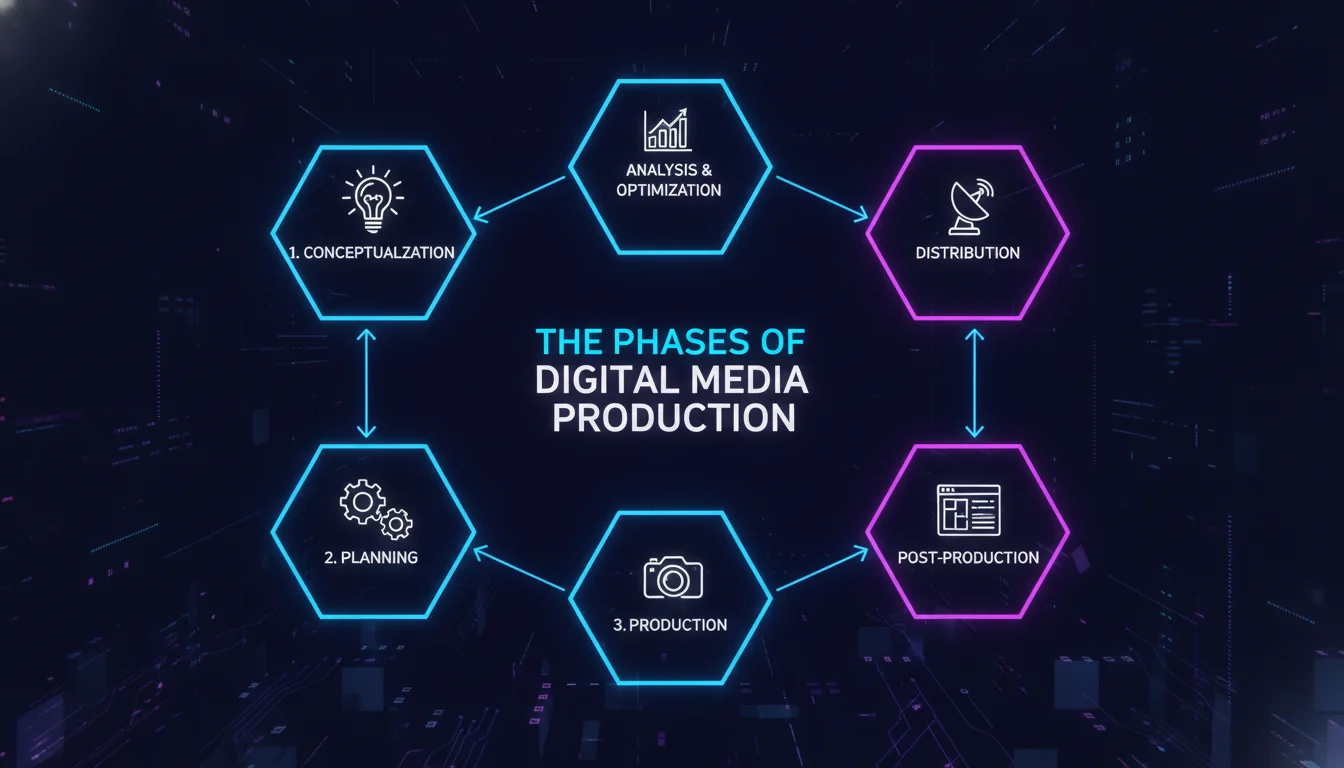
The phases of digital media production are pre-production, production, and post-production, each building on the last to move a concept from idea to finished asset. Skip a phase, or rush it, and the cracks show up later, usually in the edit bay when it’s expensive to fix.
1. Pre-Production
- Concept Development: Ideas get stress-tested here. What’s the hook? Who’s the audience? Does this concept survive contact with a 6-second scroll-past window?
- Scriptwriting: Scripts and shot lists guide everyone on set, so nobody’s guessing on the day.
- Logistics Planning: Budgeting, scheduling, and crew assembly happen now, before a single light gets plugged in.
2. Production
- Filming: Cameras, lighting, and blocking come together to capture footage that actually matches the plan from pre-production.
- Audio Recording: Clean audio on set saves hours of fixing in post. This step gets skipped more than it should.
- Graphic Design: Visual assets, lower thirds, and motion elements start taking shape to support the story.
3. Post-Production
- Editing: Raw footage becomes a story with a beginning, middle, and end (or a hook, payoff, and loop, if we’re talking short-form).
- Sound Design: Mixing, sound effects, and music layer in to make the piece feel finished instead of just assembled.
- Distribution: Files get formatted, captioned, and exported for each platform’s specs, because a square crop on a vertical platform is an amateur mistake.
How Digital Media Production Actually Works
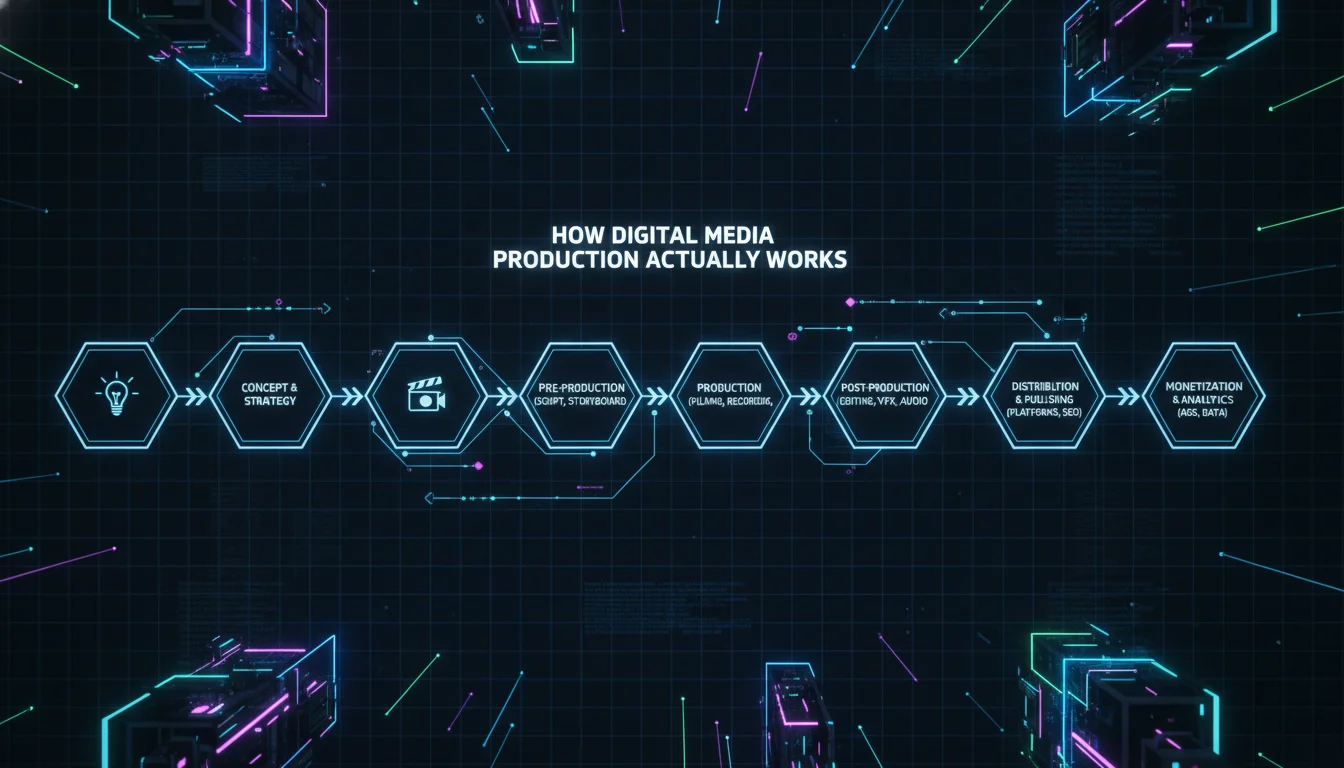
Digital media production works by moving a concept through a pipeline of creative and technical decisions, each one narrowing the gap between the idea in someone’s head and the file that ends up on a screen. Understanding this pipeline matters more than memorizing software names, because tools change every year and the underlying logic doesn’t.
Start with intent. Every piece of content should answer a question before a single frame gets shot: what does the viewer do after watching this? Buy something? Share it? Trust the brand a little more? That intent shapes every downstream choice, from camera angle to color grade to caption length.
From there, production becomes a series of translations. A brand brief gets translated into a script. A script gets translated into a shot list. A shot list gets translated into footage. Footage gets translated into an edit. Each translation loses a little of the original signal if the team isn’t careful, which is why strong creative direction (not just technical skill) tends to separate good production houses from forgettable ones.
Distribution logic closes the loop. A video built for YouTube’s 16:9 frame and a 10-minute attention span behaves completely differently than one built for TikTok’s vertical, sub-60-second world. Modern production teams shoot and edit with these platform differences in mind from day one, not as an afterthought.
Types of Digital Media
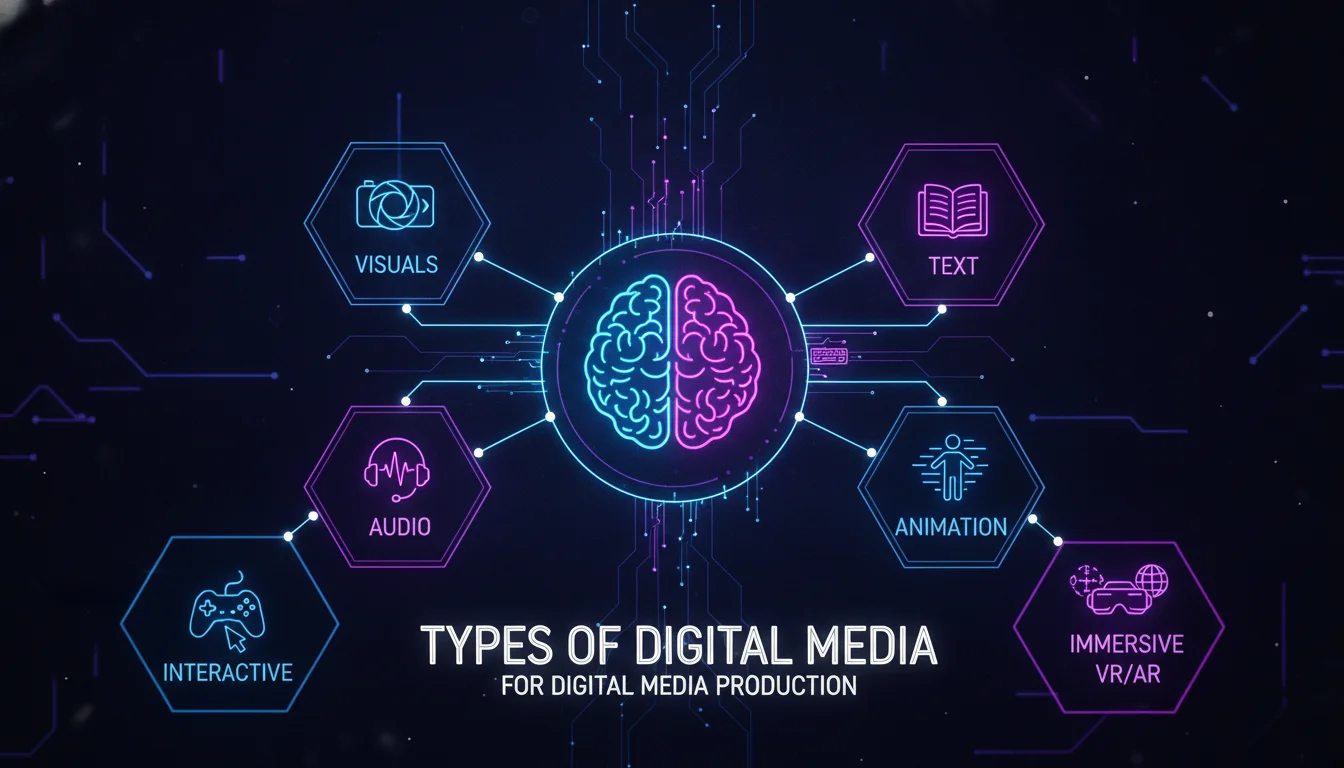
The main types of digital media are video production, audio production, animation, graphic design, and web development, and each one demands a different skill set and toolkit. Most production professionals specialize in one or two while staying conversational in the rest.
1. Video Production
Video production covers everything from short social clips to full-length branded films. It’s the most visible form of digital media production and often the one clients think of first when they say “we need content.”
2. Audio Production
This includes podcasts, music beds, and branded soundscapes. Audio production demands specialized skill in recording, mixing, and mastering, skills that get overlooked until a video sounds tinny and nobody can figure out why.
3. Animation
Animation covers 2D and 3D moving image work, from explainer videos to full motion-graphics packages. It’s often the fastest way to visualize an abstract idea a camera simply can’t capture.
4. Graphic Design
Graphic design creates visual content for both print and digital use: ads, brochures, social graphics, and brand systems. Strong design work carries a visual language across every touchpoint, so a brand feels consistent whether someone sees it on a billboard or a Story.
5. Web Development
Web development builds the sites and applications where a lot of this content eventually lives. Coding and design skills combine here, and a production team that understands both tends to build content that performs, not just content that looks nice in a portfolio.
Brand Spotlight: When Production Meets Strategy
Picture a mid-size consumer brand that’s been shooting the same studio product shots for years. The visuals are clean but forgettable. A production overhaul that leans into behind-the-scenes footage, founder-led storytelling, and short vertical cuts built specifically for Reels and TikTok can change the entire feel of a brand’s feed within a single content cycle. That’s the difference between content that exists and content that performs: the strategy behind the camera matters as much as what’s in front of it.
How to Apply This: Building Your Digital Media Production Path
Whether you’re a career-switcher or a recent grad, applying this knowledge starts with building a body of work, not waiting for permission.
1. Pick a Lane, Then Widen It
Start with one format, video editing, motion graphics, podcast production, and get genuinely good at it before spreading thin across five disciplines.
2. Build Real Projects, Not Just School Assignments
Volunteer to shoot content for a local business, a nonprofit, or a friend’s small brand. Real client constraints teach lessons that classroom assignments can’t.
3. Learn the Business Side Early
Understand budgeting, licensing, and client communication alongside the creative tools. Producers who can talk timelines and deliverables get hired faster than ones who only talk aesthetics.
4. Chase Internships and Student Media Roles
Student-run stations, campus radio, and internships give you deadline pressure and feedback loops that self-taught practice rarely replicates.
5. Package a Portfolio That Shows Range and Focus
Show three to five strong pieces instead of twenty mediocre ones. Hiring managers scroll fast; make the first ten seconds count.
Comparison of Approaches and Programs
| Path | Best For | Time Investment | Key Focus |
|---|---|---|---|
| Community College Certificate | Fast entry into entry-level roles | Under 2 years | Hands-on production basics |
| Bachelor’s Degree | Broader career flexibility, leadership roles | 4 years | Theory, production, and business skills |
| Self-Taught + Portfolio | Fast movers who learn by doing | Varies, often 6-18 months | Direct client work and freelance projects |
| Online Certification | Career-switchers adding a specific skill | Weeks to months | Software-specific or niche skills |
Comparison of Digital Media Production Programs
| Institution | Degree Offered | Key Focus Areas | Location |
|---|---|---|---|
| Community College of Baltimore County | Associate of Applied Science | Pre-production, production, post-production | Baltimore County, MD |
| Kent State University | Bachelor of Science | Writing, directing, production | Kent, OH |
| University of Texas at El Paso | Bachelor of Arts | Digital storytelling, media analysis | El Paso, TX |
| Florida State University | Bachelor of Arts | Production, media ethics | Tallahassee, FL |
Career Opportunities in This Field
Career opportunities are expanding across production, direction, editing, and design roles, with growth outpacing many other creative fields. According to data referenced by Kent State’s School of Media and Journalism, citing U.S. Bureau of Labor Statistics projections, employment in related roles is expected to grow by roughly 11% through 2031, faster than the national average across all occupations.
1. Job Roles
- Producers: Oversee the process and manage budgets from kickoff to delivery.
- Directors: Own the creative vision and guide the team toward it.
- Editors: Shape raw footage and audio into the final, polished piece.
- Graphic Designers: Build the visual assets that carry a brand’s look across every deliverable.
2. Salary Expectations
Salaries vary widely based on role, experience, and location. Per data from the Community College of Baltimore County’s program page, art directors earn a median hourly wage of around $30, with a documented range from $14 to $75 per hour depending on seniority and market.
3. Job Outlook
As of 2026, demand keeps climbing as brands shift more of their budgets toward short-form and platform-native content. New graduates and career-switchers alike are finding openings, particularly for people who can shoot, edit, and think strategically all at once.
Educational Pathways
Educational pathways for this field range from two-year certificates to four-year degrees to fully self-taught portfolios, and no single route guarantees success on its own.
1. Degree Programs
Many universities, including Kent State, Florida State, and UTEP, offer Bachelor’s degrees that cover writing, directing, production, and media ethics in depth.
2. Certification Programs
Shorter certificate programs, like the one offered through the Community College of Baltimore County, focus on specific hands-on skills such as video editing or graphic design.
3. Online Learning Options
Online courses have made this field more accessible than ever, letting career-switchers build skills without relocating or pausing a full-time job.
Common Mistakes to Watch Out For
The most common mistake in this field is treating every platform the same way, shooting one piece of content and cross-posting it everywhere without adjusting format, pacing, or captions. Here are a few others worth flagging:
- Skipping pre-production: Jumping straight to filming without a script or shot list almost always costs more time in the edit.
- Ignoring audio quality: Viewers forgive shaky footage more easily than bad sound.
- Building a portfolio of only school assignments: Client-facing work, even unpaid, shows range that classroom projects can’t.
- Underestimating distribution specs: A file cropped wrong or captioned poorly undercuts even great creative work.
- Chasing every new tool instead of mastering fundamentals: Software changes constantly; storytelling instincts don’t.
A Worked Example: From Brief to Final Cut
Consider a small business that wants a 60-second brand video for its homepage and social channels. Pre-production starts with a one-page brief: audience, goal, tone, and a rough script. The team scouts a location, books two hours of studio time, and builds a shot list with ten setups.
Production day covers those ten setups plus a handful of unscripted moments that usually end up being the most authentic footage. Audio gets recorded separately with a lavalier mic rather than relying on the camera’s built-in mic, a small decision that saves the whole project later.
Post-production takes the raw files and builds three versions: a 60-second cut for the homepage, a 30-second cut for paid social, and a 15-second vertical cut for Stories and Reels. That single shoot day now feeds three different formats, which is the kind of efficient thinking that separates production teams who plan ahead from ones who scramble after the fact.
Pros and Cons
Pros
- Growing job market with roles across production, editing, design, and direction.
- Multiple entry paths, from certificates to degrees to self-taught portfolios.
- Creative work with measurable business impact, appealing to both artists and strategists.
- Skills transfer across industries, from entertainment to corporate marketing to nonprofits.
Cons
- Equipment and software costs can add up quickly for freelancers starting out.
- Freelance and contract work can mean inconsistent income, especially early on.
- The pace of platform and tool changes demands constant learning.
- Competition for entry-level roles can be steep in major media markets.
2026 Outlook
As of 2026, digital media production keeps shifting toward short-form, platform-native storytelling, with brands expecting production teams to think in formats and feeds first, not just finished films. This year’s biggest shift is speed: teams that can plan, shoot, and turn around content within days, not weeks, are winning more client work and more audience attention. That doesn’t replace long-form or high-production video, but it does mean production professionals increasingly need range across both fast, native content and polished brand films.
“A well-structured pre-production process ensures smooth execution and minimizes production issues later,” notes Lighthouse Media Services, a production studio specializing in live event and brand content.
Frequently Asked Questions
What is digital media production?
Digital media production is the process of creating, developing, and distributing content through digital platforms, including video, audio, animation, and graphic design. It spans everything from planning and filming to editing and final distribution.
What are the five types of digital media?
The five main types are video production, audio production, animation, graphic design, and web development. Most professionals specialize in one or two while staying familiar with the rest.
What can I do with a related degree?
A degree in this field can lead to roles like producer, director, editor, graphic designer, or content strategist. Many graduates also freelance or build production companies of their own.
Is a digital media production degree worth it?
For many people, yes, a degree provides structured training, faculty mentorship, and access to equipment that’s expensive to acquire on your own. That said, a strong self-built portfolio can open similar doors, especially for freelance and agency work.
What skills matter most in this field?
Creativity, technical proficiency with production tools, project management, and clear communication all matter. The professionals who advance fastest tend to combine strong creative instincts with the discipline to hit deadlines and budgets.
How can I gain experience without a formal program?
Internships, student media organizations, and volunteer projects for small businesses or nonprofits all build real experience. Freelancing on small paid or unpaid projects, even before graduation, builds a portfolio that speaks louder than a transcript.
Ready to turn a rough idea into content that actually performs across every platform your audience lives on? Contact Emin Media for a free brand consultation, and let’s build something bold together.
Enjoyed this article?
Contact Emin Media for a free brand consultation and let's create something amazing together.
Get in Touch