Creative Agency Pricing Models: 9 Structures Explained

A creative agency pricing model is the billing framework an agency uses to charge for services, covering structures from hourly and project-based to retainer, subscription, and performance-based. The right structure balances client budget predictability with agency profitability.
Key Takeaways
- No single pricing model fits every agency. The best choice depends on service type, delivery process, and growth goals.
- Hourly and project-based models are easy to start but cap revenue and require constant new sales to sustain income.
- Retainers and subscriptions create predictable recurring revenue and simplify hiring, forecasting, and capacity planning.
- Value-based and performance-based models can boost profitability but require measurable outcomes and real risk tolerance.
- According to AdAge, cited by Resource Guru, 75% of multinational brands will seek pricing changes with their agencies in the next three years.
- Two agencies quoting the same monthly fee can represent completely different resource allocations, per RightSpend.
1. What Is a Creative Agency Pricing Model?

Definition and Core Components
A this type of model is a structured framework for setting fees on creative, marketing, or design services. It defines how an agency bills clients, how work is scoped, and how risk is shared between both sides. According to Resource Guru, an agency pricing strategy is the wider view of how pricing decisions should be made, while the specific billing framework selected to influence how clients are charged is the agency pricing model itself. The actual rates or fees are called agency pricing, and what the agency earns is called agency compensation.
Why the Structure Matters More Than the Rate
Most agency leaders fixate on the dollar amount per hour or per project. The billing structure, though, has a larger effect on profitability and client relationships than the rate itself. Stackmatix notes that marketing agency pricing has no industry standard: two agencies offering identical services can charge wildly different amounts, structured in completely different ways. The this kind of pricing model determines whether revenue is predictable, whether the agency is rewarded for speed or penalized by it, and whether the client sees the engagement as a cost or an investment.
Key Terminology: Strategy, Model, Pricing, Compensation
Resource Guru draws clear lines between four terms that often get blurred. Agency pricing strategy is the approach aligned with business goals. The the agency pricing model is the specific billing structure. Agency pricing is the actual monetary rate. Agency compensation is total monetary earnings. Agency remuneration can also include non-monetary benefits such as case studies or free meals. These distinctions matter because the model sits between strategy and the final invoice: it turns intent into a repeatable billing mechanism.
2. The 9 Core Creative Agency Pricing Model Options
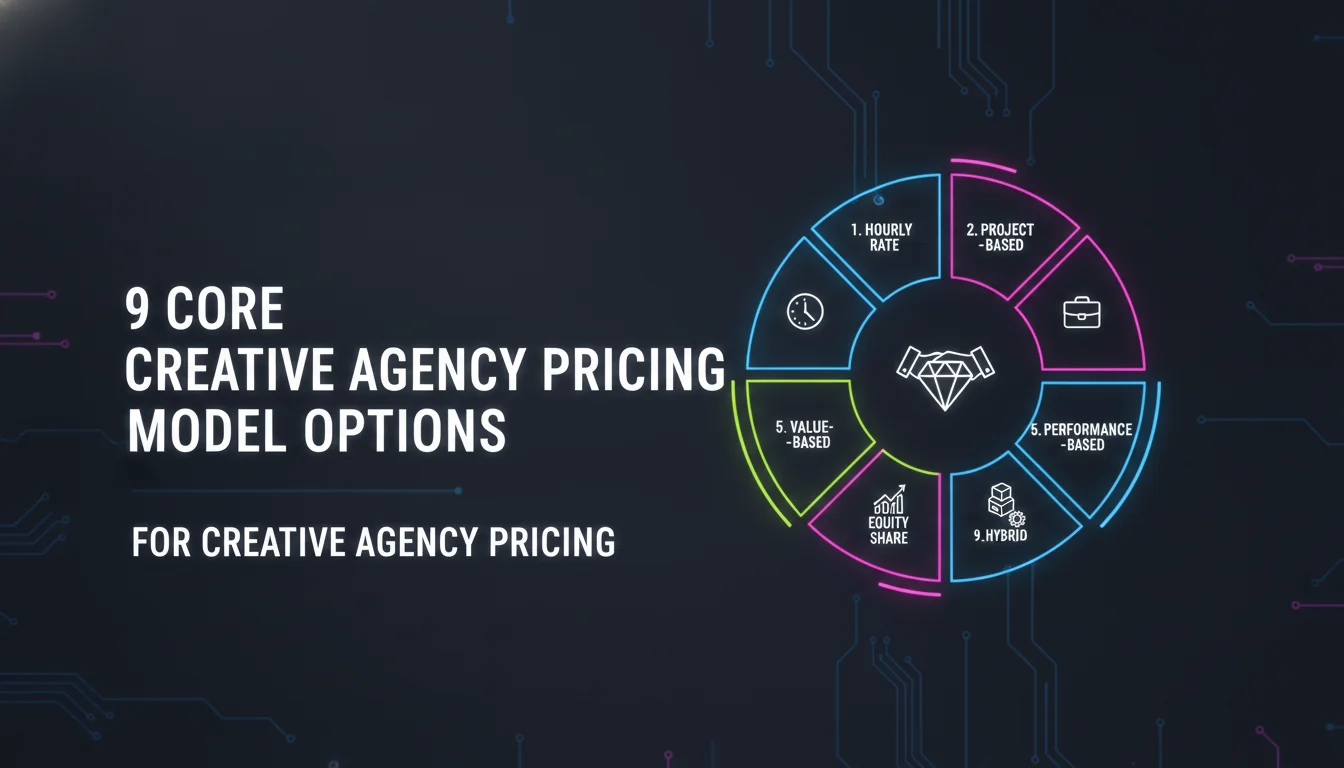
Nine well-established structures exist for building a creative agency. The right one depends on service type, scope predictability, and how much risk each side is willing to carry.
Time-Based Models: Hourly and Time and Materials
Hourly billing is the simplest pricing model: the agency tracks time and bills it at a set rate. Scoro gives a concrete example: if an agency charges $150 per hour for website development and a team logs 50 billable hours, the invoice is $7,500. The model is transparent but caps revenue at the number of hours the team can physically work. A full-time employee typically maxes out at around 35 billable hours per week, per Scoro, which limits revenue without hiring or outsourcing. AIGA’s Shel Perkins notes that time and materials also covers out-of-pocket expenses, with travel reimbursed at cost and other expenses subject to a standard markup of 20 percent. Hourly pricing works for unpredictable scope like consulting or audits, but it punishes efficiency: the faster an agency delivers, the less it earns.
Fixed and Project-Based Models
Project-based pricing uses a flat fee for a defined deliverable, such as a brand overhaul, website build, or campaign launch. The client pays for an outcome regardless of hours logged, which makes this this type of model attractive when scope is tight. A fixed-fee contract creates an entrepreneurial profit or loss depending on how well the agency estimates and manages the work. AIGA advises that fixed-fee proposals must be very specific about scope, and any additional request should be handled with a change order document. Project pricing starts from zero for each new engagement, creating revenue unpredictability.
Recurring Models: Retainer, Subscription, and Credit-Based
A retainer is a fixed monthly fee for ongoing access to services or a set number of hours. A subscription charges a fixed monthly fee for queued deliverables. Credit-based pricing lets clients buy a bank of credits to spend on requests, which suits variable monthly needs. ManyRequests identifies subscription and retainer models as the ones built to scale because they decouple price from time and create recurring revenue, making them the strongest this kind of pricing model for growth-stage agencies.
Outcome-Based Models: Value-Based and Performance-Based
Value-based pricing ties the fee to the outcome or impact the agency creates, such as revenue lift or brand value. It can increase profitability but is hard to standardize. Performance-based pricing ties fees to measurable results such as cost per lead, revenue generated, or ROAS. Scoro adds that value-based and performance-based models require strong expertise and clear ways to measure results. Stackmatix notes that pure performance models are often rejected by agencies because risk exposure is too high without some baseline revenue.
Additional Formats: Use-Based, Licensing, Hybrid, and Free
AIGA also identifies use-based pricing, licensing, hybrid structures, and free models as legitimate formats for design firms. Use-based pricing ties fees to how widely a deliverable is distributed or used. Licensing charges clients for ongoing rights to creative assets. Hybrid models combine two or more structures, such as a fixed project fee plus a performance bonus. Free work, while rare as a business model, appears in pitch situations or relationship-building contexts. These formats are worth knowing even if they are less common than the seven core structures above.
| Pricing Model | How It Works | Best For | Does It Scale? |
|---|---|---|---|
| Hourly | Bill for time tracked at a set rate | Consulting, audits, unpredictable scope | No, capped by hours |
| Project-based | Flat fee for a defined deliverable | One-off builds with clear endpoint | Limited, starts from zero each time |
| Retainer | Fixed monthly fee for ongoing access or hours | Continuous work, known volume | Yes, with right structure |
| Subscription | Fixed monthly fee for queued deliverables | Repeatable, productized services | Yes, built to scale |
| Credit-based | Clients buy a bank of credits to spend | Variable monthly needs | Yes, flexible recurring |
| Value-based | Price tied to outcome created | High-impact quantifiable work | Yes, but hard to standardize |
| Performance-based | Fee tied to measurable results | Agencies confident in their numbers | Yes, with high risk |
| Use-based / Licensing | Fee tied to distribution or asset rights | Creative IP with broad reach | Yes, with the right contracts |
| Hybrid | Combines two or more structures | Complex engagements needing flexibility | Yes, if well-defined |
Pros and Cons of Common Creative Agency Pricing Models
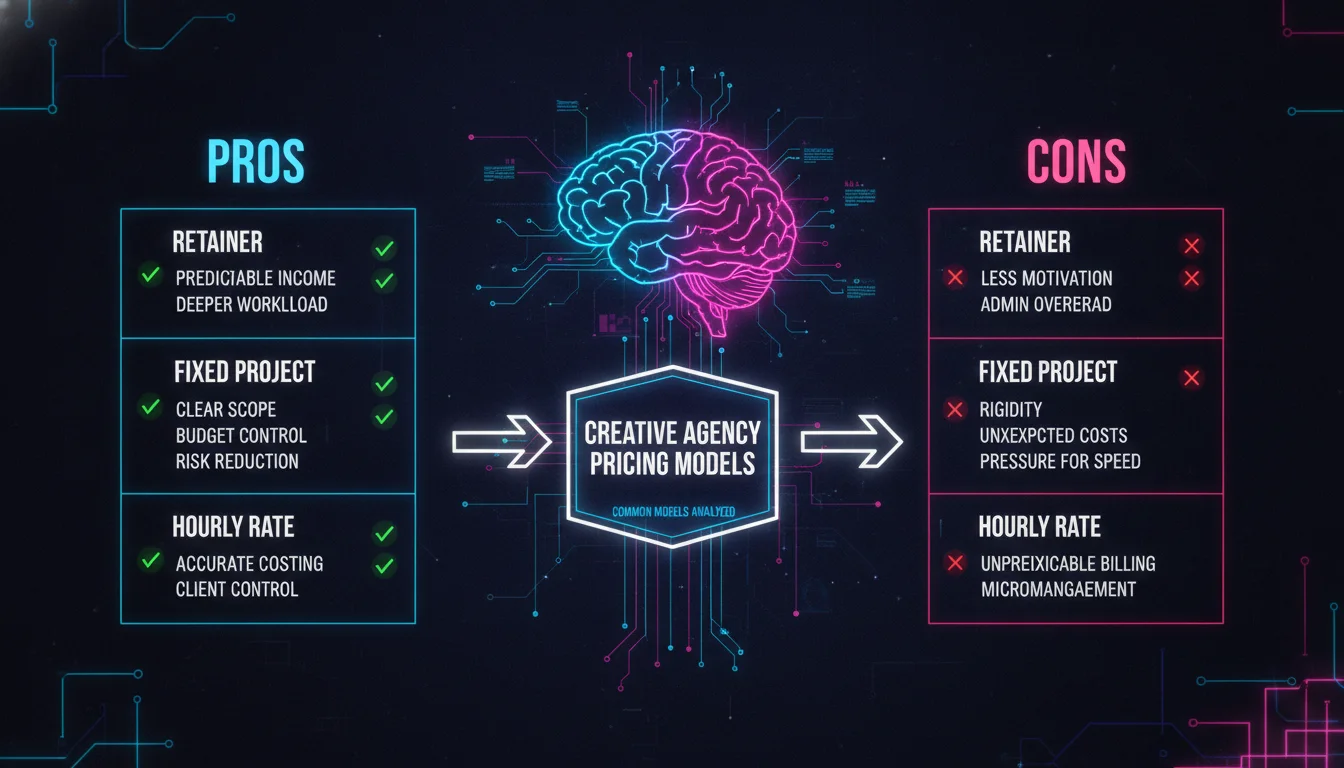
Pros
- Retainer and subscription models create predictable recurring revenue, simplify cash flow forecasting, and make capacity planning far more manageable.
- Project-based pricing protects clients from runaway hours and gives agencies a clear profit target on defined deliverables.
- Value-based and performance-based models align agency incentives with client outcomes, which can justify significantly higher fees when results are strong.
- Hourly billing is transparent, easy for clients to audit, and appropriate for genuinely unpredictable scope like consulting or discovery work.
- Credit-based pricing gives clients flexibility for variable monthly workloads while keeping recurring revenue intact for the agency.
Cons
- Hourly models punish efficiency: the faster your team works, the less the agency earns, which creates a perverse incentive structure.
- Project-based pricing starts from zero with each new engagement, creating revenue unpredictability and a constant need for new sales.
- Retainers without defined deliverables become what Stackmatix calls a “relationship fee” with unclear accountability on both sides.
- Performance-based models introduce attribution disputes and can expose agencies to significant financial risk without a baseline fee.
- Value-based pricing is difficult to standardize and requires both strong expertise and a client willing to share business outcome data.
3. How to Choose a Creative Agency Pricing Model
Assess Service Type and Scope Predictability
Choosing the right creative agency pricing model starts with understanding the type of service and how predictable the scope is. If work is genuinely unpredictable, such as consulting or audits, hourly or time and materials may be appropriate. If deliverables are repeatable and can be productized, subscription or retainer models create recurring revenue. Resource Guru recommends considering the types of services offered, client sectors, delivery capacity, expertise areas, growth goals, KPIs, team size, and sales approach before committing to any single structure.
Evaluate Client Risk Tolerance and Budget Preferences
Clients differ in how they want to carry risk. Fixed-fee and subscription models shift risk to the agency, while hourly and time-and-materials models shift risk to the client. Performance-based models attempt to align risk with results but can create disputes over attribution. Stackmatix warns that retainers without clearly defined deliverables can become a “relationship fee” with unclear accountability. The right creative agency pricing model balances client preferences against the agency’s ability to deliver consistent outcomes.
Align with Agency Growth Goals and Capacity
Hourly and project-based models are easy to start but difficult to scale because revenue is tied to time or constant new sales. Retainers and subscriptions make hiring, forecasting, and scaling easier. ManyRequests notes that many successful productized agencies use subscription pricing to standardize delivery, simplify operations, and grow recurring revenue. Scoro’s framework lists value-based and performance-based as scalable but requiring stronger measurement systems before they can be reliably deployed.
4. Hourly vs. Project-Based vs. Retainer: A Practical Comparison
When Hourly Billing Makes Sense
Hourly billing is transparent and easy for clients to understand, which is why most agencies default to it early on. It works for engagements where scope is unknown, such as audits or consulting. Scoro notes that the model has a built-in incentive problem: the faster the team works, the less the agency can bill. It also invites clients to scrutinize and challenge invoices. For a full-time employee, Scoro cites a typical cap of 35 billable hours per week, limiting revenue without hiring or outsourcing.
When Project-Based Pricing Protects Both Sides
Project-based pricing is a flat fee for a defined deliverable. It protects the client from runaway hours and protects the agency from efficiency being penalized, but only if scope is tightly defined upfront. AIGA emphasizes that additional requests must be identified as outside the original scope and handled through a change order. Without that discipline, projects become unprofitable and the creative agency pricing model breaks down entirely.
When Retainers Create Predictable Revenue
Retainers are the most common model for ongoing relationships, including paid media management, SEO, content, and fractional CMO engagements. They provide cost predictability for clients and revenue predictability for agencies. Stackmatix cautions that a retainer without clearly defined deliverables becomes a “relationship fee” with unclear accountability. Resource Guru advises defining what is in scope and out of scope before the engagement begins, not after problems arise.
“A retainer without clearly defined deliverables becomes a ‘relationship fee’ with unclear accountability.” – Stackmatix, Marketing Agency Pricing Models Explained (2026)
5. The Economics of Agency Pricing: Cost Structures and Margins
What Actually Sits Behind an Agency Fee
An agency’s fee is built on more than hourly rates. RightSpend explains that most of the cost base comes from people: creative, strategy, account, and media teams whose salaries and benefits shape the bulk of what clients pay. Added to that are overheads like rent, technology, and operations, plus an agency profit margin. Pass-through expenses such as production, media, or specialist freelancers can quickly escalate the true cost. Two agencies quoting the same monthly fee can represent completely different resource allocations.
How Overhead, Labor, and Profit Margin Shape Rates
The Forbes Agency Council offers a clear break-even calculation. If an agency has overhead costs of $10,000 per month and five employees each working approximately 160 hours per month, total hours are 800. The break-even rate is $12.50 per hour ($10,000 divided by 800 hours). Adding a 20% profit margin raises the hourly rate to approximately $15. This calculation underpins hourly pricing but also informs fixed-fee and retainer rates when agencies translate hours into a flat amount.
Blended vs. Tiered Hourly Rate Calculations
Scoro identifies two approaches to hourly pricing worth knowing before you build any rate card. Blended hourly pricing factors in the rates for all employees on a project and combines them into a single rate, which simplifies client invoices. Tiered hourly pricing assigns different rates to different team members based on seniority or role, giving clients visibility into who is doing the work and at what cost. Both approaches start from the same foundation: employee actual cost per hour plus your desired profit margin. A web development agency might blend a senior developer at $150 per hour, a mid-level developer at $125, and a QA engineer at $100 into a single blended rate that reflects the realistic team mix on any given project.
The AdAge Data: Why Clients Will Demand Pricing Changes
According to a recent AdAge article cited by Resource Guru, 75% of multinational brands will seek pricing changes with their agencies in the next three years. That means agencies can expect clients to ask for different pricing structures, not just lower rates. A creative agency pricing model that is transparent, accountable, and aligned with results will be better positioned for those conversations. RightSpend advises procurement teams to look beneath the headline number and examine talent mix, overhead and margin, and whether third-party costs are included or added later.
“Getting agency value right isn’t about pushing rates down; it’s about understanding what you’re paying for and what you’re getting back.” – RightSpend, Marketing Agency Pricing Explained
6. Step-by-Step: Selecting Your Creative Agency Pricing Model
Step 1: Audit Service Delivery and Scope
List every service your agency offers and classify each as predictable, variable, or one-off. Predictable services, such as monthly content production or technical SEO, fit retainer or subscription models. One-off deliverables like website builds fit project-based pricing. Unpredictable consulting work fits hourly. This audit prevents applying a single creative agency pricing model to services with fundamentally different economics, which is one of the most common and costly mistakes agencies make.
Step 2: Map Client Expectations and Budget
Interview current clients to understand how they prefer to buy. Some want a fixed monthly fee they can expense without surprises. Others want to test an agency with a small project before committing to a retainer. Performance-based pricing may appeal to clients who need proof of ROI, but agencies should include a baseline fee to cover costs. Stackmatix notes that agencies often won’t accept pure performance models because risk exposure is too high without some baseline revenue to cover operations.
Step 3: Test, Measure, and Iterate
Run a pilot with one pricing structure on a small cohort of clients for 90 days. Track revenue predictability, delivery margin, and client satisfaction. ManyRequests emphasizes that operational systems matter as much as pricing: the right processes and tools help deliver consistently, manage billing, and scale without adding administrative overhead. Adjust the creative agency pricing model based on what the data shows, not on what competitors are doing or what sounds most sophisticated in a pitch.
7. Pricing Examples by Agency Type
Design and Branding Agencies
ManyPixels reports that design agencies charge via hourly rates ranging from $75 to $500 per hour, flat project fees from $5,000 to $150,000 or more, or monthly retainers from $3,000 to $15,000 or more. Logo design typically runs $5,000 to $50,000, while website builds range from $10,000 to $35,000 or more. Large branding or website projects at traditional agencies often exceed $50,000 to $150,000, making them a poor fit for most startups and early-stage businesses.
Digital Marketing and PPC Agencies
For paid media, SEO, and content, retainers dominate because the work is ongoing and measurable. Stackmatix describes the monthly retainer as the most common creative agency pricing model for ongoing relationships, including paid media management, SEO, content, and fractional CMO engagements. Performance-based components may be layered on top, but agencies typically require a baseline fee. RightSpend notes that value-based or performance-linked pricing is increasingly used, where part of the agency’s remuneration depends on outcomes such as ROI or sales lift.
Productized and Subscription Design Services
Subscription design services typically cost $699 to $2,599 per month, according to ManyPixels. This creative agency pricing model offers a flat monthly price for unlimited requests and revisions, making it more predictable and often more cost-effective than a traditional retainer for ongoing marketing needs. ManyRequests adds that productized agencies use subscription pricing to standardize delivery, simplify operations, and grow recurring revenue, fully decoupling price from time.
8. Common Pitfalls and How to Avoid Them
Scope Creep in Project-Based Work
Project-based pricing fails when scope is not tightly defined from the start. AIGA recommends including an exact scope of work and using change order documents for additional requests. Without change orders, agencies absorb extra work at no additional fee, eroding margin on every project. Resource Guru similarly notes that project-based pricing requires strong agency project management and resource planning to stay profitable.
Retainers That Become Relationship Fees
Stackmatix warns that a retainer without clearly defined deliverables becomes a “relationship fee” with unclear accountability. To avoid this, agencies should specify hours, deliverables, response times, and out-of-scope work in the retainer agreement before signing. Resource Guru advises defining what is in scope and out of scope to avoid disputes later in the relationship. ManyRequests highlights that clients can pause or cancel subscriptions without awkward ghosting when the client portal makes it straightforward to do so.
Performance Pricing and Attribution Risk
A performance-based creative agency pricing model can align incentives but introduce attribution disputes. Stackmatix observes that metrics can be gamed, attribution disputes arise, and agencies often won’t accept pure performance models because risk exposure is too high without some baseline revenue. RightSpend advises selecting a model that aligns incentives, rewards efficiency, and supports the brand’s commercial goals, rather than simply pushing rates down.
The right creative agency pricing model is not the one with the lowest rate or the trendiest label. It is the structure that aligns service delivery, client risk tolerance, and agency growth goals. By matching the model to the economics of the work and reviewing it when clients demand change, an agency turns pricing from a source of friction into a real competitive advantage.
Ready to build a pricing structure that actually works for your agency? Contact Emin Media for a free brand consultation and let’s build something bold together.
Frequently Asked Questions
How much does a creative agency typically cost?
Design agency rates range from $75 to $500 per hour, project fees from $5,000 to $150,000 or more, and monthly retainers from $3,000 to $15,000 or more, according to ManyPixels. Subscription design services typically cost $699 to $2,599 per month, making them the most accessible entry point for ongoing creative work.
What are the 7 pricing strategies for agencies?
ManyRequests identifies seven core agency pricing models: hourly, project-based, retainer, subscription, credit-based, value-based, and performance-based. AIGA adds use-based pricing, licensing, hybrid structures, and free models as additional formats used by design firms and agencies.
What are the three main types of agency costs?
RightSpend breaks agency costs into three main components: talent costs (salaries and benefits of creative, strategy, account, and media teams), overhead costs (rent, technology, and operations), and agency profit margin. Pass-through expenses such as production, media, or specialist freelancers are additional and can significantly escalate the true cost.
Which agency pricing model is best for scaling?
Retainer and subscription models are best for scaling because they create predictable recurring revenue and decouple price from time. ManyRequests states that subscription pricing is the model built to scale, while credit-based pricing adds flexibility for clients with variable monthly workloads.
What is the difference between a retainer and a subscription pricing model?
A retainer is a fixed monthly fee for ongoing access or a set number of hours, while a subscription is a fixed monthly fee for queued deliverables. Retainers suit continuous known-volume work; subscriptions suit repeatable, productized services, according to ManyRequests. Both create recurring revenue, but subscriptions are generally easier to standardize and scale.
Enjoyed this article?
Contact Emin Media for a free brand consultation and let's create something amazing together.
Get in Touch