Canon Digital Rebel XTi Review: Why This 2006 DSLR Still
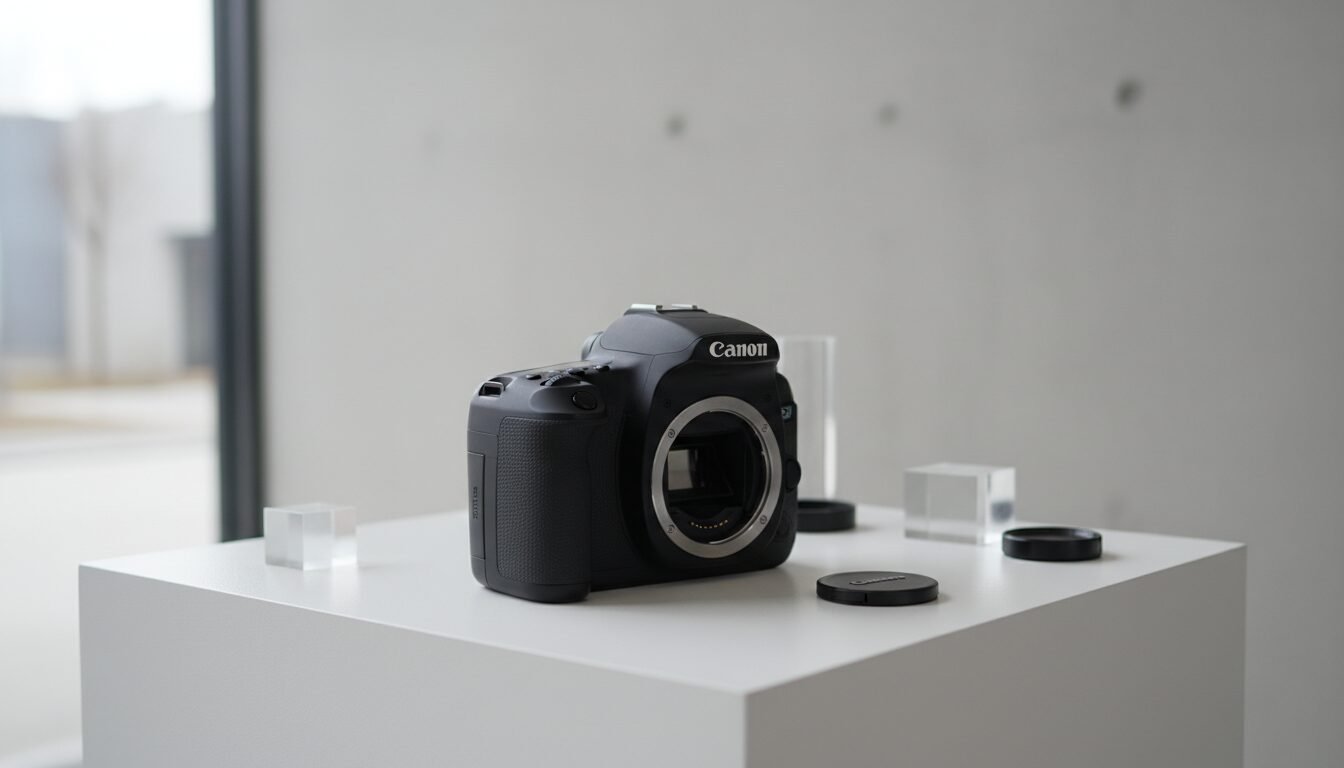
- The Canon Digital Rebel XTi (also known as EOS 400D) is a 10.1-megapixel DSLR that excels as a low-cost entry point into photography.
- It offers manual controls, RAW support, and compatibility with a vast selection of Canon EF and EF-S lenses, making it ideal for learning fundamentals.
- Despite its age, the XTi can still produce sharp, detailed images up to 18×24-inch prints when paired with good lenses and modern editing software.
- The camera’s limitations—low light performance, slower autofocus, and no video—are balanced by its used price under $200.
- For photographers wanting to understand the basics without a large investment, the XTi remains a solid choice in 2026.
The camera Canon Digital Rebel XTi is a 10.1-megapixel DSLR that teaches photography fundamentals through deliberate, hands-on learning. This 2006 classic forces you to master exposure and composition without modern automation.
Released as the successor to the popular Rebel XT (350D), the Canon Digital Rebel XTi (model name also EOS 400D or Kiss Digital X) quickly became a favorite among photo enthusiasts upgrading from point-and-shoot cameras. According to Canon’s official museum, it debuted in September 2006 and combined a then-new 10.1-megapixel APS-C CMOS sensor with the DIGIC II image processor—technology that delivered notably clean images for its era.
Camera Canon Digital Rebel XTi: An Overview
The camera Canon Digital Rebel XTi represents photography in its purest digital form—no AI assistance, no computational tricks, just you and the fundamentals. At its heart sits a 10.1-megapixel CMOS sensor that captures enough detail for stunning 18×24-inch prints when you nail the exposure.
Sensor and Image Quality
At the heart of the camera Canon Digital Rebel XTi lies a 10.1-megapixel CMOS sensor measuring 22.2 x 14.8 mm. This APS-C sized sensor captures a field of view roughly 1.6x narrower than full-frame cameras. For beginners, this “crop factor” actually helps—it makes telephoto lenses reach further without extra glass. The DIGIC II processor handles noise reduction and color rendition, producing JPEGs with natural skin tones and solid dynamic range in daylight. In low light, ISO performance tops out at 1600, but images stay usable up to ISO 400–800 depending on your tolerance for grain.
Autofocus and Shooting Speed
The XTi uses a 9-point autofocus system with a center point sensitive to f/2.8 for improved accuracy with fast lenses. While it can’t match modern phase-detection systems in speed or coverage, it remains reliable for static subjects and slow-moving scenes. The camera shoots continuously at 3.0 frames per second, sustaining up to 27 JPEG frames per burst—enough for casual action but not sports. Startup time is 0.2 seconds, so you can power on and capture almost instantly.
Build and Handling
Weighing just 556 grams with battery, the body feels compact and travel-friendly. The grip features a textured rubber coating for secure hold, and the large 2.5-inch LCD with 230,000 dots sits prominently on the rear. The viewfinder uses a pentamirror design covering about 95% of the frame, which is typical for entry-level DSLRs. All this makes the camera Canon Digital Rebel XTi an approachable tool for those stepping up from smartphones or compacts.
Key Specifications of the Canon Digital Rebel XTi
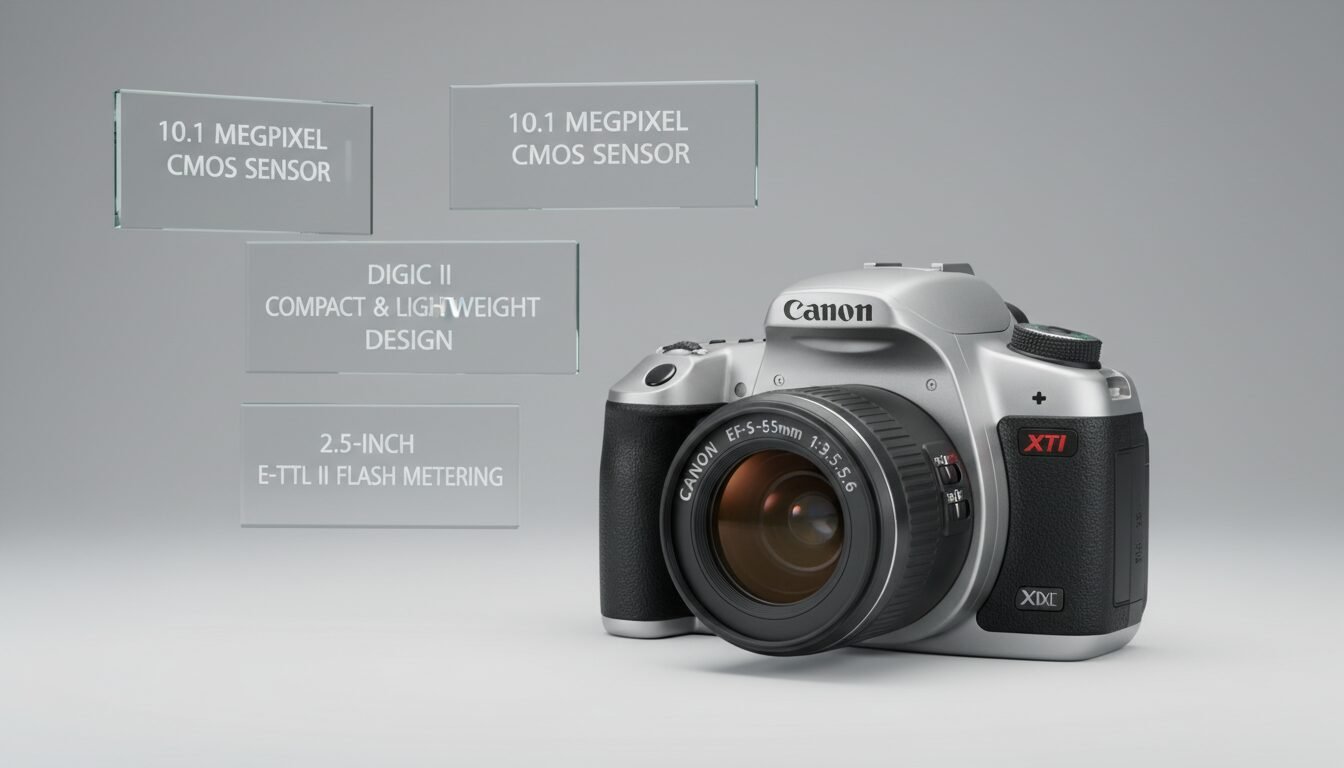
The XTi’s spec sheet reads like a photography textbook—everything you need, nothing you don’t. Here’s what powers this learning machine:
Imaging Pipeline
- Sensor: 10.1 effective megapixels APS-C CMOS (22.2 × 14.8 mm)
- Processor: DIGIC II
- File formats: JPEG (Exif 2.2), RAW
- ISO range: 100–1600
Viewfinder and Display
- Viewfinder: Eye-level pentamirror, 95% coverage
- LCD monitor: 2.5-inch TFT color LCD, 230,000 dots
- Live View: Not available
Performance and Storage
- Shutter speeds: 30 sec to 1/4000 sec + Bulb
- Continuous shooting: Up to 3 frames per second for 27 JPEG / 10 RAW
- Startup time: Approximately 0.2 seconds
- Memory card: CompactFlash (CF) Type I / II
- Battery: NB-2LH rechargeable lithium-ion (approx. 360 shots per charge)
Is the Camera Canon Digital Rebel XTi Still Relevant in 2026?
Absolutely—but for specific reasons that have nothing to do with pixel counts or processing power. The XTi teaches you to see light, understand exposure, and compose deliberately because it won’t do the thinking for you.
Where the XTi Shines
The camera Canon Digital Rebel XTi forces you to master exposure, composition, and manual settings because its feature set stays beautifully simple. There’s no eye-tracking AI, no automatic scene recognition—just a camera that rewards understanding. This makes it a discipline-building tool. Its 10.1 megapixels deliver enough resolution for high-quality prints up to 18 × 24 inches, and files remain manageable for older computers. Used prices according to current Amazon Refurbished pricing show a body alone at just $99 and a kit with the EF-S 18-55mm lens around $164. This entry cost is hard to beat.
Everyday Limitations
Low-light autofocus hunts noticeably in dim rooms, and anything above ISO 800 introduces significant noise. The small, low-resolution screen makes reviewing focus tricky, and the absence of video recording or Live View limits creative options. The camera Canon Digital Rebel XTi also uses CompactFlash cards, which are less common in 2026 and require a dedicated reader. Battery life runs about 360 shots per charge—acceptable but half what many newer DSLRs achieve. If you plan to shoot sports or indoor events, you’ll quickly hit the XTi’s ceiling.
Modern Software Breathes New Life
One under-appreciated advantage is the availability of free, powerful post-processing software. Canon’s own Digital Photo Professional 4 (DPP4) is free to download and supports the XTi’s RAW files, allowing detailed noise reduction, lens corrections, and color tuning. Combined with the RAW workflow, you can extract noticeably better dynamic range and sharpness than the camera’s built-in JPEG engine provides. This transforms the camera Canon Digital Rebel XTi into a surprisingly capable machine for deliberate still-life, landscape, and portrait work.
Lens Options and Creative Expansion

The real magic happens when you start exploring glass. The XTi’s Canon EF mount opens up decades of optical excellence at every price point.
The Kit Lens: EF-S 18-55mm f/3.5-5.6
Most used XTi bundles include the Canon EF-S 18-55mm f/3.5-5.6 lens. It covers a practical zoom range from wide-angle to short telephoto, equivalent to roughly 29–88mm on full frame. Optical performance is decent when stopped down to f/8–f/11, making it a fine starter for landscapes and general snapshots. However, the variable aperture limits background blur and low-light ability.
Portrait and Prime Lens Upgrades
For those wanting to shoot portraits with shallow depth of field, the EF 50mm f/1.8 STM is an affordable, razor-sharp option. It effectively becomes an 80mm equivalent on the XTi’s crop sensor—ideal for flattering headshots. Users in Canon community discussions frequently praise this lens as the best sub-$150 upgrade for the XTi. Other choices include the EF-S 24mm f/2.8 STM for a 38mm equivalent walk-around prime and the EF 85mm f/1.8 USM for tighter portraits.
Adapting Vintage Manual Lenses
Because the camera Canon Digital Rebel XTi uses the Canon EF mount, you can attach inexpensive adapters for M42, Nikon F, or Pentax K manual lenses. These vintage lenses—often available for under $50—deliver characterful rendering and a tactile, all-manual shooting experience that deepens your understanding of exposure. The XTi’s bright viewfinder and focus confirmation light help nail sharp focus without modern aids. This opens a world of affordable creative glass far beyond the Canon ecosystem.
Comparison: Canon Digital Rebel XTi vs. XT vs. XSi
To understand where the XTi fits in Canon’s entry-level timeline, let’s examine how it evolved from the XT and influenced the XSi. Each generation brought meaningful improvements while keeping the user-friendly philosophy intact.
Evolution of the Rebel Series
| Feature | Canon Rebel XT (350D) | Canon Rebel XTi (400D) | Canon Rebel XSi (450D) |
|---|---|---|---|
| Release Year | 2005 | 2006 | 2008 |
| Sensor Resolution | 8.0 MP | 10.1 MP | 12.2 MP |
| ISO Range | 100–1600 | 100–1600 | 100–1600 |
| AF Points | 7 (center cross-type) | 9 (center cross-type f/2.8) | 9 (center cross-type) |
| Continuous Shooting | 2.8 fps (14 JPEG) | 3.0 fps (27 JPEG) | 3.5 fps (53 JPEG) |
| LCD Monitor | 1.8″ 115k dots | 2.5″ 230k dots | 3.0″ 230k dots |
| Live View / Video | No | No | Yes (Live View only) |
| Storage Media | CompactFlash | CompactFlash | SD/SDHC |
| Dust Reduction | No | Yes (self-cleaning sensor) | Yes (EOS Integrated Cleaning System) |
The XTi sits in a sweet spot: significantly more megapixels and a bigger LCD than the XT, yet still purely a stills camera without the complexity of Live View. The XSi added SD card compatibility and Live View, making it more convenient but arguably less focused on the fundamentals.
Tips for Getting the Best Out of Your XTi
These three techniques will transform your results and accelerate your learning curve with this classic DSLR.
Step 1: Shoot in RAW
Set the image quality to RAW (or RAW+JPEG) immediately. RAW files contain far more tonal data than JPEGs, letting you recover shadow detail, adjust white balance without artifacts, and apply modern noise reduction in post. Canon’s free DPP4 software or Lightroom can process these files with dramatic improvements over in-camera JPEGs. This single change makes the camera Canon Digital Rebel XTi capable of results that rival much newer bodies in controlled lighting.
Step 2: Use Center-Point Focus and Recompose
The center AF point is the most sensitive, so lock focus with a half-press on it, then recompose your frame before fully pressing the shutter. This technique increases your hit rate in any light and is a fundamental skill that translates to all advanced cameras.
Step 3: Master Manual Mode with the Light Meter
Switch to M mode and use the viewfinder’s exposure scale. Start by setting ISO 200 outdoors, 400 indoors, and adjust shutter/aperture until the marker centers. The camera Canon Digital Rebel XTi rewards patient practice—soon you’ll be able to predict settings and get consistently exposed images without any automation.
Frequently Asked Questions
Is the Canon Digital Rebel XTi good for beginners in 2026?
Yes. The camera Canon Digital Rebel XTi covers all manual controls and produces good daylight images, making it an excellent low-cost tool to learn exposure, composition, and lens selection before investing in more expensive gear.
What memory card does the Canon Digital Rebel XTi use?
It uses CompactFlash (CF) cards, including Type I and II, which are still available from brands like SanDisk and Lexar. A USB CF reader is required for modern computers.
Can the Canon Digital Rebel XTi shoot video?
No. The XTi is a stills-only DSLR with no video recording or Live View functionality. It’s purely designed for photography.
What lenses are compatible with the Canon Digital Rebel XTi?
All Canon EF and EF-S autofocus lenses work, plus many vintage manual lenses via adapters. The native EF-S 18-55mm kit lens is the most common starting point.
How does the Canon Digital Rebel XTi compare to a modern smartphone camera?
In good light and with a quality lens, the XTi can capture more detail and true optical depth of field than a smartphone. However, phones vastly outperform it in low light, HDR processing, and video capabilities.
What is the battery life of the Canon Digital Rebel XTi?
The NB-2LH battery delivers approximately 360 shots per charge under standard testing conditions. Carrying a spare is recommended for a full day of shooting.
Final Thoughts: Why the Camera Canon Digital Rebel XTi Endures
The camera Canon Digital Rebel XTi represents a vanishing breed: a digital camera that behaves like an analog tool, demanding discipline and rewarding skill. Twenty years after its launch, it teaches photographic principles in a way that feature-packed modern cameras often bypass. While not for every task, the combination of a 10.1-megapixel sensor, vast lens ecosystem, and a used price that dips below $100 for the body alone makes it a compelling choice for students, hobbyists, and anyone wanting to rediscover the joy of deliberate image-making. If you find one in good condition, pair it with a sharp prime lens, shoot RAW, and you’ll be amazed at what this modest box can still deliver.
Contact Emin Media for a free brand consultation.
Enjoyed this article?
Contact Emin Media for a free brand consultation and let's create something amazing together.
Get in Touch