Canon 20D Digital SLR Camera: Full 2026 Review
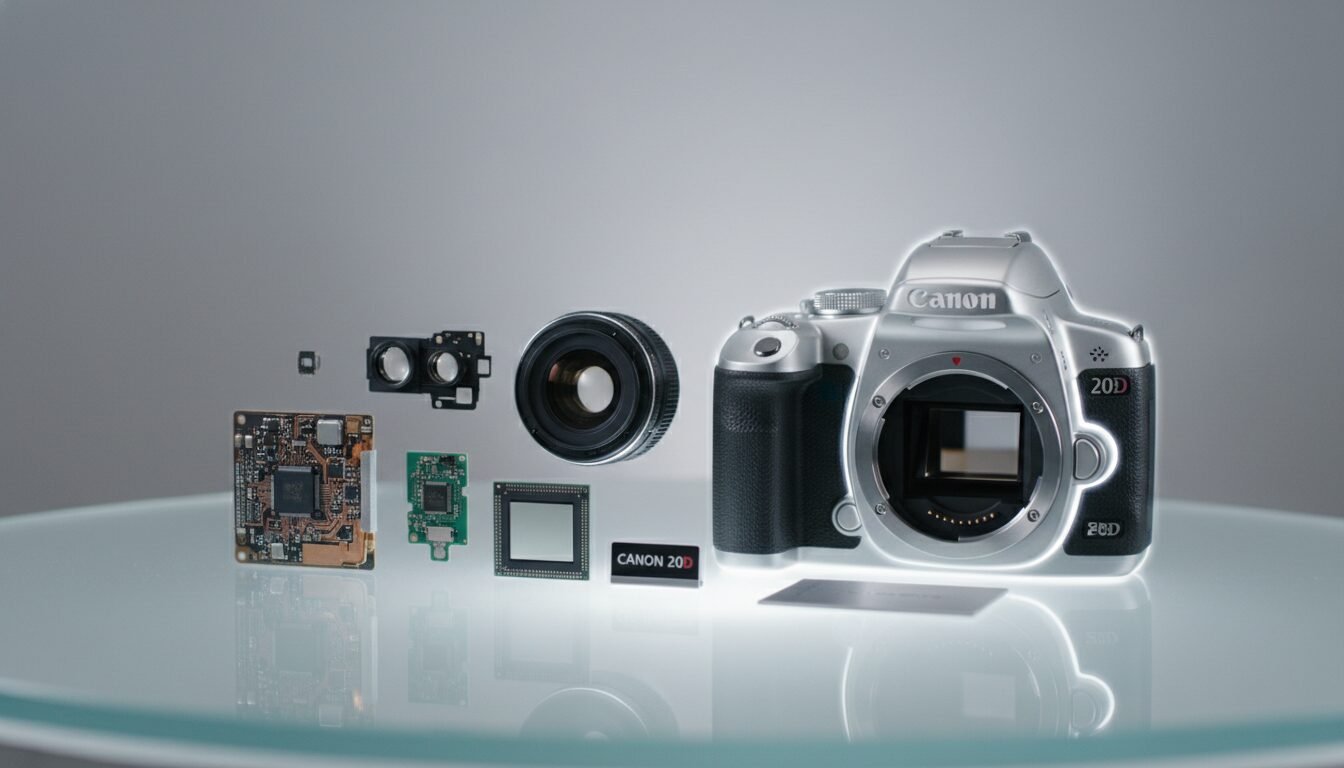
The canon 20d digital slr camera is a semi-professional 8.2-megapixel APS-C DSLR released by Canon in August 2004, built around a DIGIC II processor, 5 fps burst shooting, and a magnesium-alloy body that still feels solid two decades later.
Key Takeaways
- The Canon 20D digital SLR camera features an 8.2-megapixel APS-C CMOS sensor paired with a DIGIC II processor for warm, film-like color output.
- Used bodies sell for $45–$150 in 2026, making it one of the most affordable entry points into Canon’s EF lens system.
- It shoots at 5 frames per second with a 9-point autofocus system, still capable for pets, sports, and wildlife on a budget.
- No video or live view: this is a pure stills camera that forces you to master exposure fundamentals.
- The vintage color rendition has fueled a collector trend, with the #digicam movement driving renewed interest across Instagram and TikTok.
- Originally priced at $1,499 with an 18-55mm kit lens, the 20D now costs roughly 90% less on the used market.
Canon 20D Digital SLR Camera Specifications
The Canon 20D digital SLR camera is defined by a 22.5 mm × 15.0 mm CMOS sensor resolving 8.2 megapixels (3504 × 2336 pixels), a spec sheet that was genuinely impressive for its $1,499 launch price in 2004. Below is a quick-reference breakdown of every key number.
Sensor and Processor
Canon’s DIGIC II image processor handles noise reduction and color processing, delivering usable images up to ISO 1600, with ISO 3200 available via custom function. According to Wikipedia, this was a meaningful step up from the previous 6.3 MP EOS 10D, offering both higher resolution and faster processing in the same semi-pro body class.
Body and Controls
Weighing 770 grams with the BP-511A battery, the magnesium-alloy body measures 144 × 106 × 72 mm. The top LCD panel, rear quick-control dial, and deep ergonomic grip reflect Canon’s semi-professional design philosophy. A 1.8-inch TFT-LCD with 118,000 pixels handles menu navigation and image review. There is no live view and no video, full stop.
Storage and Battery
Images are stored on CompactFlash Type I/II cards or Microdrives, with usable capacity up to 8 GB (16 GB on some cards with firmware 2.0.3). The rechargeable BP-511A lithium-ion battery delivers approximately 500 shots per charge under CIPA testing standards, a figure that impressed prosumers in 2004 and still holds up for a day of casual shooting.
Image Quality of the Canon 20D Digital SLR Camera
The Canon 20D digital SLR camera produces images that punch well above its current price tag, especially in RAW format where the DIGIC II color matrix shows its character most clearly.
Resolution and Detail
The 8.2 MP resolution yields clean prints up to 11 × 14 inches at 300 dpi without interpolation. Files show sharp detail at low ISO, though the anti-aliasing filter introduces slight softness that rewards careful sharpening in post-processing. Most users find the JPEG engine produces pleasing skin tones and vibrant colors straight out of camera, which is part of why this body has aged so well.
“The 20D’s image quality, especially when shooting RAW, is still impressive for online sharing and small prints. The color rendition has a character that many modern sensors lack.” Christopher J Osborne, classic camera reviewer
ISO Performance
Native ISO spans 100–1600, with ISO 3200 available via custom function. Noise stays well-controlled up to ISO 800. Grain becomes visible at ISO 1600 but remains acceptable for documentary and street work. Modern cameras offer cleaner high-ISO results, yet the 20D’s output retains a film-like texture that a growing number of photographers actively seek out.
Color Science and the Vintage Digital Look
The DIGIC II processor applies a unique color matrix that enthusiasts consistently describe as warm and filmic. This has sparked real collector interest among vintage digital camera buyers who value the 20D’s specific rendering for portraits and landscapes. Side-by-side with a modern 24 MP sensor, the 20D’s files look less clinical a quality at the center of the broader “digicam” revival happening right now across social media.
Autofocus and Burst Shooting
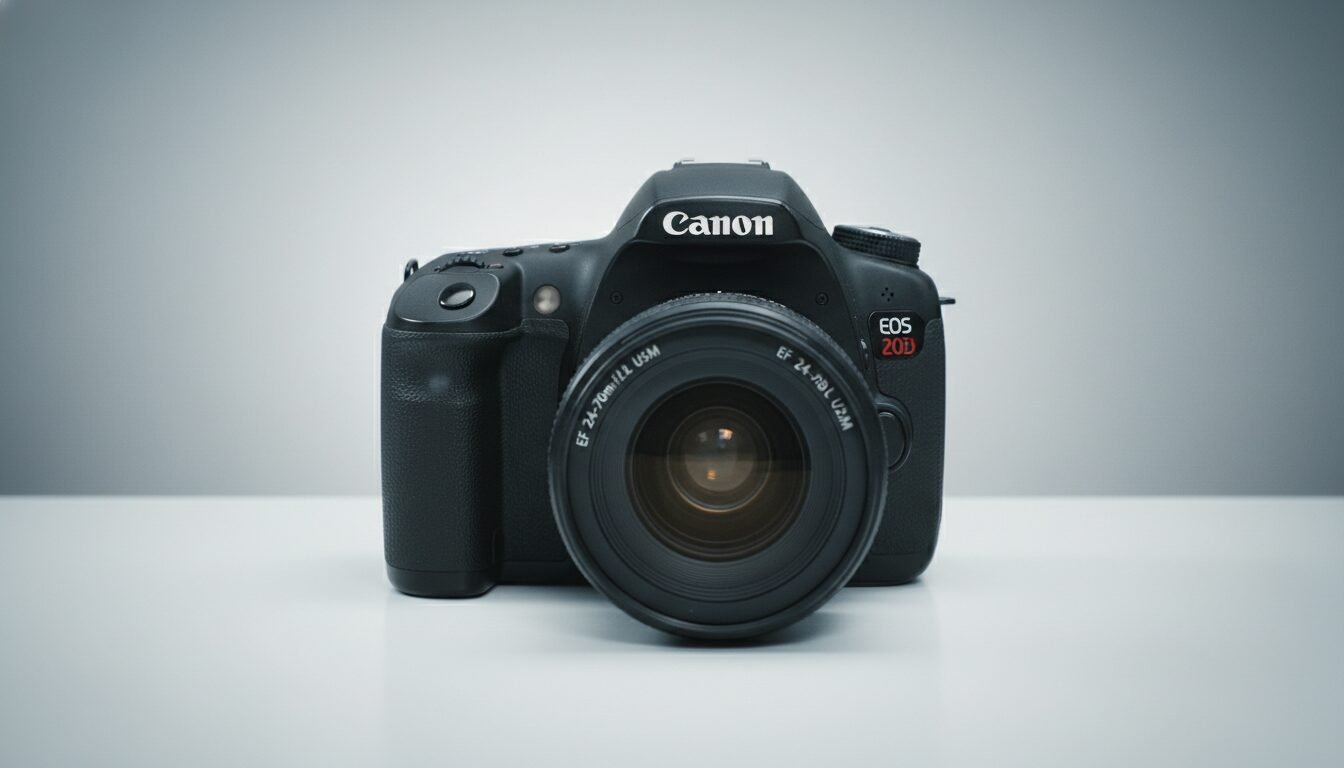
The Canon 20D digital SLR camera’s autofocus and drive system was class-leading in 2004 and still holds its own for casual action shooting in 2026.
9-Point AF System
Canon equipped the 20D with a 9-point autofocus module sensitive down to -0.5 EV, meaning it locks focus in dim light where many budget cameras struggle. The center point is cross-type for f/2.8 or faster lenses. The pentaprism optical viewfinder offers 95% coverage and 0.9× magnification, giving a bright, direct view that teaches composition discipline in a way no electronic viewfinder can replicate.
5 FPS Continuous Drive
A burst rate of 5 frames per second with a buffer of 23 JPEGs or 6 RAW files makes the Canon 20D digital SLR camera a capable budget sports and wildlife tool. Buffer clearing takes approximately 13 seconds to a fast CompactFlash card, which limits sustained action sequences. That burst speed was class-leading at launch and still matches or beats several modern entry-level DSLRs priced at $350 or more.
Real-World Shooting Scenarios
Pet photographers appreciate the shutter lag of just 65 milliseconds. Wedding photographers in the mid-2000s routinely carried a 20D as a backup body, trusting its reliable metering and E-TTL II flash system. Today, it serves as a budget-friendly tool for learning exposure fundamentals without the safety net of scene modes or AI assistance.
Why the Canon 20D Digital SLR Camera Still Matters in 2026
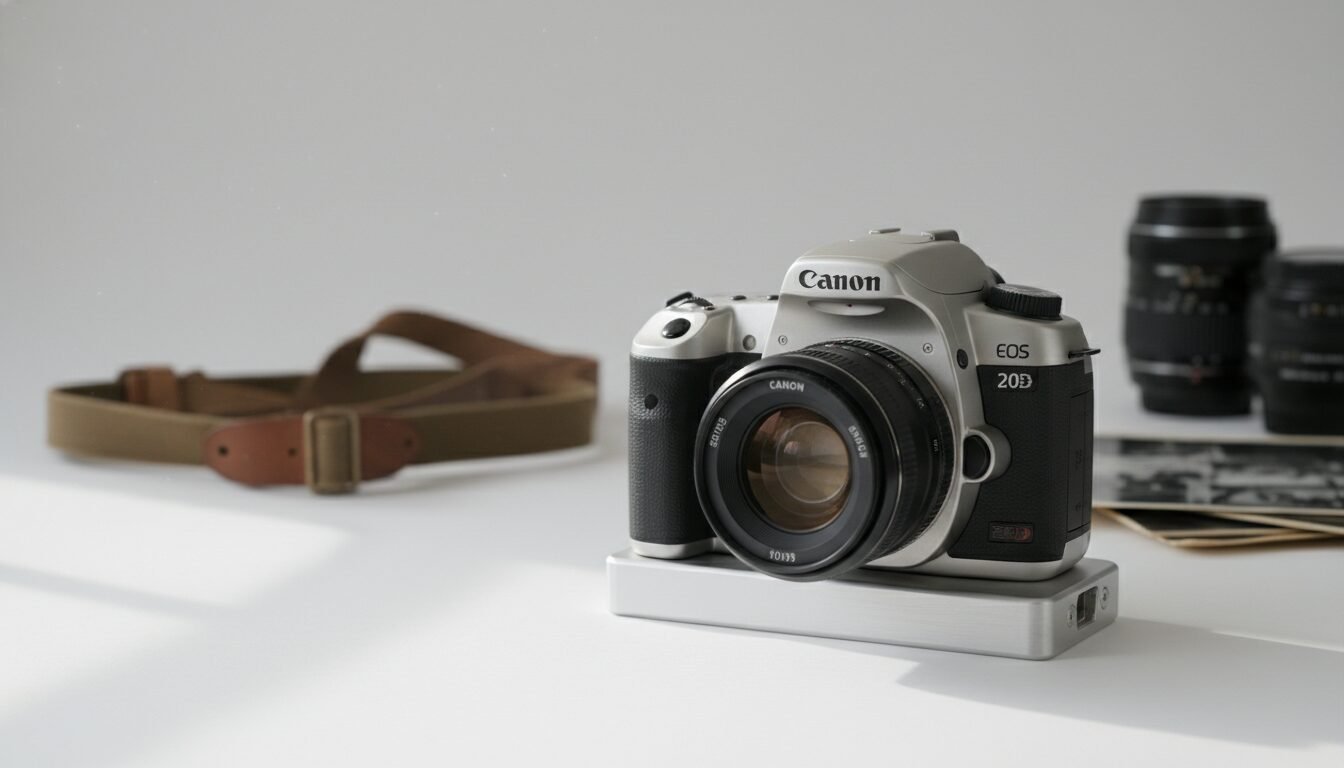
The Canon 20D digital SLR camera matters in 2026 because it combines a sub-$150 price point with a complete, distraction-free shooting experience that modern cameras at any price cannot replicate.
The Ultimate Learning Tool
Without scene modes, touchscreens, or AI assistants, the 20D forces you to master the exposure triangle. Its optical pentaprism viewfinder provides a direct, lag-free view that builds composition instincts fast. Many photography educators recommend a used 20D as a first camera precisely because it removes every shortcut and makes you think before you shoot.
“The Canon 20D digital SLR camera was my first real digital photography tool. It taught me the importance of exposure, composition, and light without any distractions.” Nando Harmsen, photographer and Fstoppers contributor
Affordable Access to Canon’s EF Lens System
With used EF and EF-S lenses available from $50–$300, building a full kit around a $75 camera body opens serious creative possibilities. A 50mm f/1.8 STM lens pairs beautifully with the 20D for portraits (rendering an effective 80mm field of view on the 1.6× crop sensor), while an EF-S 55-250mm covers telephoto needs for under $100 used. This is one of the lowest-risk paths into interchangeable-lens photography available anywhere.
The Vintage Digital Movement
On Instagram and TikTok, the hashtag #digicam has accumulated billions of views as of 2026. The Canon 20D digital SLR camera’s color output, combined with its tactile handling, places it at the center of this cultural shift. It delivers an authentic early-2000s digital aesthetic that smartphone filters simply cannot replicate with any accuracy.
Pros and Cons of the Canon 20D Digital SLR Camera
The Canon 20D digital SLR camera offers a compelling mix of strengths and real limitations. Here is an honest breakdown before you buy.
Pros
- Exceptional value: Used bodies cost $45–$150, roughly 90% less than the original $1,499 launch price.
- Fast burst shooting: 5 fps with a 23-JPEG buffer still matches or beats many modern budget DSLRs.
- Distinctive color science: The DIGIC II color matrix produces warm, filmic tones that modern sensors do not replicate.
- Rugged build quality: Magnesium-alloy construction at 770 g feels solid and professional in hand.
- Full EF lens compatibility: Access to over 200 Canon EF and EF-S optics, plus adaptable vintage glass.
- Teaches fundamentals: No scene modes or AI assistance forces genuine skill development.
Cons
- No video: Stills only. If video matters at all, look elsewhere.
- No live view: Composing via the rear screen is not possible.
- Limited ISO range: ISO 1600 native (3200 extended) versus ISO 12800+ on modern entry-level bodies.
- Outdated screen: The 1.8-inch, 118,000-dot LCD is tiny and low-resolution by any current standard.
- CompactFlash storage: CF cards are harder to find and more expensive per gigabyte than SD cards.
- No self-cleaning sensor: Manual cleaning required, which adds maintenance overhead.
Buying a Canon 20D Digital SLR Camera: Step-by-Step
Buying a used Canon 20D digital SLR camera takes about 20 minutes of due diligence if you know what to check. Follow these four steps to avoid a bad purchase.
Step 1: Determine Your Budget
Used bodies range from $45 (bargain grade) to $150 (excellent+), according to KEH. Kits with a battery, charger, and card often run higher. Set aside $20–$40 for a quality 8 GB CompactFlash card and a spare BP-511A battery. Total all-in budget: $100–$200 for a complete shooting kit.
Step 2: Check Shutter Count and Physical Condition
The 20D does not store shutter count in EXIF data, so rely on visual cues: clean exterior, intact port covers, and smooth dials. Test every button and the pop-up flash. A musty odor or corrosion near the battery compartment signals moisture damage walk away.
Step 3: Verify Sensor Cleanliness
Set the camera to Av mode at f/22, shoot a plain white surface, and inspect the image for dust spots. The 2004-era sensor has no self-cleaning mechanism, so occasional manual cleaning is normal. Heavy staining or visible scratches on the sensor warrant a pass.
Step 4: Ensure Firmware is Up-to-Date
The final firmware version is 2.0.3, which improved CompactFlash card compatibility and fixed several bugs. Download it from Canon’s support site if needed. Updated firmware also enables use of 8 GB and larger CF cards, which matters for modern shooting sessions.
How the Canon 20D Stacks Up Against Modern Cameras
The Canon 20D digital SLR camera costs roughly 80% less than a modern entry-level DSLR and trades video capability for a burst speed that still competes. The table below makes the tradeoffs clear.
| Feature | Canon 20D (2004) | Canon EOS Rebel T7 (2018) | Canon EOS R100 (2023) |
|---|---|---|---|
| Sensor Resolution | 8.2 MP APS-C | 24.1 MP APS-C | 24.1 MP APS-C |
| ISO Range | 100–1600 (3200 ext.) | 100–6400 (12800 ext.) | 100–12800 (25600 ext.) |
| Burst Rate | 5 fps (23 JPEG / 6 RAW) | 3 fps (150 JPEG / 11 RAW) | 6.5 fps (3.5 with AF) |
| Video | None | 1080p Full HD | 4K 24p / 1080p 60p |
| Screen | 1.8-inch / 118k dots | 3-inch / 920k dots | 3-inch / 1.04M dots |
| Weight (body) | 770 g | 475 g | 356 g |
| Used Price Range (2026) | $50–$150 | $350–$450 | $400–$550 |
The 20D’s 5 fps burst speed actually exceeds the Rebel T7’s 3 fps, which is a striking fact given the 14-year gap between them. What you give up is video, a modern screen, and clean high-ISO performance. For pure still photography on a tight budget, the tradeoff is easy to justify.
Lens Compatibility and Creative Options
The Canon 20D digital SLR camera accepts every Canon EF and EF-S lens ever made, giving access to over 200 optics across a wide price range.
EF and EF-S Lenses
Popular pairings include the EF 50mm f/1.8 STM (effective 80mm portrait focal length on the 1.6× crop sensor) and the EF-S 24mm f/2.8 STM pancake for discreet street photography. Both lenses are available used for under $100, keeping your total kit cost well below $250.
Adapting Vintage Manual Lenses
With a simple adapter, M42, Pentax K, or Nikon F lenses mount easily. Stop-down metering works, though focus confirmation is absent. This opens a world of inexpensive manual glass with distinctive rendering, a favorite approach for experimental and fine-art photographers who want character over clinical sharpness.
Flash and Accessory Support
E-TTL II flash metering works with all Canon EX-series Speedlites. The hot shoe accepts radio triggers for off-camera flash, making the Canon 20D digital SLR camera a capable tool for learning studio lighting on a minimal budget. Wireless TTL requires an ST-E2 transmitter or a master flash on camera. Third-party battery grips from brands like Meike are also available for under $30, extending battery life and improving handling for vertical shooting.
The Canon 20D in Context: 10D, 20D, and 30D Progression
Understanding where the Canon 20D digital SLR camera sits in Canon’s EOS lineup helps clarify exactly what you are buying and what came before and after it.
The EOS 10D (2003) offered 6.3 MP and a 3 fps burst rate. The 20D arrived in 2004 with a jump to 8.2 MP and 5 fps, plus the faster DIGIC II processor. Canon then released the EOS 30D in 2006, adding a larger 2.5-inch LCD, spot metering, and a slightly improved buffer. The 20D sits squarely in the middle of this progression: more capable than the 10D in every meaningful way, and close enough to the 30D that the upgrade is optional rather than essential for most users. According to camera industry data, Canon sold the 20D at a launch price of $1,499 with the 18-55mm kit lens, positioning it as a direct competitor to the Nikon D70 in the enthusiast segment.
Frequently Asked Questions
What is the Canon 20D digital SLR camera?
The Canon 20D digital SLR camera is a semi-professional DSLR announced in August 2004, featuring an 8.2 MP APS-C CMOS sensor, DIGIC II processor, 5 fps burst, and a rugged magnesium-alloy body. It was aimed at enthusiast photographers wanting advanced manual controls without a full-frame price tag.
Is the Canon 20D good for beginners in 2026?
Yes. Its manual controls and optical viewfinder teach exposure fundamentals effectively, and the lack of live view and video reduces complexity rather than adding it. For under $100, a used Canon 20D digital SLR camera with a kit lens provides a low-cost, distraction-free way to learn DSLR photography.
What lenses work with the Canon 20D?
All Canon EF and EF-S lenses are compatible, covering everything from ultra-wide to super-telephoto. Third-party lenses from Sigma, Tamron, and Tokina in the EF mount also work. Vintage manual lenses from M42, Pentax K, and Nikon F mounts can be adapted with inexpensive third-party adapters.
Does the Canon 20D record video?
No, the Canon 20D digital SLR camera cannot record video. It is a stills-only camera by design. If video is essential to your workflow, consider a Canon EOS Rebel T5i or any mirrorless body in the EOS R lineup.
How much does a used Canon 20D cost?
Prices in 2026 range from $45 to $150 for the body alone, depending on condition. Kits with a battery, charger, and lens may sell for $100–$200 on eBay or through KEH. The original launch price was $1,499, making today’s used pricing one of the steepest value drops in DSLR history.
What memory card does the Canon 20D use?
It uses CompactFlash (CF) Type I or Type II cards. The largest reliably usable capacity is 8 GB, though some 16 GB cards work with firmware 2.0.3 or later installed. Modern CF cards are readily available online from brands like SanDisk and Lexar.
Enjoyed this article?
Contact Emin Media for a free brand consultation and let's create something amazing together.
Get in Touch