Camera Sony Digital 8 Handycam: Complete 2026 Buying Guide
Key Takeaways
- Camera sony digital 8 handycam records digital video on Hi8 tapes and plays all 8mm, Hi8, and Digital8 cassettes.
- Key features include FireWire (IEEE 1394) output for lossless digital transfer to a computer.
- Top models like the Sony DCR-TRV820, DCR-TRV280, and DCR-TRV460 offer varying zoom, LCD sizes, and special features.
- Used and refurbished units are available from $100 to $350, making digitization affordable.
- A 5-step FireWire method ensures high-quality digitization of analog tapes without conversion artifacts.
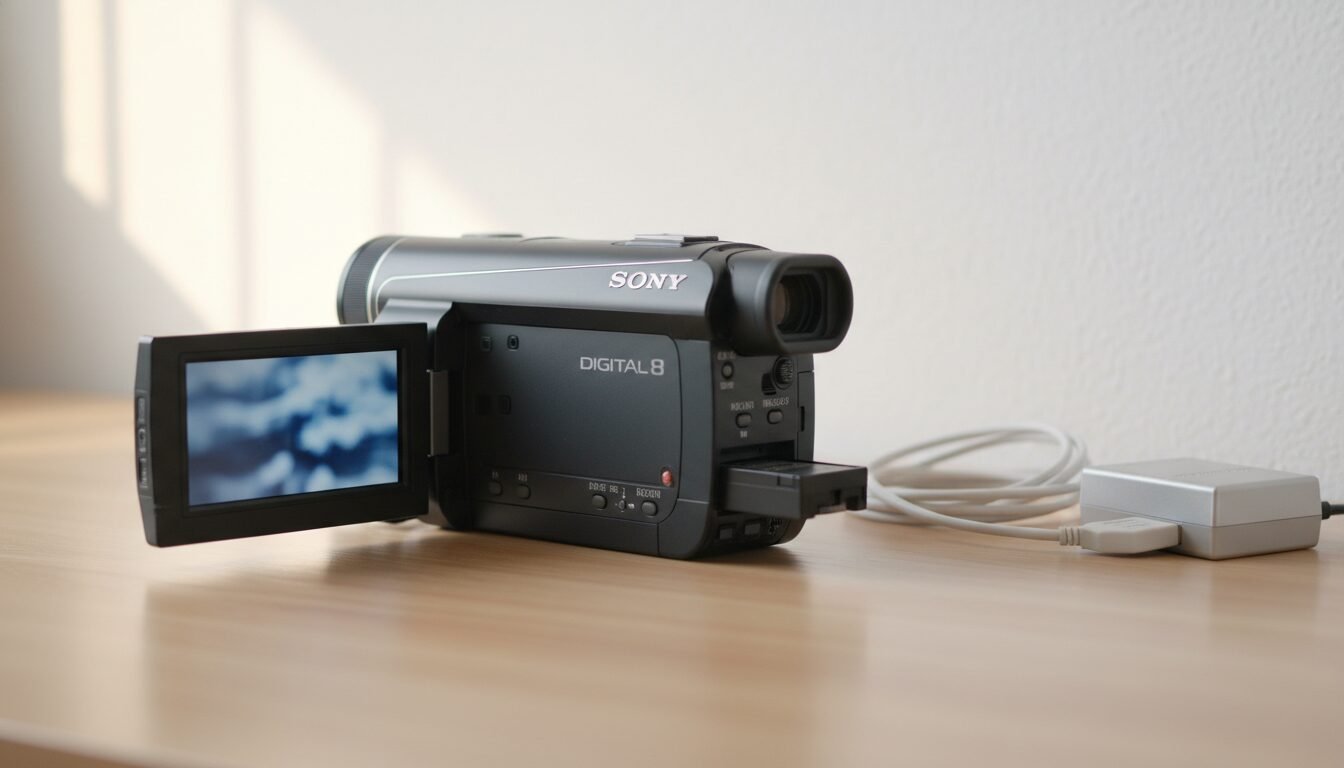
Camera sony digital 8 handycam is a digital video camcorder that records in the Digital8 format, introduced by Sony in 1999.
What is the Camera Sony Digital 8 Handycam?
Media” class=”wp-image-9747″ loading=”lazy” width=”1792″ height=”1024″ />Digital8 Format Overview
The 8 handycam uses the Digital8 format, developed by Sony to bridge analog tape recording with digital video standards. It records on standard Hi8 cassettes—measuring 95 mm × 62.5 mm × 15 mm—but captures digitally using the DV codec. This delivers video and audio quality identical to MiniDV, with up to 500 lines of horizontal resolution and 16-bit PCM stereo audio. The helical scan head drum spins 2.5 times faster than analog Hi8, enabling digital recording at 29 mm per second tape speed.
Compatibility and Playback
One of the greatest strengths of any these handycam is its backward compatibility. A single device can play all three generations of 8mm tape: the original analog Video8, the higher-resolution Hi8, and Digital8 recordings. This feature makes these camcorders essential for families and archivists needing to digitize old home videos. Many later models, such as the DCR-TRV460, also offer analog passthrough, allowing direct conversion of analog inputs to digital output through the FireWire port.
Digital8 vs. MiniDV
While both formats share the same digital signal, they differ in physical media. The such 8 handycam uses wider 8mm tape, which some users argue is more durable over time. According to a Wikipedia article, Digital8 cassettes run at a slightly faster linear tape speed (29 mm/s vs. 19 mm/s for MiniDV), potentially improving long-term reliability. Users report Digital8 tapes have survived decades with fewer dropouts than MiniDV tapes.
The Evolution of the Digital8 Format
Sony’s Launch in 1999
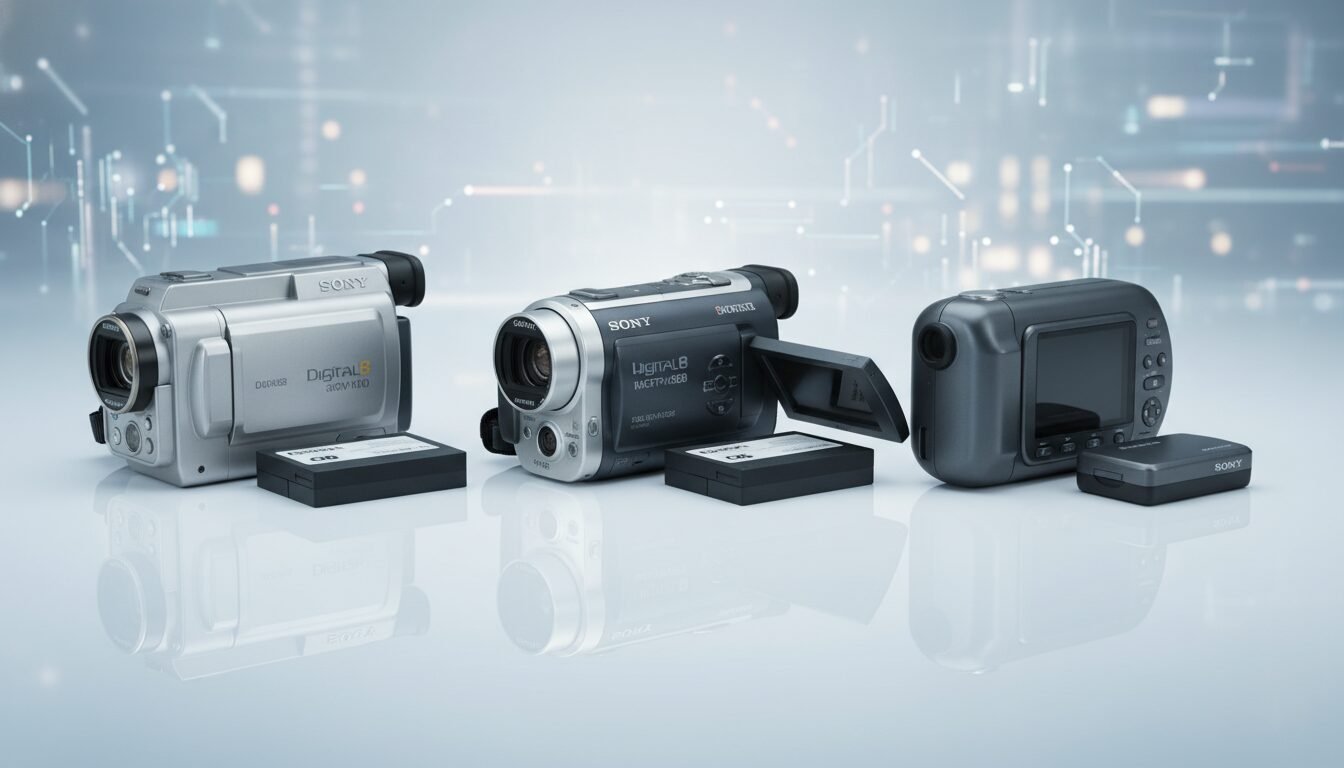
Sony introduced Digital8 in 1999, aiming to provide a digital upgrade path for millions of consumers who owned Hi8 camcorders. The first the sony digital 8 handycam models, like the DCR-TRV110 and TRV320, established core features: DV-quality recording, IEEE 1394 output, and compatibility with existing tapes. Sales were concentrated in North America, Europe, and Japan, where the 8mm format had been dominant.
Generational Improvements
Over its 8-year production span, Sony released several generations of Digital8 Handycams. Early models had basic CCD sensors and limited stabilization. The final generation, launched in 2004 and sold through 2007, included models like the DCR-TRV460 and TRV740. These featured improved 1/6-inch or 1/4-inch CCDs with 460,000 effective pixels, SteadyShot electronic image stabilization, and NightShot Plus infrared mode for low-light shooting.
Why Digital8 Was Discontinued
Despite its advantages, the handycam lost ground to MiniDV and later tapeless formats like DVD and hard disk camcorders. The larger cassette size was less convenient for a market that began valuing compactness. By 2007, Sony ceased production, and the format became a niche choice for tape digitization. However, in 2026, a resurgence of interest in vintage video has given these camcorders new life.
Key Features of Sony Digital8 Handycam Models
Optical Zoom and Digital Zoom
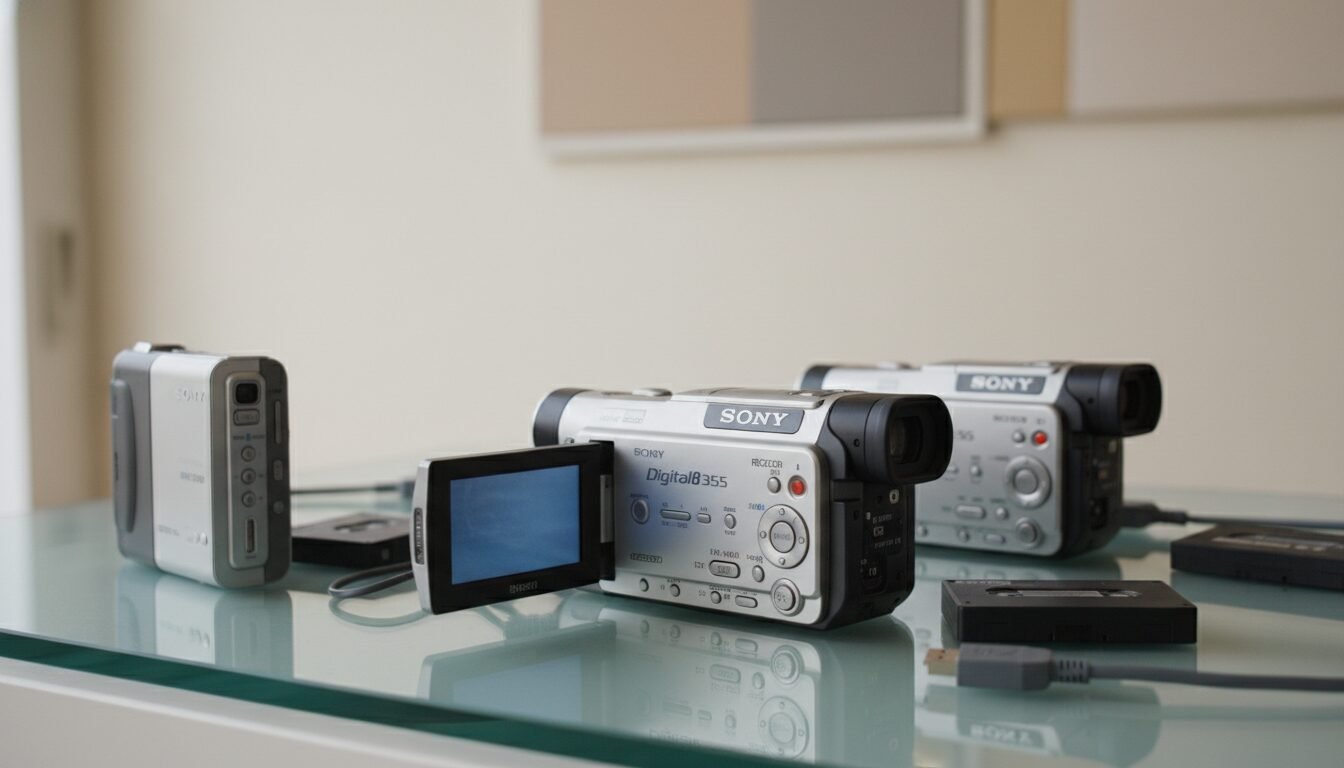
Most camera sony models offer impressive zoom ranges. The Sony DCR-TRV820 features a 25× optical zoom and 450× digital zoom, while the DCR-TRV280 provides 20× optical and 990× digital zoom. The higher optical zoom of the TRV820 is better for distant subjects without digital degradation, but the TRV280’s extreme digital zoom can be useful in certain situations, albeit with quality loss.
LCD Screens and Viewfinder
Models vary in screen size. The premium DCR-TRV820 sports a large 4-inch flip-out color LCD, which Videomaker noted was excellent for monitoring shots. In contrast, the more common DCR-TRV280 includes a 2.5-inch swivel LCD. Both also include a color eyepiece viewfinder that helps conserve battery power during extended shooting.
Connectivity and Ports
Essential for digitization, all 8 handycam models carry a FireWire (IEEE 1394 or i.LINK) port for lossless digital transfer. Additionally, they provide analog AV outputs (composite and S-Video) and, on some higher-end units, microphone and headphone jacks. The presence of S-Video is particularly valuable, as it delivers a cleaner analog signal than composite when connecting to capture devices.
Pros and Cons
Pros
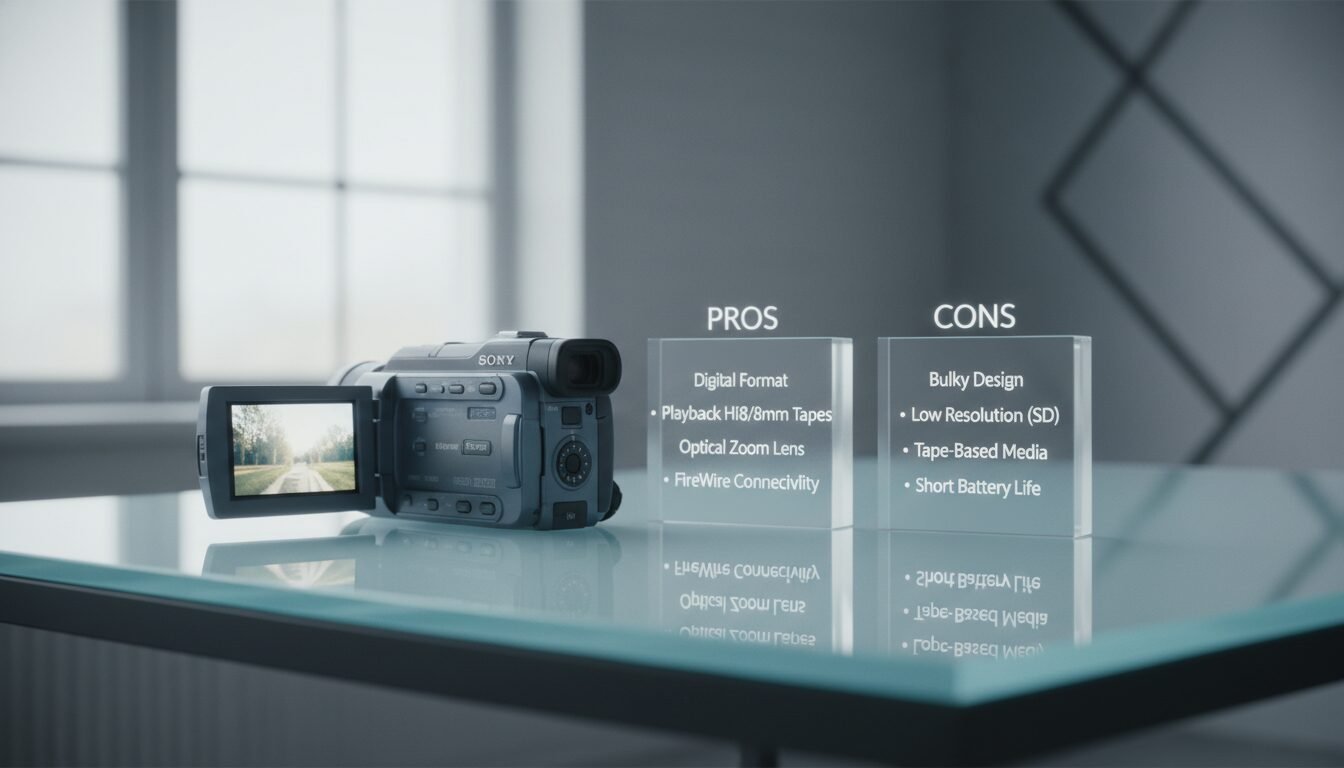
- Backward compatibility with Video8, Hi8, and Digital8 tapes
- FireWire output for lossless digital transfer
- DV-quality recording with 500 lines of resolution
- Affordable used market pricing from $100-$350
- Larger tape format potentially more durable than MiniDV
Cons
- Aging hardware with potential mechanical failures
- FireWire ports absent from modern computers
- Limited battery life on original cells
- Replacement parts increasingly scarce
- Larger cassette size less portable than MiniDV
Comparing Digital8 with Other Camcorder Formats
To understand where the these handycam fits in the broad landscape of consumer video, examine this side-by-side comparison with analog Hi8 and digital MiniDV:
| Feature | Digital8 | MiniDV | Hi8 (Analog) |
|---|---|---|---|
| Recording Type | Digital (DV codec) | Digital (DV codec) | Analog |
| Tape Width | 8 mm | 6.35 mm | 8 mm |
| Max. Recording Time (SP) | 60 min on 120-min tape | 60 min on 60-min tape | 120 min on 120-min tape |
| Horizontal Resolution | 500 lines | 500 lines | 400 lines |
| Audio | 16-bit PCM stereo | 16-bit PCM stereo | FM mono/stereo |
| Digital Output | FireWire | FireWire | None |
Compared to analog Hi8, the such 8 handycam offers a 25% increase in horizontal resolution and vastly superior digital audio. Against MiniDV, the Digital8 format provides a larger tape cassette that some professionals believe is less prone to jamming, though it sacrifices portability. Importantly, a Digital8 camcorder can often digitize analog Hi8 tapes directly through its FireWire output—something a MiniDV camcorder cannot do without an external analog-to-digital converter.
Popular Sony Digital8 Handycam Models
Sony DCR-TRV820 – The Printer Camcorder
This model stands out for a unique feature: a built-in color printer. Released in the early 2000s, the DCR-TRV820 could print business-card sized images directly from still frames or captured stills stored on a Memory Stick.
“The bar has been raised in the Sony Digital8 camcorder format with the DCR-TRV820, the gem of their Digital8 camcorders,” according to Videomaker.
Its 25× optical zoom and manual focus ring make it appealing for hobbyists who want more control. However, it lacks manual white balance, so it’s not ideal for advanced color-critical work.
Sony DCR-TRV280 – The Budget Workhorse
One of the last Digital8 models, the DCR-TRV280 is a favorite for its simplicity and reliability. This camera sony digital 8 handycam records at 500 lines of resolution, includes SteadyShot stabilization and NightShot Plus, and offers a 20× optical zoom. Its compact body and FireWire port make it an excellent choice for tape transfer jobs. On the used market, it can often be found for between $100 and $200, depending on condition.
Sony DCR-TRV460 – The Digitization Specialist
The DCR-TRV460 is widely regarded as the best last-generation camera sony digital 8 handycam. Unlike many earlier models, it can play back all three types of 8mm tapes (Video8, Hi8, Digital8) and features analog passthrough for converting non-digital sources.
“I have the TRV460! It helped me transfer and digitize SO many analog Hi8 and Video8 tapes!” shared a user on YouTube.
This model is highly sought after for archival purposes and commands a premium, typically $250 to $300 when available.
How to Transfer Digital8 Tapes to a Computer in 5 Steps
Digitizing your old tapes with any camera sony digital 8 handycam requires a FireWire connection and appropriate software. Here’s the process:
Step 1: Gather Equipment
You’ll need a working Digital8 camcorder, a FireWire cable, and a computer with a FireWire port (or an adapter if using a modern PC/Mac). On the software side, free tools like WinDV (Windows) or QuickTime Player (older Macs) work well.
Step 2: Install FireWire Drivers
If your computer lacks a built-in FireWire port, purchase a compatible PCIe card (desktop) or Thunderbolt-to-FireWire adapter (laptop). Install the necessary drivers—Windows 10 and 11 still support legacy FireWire drivers via the 1394 OHCI Compliant Host Controller.
Step 3: Connect and Set the Camcorder to VCR Mode
Connect your camera sony digital 8 handycam to power, switch it to Play/Edit (VCR) mode, and plug in the FireWire cable. Your computer should recognize the device. In Windows, you may see it under “Imaging Devices.” Do not use a USB video capture device if you want lossless quality; stick to FireWire.
Step 4: Capture Using Software
Open your capture program. WinDV is a lightweight option that splits files by timestamp automatically. Start playback on the camcorder and click “Capture.” The video streams directly to your hard drive as a large DV-AVI file.
Step 5: Edit and Compress
Once captured, you can edit the DV files in any modern video editor (DaVinci Resolve, Premiere Pro). To save space, convert to H.264 or H.265 using Handbrake. The resulting file will be significantly smaller while retaining good quality.
Where to Buy a Sony Digital8 Handycam in 2026
Refurbished Retailers
Reputable electronics refurbishers like Porter Electronics often stock tested Digital8 camcorders. In 2026, a refurbished camera sony digital 8 handycam with a battery, charger, and cables typically costs $279.99. These units come with a 90-day warranty, reducing the risk of purchasing a faulty device.
Online Marketplaces
eBay and Facebook Marketplace remain the largest sources for used units. Prices range from $30 for untested, as-is models to $350 for fully working units with original accessories. Always check seller ratings and ask about tape mechanism functionality—a common failure point.
Local Estate Sales and Thrift Stores
In North America and Europe, estate sales occasionally yield well-kept Handycams for under $50. The key is persistence and the willingness to test on-site. Bring a tape to verify playback and recording.
Is the Camera Sony Digital 8 Handycam Still Worth It in 2026?
For Archiving Family Memories
If you have a collection of 8mm or Hi8 tapes, any camera sony digital 8 handycam is arguably the most cost-effective and highest-quality method for digitization. A complete FireWire transfer retains the original DV quality, whereas USB capture devices often introduce compression artifacts. The alternative—professional digitization services—can be expensive and time-consuming, especially if you have many tapes.
For Creative Video Projects
A growing community of filmmakers and content creators in 2026 seeks out vintage camcorders for their unique aesthetic. The slight color shifts and physical grain of Digital8 tape can lend a retro feel that is hard to replicate digitally. Some artists even record new footage on Digital8, then transfer it for a lo-fi look.
Potential Drawbacks
These camcorders are aging hardware. Tape mechanisms can fail, and replacement parts are scarce. FireWire ports are absent from most modern computers, requiring adapters. Also, battery life on old cells is poor; new aftermarket batteries cost around $30 from retailers like Porter Electronics. Weigh these factors against your needs.
Conclusion
Final Recommendations
The camera sony digital 8 handycam remains a valuable tool in 2026 for anyone with a library of 8mm tapes or a passion for vintage video. It uniquely combines analog playback with digital output, offering a straightforward path to preservation.
Embracing Vintage Technology
By choosing a reliable model like the DCR-TRV460 or DCR-TRV280, and following a proper FireWire transfer workflow, you can bring decades-old memories into the digital age with minimal quality loss. As the community around retro tech grows, these camcorders are not just functional devices but also pieces of video history worth preserving.
Contact Emin Media for a free brand consultation.
Frequently Asked Questions
Do all Sony Digital8 Handycams play Hi8 tapes?
Most later models, especially from 2001 onward, can play both Hi8 and Digital8 recordings. However, very early Digital8 units may only play Digital8 and not analog Hi8 or Video8. Always verify playback compatibility before buying.
Can I use a USB capture device with my Digital8 camcorder?
While you can connect the analog AV outputs to a USB capture card, this method introduces conversion and compression that degrade the original digital signal. For lossless transfer, FireWire is the only recommended connection.
What is the best software for capturing Digital8 tapes?
For Windows, WinDV is free and reliable. Mac users with older systems can use QuickTime Player 7 or iMovie. Modern macOS (post-Monterey) often requires a Thunderbolt adapter and third-party software like LifeFlix.
How much does a used Sony Digital8 Handycam cost in 2026?
Prices range from $30 for untested units to $350 for refurbished or sought-after models like the DCR-TRV460. The average working model without major accessories typically sells for $100–$200 on eBay.
Why does my Digital8 tape playback look poor on a modern TV?
Standard-definition video (480i for NTSC) will appear soft and grainy on today’s high-resolution displays. The quality is inherently limited by the 500-line resolution of the format. Setting your TV to 4:3 aspect ratio and using component or S-Video cables can slightly improve the image.
Are replacement parts still available for these camcorders?
Parts are increasingly difficult to find. Common issues include failed drive belts and sticky tape mechanisms. Some repair shops still service them, and donor units can be scavenged from broken camcorders. Investing in a refurbished model with a warranty is wise for critical projects.
Enjoyed this article?
Contact Emin Media for a free brand consultation and let's create something amazing together.
Get in Touch